
Common Credit Card Selling Mistakes Agents Should Avoid
10 credit card selling mistakes that lose sales in the conversation itself, what each sounds like, and the exact fix that converts hesitant customers.

Most credit card sales are not lost to the customer's "no". They are lost inside the conversation itself: a pitch that opened with the product instead of the person, a doubt that got argued with instead of answered, a follow-up that never came.
This guide covers the 10 most common credit card selling mistakes agents make in the conversation, what each one sounds like, and the exact fix, so your next pitch converts instead of collapsing.
This article goes deep on the sales conversation. For the broader business mistakes, lead handling, tracking, compliance, see the full list of credit card agent mistakes.
All 10 Selling Mistakes at a Glance
| # | Mistake | The fix in one line |
|---|---|---|
| 1 | Opening with the card instead of the customer | Ask about spending before naming any card |
| 2 | Reciting features instead of benefits | Translate every feature into their money saved |
| 3 | Pitching the wrong card for the profile | Match card to spending, not to your favourite |
| 4 | Talking more than listening | Let the customer speak 60 percent of the time |
| 5 | Overpromising approval or limits | Promise only what the bank's page says |
| 6 | Arguing with objections | Acknowledge first, answer second |
| 7 | Hiding the fees | State the annual fee before they ask |
| 8 | Never asking for the decision | Close with a clear, low-pressure question |
| 9 | Treating "I'll think about it" as the end | Fix the next step and follow up in 24 hours |
| 10 | Disappearing after the application | Stay present till activation and first use |
1. Opening With the Card Instead of the Customer
What it sounds like: "Sir, this card gives 5x rewards and lounge access, should I apply for you?"
The customer has no reason to care yet. A pitch that starts with the product forces them to do the work of connecting it to their life, and most will not bother.
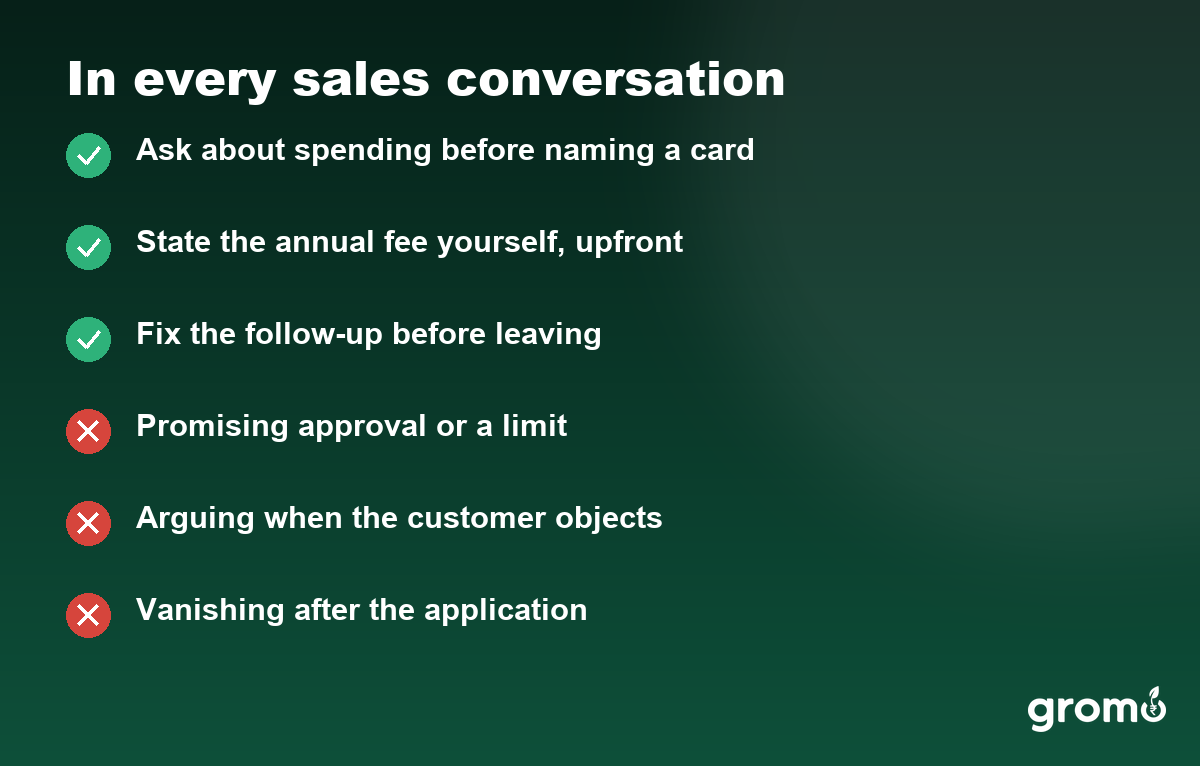
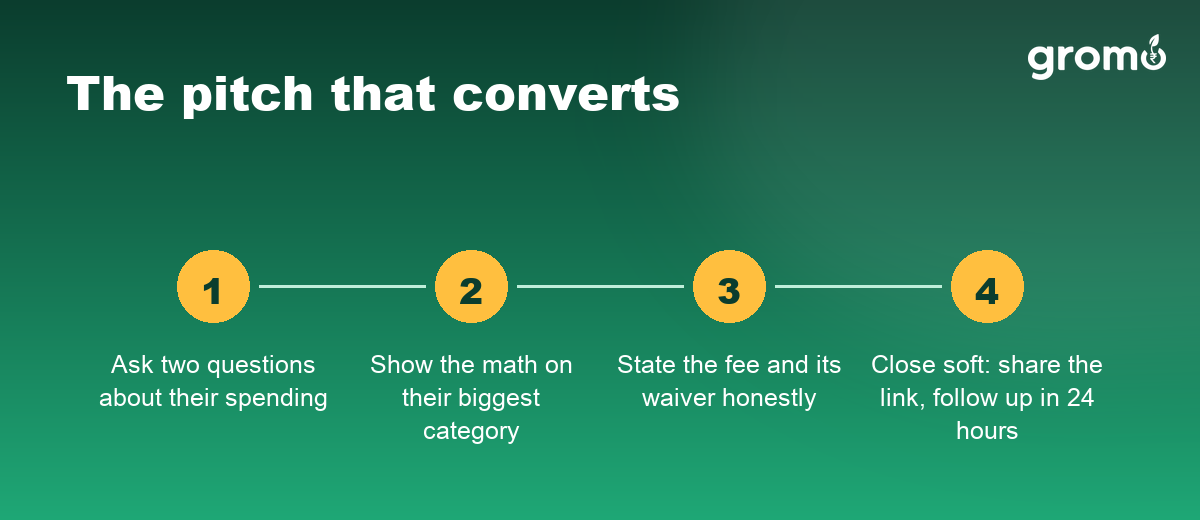
The fix: open with two questions: what do you spend most on every month, and do you already use any card? Thirty seconds of answers tells you which card to pitch and gives you the exact words to pitch it with.
2. Reciting Features Instead of Benefits
What it sounds like: "1 percent fuel surcharge waiver, 4 complimentary lounge visits, 10x on partner brands."
Features are the bank's language. Benefits are the customer's: money saved on things they already buy.
The fix: do the math out loud. "You spend Rs 4,000 on fuel monthly, so this waiver saves you around Rs 480 a year, and your Bangalore trips get free lounge food instead of Rs 600 sandwiches." Numbers from their own life close sales.
3. Pitching the Wrong Card for the Profile
What it sounds like: pitching a premium travel card to someone who last flew three years ago, because its payout is higher.
The mismatch always surfaces, either as a lost sale, a rejected application, or an annoyed customer who never sends you referrals.
The fix: know 4 or 5 cards across the main types of credit cards, shopping, fuel, travel, cashback, lifetime free, and let the customer's spending pick the card. On the GroMo app you can compare 30+ cards from different banks on the spot and show the comparison to the customer, which itself builds trust.
4. Talking More Than Listening
What it sounds like: a five-minute monologue that ends with a confused customer saying "I'll see".
Selling is diagnosis before prescription. Agents who talk 80 percent of the time miss the buying signals and the real doubts.
The fix: aim for the customer speaking more than half the time. Ask, pause, and let silences work; the customer who explains their own needs is halfway to convincing themselves.
5. Overpromising Approval or Limits
What it sounds like: "Guaranteed approval sir, minimum 2 lakh limit, lifetime free, I promise."
One broken promise costs the sale, the relationship, every future referral, and can even get your agent code blocked. Approval and limit are always the bank's decision, decided by the process explained in how credit card approval works.
The fix: say only what the bank's official page says, and frame honestly: "Approval depends on your profile; based on what you have told me, this card fits best, and I will help at every step."
6. Arguing With Objections
What it sounds like: Customer: "Credit cards trap people in debt." Agent: "No no sir, that is completely wrong."
The moment you argue, the customer defends their position instead of considering yours. Objections are requests for information, not attacks.
The fix: acknowledge, then answer. "You are right, careless use does create debt. Paying the full bill on time means zero interest, and I will show you how to set that up." The full playbook of responses is in credit card sales objections and how to handle them.
7. Hiding the Fees
What it sounds like: mumbling past the annual fee and hoping the customer never checks.
They always check, usually after the card arrives, and then your credibility is gone along with their activation and your payout.
The fix: state the fee yourself, upfront, with its waiver condition. "Rs 500 a year, waived if you spend 1.5 lakh, which at your spending you will cross by October." Honesty about fees is the cheapest trust you will ever buy.
8. Never Asking for the Decision
What it sounds like: a good pitch that ends with "...so, yes, that is the card" and an awkward silence.
Fear of seeming pushy makes agents skip the close entirely, and undecided customers default to doing nothing.
The fix: ask a clear, low-pressure closing question: "Shall I share the application link so you can see the pre-approved offer? Takes two minutes and does not commit you." An easy yes moves the sale forward without pressure.
9. Treating "I'll Think About It" as the End
What it sounds like: "Okay sir, no problem, whenever you want," and the lead dies quietly.
Most customers genuinely do need time. The mistake is leaving without a next step, because "sometime" means never.
The fix: fix the follow-up before leaving: "Of course. I will message you tomorrow evening with the comparison so you can decide with everything in front of you." Then actually follow up within 24 hours; that one habit separates earning agents from quitting ones.
10. Disappearing After the Application
What it sounds like: silence between application and card delivery, then a customer who never activates.
Many payouts depend on activation and first use, and an ignored customer is a dead referral source.
The fix: message at each stage, application received, approved, dispatched, then call after delivery to help with activation and the first-use offer. End every activation with one question: "Anyone in your family or office who could use a card like this?"
How GroMo Academy Helps You Fix These Mistakes
Every mistake in this list is a trained skill in disguise, and most agents were simply never trained. Free GroMo Academy lessons inside the GroMo app cover need-based pitching, objection handling, honest closing, and follow-up systems, and the app itself removes the product-mismatch problem by letting you compare 30+ cards from different banks and share a digital application link on the spot.
Selling well is learnable. Fix these 10 conversational habits, keep the core method of selling credit cards underneath them, and your conversion rate does the rest.
FAQ: Credit Card Selling Mistakes Agents Should Avoid
What are the most common credit card selling mistakes?
The costliest ones happen inside the conversation: opening with the card instead of the customer's needs, reciting features instead of money-saved benefits, overpromising approval or limits, arguing with objections, hiding the annual fee, never asking for a decision, and disappearing after the application. Each has a simple trained fix.
Why do customers say no even after a good credit card pitch?
Usually because the pitch answered questions the customer never asked. If the card does not connect to their actual spending, if a doubt went unacknowledged, or if the fee surfaced later than it should have, the no was built during the pitch.
Diagnosis before prescription, two questions about their spending, prevents most refusals.
Should a credit card agent ever promise approval?
Never. Approval and credit limit are always the issuing bank's decision, based on credit score, income, and policy filters. Promising approval is the fastest way to lose trust, invite complaints, and risk your agent code. The honest frame works better: this card fits your profile best, and I will help at every step.
How should an agent follow up without annoying the customer?
Fix the next step before the conversation ends, then follow up within 24 hours with something useful: the comparison you promised, an answer to their doubt, or the current offer. Two further touches at day 3 and day 7 are enough; each should add value, not repeat pressure.
How can a new agent learn to sell credit cards properly?
Learn a need-first method: ask about spending, match one of 4 or 5 known cards, translate features into rupees saved, state fees honestly, close softly, and follow up on schedule. Free GroMo Academy lessons inside the GroMo app train exactly this sequence for Indian customers, alongside product knowledge for 30+ cards.
Disclaimer
This article is general guidance, not financial or legal advice. Card features, fees, eligibility criteria, approval decisions, and agent payouts are decided by the issuing banks and platforms, vary by product and profile, and change over time; the bank's official pages are the only authoritative source, and no income or approval is guaranteed.
GroMo is a financial product distribution platform, not a bank or lender, and is available only to users aged 18 and above. Bank, card, and brand names are trademarks of their respective owners.


