
How Credit Card Approval Works in India 2026
How credit card approval works in India: the step-by-step process, the 7 factors banks check, why applications get rejected, and how to raise your odds.

Credit card approval in India follows one pipeline everywhere: application, verification, credit bureau check, the bank's internal policy filters, and a decision that also sets your limit. Understanding it removes the mystery from both approvals and rejections, whether you are applying yourself or helping customers as an agent.
This guide explains how credit card approval works in India in 2026, step by step, the factors that actually decide the outcome, why applications get rejected, and how to raise your approval odds before you apply.
Credit Card Approval: Quick Facts
| Question | Answer |
|---|---|
| Who decides approval | Only the issuing bank; no agent or platform can guarantee it |
| Time taken | Minutes for pre-approved digital offers; 3 to 10 working days typically |
| Score usually needed | Around 700 to 750+ for regular cards; secured cards need none |
| Biggest factors | Credit score, income, existing debt, employer and city, application history |
| What sets your limit | Income and repayment capacity after existing obligations |
| If rejected | Find the reason, fix it, wait 3 to 6 months before reapplying |
The Approval Process, Step by Step
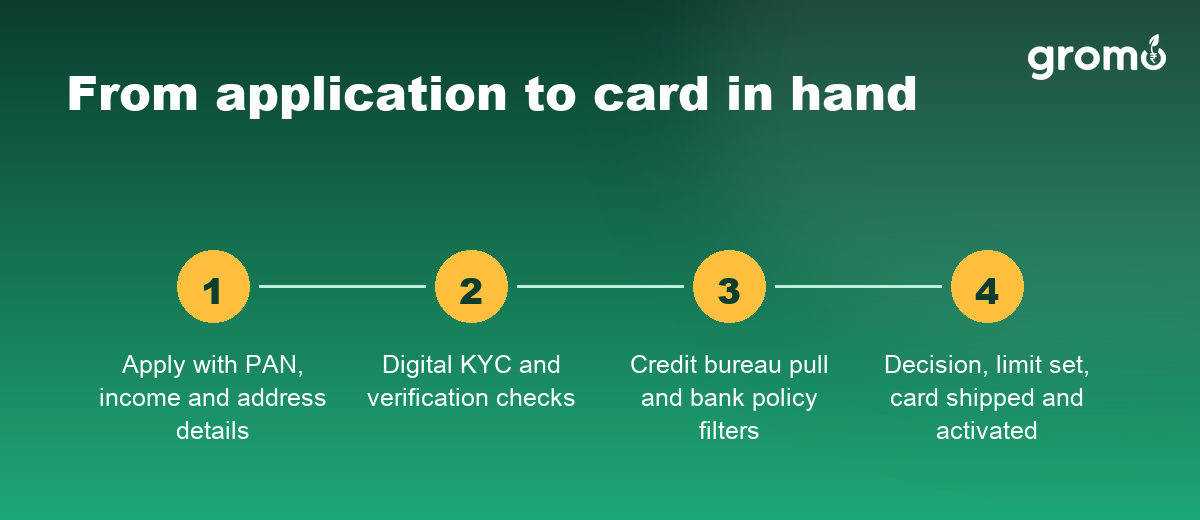
- Application. You apply through the bank's site or app, or a digital link shared by an agent, with basic details: PAN, income, employment, address.
- KYC and verification. The bank verifies identity digitally through PAN and Aadhaar-based checks; some cases get a verification call or, rarely, a physical visit.
- Credit bureau check. The bank pulls your report from CIBIL or another bureau as a hard inquiry, reading your score, active loans, card utilisation, repayment history, and recent applications.
- Policy filters. Your profile passes through the bank's internal rules: minimum income for that card, age band, serviceable pincode, employer category, and how much credit you already hold.
- Decision and limit setting. Approved profiles get a limit sized to income minus existing obligations; borderline profiles may be offered a lower-tier card instead.
- Issuance and activation. The card ships in 3 to 7 working days, and activation plus first use completes the journey; unactivated cards are often auto-closed within weeks.
The 7 Factors That Decide Approval
| Factor | What the bank looks for |
|---|---|
| Credit score | Roughly 700 to 750+ for the best odds; higher scores unlock premium cards |
| Income | Meets that card's minimum, proven by salary slips, ITR, or bank statements |
| Existing debt (FOIR) | EMIs plus card dues within about 40 to 50 percent of income |
| Repayment history | No recent defaults, settlements, or chronic late payments |
| Recent applications | Multiple hard inquiries in weeks reads as credit hunger |
| Employer and city | Stable or listed employers score better; the pincode must be serviceable |
| Age and history length | Usually 21 to 60; a longer clean credit history helps |
No single factor decides alone. A high score with too much existing debt can fail; a modest score with strong income and a clean history can pass.
Pre-Approved Offers vs Regular Applications
A pre-approved offer means the bank has already screened you using your account behaviour or bureau data, so approval is near-certain and disbursal takes minutes. It is still not a guarantee; final KYC and policy checks apply.
Regular applications run the full pipeline above. Existing customers of a bank usually clear it faster because the bank already holds their KYC and sees their account behaviour.
Why Applications Get Rejected
- Low score or thin file. Below roughly 700, or no credit history at all, fails most regular cards.
- Income below the card's bar. Every card has a minimum; premium cards have high ones.
- Too much existing credit. High utilisation or heavy EMIs signal stretched capacity.
- Recent application spree. Several hard inquiries in a short window is a classic decline trigger.
- Unserviceable pincode or unlisted employer. Policy filters, nothing personal.
- Document mismatches. Name, address, or income inconsistencies stall or sink files.
- Past defaults or settlements. These stay on the report for years and weigh heavily.
A rejection is not permanent. Find the likely cause, fix it, and reapply after 3 to 6 months; repeated blind reapplication only adds inquiries and deepens the problem.
How to Improve Your Approval Odds
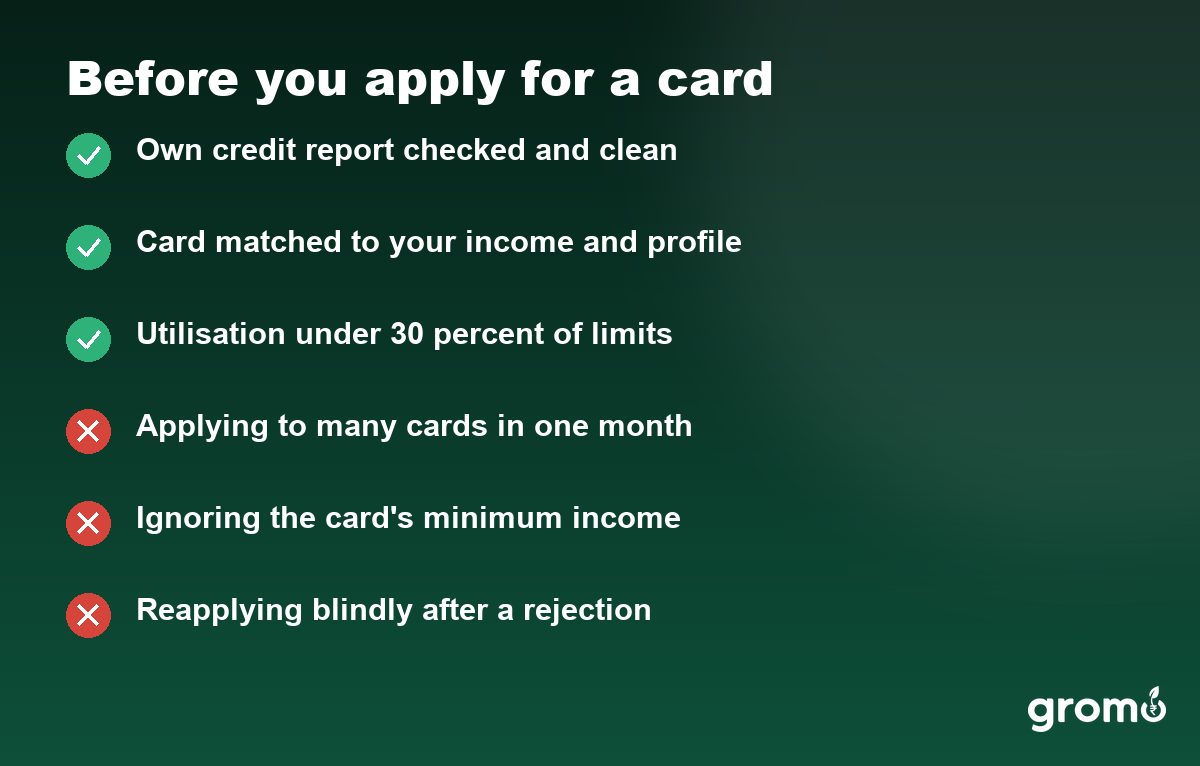
- Check your own report first, free once a year from each bureau, and dispute any errors before applying.
- Pick the card that fits your profile, not the shiniest one; entry-level cards approve where premium cards decline.
- Keep utilisation under about 30 percent and pay every EMI and bill on time for a few months; both to improve your credit score steadily.
- Apply to one card at a time and wait out rejections instead of spraying applications.
- No history at all? Start with a secured card against a fixed deposit; it approves without a score and builds your file within months.
- Keep documents consistent: the same name, address, and mobile across PAN, Aadhaar, and bank records.
What This Means for Credit Card Agents
For agents, this pipeline is the business. Payouts come from approvals, not applications, so two minutes of pre-screening, age, income, city, existing cards, credit health, decides your approval rate, and your approval rate decides your income and your standing with banks.
The agent's honest script writes itself from this article: never promise approval, match the card to the profile, and tell weak-profile customers the truth, that three months of score-building beats a rejection today. That honesty converts into long-term customers, as every experienced credit card agent learns.
On the GroMo app, you can compare 30+ cards from different banks, check eligibility signals before applying, and track every application's status in one place, and free GroMo Academy lessons train exactly this pre-screening judgment. Combined with the core method of selling credit cards, understanding approval turns guesswork into a repeatable business.
FAQ: How Credit Card Approval Works
How does credit card approval work in India?
Every application follows one pipeline: you apply with PAN, income, and address details, the bank runs digital KYC, pulls your credit report as a hard inquiry, passes the profile through policy filters like minimum income and serviceable pincode, then decides and sets a limit sized to your repayment capacity. The card ships within about a week of approval.
What credit score is needed for credit card approval?
Roughly 700 to 750 or above gives the best odds for regular cards, and higher scores unlock premium cards. Below that, entry-level cards may still approve on strong income, and secured cards issued against a fixed deposit need no score at all, making them the standard first card for thin credit files.
How long does credit card approval take?
Pre-approved digital offers for existing bank customers disburse in minutes. Regular applications typically take 3 to 10 working days across verification, bureau checks, and policy review, plus 3 to 7 days for the card to arrive after approval. Document mismatches are the most common cause of delays.
Why do credit card applications get rejected?
The usual causes: a low score or thin file, income below that card's minimum, heavy existing debt or high utilisation, several applications in a short window, an unserviceable pincode or unlisted employer, document mismatches, and past defaults or settlements. Identify the likely cause, fix it, and reapply after 3 to 6 months rather than immediately.
Can an agent or platform guarantee credit card approval?
No. Approval is exclusively the issuing bank's decision, and anyone guaranteeing it is either lying or committing fraud.
What a good agent genuinely does is raise your odds: matching the card to your profile, pre-checking eligibility, and keeping the application clean, which is exactly the judgment GroMo Academy trains.
Disclaimer
This article is general guidance, not financial or legal advice. Card features, fees, eligibility criteria, approval decisions, and agent payouts are decided by the issuing banks and platforms, vary by product and profile, and change over time; the bank's official pages are the only authoritative source, and no income or approval is guaranteed.
GroMo is a financial product distribution platform, not a bank or lender, and is available only to users aged 18 and above. Bank, card, and brand names are trademarks of their respective owners.


