
How to Become a Mutual Fund Distributor in India (2026): NISM, ARN and Costs
How to become a mutual fund distributor in India: NISM Series V-A exam, AMFI ARN, KYD, costs of about Rs 3,000, trail commissions, SEBI rules, and the GroMo way to start earning now.

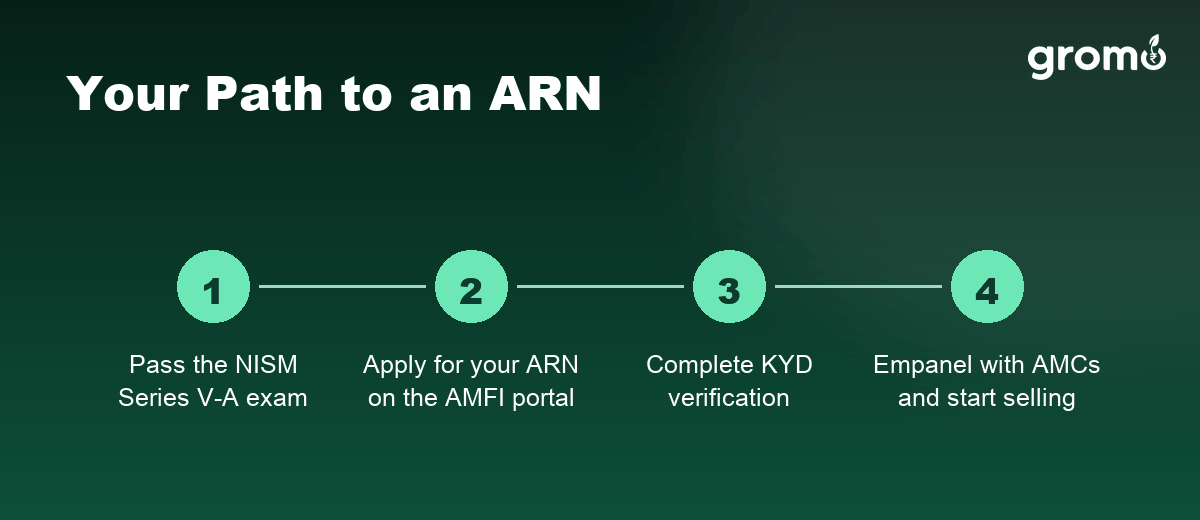
To become a mutual fund distributor in India, you pass the NISM Series V-A certification exam, register with AMFI to get an ARN (AMFI Registration Number), complete KYD (Know Your Distributor) verification, and empanel with fund houses.
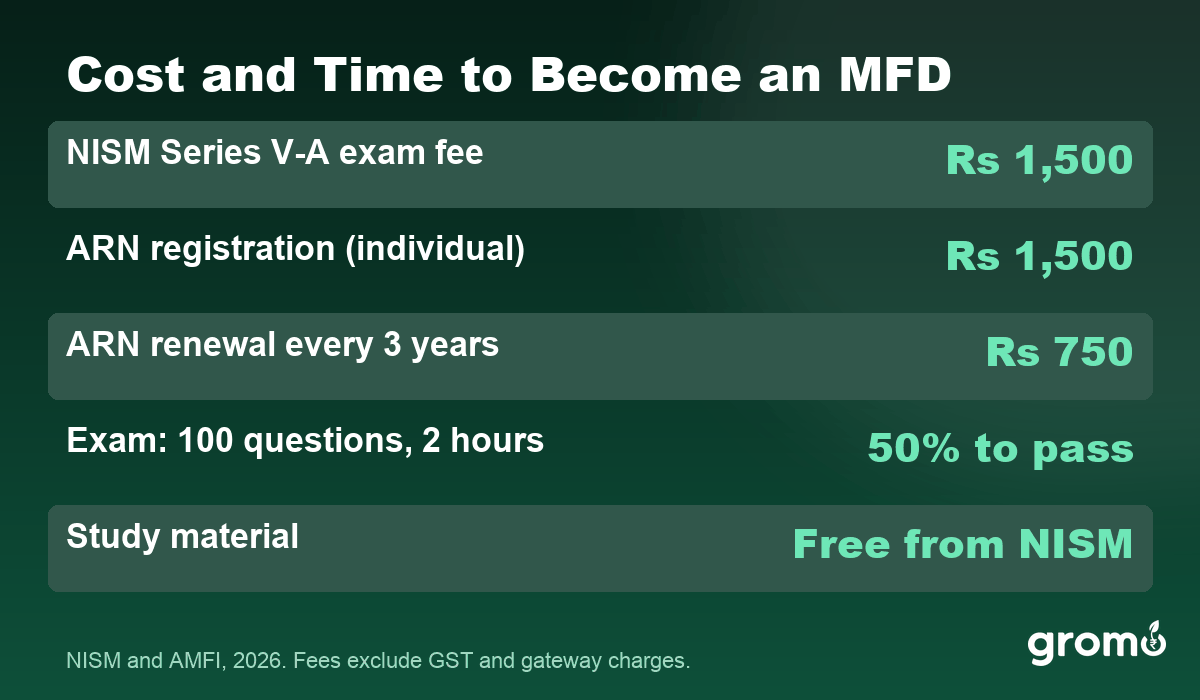
The total official cost is about Rs 3,000 plus GST: Rs 1,500 for the exam and Rs 1,500 for the ARN. There is no minimum degree required, and the whole process typically takes a few weeks.
If you want to start earning from mutual funds before you have your own ARN, GroMo lets you refer customers to invest with partner fund houses and earn a payout per completed action. This guide covers both paths, plus the exam, costs, commissions, and the rules every distributor must follow.
Mutual fund distributor: quick facts
| Question | Quick answer |
|---|---|
| Exam needed | NISM Series V-A: Mutual Fund Distributors |
| Exam format | 100 questions, 2 hours, 50% to pass, no negative marking |
| Exam fee | Rs 1,500 plus GST and gateway charges |
| Registration | ARN from AMFI, Rs 1,500 for individuals, Rs 750 to renew (plus GST) |
| Validity | 3 years, renewed through NISM CPE or by retaking the exam |
| Education required | No minimum degree, you need PAN, Aadhaar, and a bank account |
| How you earn | Trail commission on regular plans, paid by fund houses |
| Start earning before ARN? | Yes, through referral payouts on GroMo |
What does a mutual fund distributor do?
A mutual fund distributor, also called a mutual fund agent or MFD, helps people invest in mutual funds. You explain schemes, help customers complete KYC, set up SIPs and lump-sum investments, and service them over the years: switches, redemptions, nominee updates, and statements.
In return, the fund house (AMC) pays you a commission. Customers who invest through a distributor use the regular plan of a scheme, and the commission is part of that plan's expense ratio, so the customer does not pay you separately.
Distributors and agents are the same role in practice. Whether you search how to become mutual fund distributor, how can I become mutual fund agent, or how to become MF distributor, the legal route is identical: NISM certification plus an ARN. New to the product itself? Start with what mutual funds are.
Who can become a mutual fund distributor?
- Age: 18 or older.
- Education: NISM sets no minimum qualification, students, homemakers, retirees, and working professionals can all take the exam.
- Documents: PAN (required for your NISM certificate), Aadhaar or address proof, a photograph, and a bank account for commission payouts.
- Not allowed: you cannot hold an ARN and be a SEBI Registered Investment Adviser (RIA) at the same time, you must choose one role.
How to become a mutual fund distributor: 4 steps
Step 1: Pass the NISM Series V-A exam
The National Institute of Securities Markets (NISM) runs the mandatory certification. Register on the NISM certification portal, download the free workbook, and book an exam slot.
| Questions | 100 multiple-choice, 100 marks |
| Duration | 2 hours |
| Passing score | 50 percent |
| Negative marking | None |
| Fee | Rs 1,500 plus GST and payment gateway charges |
| Certificate | Issued within about two weeks if your PAN is registered, valid for 3 years |
What the exam covers: mutual fund basics and structure, types of schemes, NAV and pricing, taxation, SEBI regulations and investor rights, risk and return, scheme selection, SIPs and other investment modes, and investor services.
How to prepare: read the free NISM workbook twice, focus on regulations and taxation where most people lose marks, and take mock tests until you consistently score 65 percent or more. Most first-time candidates need 3 to 4 weeks of steady study.
Step 2: Apply for your ARN with AMFI
Once you pass, apply for your ARN through AMFI's online registration portal, which is operated by CAMS. You will need your NISM certificate, PAN, Aadhaar or address proof, a photograph, and bank details.
The ARN fee for individual distributors is Rs 1,500 plus GST, reduced by 50 percent by AMFI from May 1, 2021. Firms pay more: partnership firms and HUFs Rs 10,000, and companies and LLPs Rs 20,000.
Step 3: Complete KYD verification
KYD (Know Your Distributor) confirms your identity, similar to KYC for investors. It is completed through Aadhaar-based e-KYC or in-person or video verification as part of the ARN process. Your ARN card is issued after KYD is complete.
Step 4: Empanel with fund houses and start selling
An ARN lets you distribute, but you still need to empanel with the fund houses (AMCs) whose schemes you want to sell, done online on each AMC's distributor portal.
Many distributors also use industry transaction platforms like BSE StAR MF, NSE NMF II, or MF Utilities to process investments across fund houses from one place.
If you join a distribution firm as an employee instead of working independently, you get an EUIN (Employee Unique Identification Number) under the firm's ARN rather than your own.
How mutual fund distributors earn
SEBI banned upfront commissions on mutual funds in 2018, so distributors now earn trail commission: a small annual percentage of the money your customers have invested with you (your AUM, or assets under management), paid as long as the money stays invested.
Trail rates vary by fund house and scheme type, and equity funds generally pay more than debt funds.
As an illustration, at an average trail of around 0.5 to 1 percent a year, a book of Rs 1 crore AUM earns roughly Rs 50,000 to Rs 1 lakh a year, and the income grows as your customers' SIPs and market values grow. Detailed rates are in mutual fund distribution commissions.
The honest catch: trail commission builds slowly. The first year earns little because your book is small, and real income arrives in years three to five as SIPs compound. That is exactly why many new distributors start with a faster-paying income stream alongside.
The GroMo way: earn from mutual funds while you build
You do not need your own ARN to start earning from mutual funds on GroMo. The GroMo catalogue includes mutual fund products from partner platforms, such as Axis Mutual Funds (up to Rs 400), ICICI Prudential Mutual Fund, Appreciate Wealth, and BharatPe Mutual Fund.
You refer customers to start investing on these platforms, and GroMo pays you a flat payout for each completed action, with current rates shown on each product card in the app.
The two paths work differently, and it helps to understand both:
| GroMo partner | Own ARN as MFD | |
|---|---|---|
| Certification needed | None to start | NISM V-A plus ARN |
| How you earn | Flat payout per completed action | Trail commission for years on AUM |
| Speed of first income | Days to weeks | Slow, builds over years |
| Other products | Also cards, loans, savings, demat | Mutual funds only under ARN |
| Best for | Starting now, part-time, testing interest | Long-term investment advisory business |
The smart route for most people is both: start on GroMo to earn and learn customer conversations now, prepare for NISM in parallel, and build your own ARN book once you are confident.
The same customers who start an SIP also need demat accounts, savings accounts, and cards, and the full product ladder is in sell financial products and earn money.
One rule applies on both paths: do not give personalised investment advice or promise returns. Explain the product honestly and let the customer choose.
Rules every mutual fund distributor must follow
- You are not an adviser. MFDs cannot call themselves "adviser" or do comprehensive financial planning. Advice must be incidental to the products you distribute.
- Disclose your commission. SEBI and AMFI rules require distributors to disclose the commission they earn from fund houses.
- Suitability first. Recommend schemes that fit the customer's risk profile and goals, never schemes chosen for higher commission.
- No return guarantees. Mutual funds are market-linked, and promising returns violates the code of conduct.
- Tax compliance. Commission is taxable income, TDS may be deducted by AMCs, and GST registration becomes mandatory once your turnover crosses Rs 20 lakh a year.
- Keep your certification current. Your NISM certificate and ARN are valid for 3 years. Renew through NISM's Continuing Professional Education (CPE) programme before expiry, or your ARN lapses and commissions can stop.
Mutual fund distributor vs investment adviser
| MFD (ARN holder) | RIA (SEBI registered) | |
|---|---|---|
| Earns from | Commission from fund houses | Fees paid by the client |
| Plans offered to clients | Regular plans | Direct plans |
| Advice allowed | Only incidental to products sold | Personalised financial advice |
| Entry bar | NISM V-A plus ARN | Higher qualification and SEBI registration |
Most people start as distributors because the entry bar is low and the income is commission-based. A broader career view is in how to become a financial advisor.
Mistakes new distributors make
Waiting for the ARN to start learning customers. The exam teaches products, not selling. Start conversations early, the GroMo route is one way.
Chasing only big investors. Many small SIPs that run for years build a steadier trail than a few lump sums that get redeemed.
Letting the ARN lapse. Set a reminder 3 months before your 3-year validity ends and complete CPE in time.
Start earning from mutual funds, demat accounts, and more on GroMo while you prepare for NISM. Free to join.
FAQ: becoming a mutual fund distributor
1. How can I become a mutual fund agent in India?
The route for how to become mutual fund agent is short: pass the NISM Series V-A exam, apply for an ARN on AMFI's portal, complete KYD verification, and empanel with fund houses. The official cost is about Rs 3,000 plus GST, and no degree is required.
2. How long does it take to become a mutual fund distributor?
Typically 1 to 2 months: 3 to 4 weeks to prepare for and pass the exam, about two weeks for the certificate, and then the ARN and KYD process.
3. What is the fee to become a mutual fund distributor?
Rs 1,500 for the NISM Series V-A exam and Rs 1,500 for an individual ARN, both plus GST. ARN renewal costs Rs 750 plus GST every 3 years.
4. Is the NISM Series V-A exam difficult?
It is manageable with preparation. You need 50 percent to pass, there is no negative marking, and the official workbook is free. Regulations and taxation are the sections most candidates find hardest.
5. Can I sell mutual funds without an ARN?
You cannot distribute mutual funds and earn trail commission under your own name without an ARN. You can, however, refer customers to invest through partner platforms on GroMo and earn a flat payout, without holding your own ARN.
6. How much does a mutual fund distributor earn?
Distributors earn annual trail commission on their clients' invested money. As an illustration, around 0.5 to 1 percent a year on a Rs 1 crore book is roughly Rs 50,000 to Rs 1 lakh a year, and income grows as the book grows.
7. Can I become a mutual fund distributor part-time?
Yes. Many distributors start part-time alongside a job or studies, since the work is relationship-based and can be done from a phone. Keep in mind that trail income builds slowly in the first years.
8. What is the validity of an ARN?
Your ARN is valid for 3 years, in line with your NISM certificate. Renew it before expiry by completing NISM's CPE programme or passing the exam again.
Disclaimer
Exam and registration details are taken from NISM and AMFI announcements as of September 2026, and fees exclude GST and gateway charges.
Rules and fees can change, so verify the latest on the official NISM and AMFI websites before applying. Commission rates vary by fund house and scheme, and the earnings figures here are illustrative, not promises.
GroMo payouts are indicative, campaign-linked, and shown live in the app. Mutual fund investments are subject to market risks, read all scheme related documents carefully. This article is for information only and is not financial advice. GroMo is available only to users aged 18 and above.


