
Common Credit Card Sales Objections and How to Handle Them
The 9 objections every credit card agent hears in India, why customers really raise them, the exact responses that work, and what never to say.

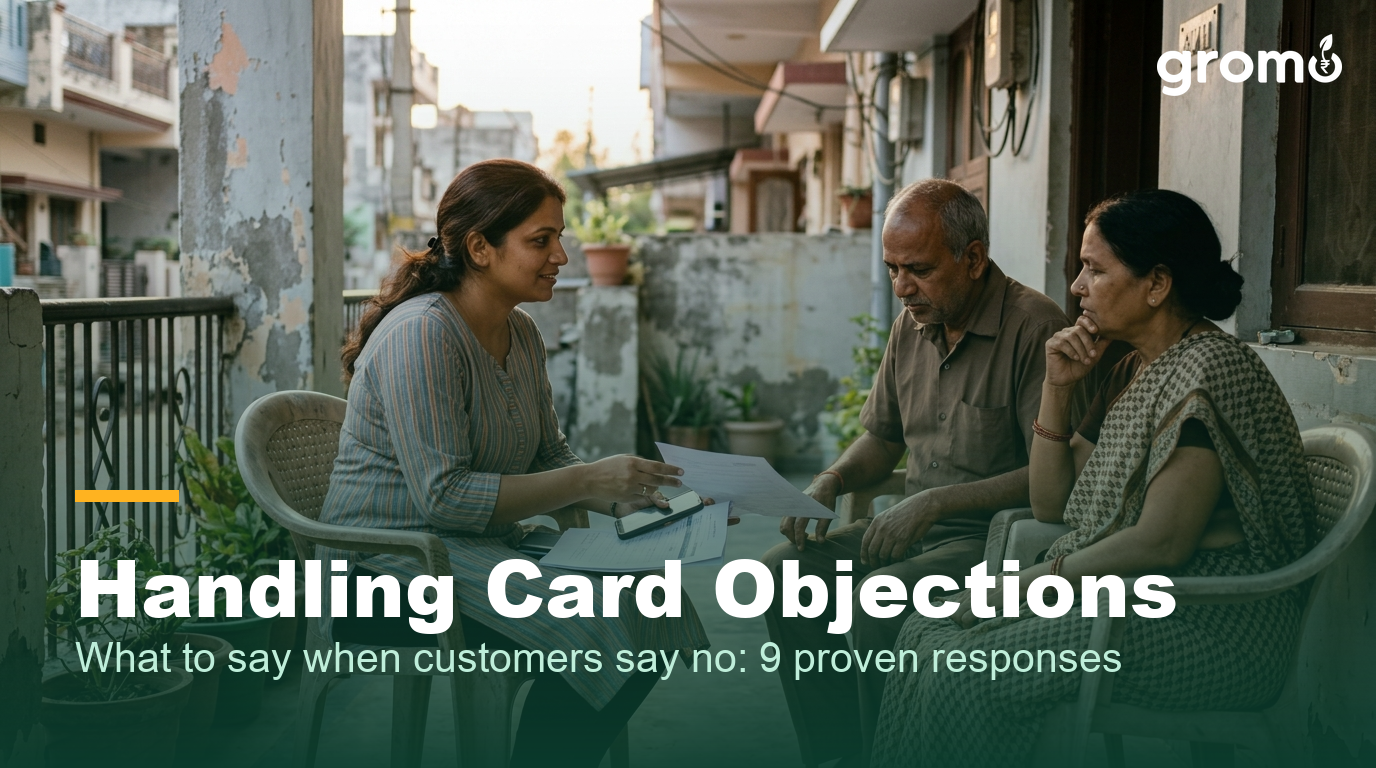
Every credit card agent hears the same nine objections, and the difference between a 5 percent and a 25 percent conversion rate is simply knowing what to say next. An objection is not a rejection; it is the customer telling you exactly what stands between them and a yes.
This guide covers the most common credit card sales objections in India, why customers really raise each one, the exact response that works, and what never to say.
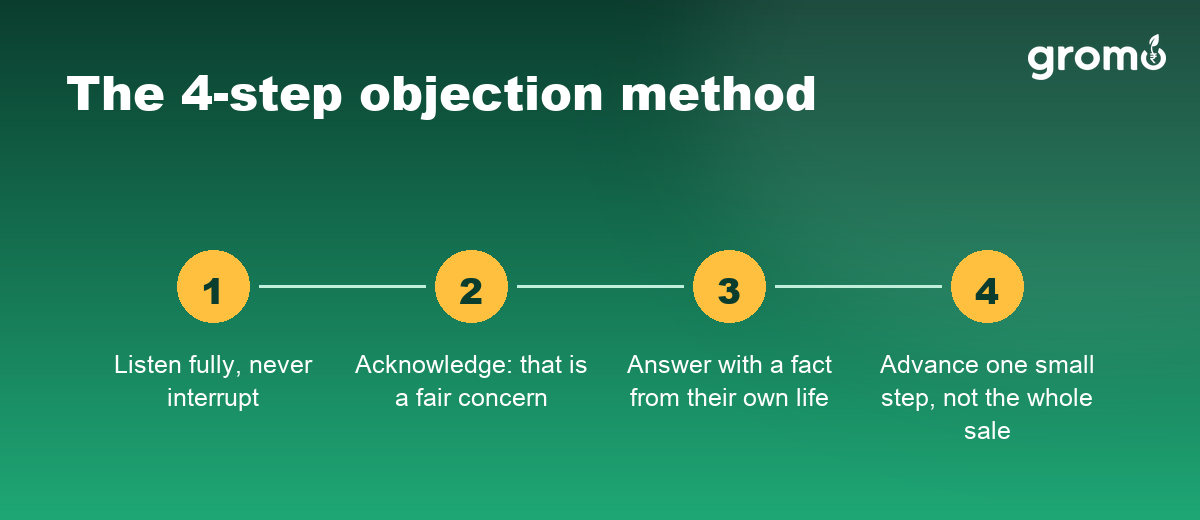
The 4-Step Method for Any Objection
Before the specific scripts, learn the frame that handles everything:
- Listen fully. Let them finish; interrupting confirms you are there to push, not help.
- Acknowledge honestly. "That is a fair concern" costs nothing and lowers the walls.
- Answer the real doubt with a fact, a number, or a story from their own life.
- Advance one small step. Not "so will you buy?", but "shall I send the comparison?"
Arguing skips steps 1 and 2, which is the single biggest of the credit card selling mistakes. Now, the nine objections.
1. "I Don't Need a Credit Card"
What they usually mean: nobody has shown them a benefit connected to their actual life.
Handle it: "Fair enough. Can I ask what you spend on monthly, fuel, groceries, online shopping? If a card gave you Rs 3,000 to 5,000 a year back on that same spending, with no change in habits, would that be worth two minutes?" Then show the math for their biggest category.
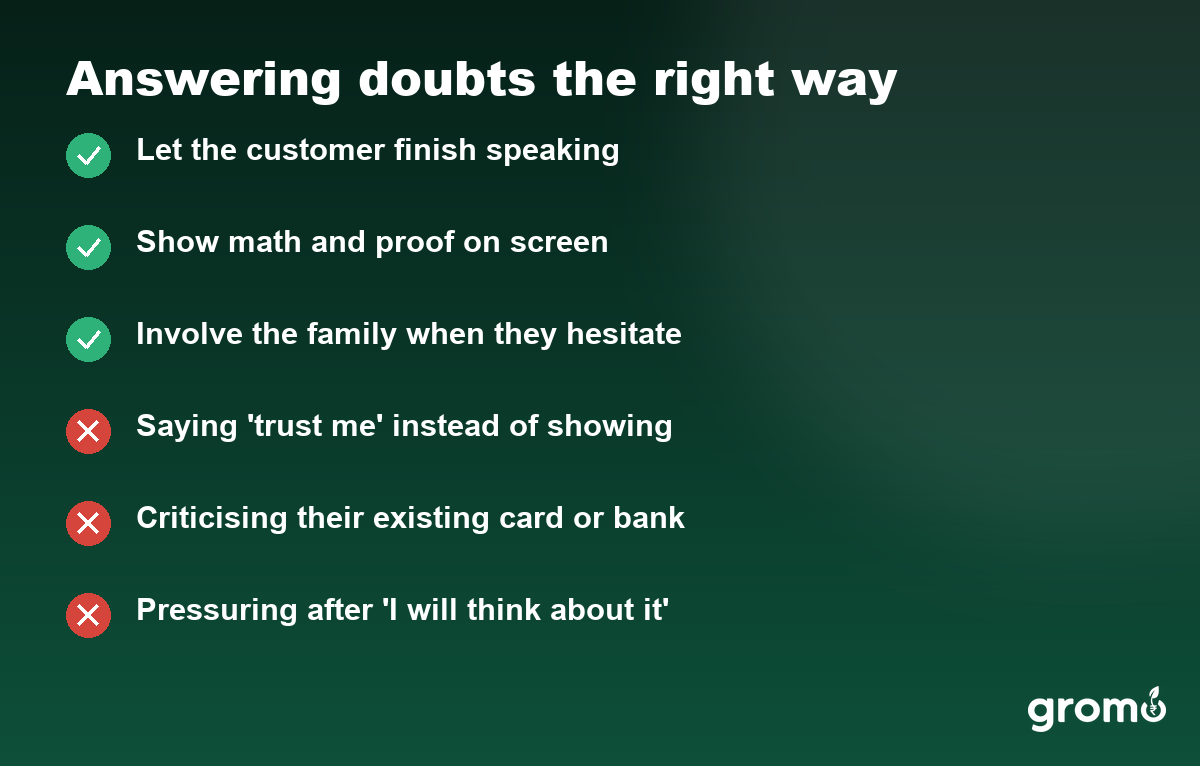
Never say: "Everyone needs a credit card these days." Generic claims deepen resistance.
2. "Credit Cards Trap People in Debt"
What they usually mean: they have seen someone pay minimum dues and drown in interest, and the fear is legitimate.
Handle it: "You are right, careless use does create debt. The trap has one door: paying only the minimum due. Pay the full bill on time, and the card is free credit for 20 to 50 days with rewards on top. I will help you set autopay for the full amount on day one, so the trap never opens."
Never say: "That only happens to careless people." You just called their relative careless.
3. "The Annual Fee Is a Waste of Money"
What they usually mean: nobody has shown them the fee against the value, or told them waivers exist.
Handle it: "Good point, so let us check the math. This card's Rs 500 fee is waived if you spend Rs 1.5 lakh a year, about Rs 12,500 a month, which your groceries and fuel already cross. And if you would rather never think about fees, there are genuinely lifetime free options too." Then show both.
Never say: "Rs 500 is nothing, sir." It is their Rs 500.
4. "I Already Have a Credit Card"
What they usually mean: they think one card is the finish line, or they fear managing two.
Handle it: "That is good, which one? If it covers your shopping, a second card that covers your fuel or travel fills the gap your current card leaves, and two cards used well actually help your credit score by lowering utilisation. Let me show what your current card does not cover."
Never say: anything negative about their existing card or bank; it reads as salesmanship, not advice.
5. "I'll Think About It"
What they usually mean: an unanswered doubt they have not voiced, or genuine need for time.
Handle it: "Absolutely, take your time. So you can decide properly, what is the one thing you would want to be sure about, the fee, the approval, the safety?" The answer usually surfaces the real objection, which you then handle.
If they truly need time: "I will message you the comparison tonight and check in tomorrow evening."
Never say: "What is there to think about?" Pressure converts thinkers into avoiders.
6. "Is This Safe? Why Do You Need My Documents?"
What they usually mean: they have heard fraud stories, and they are right to ask.
Handle it: "Great question, and please ask it to anyone who approaches you. The application goes directly through the bank's official process; I never take your OTP, and your documents upload into the bank's own system, not my phone.
You can see the bank's name on every screen." Working through a platform like GroMo strengthens this answer: the customer applies through an official digital link and can verify everything.
Never say: "Trust me." Show the process instead of asking for faith.
7. "My CIBIL Score Is Low, I Will Get Rejected"
What they usually mean: a past rejection or default has made them afraid of another hard inquiry.
Handle it: "Thank you for telling me, that saves us both a wrong application. Let us not apply for this card today.
Depending on your score there are entry-level and secured card options, and a few months of on-time payments to improve your credit score reopens every door. I would rather get you approved in three months than rejected today."
Never say: "No problem, apply anyway." A predictable rejection hurts them and your approval rate.
8. "I Use UPI for Everything"
What they usually mean: UPI feels free, instant, and sufficient, and for payments it is.
Handle it: "UPI is brilliant for paying, but it gives nothing back and builds nothing. A card adds three things UPI cannot: rewards on the same spending, an interest-free month of float, and a credit history that decides your future home loan rate.
And RuPay credit cards now work on UPI, so you can keep the same habit and earn on it."
Never say: "UPI is not good." It is good; the card is simply a different tool.
9. "My Family Says Credit Cards Are Bad"
What they usually mean: a respected elder's experience from a different era of hidden charges and pushy telecallers.
Handle it: "I respect that, and honestly the old days earned that reputation. Two things have changed: RBI rules now force every charge into a Key Fact Statement, and you can see every rupee in the app. Would it help if I explained it with your father present? I would rather have the whole family comfortable."
Never say: "Do not listen to them." You will lose to the family every time; join them instead.
Objection Cheat Sheet
| Objection | Real doubt | Your one-line key |
|---|---|---|
| Don't need one | No benefit shown | Math on their biggest spend |
| Debt trap | Fear of interest | Full payment = free credit; set autopay |
| Annual fee | Fee vs value unclear | Waiver math, or lifetime free option |
| Already have one | Thinks one is enough | Cover the gap the current card leaves |
| Will think about it | Unvoiced doubt | Ask what they need to be sure about |
| Is it safe | Fraud fear | Bank's official process, never your OTP |
| Low CIBIL | Rejection fear | Right card now or better score first |
| UPI is enough | Sees no extra value | Rewards, float, credit history; RuPay on UPI |
| Family says no | Old-era reputation | New RBI transparency; involve the family |
Practising Until It Is Natural
Reading scripts is not the same as owning them. Practise each response aloud, in your own words and language, until it stops sounding like a script, and track which objections you hear most; your top three deserve your best answers.
Free GroMo Academy lessons inside the GroMo app include objection-handling training built for Indian customers, and the app's card comparison gives your answers proof on screen: when a customer doubts the fee, showing the waiver condition beats claiming it. Combined with a steady flow of prospects from the methods in how to get credit card leads, handled objections become your most reliable source of closed sales.
FAQ: Credit Card Sales Objections and How to Handle Them
What are the most common credit card sales objections?
The nine that decide most conversations in India: I don't need a card, cards create debt, the annual fee is a waste, I already have one, I'll think about it, is this safe, my CIBIL is low, UPI is enough for me, and my family says no. Each maps to one real doubt, and each has a specific response that works.
How do you handle the objection that credit cards create debt?
Agree first, because careless use genuinely does. Then narrow the danger to its single door: paying only the minimum due. Paying the full bill on time makes the card interest-free credit for 20 to 50 days with rewards on top, and offering to set up full-amount autopay on day one turns the fear into a solved problem.
What should I say when a customer says I will think about it?
Accept it genuinely, then ask one question: what is the one thing you would want to be sure about, the fee, approval, or safety? The answer usually reveals the unvoiced doubt, which you can then address. If they truly need time, fix the next step: send the comparison tonight, check in tomorrow evening.
How do I convince a customer who only uses UPI?
Do not argue against UPI; add to it. A credit card gives three things UPI cannot: rewards on the same spending, an interest-free month of float, and the credit history that decides future loan rates. RuPay credit cards on UPI let them keep the same payment habit and earn on it.
Where can agents learn objection handling for Indian customers?
Free GroMo Academy lessons inside the GroMo app include objection-handling training built for Indian financial products, and the app's on-screen card comparison lets you prove answers instead of claiming them. Practising your three most-heard objections aloud, in your own language, converts scripts into natural conversation.
Disclaimer
This article is general guidance, not financial or legal advice. Card features, fees, eligibility criteria, approval decisions, and agent payouts are decided by the issuing banks and platforms, vary by product and profile, and change over time; the bank's official pages are the only authoritative source, and no income or approval is guaranteed.
GroMo is a financial product distribution platform, not a bank or lender, and is available only to users aged 18 and above. Bank, card, and brand names are trademarks of their respective owners.


