
What Is SIP? Meaning, How It Works, and What It Costs
What is SIP? A Systematic Investment Plan puts a fixed amount into a mutual fund each month. SIP meaning, a worked example, SIP vs lumpsum and SIP vs FD, explained.


What is SIP? SIP stands for Systematic Investment Plan. A SIP invests a fixed amount into a mutual fund at a fixed interval, usually monthly, rather than one large sum at once. Most funds accept ₹500 a month; some start at ₹100.
The amount is auto-debited on a date you choose and buys units at that day's price. As of March 2026, 9.72 crore SIP accounts were contributing ₹32,087 crore a month (AMFI, March 2026).
Key takeaways
- SIP is a method of buying a mutual fund, not a product in itself.
- Fixed monthly amounts buy more units when prices fall, fewer when they rise.
- Most SIPs can be paused or stopped any time, unlike a fixed deposit.
- Returns are not guaranteed. Mutual funds carry market risk.
What is SIP in mutual funds?
SIP meaning in practice: what is SIP investment, and what is SIP plan structure day to day? A Systematic Investment Plan is a standing instruction to a fund house: take this amount from my bank account on this date each month, and buy units of this fund.
NAV: Net Asset Value is a mutual fund's price per unit. It changes daily with the value of the fund's holdings.
Units: Units are the shares of the fund you own. Your instalment divided by that day's NAV gives the units you receive.
SIP is not a product but a way of paying for a mutual fund. You can buy the same fund through a SIP or in one lump sum. It remains the same fund.
How does a SIP work, step by step?
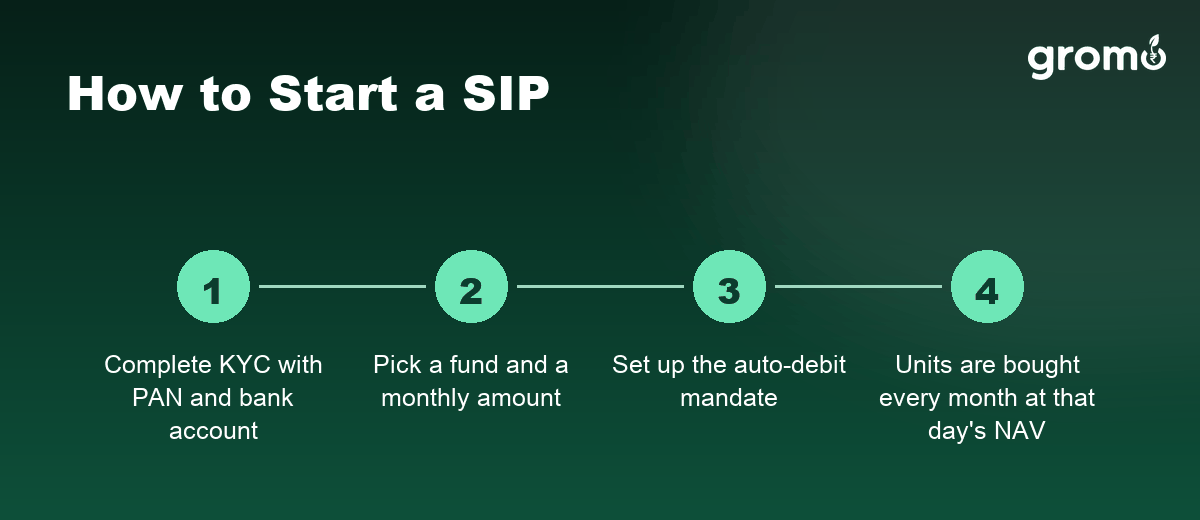
This is what is SIP and how it works in practice, and it doubles as how to invest in SIP for the first time. For how to start SIP investing, you need about 20 minutes and a completed KYC:
- Pick a fund. Equity, debt or hybrid, based on how long you will stay invested.
- Choose an amount and a date. Many funds start at ₹500 a month.
- Set up the auto-debit. A one-time mandate authorises the monthly deduction.
- Units get credited. Each instalment buys units at that day's NAV.
- Review once or twice a year. Not monthly.
- Stop, pause or increase whenever you want. Most funds allow all three.
A worked example: what rupee-cost averaging actually does
This is arithmetic, not a return projection. Assume ₹1,000 a month for four months, into a fund whose NAV moves.
| Month | Amount | NAV | Units bought |
|---|---|---|---|
| 1 | ₹1,000 | ₹50 | 20.00 |
| 2 | ₹1,000 | ₹40 | 25.00 |
| 3 | ₹1,000 | ₹25 | 40.00 |
| 4 | ₹1,000 | ₹50 | 20.00 |
| Total | ₹4,000 | 105.00 |
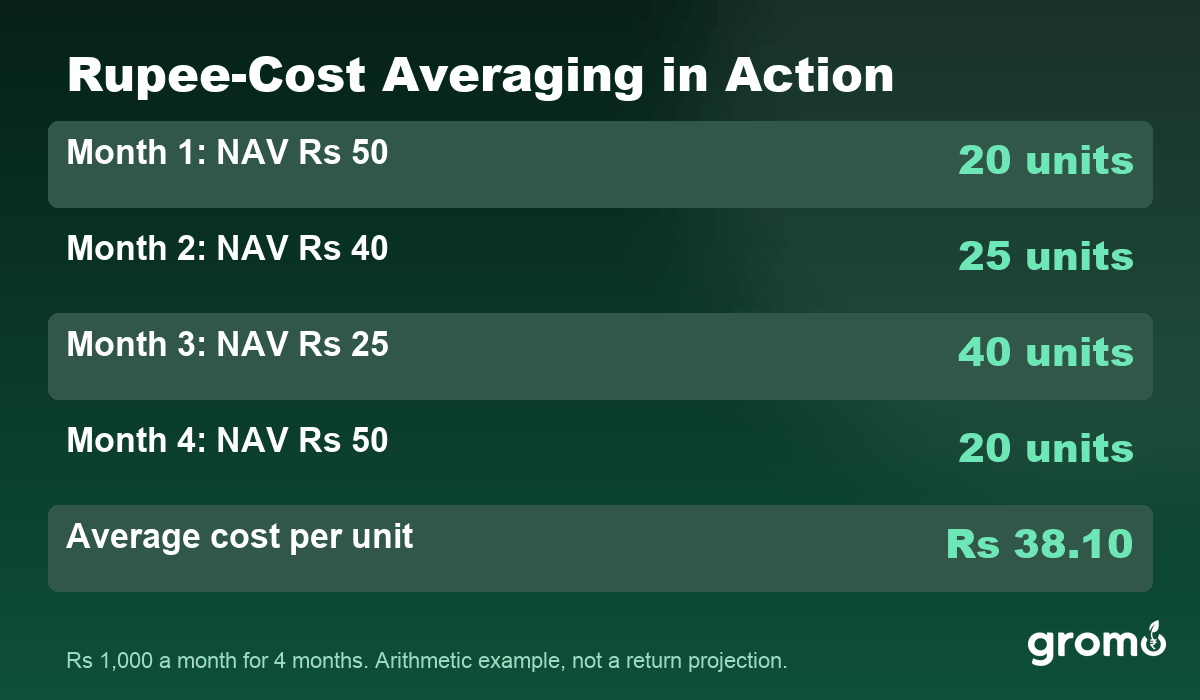
You invested ₹4,000 and hold 105 units. Your average cost works out to 38.10 rupees per unit (4,000 divided by 105), against a simple average NAV of 41.25 rupees across the four months. Both come from the table above by arithmetic alone, not from any return projection.
The gap exists because the fixed rupee amount bought most units in month 3, when the price was lowest. That is the whole mechanism. It lowers your average purchase price when prices move around. It does not protect you if the fund falls and stays down.
What is the difference between SIP and mutual fund?
A mutual fund is the thing you own. A SIP is how you pay for it.
Compare it to buying a phone. The phone is the product. EMI is a payment method. Asking whether a phone is better than an EMI makes no sense, because they answer different questions.
The comparison that does make sense is SIP versus lumpsum.
SIP vs lumpsum: which suits you?
| SIP | Lumpsum | |
|---|---|---|
| How you invest | Fixed amount monthly | One amount, once |
| Suits | Salary earners | A bonus or maturity payout |
| If the market falls | You buy more units cheaper | The whole amount falls together |
| Discipline | Automatic | Needs you to act |
| Timing risk | Spread across dates | Concentrated in one date |
Neither wins in the abstract. If your money arrives monthly, a SIP matches how you earn. If a large sum is already idle, a lumpsum puts it to work sooner.
SIP vs fixed deposit: what changes?
A fixed deposit pays a rate the bank sets in advance. You know on day one what maturity brings.
A SIP into an equity fund does not work that way. The value moves with the market. It can fall below what you put in, especially over short periods.
Certainty is the trade-off. An FD gives a modest return you can count on. A SIP gives no certainty and a wider range of outcomes.
Neither replaces the other. Money needed within a year or two belongs somewhere predictable. Money you will not touch for several years is where a SIP earns its place.
How much money do you need to start a SIP?
Less than most people assume. Many funds accept ₹500 a month. Some micro-investment products start at ₹100.
There is no minimum income requirement. Most open-ended funds have no lock-in, though tax-saving ELSS funds lock each instalment for three years.
What you do need: a PAN, a bank account, and completed KYC.
Common mistakes first-time SIP investors make
Stopping when the market falls. A falling market is when a fixed amount buys the most units. In the worked example above, month 3 delivered 40 of the 105 units. Stopping then removes the cheapest purchases.
Checking daily. Daily movement says nothing useful about a multi-year plan.
Picking a fund on last year's returns alone. Rankings shuffle. A fund that topped one year often sits mid-table the next. Learn the core investment product terms, like NAV, expense ratio, and exit load, before comparing funds.
Assuming a SIP removes risk. Averaging reduces timing risk. It does not remove market risk.
Refer mutual fund products with GroMo
GroMo is an Indian financial-products distribution platform. Individuals refer products from partner banks, NBFCs and fund houses, and earn a commission when a referral converts.
Mutual fund and SIP-based products sit in the catalogue alongside credit cards and loans. SIP assets reached ₹15.11 lakh crore in March 2026, about 20.5% of all mutual fund assets in India (AMFI, March 2026), so the audience for these products is large and still growing.
| Product | Payout per approved referral |
|---|---|
| Axis Micro Investment | Up to ₹1,000 |
| Axis Mutual Funds | Up to ₹400 |
| Appreciate Wealth Mutual Fund | Up to ₹200 |
| ICICI Prudential Mutual Fund | Up to ₹100 |
| BharatPe Mutual Fund | Up to ₹100 |
Commission rates read from the GroMo product catalogue on 29 September 2026. Rates are campaign-linked and change without notice. The live rate in the app at the time of referral is the one paid.
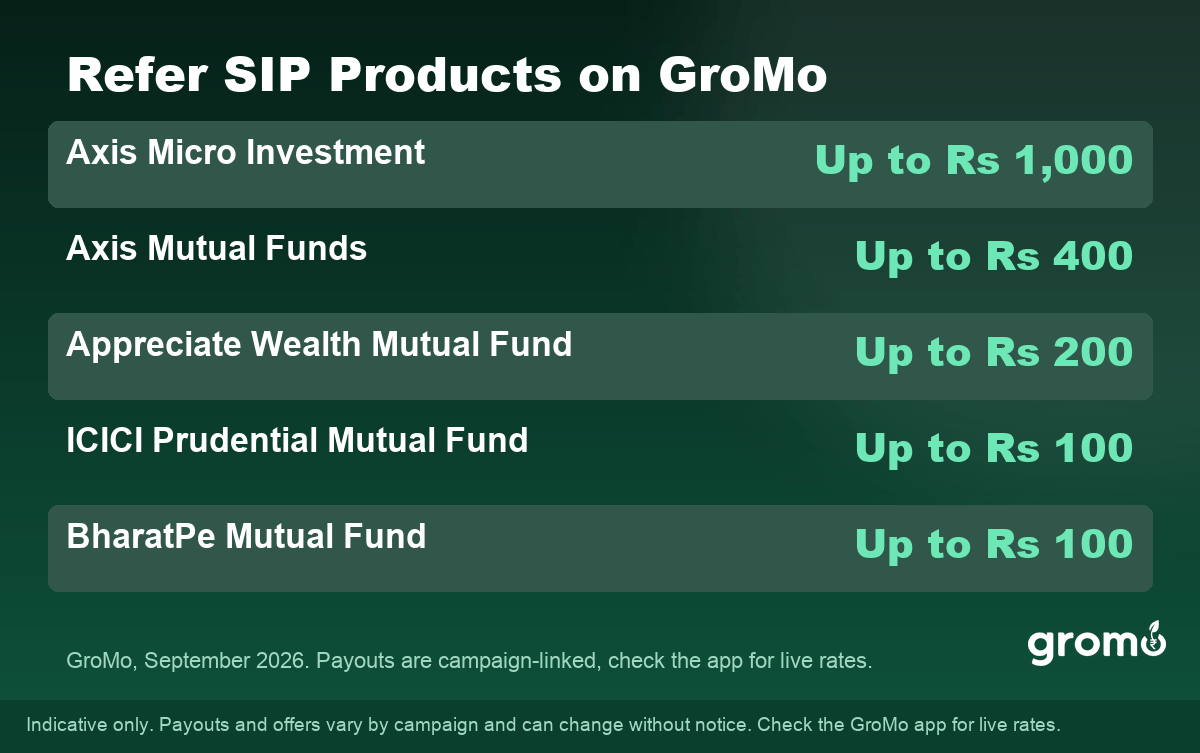
Axis Micro Investment pays the most of these, and it is SIP-based, with small amounts invested regularly.
To start: download the GroMo app, complete KYC with PAN and Aadhaar, and share products with people already asking where to begin. Commission is credited once a referral converts.
Distributors with their own ARN earn ongoing trail commission instead, and mutual fund distribution commissions vary by fund type. Referring SIP products is also the easiest first step toward becoming a mutual fund distributor.
Frequently asked questions
What is SIP in simple words?
SIP stands for Systematic Investment Plan. It invests a fixed amount into a mutual fund at a fixed interval, usually monthly, through an automatic bank debit.
What is the difference between SIP and mutual fund?
A mutual fund is the product you own. A SIP is the method used to buy it. The same fund can be bought through a monthly SIP or a single lumpsum.
How does SIP work?
A fixed amount is auto-debited on a chosen date each month and buys units at that day's NAV. Because the NAV varies, the unit count differs monthly while the rupee amount stays the same.
How much money do I need to start a SIP?
Many funds start at ₹500 a month. Some micro-investment products start at ₹100. You need a PAN, a bank account and completed KYC.
Is SIP safe?
A SIP reduces the risk of investing everything at one price. It does not remove market risk. Equity fund values move with the market and can fall below the amount invested.
Can I stop a SIP any time?
Yes, on most open-ended funds, with no penalty. ELSS funds are the exception: each instalment is locked for three years from its own date.
How many people invest through SIPs in India?
As of March 2026, 9.72 crore SIP accounts were contributing, up from 9.44 crore the previous month (AMFI, March 2026).
Summary
SIP means Systematic Investment Plan: a fixed amount into a mutual fund at a fixed interval, usually monthly, starting from about ₹500 with most funds.
It lowers your average purchase price when markets move around, and it can be paused or stopped at any time on most funds. It does not remove market risk, and returns are not guaranteed.
Disclaimer
GroMo (Vitrak Technologies Pvt Ltd) is a distribution platform. GroMo is not a bank, NBFC, insurer or investment adviser. All products are offered by their respective RBI, IRDAI or SEBI-regulated providers.
Partner earnings depend on effort, product mix and customer eligibility. Any figures shown are illustrative examples of individual results. They are not typical and are not guaranteed. GroMo does not guarantee any level of income.
Investments are subject to market risks. Read all scheme-related documents carefully. Past performance does not indicate future returns. This article is for information only and is not investment advice. GroMo is available only to users aged 18 and above.


