
Types of Credit Cards in India: The Complete 2026 Guide
All types of credit cards in India explained by category: cashback, travel, secured, RuPay UPI, premium and more, plus how to choose the right one.

All credit cards do the same basic job: they let you spend now and pay later, interest-free if you clear the bill on time. (Completely new to cards? Start with our explainer on what credit cards mean and how they work, then come back here.) But the types of credit cards in India differ enormously in what they reward, who they suit, and how they work underneath. Pick the right type and the card quietly pays you back all year; pick the wrong one and you fund benefits you never use.
This guide organizes every major credit card type into three clean categories: by reward style (what the card gives back), by user profile (who the card is built for), and by structure (how the card itself works). Skim the table, then read the types that fit your life.
Types of Credit Cards at a Glance
| Category | Types covered | Best for |
|---|---|---|
| By reward style | Cashback, Rewards, Travel, Fuel, Shopping/Co-branded, Dining & entertainment | Matching the card to your biggest spending head |
| By user profile | Entry-level, Student, Premium, Super-premium/Metal, Business, Women-focused | Matching the card to your income and life stage |
| By structure | Secured (FD-backed), Lifetime-free, RuPay UPI credit cards, Virtual, Add-on, Balance transfer/Low interest, Charge cards, Forex/Travel prepaid hybrids | Matching the card to your credit history and habits |
Category 1: Types of Credit Cards by Reward Style
1. Cashback Credit Cards
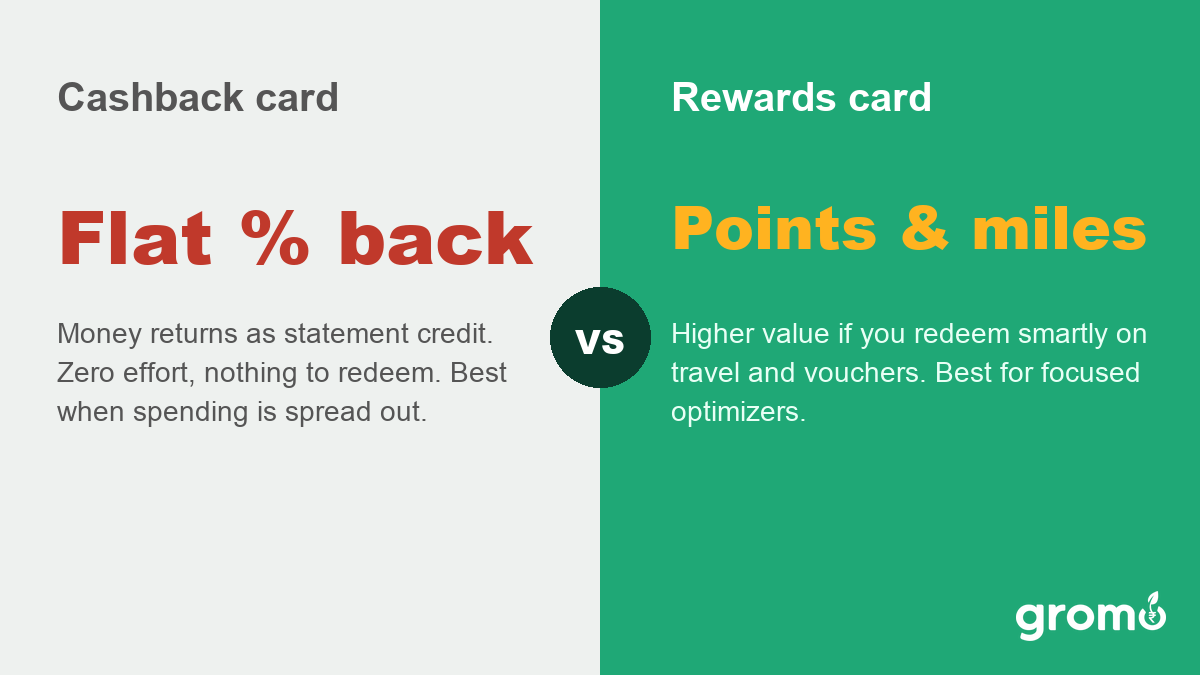
The simplest value proposition: a percentage of what you spend comes back as statement credit. Flat cashback cards pay the same rate everywhere; category cards pay more on online shopping, groceries, or bill payments. Choose this if you want zero mental effort and spend across many categories. Watch the fine print for monthly cashback caps and excluded categories like rent, fuel, and wallet loads.
2. Rewards Credit Cards
These earn points on every spend that you redeem for products, vouchers, air miles, or statement credit. Reward cards beat cashback when you redeem smartly (transfers to airline partners often yield the most value) and lose to cashback when points expire unused. Choose this if you enjoy optimizing and will actually redeem.
3. Travel Credit Cards
Built around journeys: air miles on spends, complimentary airport lounge access, lower forex markup, travel insurance, and hotel or airline tie-ups. Choose this if you fly several times a year; the lounge access alone can repay the annual fee. Frequent international travellers should prioritize cards with low foreign currency markup.
4. Fuel Credit Cards
These waive the ~1% fuel surcharge and add fuel-specific rewards or points at partner pumps. The savings are small per transaction but meaningful for daily commuters, cab fleet owners, and delivery riders. Choose this if fuel is one of your top three monthly expenses.
5. Shopping and Co-branded Credit Cards
Issued jointly by a bank and a brand (e-commerce platforms, airlines, hotels, even supermarkets), these pay outsized rewards inside that brand's ecosystem: extra cashback on the partner site, membership perks, early sale access. Choose this if a large share of your spending already goes to one platform; skip if your loyalty shifts with discounts.
6. Dining and Entertainment Credit Cards
Higher rewards on restaurants, food delivery, and movie tickets, often with buy-one-get-one ticket offers and dining program memberships. Usually a secondary card rather than a primary one. Choose this if eating out and movies are genuine line items in your monthly budget.
Category 2: Types of Credit Cards by User Profile
7. Entry-Level Credit Cards
Low or zero joining fees, easier approval, modest limits, and basic rewards. Their real job is not rewards at all: it is building your credit score so better cards and loans come cheaper later. Choose this if this is your first card; pay in full every month and your CIBIL score does the compounding.
8. Student Credit Cards
Designed for college students with little or no income: small limits, minimal fees, and often issued against simplified criteria or as secured variants. They teach credit discipline early and start the credit history clock years ahead of peers. Choose this if you are studying and can commit to full, on-time payments.
9. Premium Credit Cards
Mid-to-high annual fees traded for stronger reward rates, lounge access, golf privileges, concierge services, and milestone bonuses. The math matters: a premium card pays for itself only when your annual spend crosses the level where milestone benefits and reward rates outrun the fee. Choose this if your monthly card spend is consistently high and you use the lifestyle benefits.
10. Super-Premium and Metal Credit Cards
Invite-only or high-income cards with unlimited lounge access, low forex markup, luxury hotel status, and heavy welcome benefits, often in metal form. Fees run into tens of thousands of rupees and make sense only for very high spenders and frequent international travellers.
11. Business and Corporate Credit Cards
For proprietors, companies, and employees who travel: separate business expenses from personal, employee card controls, GST-friendly statements, and rewards on vendor payments, travel, and office spends. Choose this if you run a business; keeping business spends off your personal card also protects your personal credit utilization.
12. Women-Focused Credit Cards
Several issuers offer cards with reward structures tilted toward categories like shopping, groceries, and wellness, sometimes with added insurance or offers. Evaluate them exactly like any rewards card: by whether the reward categories match your actual spending, not by the branding.
Category 3: Types of Credit Cards by Structure
13. Secured Credit Cards (Against Fixed Deposit)
Issued against an FD you park with the bank, usually with a limit of 80-90% of the deposit. No income proof or credit history needed, near-guaranteed approval, and your FD keeps earning interest. This is the single best tool for building or repairing a CIBIL score. Choose this if you are new to credit, self-employed without income proof, or recovering from a low score.
14. Lifetime-Free Credit Cards
No joining fee, no annual fee, ever. Rewards are usually modest, but the cost of holding one is zero, which makes them excellent first cards and permanent backups. Verify the card is genuinely lifetime-free rather than fee-waived-on-spend.
15. RuPay Credit Cards on UPI
The newest mainstream type in India: RuPay credit cards can be linked to UPI apps, letting you pay by QR code at kirana stores and small merchants directly from your credit limit. It merges credit card rewards with UPI's universal acceptance. Choose this if most of your spending happens at QR-code merchants where card machines never existed.
16. Virtual and Digital Credit Cards
App-issued card numbers, sometimes standalone and sometimes companions to a physical card, usable instantly for online payments. Useful for online-only spends and safer for merchant sites you do not fully trust, since limits can be capped per card.
17. Add-On Credit Cards
Supplementary cards issued on your account for family members, sharing your limit and billing. Spends aggregate to your rewards, and you see all family spending in one statement. Remember the primary holder carries full liability for every add-on spend.
18. Balance Transfer and Low-Interest Credit Cards
These let you move an outstanding balance from a high-interest card and repay at a lower or promotional rate, or carry structurally lower interest for revolvers. They are repair tools: useful in a debt crunch, never a licence to keep revolving.
19. Charge Cards
No preset spending limit, but the full balance must be paid every cycle; revolving is not an option. Rare in India and aimed at high spenders who want flexibility with enforced discipline.
20. Forex and Travel-Prepaid Hybrids
Strictly speaking prepaid rather than credit, but worth knowing when comparing travel options: load currency at locked rates and spend abroad without per-transaction forex markup. Frequent flyers often pair one with a travel credit card.
How to Choose the Right Type of Credit Card
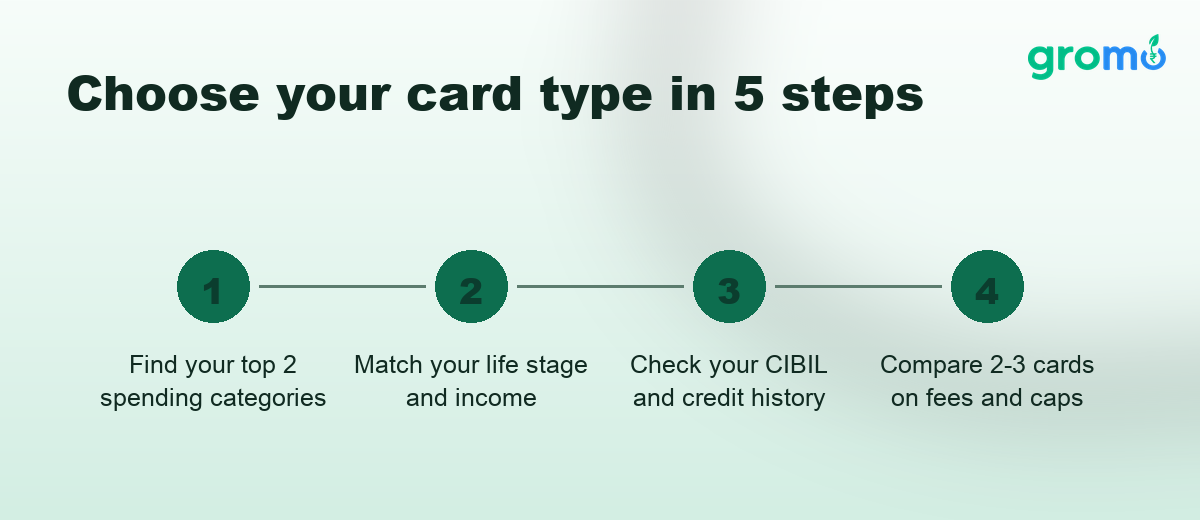
- Pull your last three months of spending and find your top two categories: that points to your reward style (Category 1).
- Match your life stage and income: first card or student pick entry-level or secured; established spender considers premium (Category 2).
- Check your credit position: no history or low CIBIL means start secured or lifetime-free; a 750+ score opens every door (Category 3).
- Compare two or three specific cards of that type on fees, reward caps, and exclusions, and read the fee-waiver spend condition.
- Apply for one card, use it for 6-12 months with full on-time payments, and only then add a second type that covers a different spending head.
Two closing truths that apply to every type above. First, the best credit card type is decided by your spending pattern, not by the card's marketing. Second, every benefit on every card is cancelled by revolving interest, so the on-time full payment habit matters more than the type you choose. If you want to compare credit cards from India's leading banks in one place, or help others find the right card as a distributor, many of these card types are available through the GroMo app.
FAQ: Types of Credit Cards
What are the main types of credit cards in India?
They fall into three groups. By reward style: cashback, rewards, travel, fuel, co-branded shopping, and dining cards. By user profile: entry-level, student, premium, super-premium, business, and women-focused cards. By structure: secured cards against FD, lifetime-free cards, RuPay credit cards on UPI, virtual cards, add-on cards, balance transfer cards, and charge cards.
Which type of credit card is best for beginners?
An entry-level or lifetime-free card if you have income proof, and a secured card against a fixed deposit if you have no credit history or a low CIBIL score. Both build your credit record with zero or minimal fees; pay the bill in full every month and upgrade to a rewards or premium card after 12-18 months of clean history.
What is a secured credit card and who should take one?
A secured card is issued against a fixed deposit you keep with the bank, usually with a limit of 80-90% of the FD. Approval is nearly guaranteed since the deposit covers the risk, your FD keeps earning interest, and your repayment gets reported to credit bureaus. It suits first-time users, self-employed people without income proof, and anyone rebuilding a low score.
What is a RuPay credit card on UPI?
It is a RuPay credit card linked to your UPI apps, letting you pay by scanning QR codes at any UPI merchant directly from your credit limit. You get credit card benefits like the interest-free period and rewards at small shops that never had card machines. It is currently the fastest-growing credit card type in India.
How many types of credit cards should I have?
One card used well beats five used carelessly. A practical ceiling for most people is two or three: a primary card matched to your biggest spending category, plus at most one specialist (travel or fuel) and one lifetime-free backup. Every new card adds a hard inquiry and another bill date, so add types only when your spending genuinely justifies them.
Can I earn money by referring or selling credit cards?
Yes. Banks pay commissions for new card customers, which is why credit card agents earn Rs 1,000-2,000+ per approved application. You can start through credit card refer and earn programs with your own network, and even become a credit card agent without investment on distribution platforms. Knowing the card types in this guide is exactly what makes such referrals honest and effective: you match the right type to the right person.
Are lifetime-free credit cards really free?
A genuine lifetime-free card charges no joining or annual fee, ever, and holding it costs nothing. But free applies only to the fee: interest on revolved balances, late payment charges, cash withdrawal fees, and forex markup still apply like any other card. Also confirm the card is truly lifetime-free rather than first-year-free or fee-waived-on-spend; the schedule of charges on the bank's page settles it in one look.
Disclaimer
This article is general information, not financial advice, and no card type is a recommendation for your specific situation. Card features, fees, reward rates, caps, and eligibility differ by issuer and change without notice; always read the latest schedule of charges and terms on the issuing bank's page before applying. Approval, credit limits, and interest rates are decided entirely by the issuing bank. Some credit cards mentioned by type are available for comparison through the GroMo app; GroMo is a distribution platform, not a card issuer, and is available only to users aged 18 and above.


