
Credit Card Eligibility in India 2026: Age, Income, CIBIL and Documents
Credit card eligibility in India: age, income and CIBIL criteria for SBI, HDFC, Axis and slice, how eligibility checkers work, documents needed, and options with no income.

Credit card eligibility in India comes down to four things: age (usually 21 to 60 or 65, though some issuers start at 18), a steady income that meets the card's minimum, a good credit score (750 or above is preferred by most banks), and valid KYC documents like PAN and Aadhaar.
Each card has its own income bar, so an entry-level card might need a monthly income of around Rs 15,000 to 25,000 while premium cards ask for Rs 1 lakh or more.
This guide covers the eligibility rules of SBI, HDFC, Axis, and slice, how credit card eligibility checkers work, the documents you need, and your options if you are a student, self-employed, have no income, or have a low CIBIL score.
Credit card eligibility: quick facts
| Criteria | Typical requirement |
|---|---|
| Age | 21 to 60 for salaried, up to 65 or 70 for self-employed (varies by bank) |
| Income | Card-specific, from about Rs 15,000/month for entry cards to Rs 1 lakh+/month for premium |
| Credit score | 750 or above preferred, 700+ accepted by many entry-level cards |
| Employment | Salaried or self-employed with a verifiable income |
| Residency | Indian resident, NRIs usually need an FD-backed card |
| Documents | PAN, Aadhaar or address proof, income proof |
| No income? | FD-backed secured cards, no income proof needed |
The 5 criteria banks check
1. Age. Most banks want primary cardholders between 21 and 60 or 65. Some issuers start at 18: Axis Bank accepts applicants aged 18 to 70, and slice's UPI credit card is open to those 18 and above.
2. Income. Every card has a minimum income. Salaried applicants prove it with salary slips, self-employed applicants with ITR. The higher the card tier, the higher the income bar.
3. Credit score. Banks prefer a CIBIL score of 750 or above, because it shows a record of repaying on time. Below 700, approval for unsecured cards gets difficult, though secured cards remain open.
4. Existing debt. Banks look at how much of your income already goes to EMIs and other cards. RBI rules require issuers to assess your total credit limits across all lenders, so a heavy existing debt load can reduce your eligibility even with a good income.
5. Residency and KYC. You need to be an Indian resident with valid PAN and address proof. Some banks also limit applications to cities they service, SBI Card, for example, states its online application covers 23 locations.
Bank-wise credit card eligibility
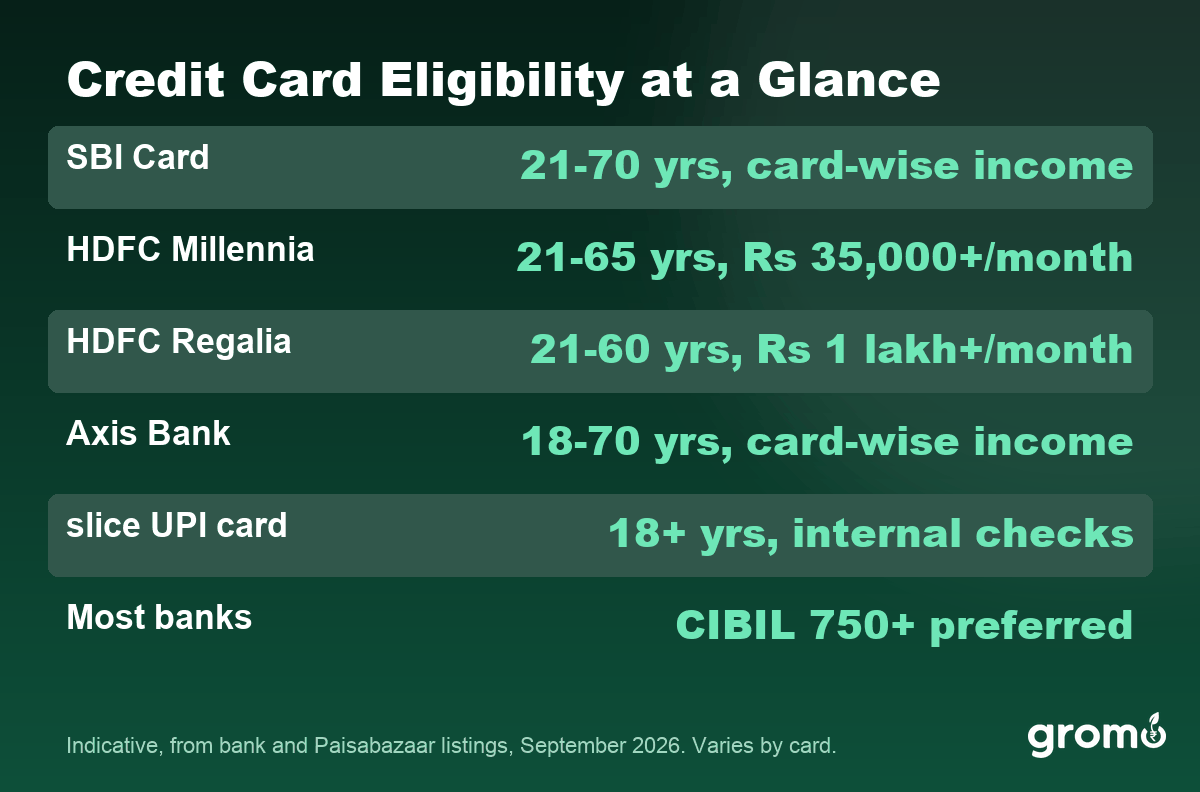
These figures are indicative, taken from bank eligibility pages and Paisabazaar's bank listings in September 2026. Each card has its own criteria, so always check the specific card's eligibility page before applying.
SBI credit card eligibility
| Age | Salaried 21+, self-employed 25+, maximum 70 years |
| Income | Varies by card, entry cards commonly need about Rs 18,000 to 20,000/month (salaried) |
| Credit score | 700+ preferred |
| Eligibility tool | SBI Card's "Simplyfier" suggests a card based on your spending needs |
SBI Card lets you apply even if you do not hold any other credit card. If an application is declined, SBI Card says you can normally reapply after 3 months, and processing can take up to 21 days after documents are collected.
HDFC credit card eligibility
| Millennia | Age 21 to 65, salaried net income above Rs 35,000/month, self-employed ITR above Rs 6 lakh/year |
| Regalia | Salaried age 21 to 60 with income above Rs 1 lakh/month, self-employed age 21 to 65 with ITR above Rs 12 lakh/year |
| Regalia First | Salaried income above Rs 1.2 lakh/month, self-employed ITR above Rs 12 lakh/year |
HDFC publishes eligibility per card on its website and runs an online eligibility checker. Existing HDFC account holders often see pre-approved card offers in NetBanking, which is the quickest route.
Axis credit card eligibility
| Age | 18 to 70 years for primary cardholders, add-on cardholders 15+ |
| Income | Card-specific, for example around Rs 6 lakh/year for some cards and over Rs 18 lakh/year for Magnus |
| Credit score | 700+ preferred |
| Secured options | FD-backed cards like IndianOil Easy, Privilege Easy, and MY Zone Easy |
slice credit card eligibility
slice has become a small finance bank, formed through its merger with North East Small Finance Bank, and now offers the slice UPI credit card. It is open to applicants aged 18 and above, earlier than most banks.
slice does not publish fixed income or score cut-offs. Its help centre says applications are assessed on internal credit policies, eligibility criteria, and credit bureau data, and that these criteria are updated regularly. If you are declined, slice suggests reapplying after a few months.
How a credit card eligibility checker works
A credit card eligibility checker compares the details you enter, age, income, city, employment, with a bank's criteria and tells you which cards you are likely to qualify for. Here is how to check eligibility for a credit card without hurting your score:
- Look for pre-approved offers first. If you bank with HDFC, SBI, ICICI, or Axis, log into net banking or the app. Pre-approved offers mean the bank has already assessed you.
- Use the bank's own checker. HDFC's eligibility checker and SBI Card's Simplyfier guide you to suitable cards before you apply.
- Compare on aggregator sites like Paisabazaar, which match your profile against multiple banks.
- Apply for one card at a time. Checking eligibility is typically a soft enquiry that does not affect your score, but a formal application triggers a hard enquiry, and several in a short time pull your score down.
Documents required for a credit card
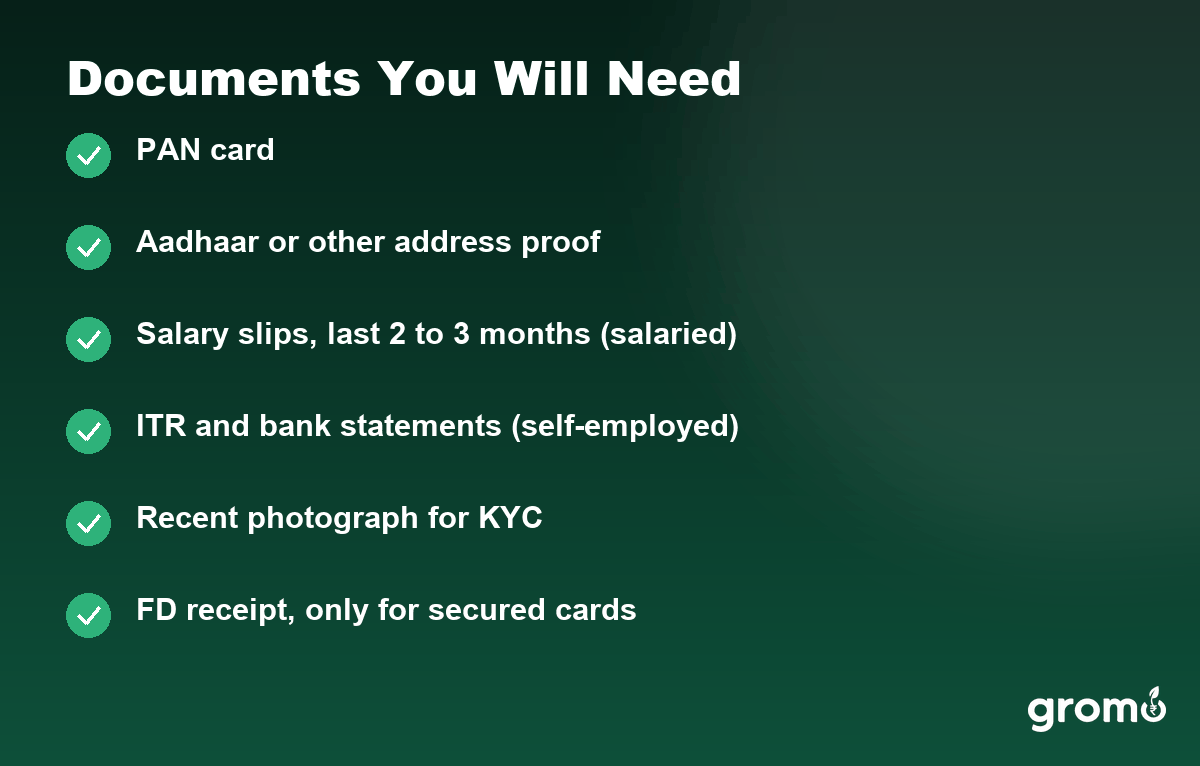
| Applicant | Documents |
|---|---|
| Salaried | PAN, Aadhaar or address proof, last 2 to 3 months salary slips, bank statement |
| Self-employed | PAN, address proof, latest ITR, 3 to 6 months bank statements |
| Secured card | PAN, Aadhaar, and the fixed deposit, no income proof |
Most banks now complete KYC digitally with Aadhaar and video verification, so you rarely need to submit physical copies.
Eligibility by profile: every situation covered
Salaried employees have the easiest path: meet the card's income minimum, keep a 750+ score, and apply with salary slips. Your employer's category also matters, as some banks relax criteria for employees of listed companies.
Self-employed and business owners qualify on ITR income rather than salary. Banks often set a slightly higher age floor (SBI asks for 25+) and want 2 or more years of consistent returns.
Students without income can get an FD-backed student card or an add-on card on a parent's account. The full options are in student credit cards.
Homemakers and people with no income have two routes: a secured card against a fixed deposit, or an add-on card linked to a spouse's or parent's card, where the primary holder is liable for the spends.
Low CIBIL score or no credit history applicants should start with a secured card. Using it well for 6 to 12 months builds the score needed for regular cards, covered in credit card for low CIBIL score.
Senior citizens are eligible up to the bank's maximum age, 60 to 70 for most, and pensioners can use pension income as proof. Above the age limit, an FD-backed card is the usual option.
NRIs generally need an NRE or NRO account with the bank and usually get FD-backed cards rather than unsecured ones.
How to improve your credit card eligibility
- Raise your score: pay every EMI and bill on time, and keep card usage under 30 percent of the limit. The steps are in how to improve your credit score.
- Reduce existing debt before applying, since high EMIs lower the amount banks will lend you.
- Start where you bank. Your own bank already knows your account history and is most likely to approve you.
- Pick the right tier. Applying for a premium card you do not qualify for wastes a hard enquiry, so start with a card that matches your income.
Once you have a card, the next step is growing its limit, explained in how to increase your credit card limit. How banks decide approvals behind the scenes is in how credit card approval works.
Why credit card applications get rejected
The most common reasons are a low or no credit score, income below the card's minimum, too many recent applications, high existing debt, mismatched details between your form and documents, and living outside the bank's serviceable cities.
Fix the cause, wait around 3 months, then apply again, ideally for a card that fits your profile better.
Help people find cards they qualify for
Most rejections happen because people apply for the wrong card. On GroMo, partners match customers to cards from multiple banks based on their income and profile, including 29 credit cards and 7 secured credit cards in the catalogue at the time of writing, and earn Rs 500 to 2,000 per approved card.
It is free to join, and the earning side is explained in credit card refer and earn.
FAQ: credit card eligibility
1. What is the minimum salary for a credit card in India?
It depends on the card. Entry-level cards often need around Rs 15,000 to 25,000 per month, HDFC Millennia needs above Rs 35,000, and premium cards like HDFC Regalia need above Rs 1 lakh per month. Secured cards need no income proof at all.
2. How can I check eligibility for a credit card?
Check for pre-approved offers in your bank's app, use the bank's online eligibility checker, or compare on an aggregator like Paisabazaar. These checks typically do not affect your credit score, only formal applications do.
3. What is SBI credit card eligibility?
Salaried applicants need to be 21 or older, self-employed 25 or older, with a maximum age of 70. Income requirements vary by card, and a credit score of 700 or above is preferred.
4. What is HDFC credit card eligibility?
It is card-specific. Millennia needs age 21 to 65 and salaried income above Rs 35,000 per month or ITR above Rs 6 lakh. Regalia needs salaried income above Rs 1 lakh per month or ITR above Rs 12 lakh.
5. What is Axis credit card eligibility?
Primary cardholders must be 18 to 70 years old, with card-specific income requirements, for example over Rs 18 lakh a year for Magnus. A credit score above 700 improves your chances.
6. What is slice credit card eligibility?
The slice UPI credit card is open to applicants aged 18 and above. slice does not publish fixed income or score cut-offs, and decides using internal credit policy and credit bureau data.
7. Can I get a credit card with no income?
Yes, through a secured card backed by a fixed deposit, or an add-on card on a family member's account. Neither needs income proof.
8. What CIBIL score is needed for a credit card?
Most banks prefer 750 or above. Some entry-level cards accept 700 or so, and secured cards are available regardless of score.
Disclaimer
Eligibility criteria are indicative, taken from the official websites of SBI Card, HDFC Bank, Axis Bank, and slice and from Paisabazaar's bank listings as of September 2026.
Banks change their criteria without notice, and meeting the listed criteria does not guarantee approval, which rests entirely with the card issuer.
Verify the latest criteria on the bank's official page before applying. GroMo commissions are indicative and depend on approvals by partner banks. This article is for information only and is not financial advice. GroMo is available only to users aged 18 and above.


