
Student Credit Cards in India 2026: Best Options With No Income Proof
Best student credit cards in India 2026: lifetime free FD-backed cards from Rs 2,000, no income proof, limits, interest rates, and how students build CIBIL early.

Student credit cards are entry level credit cards that anyone 18 or older can get without a salary, usually by opening a small fixed deposit of Rs 2,000 to Rs 20,000 with the bank. The card limit is set at 80 to 100 percent of that deposit, the best options charge no annual fee, and paying the bill on time every month starts building your CIBIL score years before your first job.
This guide covers the best credit cards for students in India in 2026, how to get one with no income, what it costs, and the mistakes that hurt young credit scores.
Student credit cards in India: quick facts
| Question | Quick answer |
|---|---|
| Who can get one? | Anyone 18+, students included. No job or salary needed |
| Income proof needed? | No, if you take the fixed deposit (FD) route |
| Minimum FD | Rs 2,000 to Rs 20,000 depending on the bank |
| Credit limit | 80 to 100 percent of your FD amount |
| Annual fee | Rs 0 on the best student cards (lifetime free) |
| Interest rate | Roughly 3 to 3.8 percent per month if you do not pay in full |
| Documents | PAN, Aadhaar, and sometimes college ID or address proof |
| Best use | Small spends, paid in full, to build a CIBIL score early |
What is a student credit card?
A student credit card is a credit card designed for people who are studying and do not have a regular income yet. Banks market them as credit cards for college students, but any Indian student aged 18 or above can apply. In India, most of these are secured cards, which means the bank gives you the card against a fixed deposit instead of a salary slip.
Your FD stays with the bank and keeps earning interest. The bank gives you a credit limit close to the FD amount, so it takes almost no risk, and that is why approval is nearly certain even with no income and no credit history.
If you are new to cards, first understand the difference between credit card and debit card. A debit card spends your own money, while a credit card spends the bank's money that you repay by the bill due date.
Best student credit cards in India 2026
These are the top student credit cards in India right now, each one a practical credit card for Indian students. All of them work without income proof, and most are free for life.
| Card | Annual fee | FD needed | Best for |
|---|---|---|---|
| IDFC FIRST WOW! | Rs 0 (lifetime free) | From Rs 2,000 | Zero forex, overall value |
| Kotak 811 #DreamDifferent | Rs 0 (lifetime free) | From Rs 5,000 | Digital-first students |
| ICICI Instant Platinum | Rs 0 | From Rs 10,000 approx | Movie and fuel savings |
| SBI Student Plus Advantage | Rs 500 (often waived on spends) | FD or education loan | Education loan holders |
| Axis Insta Easy | Rs 0 to Rs 500 | From Rs 20,000 | Quick FD-based approval |
| Add-on card on a parent's card | Usually Rs 0 | None | Students under 21 or without FD money |
1. IDFC FIRST WOW! Credit Card
| Annual fee | Rs 0, lifetime free |
| FD needed | Starts around Rs 2,000 |
| Credit limit | Up to 100 percent of FD |
| Key benefit | Zero forex markup and reward points that never expire |
Why it is good: This is the most recommended credit card for students in 2026 because everything about it is free. There is no joining fee, no annual fee, and no forex markup, which matters if you pay for international apps, courses, or exam fees in dollars. Your FD keeps earning around 7 percent interest while the card builds your credit score.
2. Kotak 811 #DreamDifferent Credit Card
| Annual fee | Rs 0, lifetime free |
| FD needed | Starts around Rs 5,000 |
| Credit limit | Up to 90 percent of FD |
| Key benefit | Interest free cash withdrawal up to 48 days, fuel and railway surcharge waiver |
Why it is good: The 811 card is built for people who opened a Kotak 811 digital account, which many students already have. The full journey from FD to card is online, and the fuel plus railway booking surcharge waivers suit students who travel home by train.
3. ICICI Instant Platinum Credit Card
| Annual fee | Rs 0 |
| FD needed | Around Rs 10,000 |
| Credit limit | Up to 85 to 90 percent of FD |
| Key benefit | Rs 100 off movie tickets twice a month, 2.5 percent fuel surcharge waiver |
Why it is good: It is issued against an FD in minutes if you already bank with ICICI, and the movie discount alone can save a hosteller Rs 200 a month. Reward points on every spend add small but steady value.
4. SBI Student Plus Advantage Card
| Annual fee | Rs 500, often reversed on yearly spends |
| Backed by | Fixed deposit or an SBI education loan |
| Credit limit | Set against FD or loan margin |
| Key benefit | 1 percent fuel surcharge waiver, cash withdrawal up to 80 percent of limit |
Why it is good: This is one of the few cards in India actually named for students. If your family already has an SBI education loan for your course, you can get this card without a separate FD, which no other major bank offers.
5. Axis Bank Insta Easy Credit Card
| Annual fee | Rs 0 to Rs 500 depending on variant |
| FD needed | From Rs 20,000 |
| Credit limit | Up to 80 percent of FD |
| Key benefit | eDGE reward points and instant issue against an Axis FD |
Why it is good: Approval is almost instant if you hold an Axis FD, and the card reports to CIBIL like any regular card. The FD requirement is higher, so it suits students who already have some savings parked.
6. Add-on card on a parent's credit card
| Annual fee | Usually Rs 0 for the first add-on |
| FD needed | None |
| Credit limit | Shared with the parent's limit, parent can cap it |
| Key benefit | Available even before you have any documents beyond ID proof |
Why it is good: If you cannot lock money in an FD, an add-on card from a parent's account is the simplest free student credit card option. The catch is that spends appear on the parent's bill and the credit history builds on their profile, not yours, so switch to your own FD-backed card when you can.
How to get a credit card as a student with no income
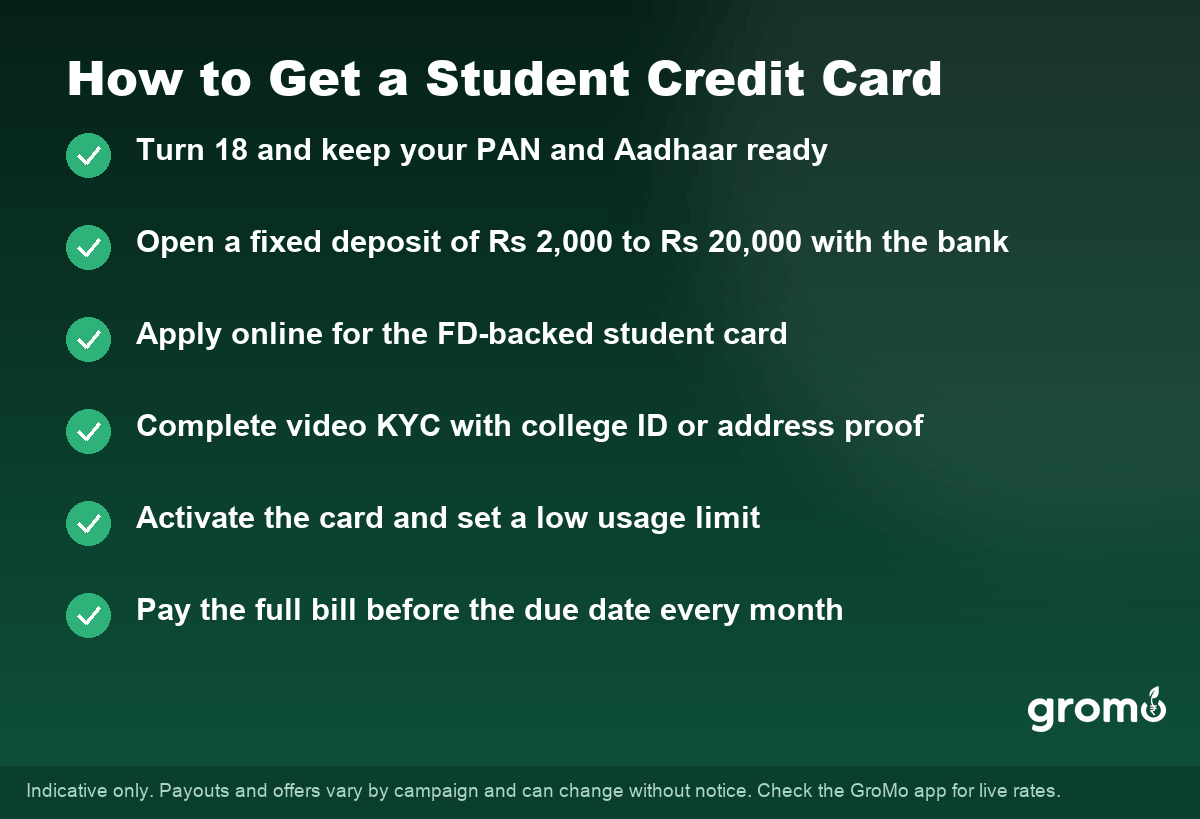
Credit cards for students with no income work through the fixed deposit route. Here is the exact process, and it takes about 20 minutes online with most banks.
- Pick a bank from the list above and open a savings account with it if you do not have one.
- Open a fixed deposit of Rs 2,000 to Rs 20,000. Choose an amount you will not need for a year.
- Apply for the FD-backed card on the bank's app or website. Look for words like "secured card" or "card against FD".
- Complete video KYC with your PAN and Aadhaar. Some banks also ask for college ID or hostel address proof.
- Set your card limit. Keeping it at 80 to 90 percent of the FD is standard.
- Activate the card, make one small purchase, and pay the full bill before the due date.
No FD money at all? Start with an add-on card, or use a credit card for low CIBIL score route once you have any credit history. Avoid apps that promise instant online credit cards for students without KYC, most are not real credit cards and some are outright scams.
Student credit card benefits
Used well, a student credit card gives you four real benefits.
Early CIBIL history: Your score starts building at 18 instead of 24. By the time you apply for your first big loan, you can have 5+ years of clean history, which gets you better interest rates.
Zero cost: The best free student credit cards charge nothing per year, and your FD keeps earning 6.5 to 7.5 percent interest the whole time.
Online payment safety: A credit card between your bank account and the internet means a fraudulent charge hits the card, not your savings, and you can dispute it before paying.
EMI access: Most student cards let you convert purchases above Rs 2,500 or so into EMIs, which works like an emi card for students buying a laptop or phone. Check the conversion charge first, it is usually 1 to 2 percent plus interest.
Student credit card interest rate and charges
The interest rate is where new card users get hurt. If you do not pay the full bill, banks charge roughly 3 to 3.8 percent per month, which is 36 to 45 percent a year.
Interest is only the start. Late payment fees run Rs 500 to Rs 1,300 per miss, cash withdrawals attract charges from day one, and there are several credit card hidden charges like forex markup and EMI processing fees that never appear in the ad.
The rule that makes all of this irrelevant: spend only what you can pay in full, and pay before the due date every single month. Do that and your card costs you nothing.
Student credit card vs regular credit card
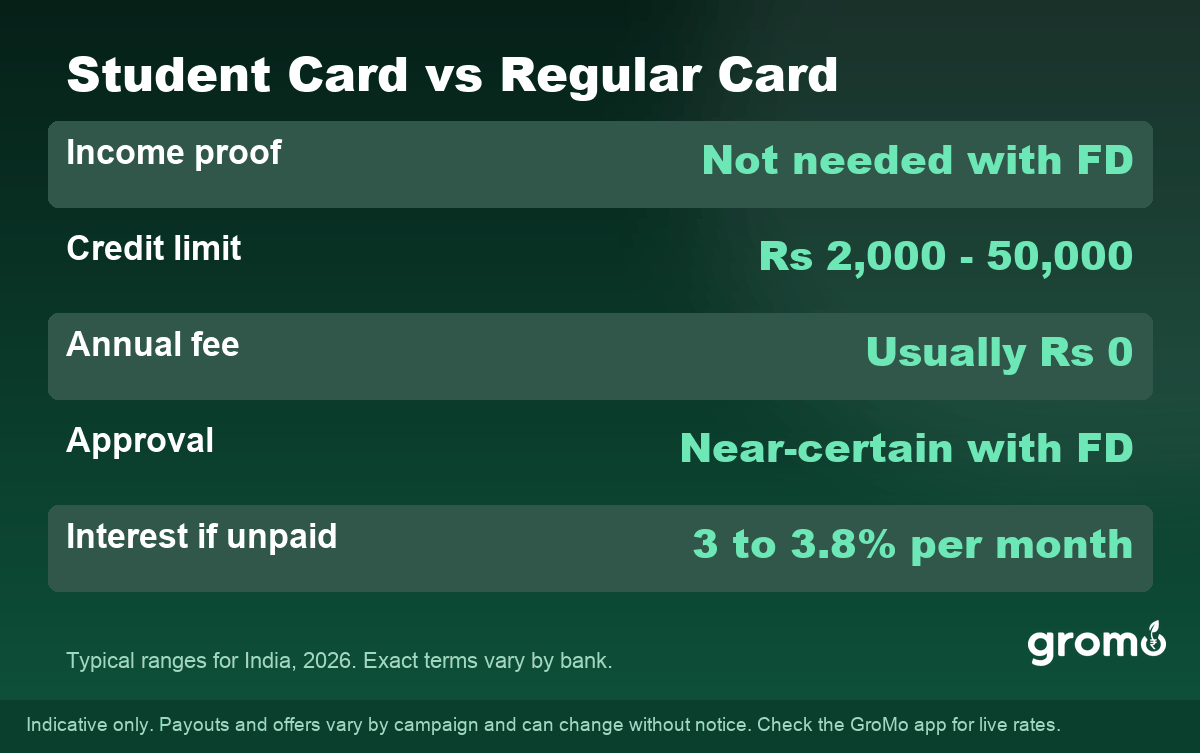
Good credit cards for students trade size for access. You accept a small limit and fewer perks, and in return the bank ignores your empty salary account.
| Feature | Student credit card | Regular credit card |
|---|---|---|
| Income proof | Not needed with FD | Salary of Rs 15,000 to 25,000+ per month |
| Credit limit | Rs 2,000 to Rs 50,000 | Rs 50,000 to Rs 5 lakh+ |
| Annual fee | Usually Rs 0 | Rs 500 to Rs 5,000 |
| Rewards | Basic points, small waivers | Cashback, lounge access, milestones |
| Approval | Near certain with FD | Depends on CIBIL and income |
| Purpose | Build credit history | Maximise rewards on spending |
Students with good credit already, say a 750+ score from an earlier secured card, can sometimes qualify for entry level regular cards. Even then, best credit cards for students with good credit are usually the same lifetime free FD cards with a raised limit, because the fee stays zero.
How to build your CIBIL score with a student card
The card only helps if you use it in a way the credit bureau likes. Three habits matter.
Use less than 30 percent of the limit. On a Rs 10,000 limit, keep monthly spends under Rs 3,000. High utilisation signals money stress and drags the score down.
Pay in full, never just the minimum due. The minimum keeps the account current but interest still runs on the rest, and revolving balances slow score growth.
Keep the card for years. Age of credit history is a scoring factor, so do not close your first card even after you get better ones. One recharge a month keeps it active.
Can students also earn from credit cards?
Yes, and this is the part most student credit card guides skip. Banks pay a commission for every new card customer someone brings in, and students with a good campus network use this as a real income source.
Platforms like GroMo let you share card offers from multiple banks and earn Rs 500 to Rs 2,000 or more per approved card through credit card refer and earn programs. Consistent sharers earn money by selling credit cards alongside their studies, and it pairs naturally with other earning apps for students without investment.
FAQ: student credit cards
1. Can a student get a credit card in India without income?
Yes. Open a fixed deposit of Rs 2,000 to Rs 20,000 with a bank and take a secured card against it. No salary slip or income proof is needed, and approval is nearly certain.
2. Which is the best student credit card in India in 2026?
The IDFC FIRST WOW! card is the strongest overall pick because it is lifetime free, needs a small FD, has zero forex markup, and its reward points never expire. Kotak 811 #DreamDifferent is a close second for digital account holders.
3. What is the minimum age for a student credit card?
18 years. Below 18 you cannot hold any credit card in your own name, though a parent can add you as an add-on card holder on some banks from 18 as well.
4. Do student credit cards affect CIBIL score?
Yes, exactly like regular cards. On-time payments build your score from scratch, and missed payments damage it. Most students reach 700+ within 12 to 18 months of clean usage.
5. Is there a truly free student credit card?
Yes. IDFC FIRST WOW! and Kotak 811 #DreamDifferent charge no joining fee and no annual fee for life. Your only commitment is the FD, which stays yours and keeps earning interest.
6. Can I get a student credit card online?
Yes. All the FD-backed cards in this list can be applied for on the bank's app or website with video KYC. If you already have an account with the bank, issue can take under 30 minutes.
7. What credit limit do student cards give?
80 to 100 percent of your FD amount. A Rs 10,000 FD typically means an Rs 8,000 to Rs 10,000 limit. Increase the FD later to raise the limit.
8. Can I get a student credit card without an FD?
Two routes exist: an add-on card on a parent's credit card, or the SBI Student Plus Advantage card if your family has an SBI education loan. Unsecured cards without income proof are rare and usually not worth the fees.
9. What happens to my FD if I miss payments?
The bank can break the FD and recover its dues if you default for long. The miss is also reported to CIBIL. Set an autopay for the full bill amount so this never happens.
10. Student credit card or add-on card, which is better?
Your own FD-backed card is better because the credit history builds on your PAN. An add-on card is convenient but every rupee of history goes to the parent's profile.
Disclaimer
Card features, fees, FD requirements, and reward rules are set by the issuing banks and change often. All figures here are indicative as of September 2026, always verify current terms on the bank's official website before applying. This article is for information only and is not financial advice. Earnings from referral platforms depend on your effort and network, and there is no guaranteed income. GroMo is available only to users aged 18 and above.


