
Bank DSA vs NBFC DSA: Which Should You Join in 2026?
Bank DSA vs NBFC DSA compared: customers, approval speed, documents, RBI rules and real payout data, so you can pick the right lender to partner with.

A bank DSA finds loan and card customers for a bank; an NBFC DSA finds them for an RBI-registered non-banking finance company. Both collect documents and submit applications, and the lender alone approves. Banks usually want stronger credit and more paperwork. NBFCs usually accept more borrower types and decide faster. In the GroMo app, 3 of 28 personal loans came from banks and 25 from NBFCs or NBFC-backed apps (GroMo product catalogue, 25 November 2026).
GroMo is a free app where partners earn commission by referring customers to banks and NBFCs for loans, credit cards and savings accounts. If you already know which customers you meet every day, the right choice gets much easier. The sections below compare the two side by side, show what the RBI expects from every DSA, and explain how to start with either one.
What Is the Difference Between a Bank DSA and an NBFC DSA?
A bank DSA (Direct Selling Agent) works under an agreement with a bank, such as a private or public sector bank or a small finance bank. An NBFC DSA works under an agreement with a non-banking financial company. The daily work looks the same: you find a customer who needs a loan or credit card, check basic eligibility, collect documents, submit the application and follow up until the lender decides.
The lender behind you is what changes. According to the RBI, NBFCs cannot accept demand deposits, are not part of the payment and settlement system, cannot issue cheques drawn on themselves, and their depositors do not get DICGC deposit insurance (RBI FAQs on NBFCs, 11 November 2026). Banks raise cheap money from savings and current accounts, so they tend to lend at lower rates to safer borrowers. NBFCs raise money from markets and banks, so they tend to price loans higher and accept customers banks may turn away.
Bank deposits are insured by DICGC up to ₹5 lakh per depositor per bank (DICGC FAQs, retrieved 2026-11-25), while NBFC deposits carry no DICGC cover (RBI FAQs on NBFCs, retrieved 2026-11-25). Every NBFC also needs an RBI certificate of registration under Section 45-IA of the RBI Act, 1934, and new NBFCs must hold net owned funds of ₹10 crore.
For a DSA, the lender type decides the work: a bank tie-up suits customers with good credit and full documents, and an NBFC tie-up suits customers who need speed or flexibility.
How Do Bank DSA and NBFC DSA Compare Side by Side?
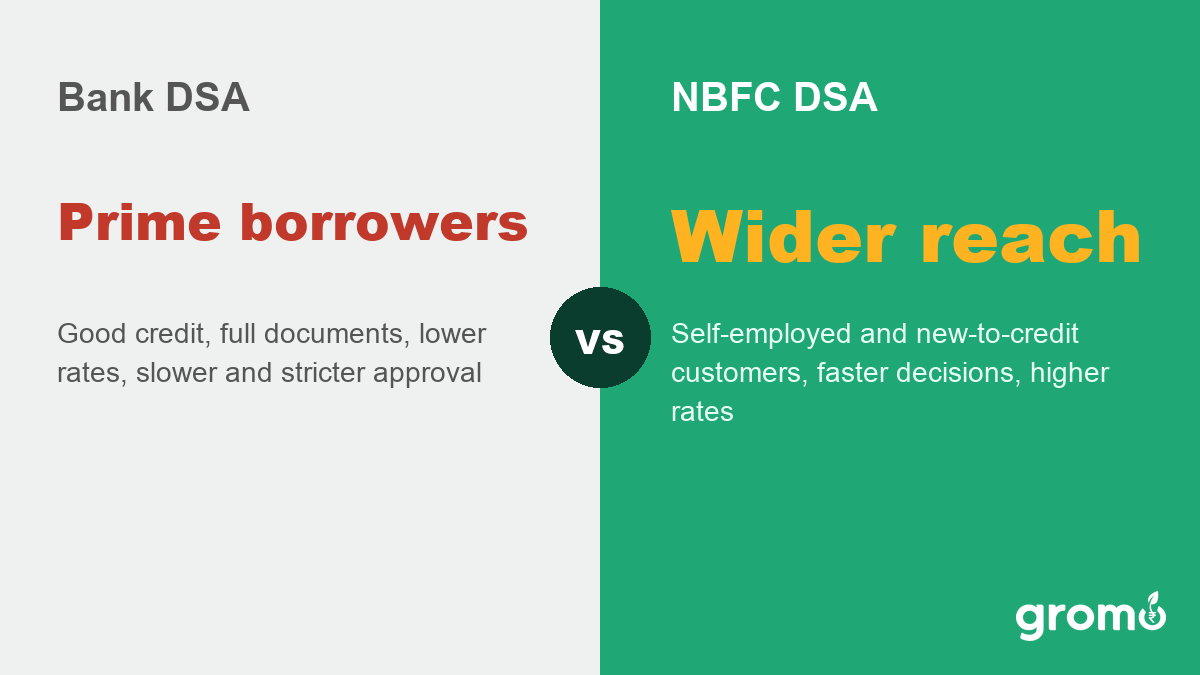
The table below compares the two on the points that decide your daily income. The rows describe common patterns, not fixed rules. Every lender sets its own policy, so read your own agreement.
| Point | Bank DSA | NBFC DSA |
|---|---|---|
| Who you work for | A bank (public, private or small finance bank) | An RBI-registered NBFC |
| Typical customers | Salaried people with good credit scores and full documents | Self-employed people, first-time borrowers, thinner credit files |
| Typical products | Home loans, loan against property, personal loans, credit cards | Personal loans, business loans, two-wheeler loans, consumer loans |
| Approval speed | Usually slower, with more checks | Usually faster, often app-based |
| Paperwork for the customer | More (income proof, bank statements, property papers) | Often less, especially on digital journeys |
| Interest rate the customer sees | Usually lower | Usually higher |
| Getting empanelled | Stricter: experience, references and office checks are common | Often easier for new agents |
| Who approves the loan | The bank, always | The NBFC, always |
| RBI conduct rules on you | Yes, through the bank's code of conduct | Yes, through the NBFC's code of conduct |
The last two rows matter most. Whichever lender you choose, you never approve a loan, and you are bound by the same type of RBI conduct rules. The basics of the role are the same either way, as our guide to what a loan agent does explains.
What Rules Does the RBI Set for Bank and NBFC DSAs?
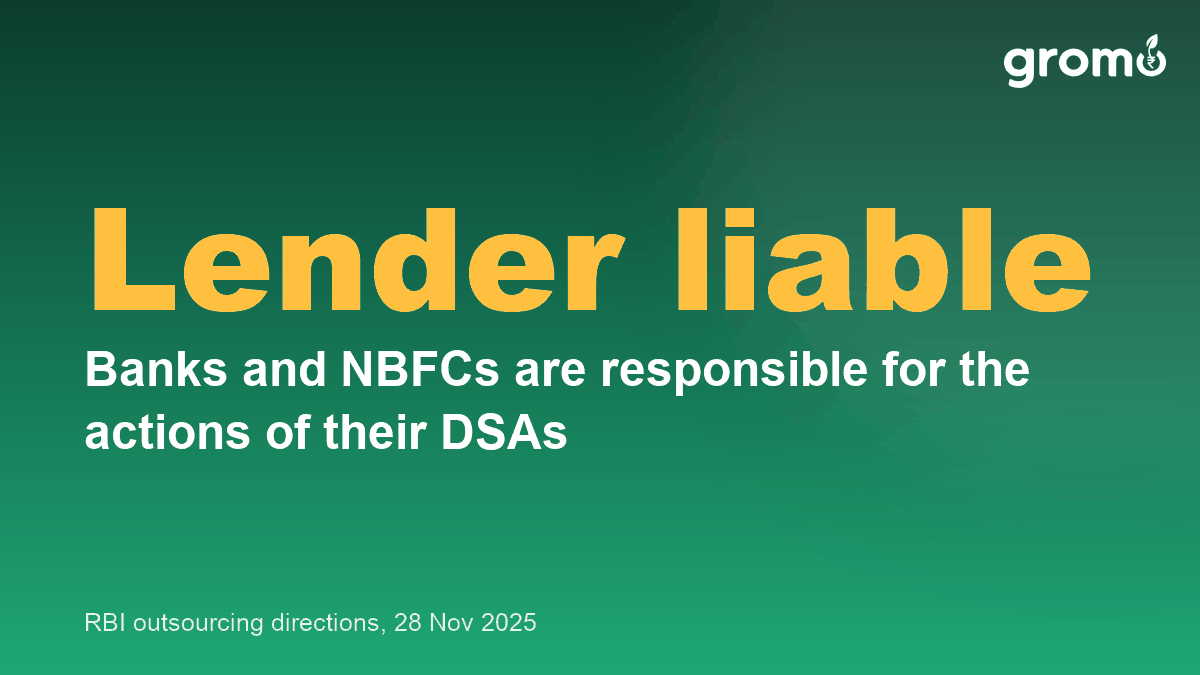
The RBI does not license DSAs directly. Instead, it holds every bank and NBFC responsible for the agents it appoints. The current rules for banks are in the Reserve Bank of India (Commercial Banks: Managing Risks in Outsourcing) Directions, 2025, dated 28 November 2025, with matching directions for NBFCs issued the same day.
The 2025 bank outsourcing directions say: "The bank shall, therefore, be responsible for the actions of its service provider including Direct Sales Agents (DSAs) / Direct Marketing Agents (DMAs) and recovery agents, and the confidentiality of information pertaining to the customers that is available with the service provider." (Reserve Bank of India, 28 November 2025)
In practice, four rules shape a DSA's work at both banks and NBFCs:
| Rule | What it means for you |
|---|---|
| Lender keeps the loan decision | Banks and NBFCs cannot outsource loan sanction or KYC compliance decisions. You collect and submit; the lender decides. |
| Code of conduct | Lenders put in place a code of conduct for DSAs, and many banks build theirs on the Indian Banks' Association model code. You sign an undertaking to follow it. |
| Customer data | Customer documents and details must stay confidential. Sharing them outside the lender is a breach. |
| Digital lending | Under the RBI (Digital Lending) Directions, 2025 (8 May 2025), loan money must move directly between the lender and the borrower, never through an agent's or app's pool account. |
Recovery agents also face a calling window: lenders and their recovery agents may not call borrowers about overdue loans before 8:00 a.m. or after 7:00 p.m. (RBI Responsible Business Conduct Directions, 28 November 2025). Most DSAs never do recovery work, but the rule shows how closely conduct is watched.
Which Pays More, a Bank DSA or an NBFC DSA?
There is no single answer, because every lender sets its own payout, and payouts change often. The only data GroMo can show is its own app. On 25 November 2026, the GroMo product catalogue listed these personal loan payouts:
| Lender type | Product in the GroMo app | Payout per approved loan (up to) |
|---|---|---|
| Bank | IDFC First Bank Personal Loan | ₹250 |
| Bank | Unity SFB Personal Loan | ₹150 |
| Bank | HDFC Insta Jumbo Loan | ₹125 |
| NBFC or NBFC-backed app | Lendingplate Personal Loan | ₹500 |
| NBFC or NBFC-backed app | InCred Personal Loan | ₹325 |
| NBFC or NBFC-backed app | KreditBee | ₹325 |
| NBFC or NBFC-backed app | Poonawalla Fincorp Personal Loan | ₹150 |
| NBFC (business loan) | ClickPe Business Loan (powered by Muthoot Finance) | ₹100 |
Source: GroMo product catalogue, retrieved 2026-11-25.
Please note: payouts change often and differ by product, lender and city. Most products pay less than the top figure shown here. Commission is paid only when the bank or NBFC approves and disburses the loan, and the lender alone decides approval. Always check the live payout in the app before you share a link.
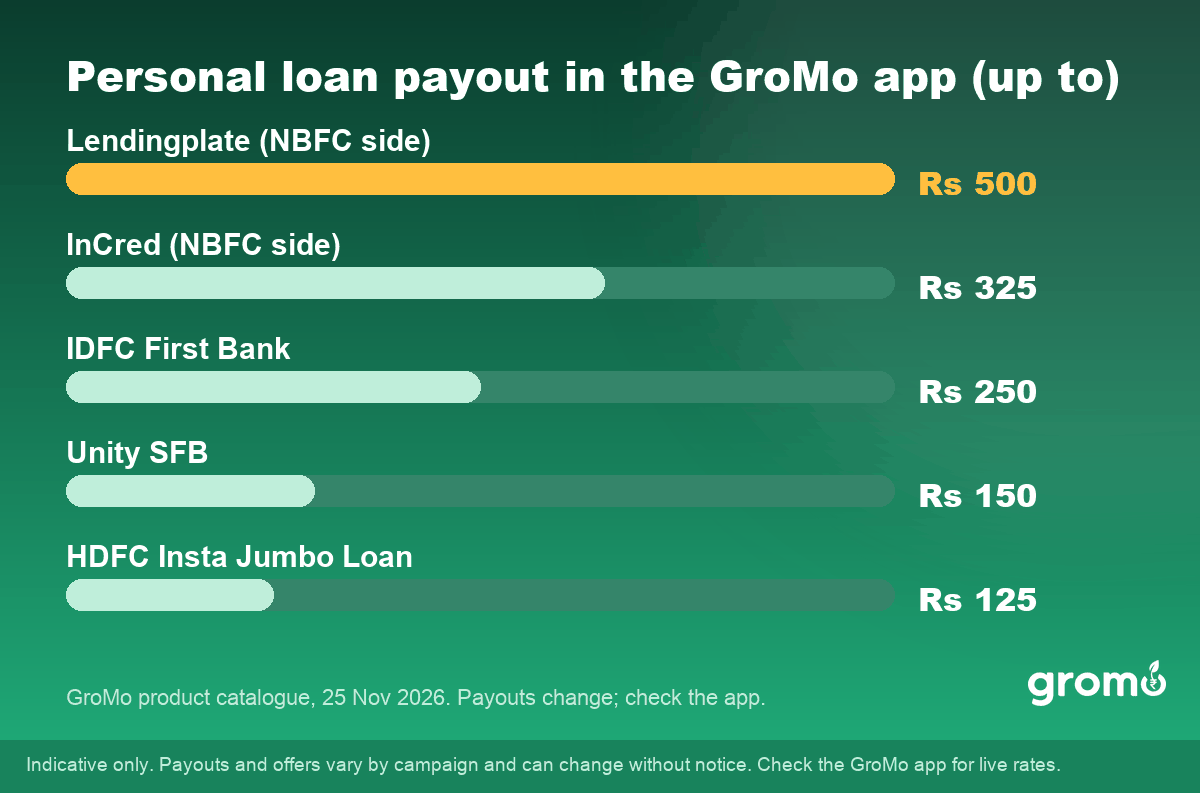
In this snapshot, NBFC-side loans had more high-paying options (up to ₹500 against up to ₹250 for banks; GroMo product catalogue, retrieved 2026-11-25), but the bank loans usually go to customers with better approval odds. A lower payout on a loan that gets approved beats a higher payout on one that gets rejected. Learn more about how payouts are calculated in our guide to DSA loan agent commission.
Who Should Join a Bank as a DSA, and Who Should Join an NBFC?
Start with the customers you already meet. Your network decides which lender approves your files, and approvals decide your income.
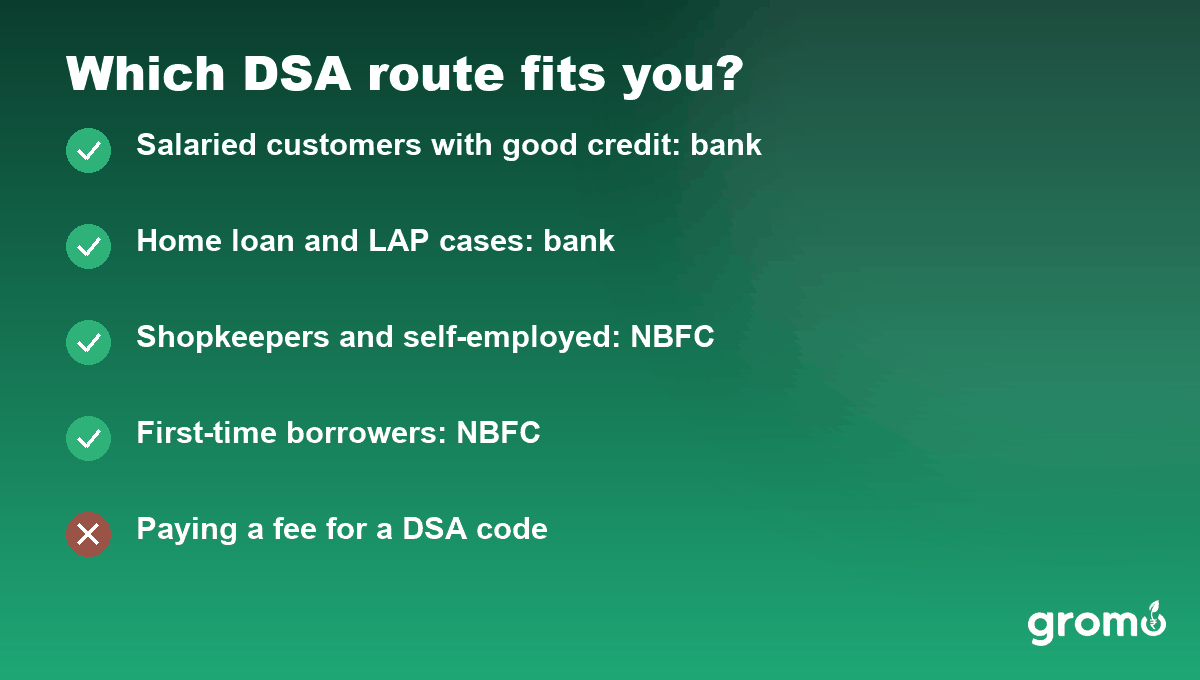
A bank DSA tie-up fits you if:
- Most of your contacts are salaried, with strong credit histories and salary slips or Form 16 ready
- You work with property buyers, builders or chartered accountants who bring home loan and loan against property cases
- You can handle a slower process and longer paperwork in return for lower interest rates for your customer
- You already have a few years of loan selling experience and references to show the bank
An NBFC DSA tie-up fits you if:
- Your customers are shopkeepers, traders, small business owners or gig workers with irregular income proof
- Many of your contacts are first-time borrowers with little or no credit history
- Your customers want a fast decision on a small personal or business loan
- You are new to loan selling and want a quicker start
Many experienced agents do both: a bank for prime customers and two or three NBFCs for everyone else. Before you sign, check whether either agreement asks for exclusivity.
How Do You Register as a DSA with a Bank or an NBFC?
The steps are similar at both. Banks usually ask for more experience and run more checks before they empanel you.
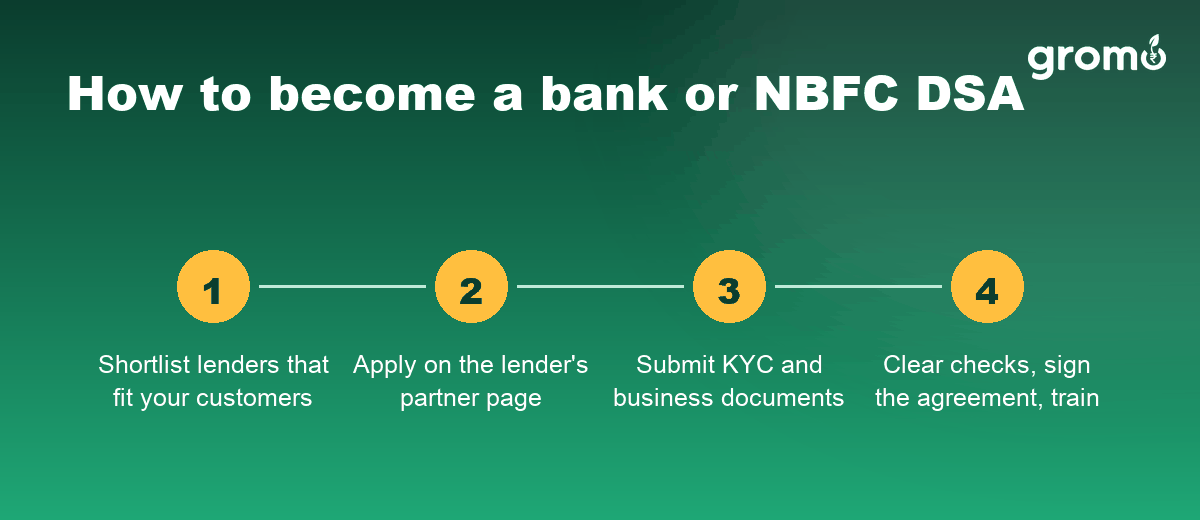
- Shortlist lenders. Pick one or two banks and two or three NBFCs whose products match your customers.
- Apply through the lender's DSA or partner page, or through its local branch or sales manager.
- Submit documents. Expect PAN, Aadhaar, address proof, bank account details, photographs, and for businesses, GST registration and business proof. Banks may also ask for income tax returns and experience proof.
- Clear verification. Lenders may run a background check, visit your office and check your own credit report.
- Sign the DSA agreement and code of conduct, then receive your DSA code and login.
- Complete product training before you submit your first file.
Timelines vary widely by lender. For a document-by-document walkthrough, see our guide to DSA loan agent registration. Once you are approved, the lender gives you a unique DSA code and a login.
How Do You Check That a Bank or NBFC Is Genuine Before You Sign?
Fake "DSA franchise" offers that ask for a joining fee are common. Check these five points before you share documents or money with any lender.
- Look the lender up on the RBI website. The RBI publishes the list of registered NBFCs and the list of banks. An NBFC that is missing from the list cannot legally lend.
- Check the name on the agreement. The agreement should name the bank or NBFC itself, not only an unnamed "partner company".
- Refuse upfront fees for a DSA code. Genuine lenders pay you; they do not charge you for empanelment. Read our guide to loan DSA franchise offers before paying any fee.
- Check the money flow. Loan money must go from the lender straight to the borrower's account, as the RBI digital lending rules require.
- Report suspicious entities on the RBI's Sachet portal, which takes complaints about unauthorised deposit-taking and lending.
A genuine NBFC must hold an RBI certificate of registration under Section 45-IA of the RBI Act, 1934, and net owned funds of ₹10 crore for new registrations (RBI FAQs on NBFCs, retrieved 2026-11-25).
The RBI FAQs on NBFCs also explain that NBFCs with a customer interface and assets of ₹100 crore or more come under the RBI Integrated Ombudsman Scheme, 2021, which gives your customers a route to complain.
Can You Be a DSA for Both Banks and NBFCs at the Same Time?
Yes, in most cases. DSA agreements are usually non-exclusive, so many agents hold codes with several banks and NBFCs and send each customer to the lender most likely to approve them. Some agreements do restrict competing tie-ups, so read the exclusivity and termination clauses before you sign.
Working with many lenders has two costs. Each lender issues its own DSA code for loan agents, its own login, documents, training and payout cycle to track. You also have to know each lender's credit policy well enough to avoid sending files that will be rejected, which wastes your time and your customer's credit enquiries.
A multi-lender platform reduces that load. With GroMo, for example, you can offer personal loans from banks and NBFCs, plus business loans, credit cards and savings accounts, from one app with one login. The lender still approves every application, and you earn the payout shown in the app.
What Mistakes Do New Bank and NBFC DSAs Make?
Most new DSAs lose time and money in the same five ways.
| Mistake | What to do instead |
|---|---|
| Joining a bank when most of your customers have low or no credit scores | Match the lender to your customers, not to the brand name |
| Promising customers approval or a fixed interest rate | Say "the lender decides", and show the lender's own rate range |
| Sending one customer to many lenders at once | Each application can add a hard enquiry to the credit report; pick the best fit first |
| Paying a fee for a "DSA franchise" or code | Genuine banks and NBFCs do not charge for empanelment |
| Keeping customer documents on your phone after submission | Delete them; customer data must stay confidential under your code of conduct |
Avoiding these five mistakes keeps your approval rate high, which matters more to your income than the headline payout on any single product.
Start with the Customers You Already Know
Pick the lender type that fits the people you meet every week. Salaried customers with good credit suit a bank DSA tie-up; small business owners and first-time borrowers suit an NBFC. If you want both without separate empanelments, GroMo lets you offer bank and NBFC products from one app, free to join, with payouts shown before you share a link. Loan agents, shopkeepers and bank mitras already use it, as our guide on who can earn money with GroMo shows.

FAQ: Bank DSA vs NBFC DSA
What is the full form of DSA in a bank?
DSA stands for Direct Selling Agent (also written Direct Sales Agent). A DSA is an individual or firm appointed by a bank or NBFC to find customers for loans and credit cards and submit their applications. The lender approves the loan and pays the DSA a commission.
Is a bank DSA better than an NBFC DSA?
Neither is better for everyone. A bank DSA suits agents whose customers have good credit and full documents. An NBFC DSA suits agents whose customers are self-employed, new to credit or want faster decisions. Many agents work with both.
Does the RBI register DSAs?
No. The RBI regulates banks and NBFCs, and each lender is responsible for the DSAs it appoints under the RBI outsourcing directions. You get your DSA code from the lender, not from the RBI.
Do NBFCs pay DSAs more than banks?
Not always. Payouts depend on the lender, product and loan amount. In the GroMo app, the highest personal loan payout was up to ₹500 from an NBFC-side lender, while bank personal loans paid up to ₹250 (GroMo product catalogue, retrieved 2026-11-25).
Can I become a DSA without experience?
Yes, with some lenders. NBFCs and multi-lender platforms often accept new agents, while banks more often ask for experience or references. Every lender sets its own criteria.
Do I need to pay a fee to become a bank or NBFC DSA?
Genuine banks and NBFCs do not charge a fee to appoint you as a DSA. Treat any demand for a joining fee or franchise fee as a warning sign and check the lender on the RBI website.
Can I work as a DSA from home?
Yes. Many DSAs now work from home on phone and app-based journeys, especially with NBFCs and digital lenders. Some bank tie-ups may still expect an office address for verification.
Disclosures
GroMo (Vitrak Technologies Pvt Ltd) is a distribution platform. GroMo is not a bank, NBFC, insurer or investment adviser. All products are offered by their respective RBI or SEBI-regulated providers, who alone decide approval, interest rates and terms.
Loans and credit cards are issued by RBI-regulated banks and NBFCs. Approval is at the lender's sole discretion and is never promised. GroMo does not lend money.
Partner earnings depend on effort, product mix and customer eligibility. Any figures shown are illustrative examples. They are not typical and are not guaranteed. GroMo does not guarantee any level of income.
Disclaimer
The information on this page is for general information only and is not financial, legal or investment advice. RBI rules summarised here may change; read the current directions on the RBI website. Commission rates are set by lenders and change often; check the live figure in the app. Loan approval is decided only by the bank or NBFC. You must be 18 or older to join GroMo.


