
DSA Full Form in Banking: Meaning, Role & How It Works
DSA full form in banking is Direct Selling Agent. Learn what a DSA does, how DSA work in a bank happens, eligibility, documents, and typical commissions.

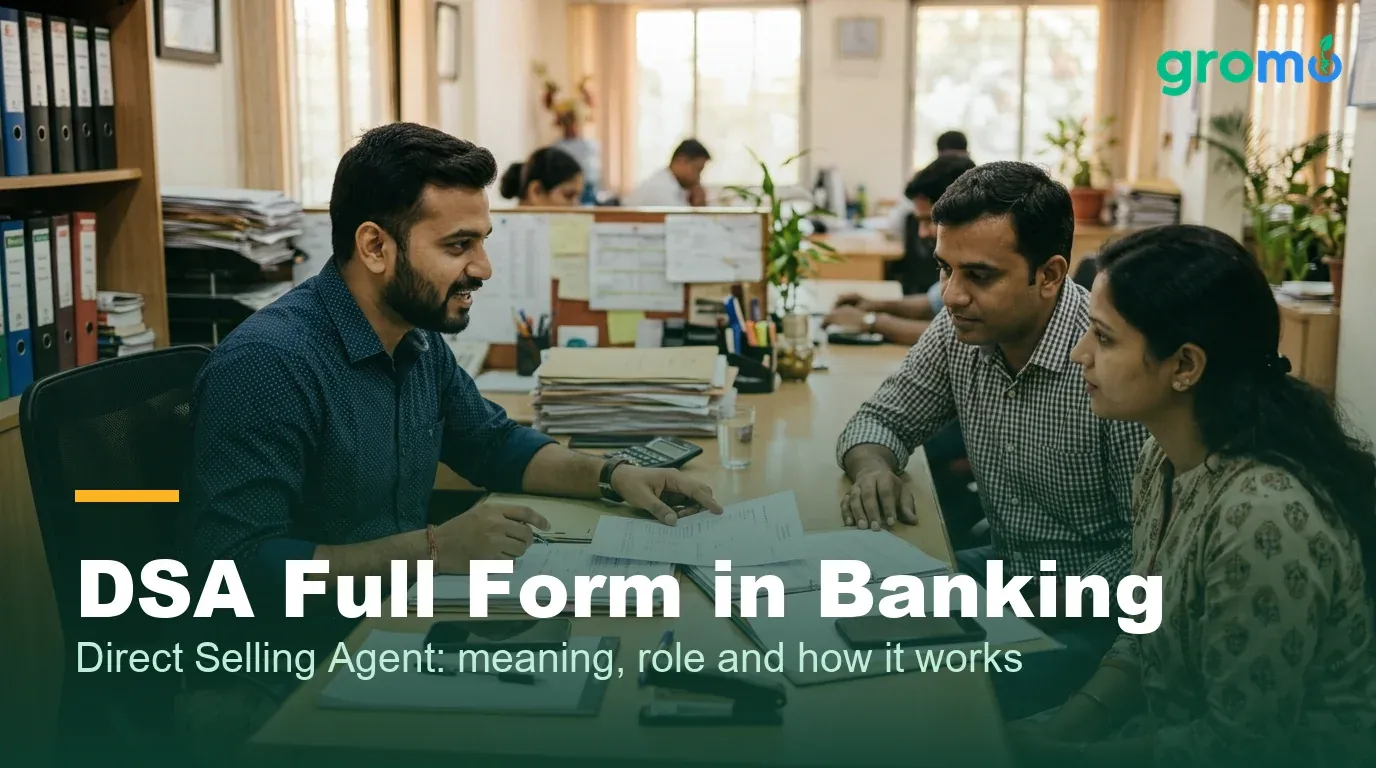
If you have ever applied for a loan through an agent, you have probably met a DSA without knowing it. The DSA full form in banking is Direct Selling Agent: a person or company officially appointed by a bank or NBFC to find loan customers, help with paperwork, and earn a commission on every loan that gets disbursed.
This guide explains what a DSA is, how DSA work in a bank actually happens, the eligibility for bank DSA registration, the documents you need, and how much a DSA can earn.
DSA in Banking: Quick Facts
| Question | Answer |
|---|---|
| DSA full form in banking | Direct Selling Agent |
| DSA agent full form | Direct Selling Agent (also called Direct Sales Associate) |
| Who appoints a DSA | Banks and NBFCs, through a registration agreement |
| What a DSA sells | Loans, credit cards, and other financial products |
| How a DSA earns | Commission, usually a percentage of the disbursed loan amount |
| Basic eligibility | Indian resident, age 18 or above, valid PAN and Aadhaar |
| Investment needed | Usually zero; genuine lenders do not charge joining fees |
What Is the DSA Full Form in Banking?
DSA stands for Direct Selling Agent. A DSA is an authorised intermediary who works between borrowers and lenders. The bank or NBFC appoints the DSA through a formal agreement, gives them a DSA code, and pays them a commission for every customer they bring whose loan is approved and disbursed.
The important word is "direct". A DSA sells directly to customers on behalf of the lender, but the DSA is not a bank employee. They do not approve loans, decide interest rates, or handle the loan money. Their job ends where the bank's job begins: at credit assessment and disbursal.
DSA Finance Full Form: Is It Different?
No. The DSA finance full form is the same: Direct Selling Agent.
Some banks and companies use the variant Direct Sales Associate or Direct Sales Agent, and in the loan industry people casually say "loan agent" or "loan DSA", but all of these mean the same role. Whether the appointing institution is a bank, an NBFC, or a fintech platform, a DSA is always a commission-based partner who sources customers for financial products.
How Does DSA Work in a Bank?
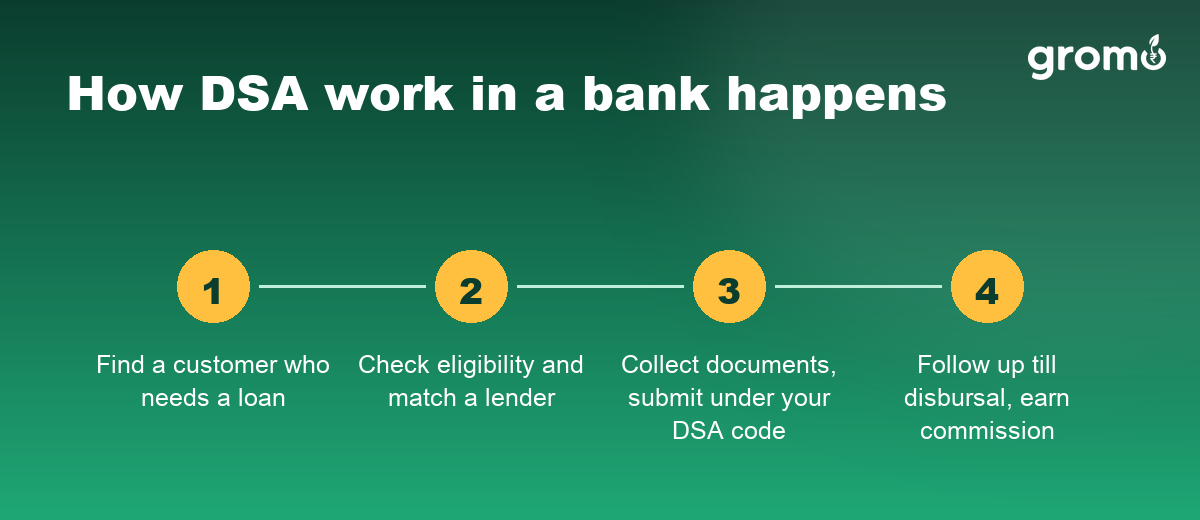
DSA work in a bank follows a simple cycle. Here is the process from first contact to commission payout:
- Find the customer. The DSA finds people who need a loan through their personal network, local market contacts, social media, or referrals from past customers.
- Understand the need and check eligibility. The DSA asks about the loan amount, purpose, income, and existing loans, then matches the customer with a lender whose criteria they can meet.
- Collect and check documents. The DSA helps the customer put together KYC documents, income proof, and bank statements, and checks them for clarity and completeness before submission.
- Submit the application. The application goes to the bank or NBFC under the DSA's code, which is how the lender knows who sourced the customer.
- Follow up till disbursal. The DSA tracks the application, passes on any queries from the bank, and stays with the customer until the loan is approved and the money is disbursed. The commission is calculated on the disbursed amount and paid to the DSA.
Roles and Responsibilities of a DSA
| For the customer | For the bank or NBFC |
|---|---|
| Explain loan products, rates, and fees in simple words | Bring in genuine, eligible loan customers |
| Compare options and suggest the best fit | Do the first level of eligibility screening |
| Help collect and organise documents | Submit clean, complete application files |
| Give honest information, never false promises | Follow RBI and lender rules on fair selling |
| Follow up and share application status | Protect customer data and take proper consent |
Types of DSA
There are three common types of DSA in India:
- Bank DSA. Registered with one specific bank and sells only that bank's products. Deep product knowledge, but limited options for the customer.
- NBFC DSA. Registered with an NBFC, often working through fully digital processes for personal loans and small business loans.
- Multi-lender DSA. Works with many banks and NBFCs at once, usually through a distribution platform. This type can compare offers across lenders and match more customer profiles, which typically means more conversions.
Eligibility for Bank DSA
The eligibility for bank DSA registration is simpler than most people expect. You do not need a finance degree or banking experience. Typical requirements are:
- Age: 18 years or above (a few banks prefer 21 or above).
- Nationality: Indian citizen or resident.
- KYC: Valid PAN card and Aadhaar card.
- Credit history: A reasonable CIBIL score is preferred, since lenders like partners who manage their own credit well. It is checked, but a specific score is usually not mandatory. If yours is low, work to improve your credit score before applying.
- Education: No fixed qualification. Basic understanding of financial products matters more than degrees.
- For firms and companies: Business registration proof and GST registration where applicable.
Both individuals (students above 18, salaried people, homemakers, retired professionals) and business entities (shops, consultancies, firms) can become DSAs.
Documents Required to Become a DSA
Keep these ready before you apply:
- PAN card
- Aadhaar card or another address proof (passport, voter ID, utility bill)
- Passport-size photograph
- Bank account details for commission payouts (cancelled cheque or passbook)
- Income proof where asked: recent ITR, Form 16, or salary slips
- Bank statement of the last 3 to 6 months, if the lender asks
- GST certificate and business registration, only for business entities
How Much Does a DSA Earn?
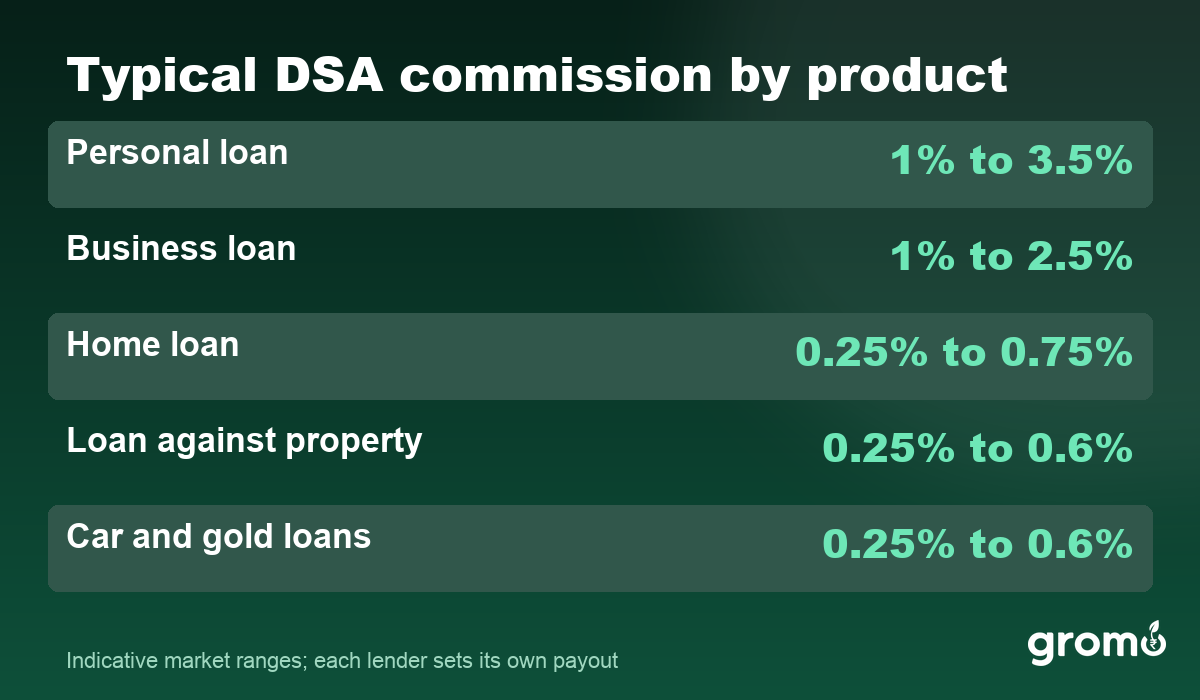
A DSA earns a commission calculated as a percentage of the disbursed loan amount. The rate depends on the lender and the product. Typical market ranges look like this:
| Product | Typical DSA commission |
|---|---|
| Personal loan | 1% to 3.5% of disbursed amount |
| Business loan | 1% to 2.5% of disbursed amount |
| Home loan | 0.25% to 0.75% of disbursed amount |
| Loan against property, car loan, gold loan | 0.25% to 0.6% of disbursed amount |
A simple example: if you help a customer get a Rs 4,00,000 personal loan at a 2 percent payout, you earn Rs 8,000 from that one file. Income is not fixed or guaranteed; it depends entirely on how many loans you source and their size.
For a lender-wise payout breakdown, see our detailed guide on DSA loan agent commission. Active DSAs with a steady pipeline commonly build a monthly income in the tens of thousands, while part-time DSAs earn in proportion to their effort.
How to Register as a DSA
The registration process is similar across banks, NBFCs, and platforms:
- Choose where to register: a single bank, an NBFC, or a multi-lender platform.
- Fill the DSA registration form online or at a branch with your basic details.
- Submit your KYC documents and photographs.
- Complete the verification step; some lenders do a short interview or a background and credit check.
- Sign the DSA agreement, which covers your commission structure, code of conduct, and data rules.
- Receive your DSA code and start sourcing customers.
One warning: genuine banks, NBFCs, and platforms do not charge money to make you a DSA. Anyone demanding a registration fee or a security deposit for a "DSA code" is almost certainly running a scam.
DSA vs Bank Employee vs Loan Broker
| Point | DSA | Bank employee | Loan broker |
|---|---|---|---|
| Relationship | Registered partner, not on payroll | On the bank's payroll | Independent middleman, may be unregistered |
| Income | Commission per disbursed loan | Fixed salary | Fees or commission, sometimes charged to the customer |
| Products | One or many lenders, depending on type | Only their bank's products | Varies, often unregulated |
| Cost to customer | Free; the lender pays the DSA | Free | May charge the borrower a fee |
| Working hours | Flexible, own schedule | Fixed office hours | Flexible |
Benefits and Challenges of DSA Work
Why people become DSAs: zero or near-zero investment, flexible hours that fit around a job or business, income that grows with effort instead of being capped, and free training and marketing support from many lenders and platforms. Repeat customers and referrals make the work compound over time.
What to watch out for: income is irregular in the first months until your network builds, you must keep up with each lender's changing policies, and you carry real responsibility for honest selling and customer data. Recommending a product only because it pays you a higher commission is the fastest way to destroy the trust the whole business runs on.
Becoming a Loan DSA With GroMo
If you want to start as a multi-lender DSA without visiting bank branches, GroMo is a simple route. The GroMo app lets you offer loans from 30+ RBI-regulated banks and NBFC lending partners in one place, along with credit cards and other financial products. DSA loan agent registration on GroMo is free and digital, eligibility checks happen in the app, the customer applies through your shared link, and your payouts (typically 0.5% to 4% of the disbursed amount depending on the lender) are tracked transparently.
Free GroMo Academy lessons cover exactly the selling skills this article describes. GroMo is a distribution platform, not a lender.
FAQ: DSA Full Form in Banking
What is the DSA full form in banking?
DSA stands for Direct Selling Agent. In banking, a DSA is a person or business officially appointed by a bank or NBFC to find loan and credit card customers, help them with documents, and earn a commission on every product that gets approved and disbursed. A DSA is a partner of the bank, not its employee.
What is the DSA finance full form and the DSA agent full form?
Both are the same: Direct Selling Agent. Some institutions use the variant Direct Sales Associate or Direct Sales Agent, and in everyday use people say loan agent or loan DSA. Whether the appointing institution is a bank, an NBFC, or a fintech platform, the role and the full form do not change.
What is the eligibility for bank DSA registration?
You must be an Indian resident aged 18 or above (a few banks prefer 21 plus) with a valid PAN and Aadhaar. A reasonable credit history is preferred, and business entities need registration and GST proof.
No finance degree or banking experience is required, which is why students above 18, salaried people, homemakers, and shop owners all become DSAs.
How does DSA work in a bank?
The DSA finds a customer who needs a loan, checks their basic eligibility, helps collect documents, and submits the application to the bank under their unique DSA code. The bank then does its own credit assessment and decides.
If the loan is approved and disbursed, the DSA earns a commission calculated as a percentage of the disbursed amount.
How much commission does a DSA earn?
Typical market ranges are 1 to 3.5 percent on personal loans, 1 to 2.5 percent on business loans, and 0.25 to 0.75 percent on home loans, with each lender setting its own payout. On a Rs 4,00,000 personal loan at 2 percent, that is Rs 8,000 from one file.
Earnings depend fully on how many loans you source, so income is performance-based, not fixed.
Do I need to pay any fee to become a DSA?
No. Genuine banks, NBFCs, and distribution platforms do not charge a registration fee, security deposit, or any other payment for a DSA code. Anyone demanding money to make you a DSA is almost certainly running a scam and should be avoided.
Disclaimer
This article is general information, not financial, legal, or career advice. Commission ranges shown are indicative market figures at the time of writing; actual payouts are set by each bank, NBFC, or platform, vary by product and profile, and change over time.
No income is guaranteed, and loan approval is always the lender's decision. GroMo is a financial product distribution platform, not a bank or lender, and is available only to users aged 18 and above.
Bank, NBFC, and brand names are trademarks of their respective owners. Never pay any fee to become a DSA or to get a loan.


