
Airtel Payments Bank Retailer: How to Join and Earn More
How to become an Airtel Payments Bank retailer, what you can offer, how commission works, and which other accounts, cards and loans your shop can add.

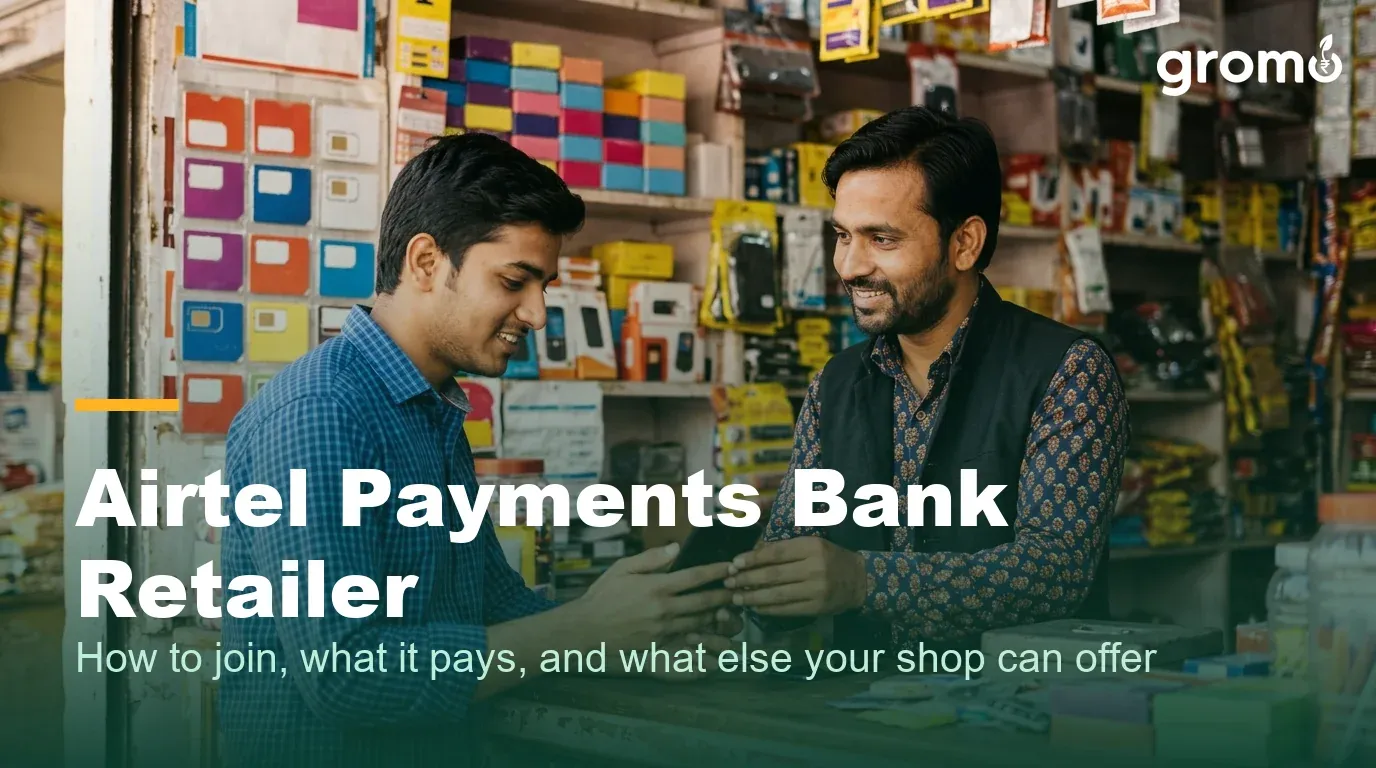
An Airtel Payments Bank retailer is a shop owner who offers Airtel Payments Bank services at the counter: opening savings accounts, cash deposits, Aadhaar-based withdrawals (AEPS), money transfers, recharges and bill payments. To join, Airtel Payments Bank asks for a physical shop, an age of at least 18 and basic financial knowledge, then verifies your shop address. The bank says it has 5 lakh active banking retailers across 18,000+ pin codes (Airtel Payments Bank retailer page, retrieved 2026-11-25). It does not publish its retailer commission rates.
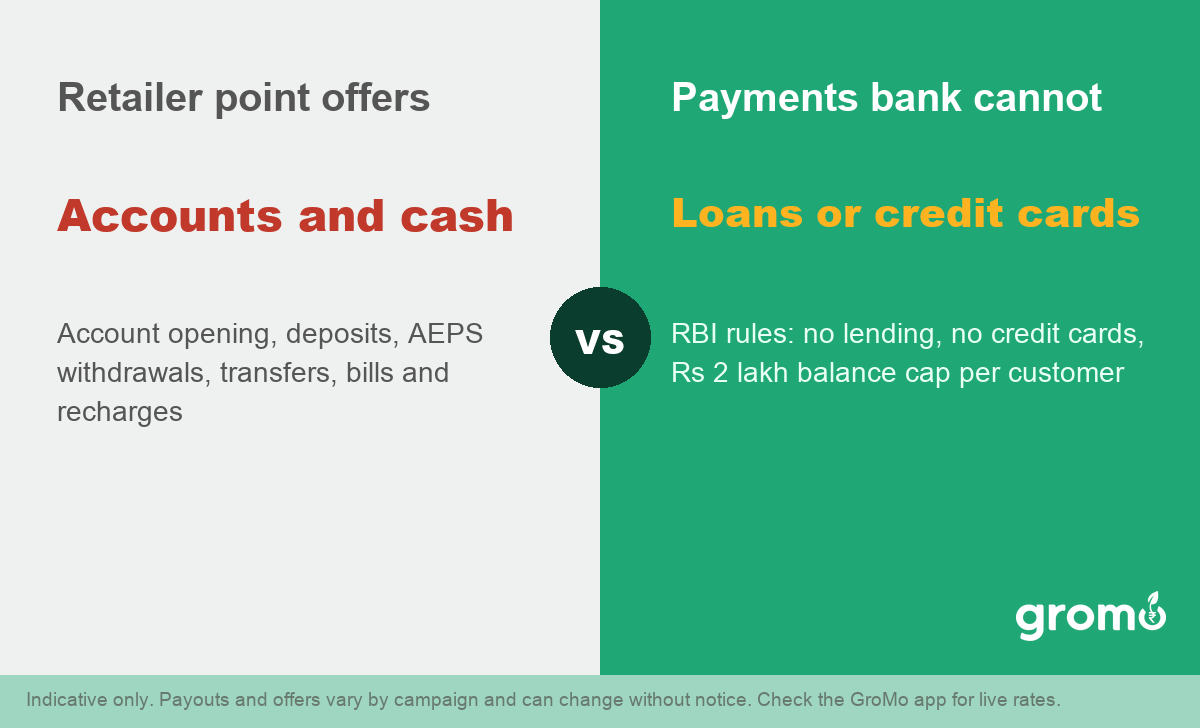
A payments bank cannot lend money or issue credit cards (RBI licensing guidelines, 27 November 2014), so many customers who walk into an Airtel point still need a loan, a card or a demat account somewhere else. GroMo is a free app where partners earn commission by referring customers to banks, NBFCs and brokers for these products. The sections below cover how the Airtel retailer programme works, what it pays, what it cannot offer, and how a shop can add more products from one phone.
What Does an Airtel Payments Bank Retailer Do?
An Airtel Payments Bank retailer runs a small banking point inside an existing shop. On its official retailer page, Airtel Payments Bank lists the services a retailer point can offer customers (Airtel Payments Bank retailer page, retrieved 2026-11-25):
| Service | What the customer gets at your counter |
|---|---|
| Account opening | A new Airtel Payments Bank savings or current account, opened in minutes |
| Deposit, withdrawal and transfer | Cash deposits, AEPS cash withdrawals and money transfers |
| AEPS | Basic banking from any bank account using Aadhaar and biometric authentication |
| Recharge and bill payments | Mobile and DTH recharges, electricity and water bills |
| Help with loans | Connection to loan providers (the payments bank itself cannot lend) |
| Cash drop point | A place where businesses deposit cash they collected from customers |
| Direct Benefit Transfer | Enrolment so government subsidies reach the customer's bank account |
| Micro-ATM | Cash withdrawals from any bank account using a debit card |
For the shop, an Airtel Payments Bank retailer point is a way to earn from customers who already walk in, and to bring in new ones who need cash or a bank account nearby. The work is closest to that of a bank mitra or CSP: you are the bank's last-mile counter, but you are not a bank employee.
How Do You Become an Airtel Payments Bank Retailer?
You apply through the "Become a Retailer" form on the Airtel Payments Bank website, and the bank's sales team contacts you. The official page lists these requirements (Airtel Payments Bank retailer page, retrieved 2026-11-25):
- A physical shop. You do not need to own it; an officially leased or rented space is accepted.
- Age. At least 18. The upper limit is shown as 70 in one place on the page and 75 in its FAQ, so confirm it with the sales team.
- Basic financial knowledge. Enough to explain an account and handle cash safely.
- Shop address proof. You are onboarded after the bank verifies it.
The form asks for your name, mobile number, shop name and address, the current nature of your business, and whether you have a biometric device. Airtel Payments Bank says set-up costs nothing, but AEPS and micro-ATM services need a biometric device or card reader, so ask what equipment your point will need and who pays for it.
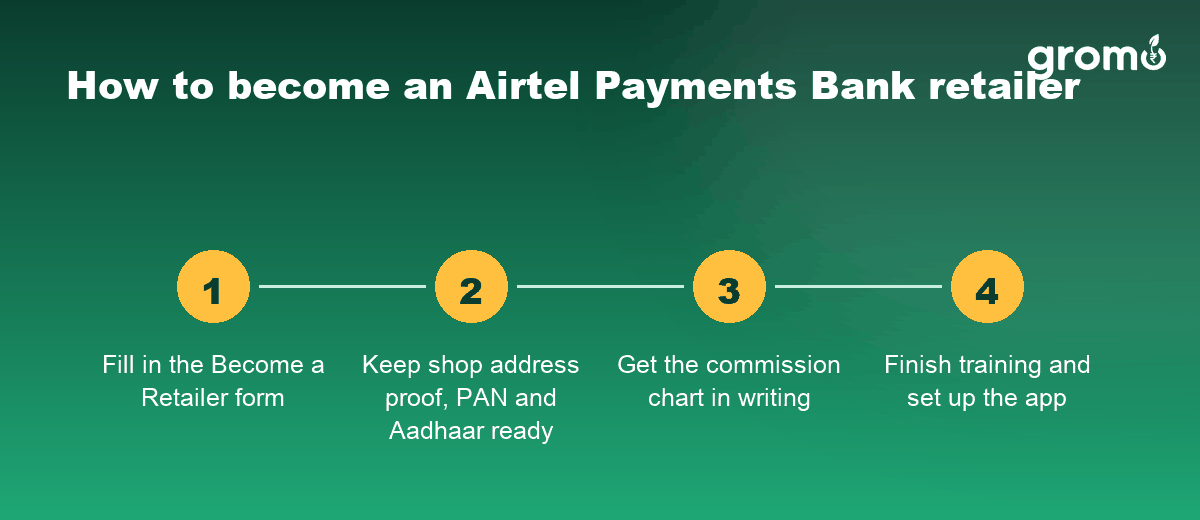
To start: 1. Fill in the "Become a Retailer" form on the Airtel Payments Bank website. 2. Keep your shop address proof, PAN, Aadhaar and bank account details ready for the call. 3. Ask for the written commission chart and the agreement before you sign. 4. Complete the training and set up the retailer app on your phone.
How Much Commission Does an Airtel Payments Bank Retailer Earn?
Airtel Payments Bank does not publish a retailer commission chart on its website. The official retailer page promises "Best Commissions & Timely Payouts with Zero Set-Up Cost" and says you earn with every service, but it gives no rupee figures (Airtel Payments Bank retailer page, retrieved 2026-11-25). Commission charts shared on social media or other websites are not official and may be old.
In practice, a retailer's income depends on three things:
- The mix of services. Account opening, cash transactions, AEPS withdrawals and bill payments usually carry different commissions.
- Footfall. Banking points earn on volume, so a busy market shop earns more than a quiet lane.
- The written agreement. Your agreement with the bank, or with its distributor, is the only reliable source for your rates.
Before you sign, ask the sales team for the current chart in writing, how often payouts are made, and whether any targets apply. If someone asks you to pay a fee to "activate" a retailer ID, stop and call Airtel Payments Bank on its toll-free number, 1800-23400, listed on its website.
What Can a Payments Bank Not Offer Your Customers?
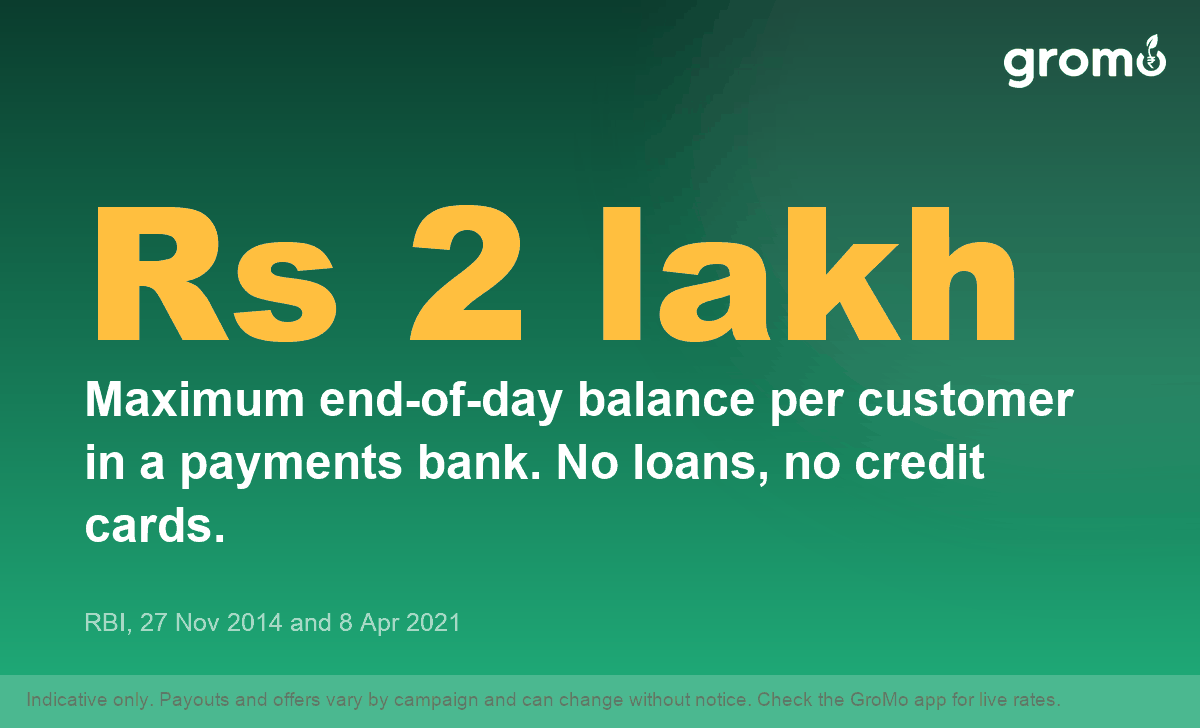
A payments bank is a restricted type of bank, so some of your customers' needs will always sit outside it. The RBI's licensing guidelines for payments banks, dated 27 November 2014, state: "The payments bank cannot undertake lending activities." The same guidelines say: "Payments banks, however, cannot issue credit cards."
Three RBI rules shape what an Airtel Payments Bank customer can and cannot do:
| RBI rule | What it means at your counter |
|---|---|
| No lending | A payments bank cannot give loans from its own books; it can only connect customers to other lenders |
| No credit cards | Customers who want a credit card must apply to another bank |
| Balance cap of ₹2 lakh | An individual customer can keep an end-of-day balance of at most ₹2 lakh, raised from ₹1 lakh by the RBI notification of 8 April 2021 |
Eligible deposits in a payments bank are covered by DICGC, the same deposit cover that applies to other banks (RBI licensing guidelines, 27 November 2014). The limits are the gap a shop can fill: the same customer who opens a payments bank account may want a credit card, a personal loan, a demat account or a full-service zero balance savings account with another bank.
How Is an Airtel Retailer Different from a GroMo Partner?
An Airtel Payments Bank retailer signs with one bank and runs a cash-handling banking point. A GroMo partner refers customers to many banks, NBFCs and brokers through one app, and does not handle customer cash at all. The table compares the two routes as they work in November 2026.
| Point | Airtel Payments Bank retailer | GroMo partner |
|---|---|---|
| Who you sign with | Airtel Payments Bank (directly or through its distributor) | GroMo, a distribution platform; each product comes from its own regulated provider |
| What you need | A physical shop, address proof, age 18+, often a biometric device | An Android phone, PAN, a bank account in your name, age 18+ |
| Products | Airtel Payments Bank accounts, cash services, AEPS, bills, recharges | Savings accounts, demat accounts, credit cards, personal and business loans, credit lines from many brands |
| Cash handling | Yes: deposits, withdrawals and transfers pass through your counter | No: customers apply on their own phone with your link |
| Joining cost | Airtel says zero set-up cost; equipment terms vary | Free to join |
| Commission chart | Shared privately by the bank | Shown in the app for every product before you share a link |
| Where you can work | From your shop | From anywhere, including your shop |
The two routes do not cancel each other out. A retailer point brings footfall through cash services; product referrals add income from the same customers. If you are already an Airtel retailer, read your agreement for any rule on offering other banks' products before you add a second channel. Our comparison of Jan Seva Kendra and GroMo commission shows how other counter businesses think about the same choice.
Which Other Products Can a Shop Add Through GroMo?
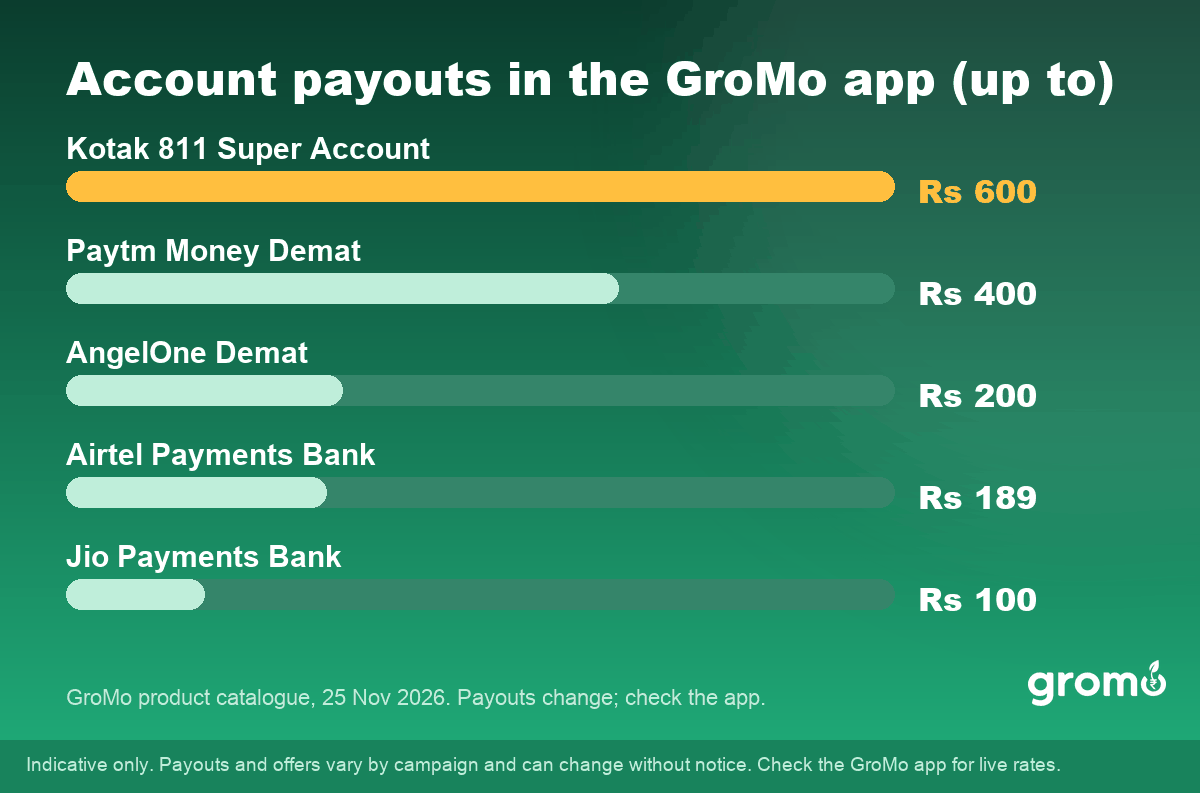
Through the GroMo app, a shop owner can offer an Airtel Payments Bank account and several other zero-cost products to the same walk-in customers. Customers apply on their own phones, and the provider alone approves each account. On 25 November 2026, the GroMo product catalogue listed these payouts:
| Product in the GroMo app | Type | Payout per successful account (up to) | When it counts |
|---|---|---|---|
| Kotak 811 Super Account | Savings account | ₹600 | Aadhaar-linked mobile and a serviceable pin code |
| Paytm Money Demat Account | Demat account | ₹400 | Customer funds the account and makes a first trade within 30 days |
| AngelOne Demat Account | Demat account | ₹200 | New Angel One customer who trades within 7 days of opening |
| Airtel Payments Bank | Savings account | ₹189 | As shown in the app for the product |
| Jio Payments Bank | Savings account | ₹100 | As shown in the app for the product |
Source: GroMo product catalogue, retrieved 2026-11-25.
Please note: payouts change often and differ by product and city. Most products pay less than the top figure shown here. Commission is paid only when the provider confirms the account under its own conditions, and the provider alone decides approval. Always check the live payout and conditions in the app before you share a link.
The same app also lists credit cards, personal loans and credit lines, which payments bank customers cannot get from their payments bank. Accounts are usually the easiest place to start, because the customer pays nothing and needs no credit check. The full process for account referrals is in saving account refer and earn.
How Much Could a Shop Earn by Adding These Products?
Here is a simple monthly example for a mobile recharge shop that already sees steady footfall. The figures use base payouts from the GroMo product catalogue (retrieved 2026-11-25) and assume every account below is completed under the provider's conditions.
| Product | Successful accounts in the month | Payout each (up to) |
|---|---|---|
| Airtel Payments Bank | 5 | ₹189 |
| Kotak 811 Super Account | 3 | ₹600 |
| AngelOne Demat Account | 2 | ₹200 |
Each payout above is the base figure for one completed account, as the app listed it on 25 November 2026, before any campaign bonus or change.
Together, the 10 completed accounts would add ₹3,145 in the month (base payouts from the GroMo product catalogue, retrieved 2026-11-25). That figure is an illustration only. It is not typical and not guaranteed. Many customers who start an application never finish it, some will not meet a provider's conditions, and payouts change. A shop that explains each product clearly and helps customers through the steps on their own phones will complete more accounts than one that only shares links.
Customers who want to trade also need the steps explained honestly. A demat payout counts only after the customer's own first trade, so pick customers who already want to invest, as covered in our guide to demat account refer and earn.
What Mistakes Should a Retailer Avoid When Adding More Products?
A shop that adds product referrals to a banking point usually makes the same few mistakes in the first month. Each one costs either a payout or a customer's trust.
| Mistake | What to do instead |
|---|---|
| Opening an account with your own mobile number | Use the customer's own Aadhaar-linked number; accounts opened on your number usually do not count |
| Pushing a demat account on someone who will not trade | Offer it only to customers who want to invest; the payout needs their first trade |
| Keeping photos of customers' Aadhaar or PAN | Never store customer documents; the customer enters details on their own phone |
| Promising a loan or card approval | Say clearly that the bank or NBFC decides; approval is never promised |
| Quoting old commission figures | Check the live payout in the app before you explain it |
Avoiding these five mistakes keeps your completion rate high, which matters more to your monthly income than the headline payout on any single product.
Grow Your Counter with More Products
An Airtel Payments Bank retailer point is a solid base: it brings people into your shop for cash and bills. Adding savings accounts, demat accounts, cards and loans from other providers lets you earn from needs a payments bank cannot meet. GroMo is free to join, shows the payout for every product before you share a link, and works from any Android phone, which is why shopkeepers, bank mitras and recharge shops already use it, as our guide on who can earn money with GroMo explains.
FAQ: Airtel Payments Bank Retailer
Is there a fee to become an Airtel Payments Bank retailer?
Airtel Payments Bank says its retailer programme has zero set-up cost. Equipment such as a biometric device may be needed for AEPS, so ask the sales team in writing what you must buy. Never pay anyone a fee to "activate" a retailer ID.
What documents do I need to become an Airtel Payments Bank retailer?
Airtel Payments Bank asks for a physical shop and verifies your shop address proof before onboarding. Keep your PAN, Aadhaar and bank account details ready as well, since the sales team will complete your KYC.
Can I become an Airtel Payments Bank retailer without a shop?
No. The official retailer page says you must have a physical shop set-up, though a rented or officially leased shop is accepted. Without a shop, a GroMo partner account lets you refer customers for accounts, cards and loans from your phone.
Does Airtel Payments Bank publish its retailer commission chart?
No. The official website does not show rupee commission figures. Ask the sales team for the current chart in writing before you sign, and treat charts on social media as unofficial.
Can an Airtel Payments Bank customer get a loan or credit card from the payments bank?
No. RBI rules do not allow payments banks to lend or issue credit cards. A retailer point can only connect customers to other lenders, and a customer who wants a card or loan must apply to a bank or NBFC.
Can I open Airtel Payments Bank accounts through GroMo?
Yes. Airtel Payments Bank is listed in the GroMo app, with a payout of up to ₹189 per successful account (GroMo product catalogue, retrieved 2026-11-25). If you are already an Airtel retailer, read your agreement before you open the same bank's accounts through another channel.
Disclosures
GroMo (Vitrak Technologies Pvt Ltd) is a distribution platform. GroMo is not a bank, NBFC or investment adviser and is not part of Airtel Payments Bank. All products are offered by their respective RBI or SEBI-regulated providers, who alone decide approval, interest rates and terms. Airtel Payments Bank is a trademark of its owner and is named here only for information.
Loans and credit cards are issued by RBI-regulated banks and NBFCs. Approval is at the lender's sole discretion and is never promised. GroMo does not lend money.
Demat accounts are offered by SEBI-registered brokers. Investments in securities are subject to market risks; read all related documents carefully before investing.
Partner earnings depend on effort, product mix and customer eligibility. Any figures shown are illustrative examples. They are not typical and are not guaranteed. GroMo does not guarantee any level of income.
Disclaimer
The information on this page is for general information only and is not financial, legal or investment advice. Details of the Airtel Payments Bank retailer programme come from its official website on 25 November 2026 and may change; confirm them with Airtel Payments Bank. RBI rules summarised here may change; read the current rules on the RBI website. Payouts in the GroMo app change often; check the live figure in the app. You must be 18 or older to join GroMo.


