
DSA Code: What It Is and How to Get One (DSA Code Kya Hota Hai)
DSA code explained: what a bank DSA code is, who issues it, documents and steps to get one, DSA code vs connector code, and how to earn on loans without one.

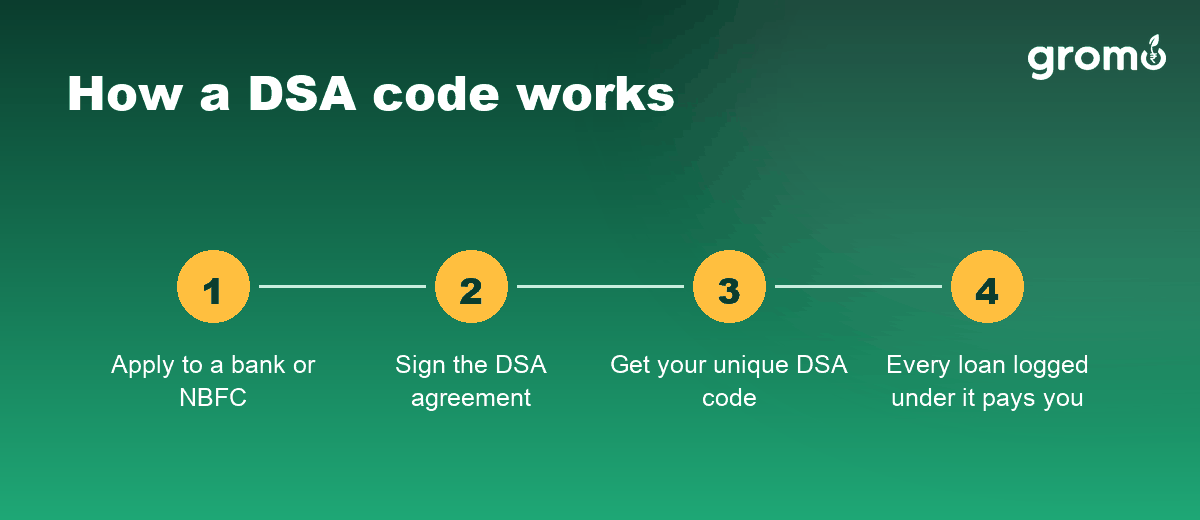
A DSA code is the unique ID a bank or NBFC gives a Direct Selling Agent after signing an empanelment agreement with them. Every loan or card application you send carries this code, so the lender knows the customer came from you and pays your commission to it. You get one by applying to a lender (or a master DSA), submitting KYC and business documents, and signing the agreement. New to the term? Start with our guide on the DSA full form in banking.
Below are the 7 steps to get a DSA code, what each step needs, and the difference between a direct bank code, a sub-DSA code and a connector code. Where a route has trade-offs, like slow approval or shared commission, we say so plainly.
| Question | Short answer |
|---|---|
| What is it? | A unique agent ID a lender gives its Direct Selling Agent |
| Who issues it? | Each bank or NBFC, after empanelment |
| One code for all banks? | No, each lender gives its own code |
| Documents | PAN, Aadhaar, bank statement, address proof, business papers |
| Fee to the bank? | Usually none; check the agreement for any deposit |
| Agreement term | Often 1 year, renewable at the lender's choice |
| Faster option | Sub-DSA or connector code under a master DSA, or a partner app |
The empanelment details above come from published bank DSA forms, such as Indian Bank's DSA application and agreement, which ask for bank statements, education proof and firm papers and set a one-year initial term (Indian Bank DSA documents, retrieved 2026-10-28).
How this guide is ordered: the steps follow the real sequence, from choosing your route to receiving your first payout under the code.
1. Choose Your Route: Bank Code, Sub-DSA Code or Connector
Bank or NBFC code: direct tie-up, full commission | Sub-DSA code: under a master DSA, shared commission | Connector: sends leads, smallest share
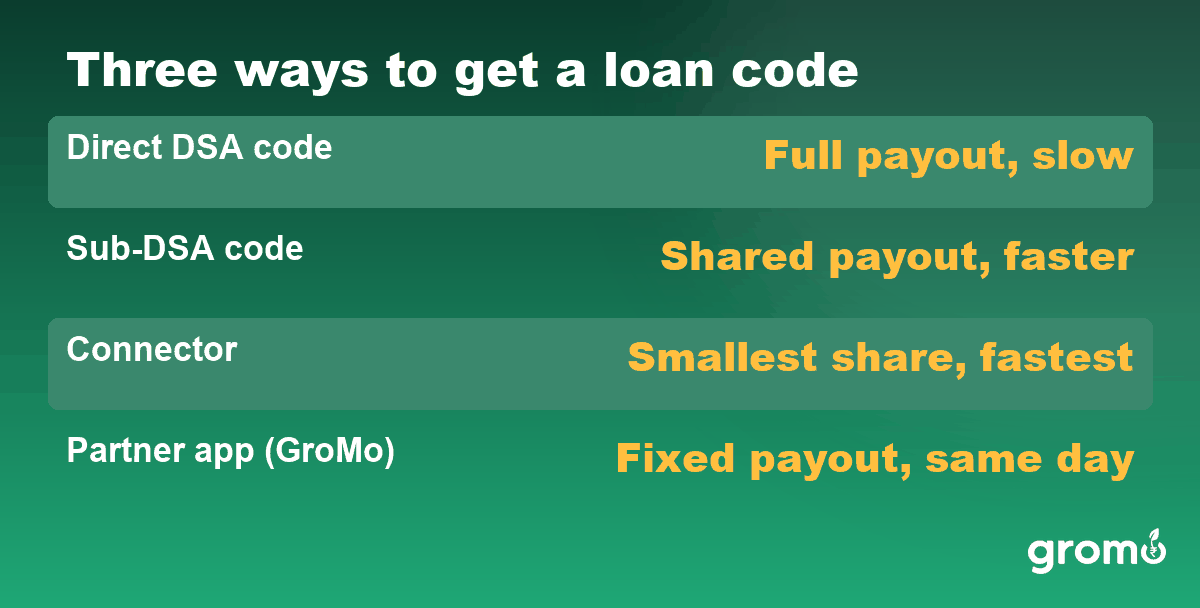
There are three ways to sell loans under a code. A direct DSA code means your own agreement with the lender. A sub-DSA code means you work under a bigger DSA, called a master DSA or aggregator, which already holds codes with many lenders. A connector only passes leads to a DSA and gets a share of that DSA's payout.
| Route | Who gives the code | Commission | Speed to start |
|---|---|---|---|
| Direct DSA code | The bank or NBFC | Full DSA commission | Slow, weeks to months |
| Sub-DSA code | A master DSA or aggregator | Share of the master DSA's commission | Faster |
| Connector | A DSA | Smaller share | Fastest |
| Partner app (like GroMo) | The app, which holds lender tie-ups | Fixed payout per approved case | Same day |
Pick a direct code only if you already bring steady loan volume. Most new agents start with a sub-DSA route or a partner app and apply for direct codes later.
2. Check Your Eligibility
Age: 18+ | KYC: valid PAN and Aadhaar | Preferred: some sales or finance experience, a clean credit record
Lenders want an adult with valid KYC, a bank account and, ideally, a track record in sales or finance. Bajaj Finserv, for example, lists age 18 or above with valid KYC for its DSA programme (Bajaj Finserv DSA page, retrieved 2026-10-28). Banks often prefer applicants with an office or shop and a clean credit history.
How to check you are ready:
- Make sure your PAN and Aadhaar details match.
- Check your own CIBIL score; a poor record can lead to rejection.
- Keep 6 months of bank statements ready.
- Decide whether you will apply as an individual or a firm.
3. Prepare Your Documents
Individual: PAN, Aadhaar, photo, bank statement, address proof | Firm: plus GST, registration, partner or director details
The document list varies by lender, but the core set is the same. Indian Bank's DSA application asks for 6 months of bank statements, education proof and firm registration papers (Indian Bank DSA application, 2023). Vendor forms used by lenders for DSA and connector codes also ask for PAN, GSTIN, a cancelled cheque and partner or director details.
| Document | Individual | Firm or company |
|---|---|---|
| PAN and Aadhaar | Yes | Yes, for each partner or director |
| Photo | Yes | Yes |
| Bank statement (6 months) | Yes | Yes |
| Address proof | Yes | Office address proof |
| Cancelled cheque | Yes | Yes |
| GST registration | If registered | Usually yes |
| Firm registration papers | No | Yes |
| Education proof | Some lenders | Some lenders |
4. Apply for Empanelment
Online: some banks run DSA application portals | Offline: branch or regional office | Via aggregator: master DSA signs you up
Some banks accept DSA applications online. Canara Bank, for example, runs an online DSA application portal. Others take applications at a branch or regional office. If you go through a master DSA, they handle the paperwork with the lender.
How to apply:
- List the lenders whose products suit your customers.
- Check each lender's website or nearest branch for its DSA process.
- Submit the form with your documents.
- Keep copies and an acknowledgement for every application.
Our guide on DSA loan agent registration covers the full registration process in detail.
5. Sign the Agreement and Receive Your Code
Agreement: contract for service, not a job | Term: often 1 year, renewable | Code: issued after approval
Once approved, you sign a DSA agreement and the lender issues your code. Indian Bank's sample agreement describes the relationship as a contract for service, not employment, with a one-year initial term that the bank can extend or end (Indian Bank DSA agreement, retrieved 2026-10-28). Read the commission table, payment timeline and termination clauses before signing.
Before you sign, check:
- The commission rate for each product.
- When and how payouts are made.
- Any target, deposit or penalty clause.
- The lender's DSA code of conduct.
6. Follow the Lender's DSA Code of Conduct
Rules come from: each lender's DSA code of conduct | Breach can mean: tie-up ended, blacklisting | RBI view: lenders stay responsible for their agents
Every bank publishes a DSA code of conduct that its agents must follow. HDFC Bank's credit card DSA code, for example, says a breach can end the tie-up and lead to blacklisting across the industry (HDFC Bank DSA code of conduct, retrieved 2026-10-28). RBI's outsourcing rules keep the lender responsible for what its agents do.
The basics in most codes:
- Introduce yourself with your name, the lender's name and your DSA identity.
- Call customers only at reasonable hours and respect a "no".
- Never promise approval or a specific interest rate.
- Never collect cash, cheques or fees in your own name.
- Keep customer documents private.
7. Send Applications and Track Payouts
Payout trigger: loan disbursed or card approved | Paid to: your registered bank account | Track: lender MIS or agent portal
Every application you log carries your DSA code. When the loan is disbursed, the lender records the case against your code and pays your commission as per the agreement. Keep your own record of every case so you can match it with the lender's statement.
Commission rates differ by lender and product. Our guide on DSA loan agent commission explains typical payout structures.
What Is a DSA Code? Meaning, Types and Rules
A DSA code is the reference number that links a loan or card application to the agent who sourced it. Without it, the lender cannot credit the case to you.
DSA code kya hota hai?
DSA code ek unique ID hai jo bank ya NBFC apne Direct Selling Agent ko deta hai. Har loan application par yeh code lagta hai, jisse bank ko pata chalta hai ki customer kis agent se aaya, aur commission usi agent ko milti hai.
DSA code vs connector code
| Point | DSA code | Connector code |
|---|---|---|
| Given by | The bank or NBFC | A DSA or master DSA |
| Agreement with | The lender | The DSA |
| Commission | Full DSA payout | Share of the DSA's payout |
| Paperwork | More | Less |
| Best for | Agents with steady volume | Beginners and part-timers |
Master DSA and sub-DSA
A master DSA, also called an aggregator, holds codes with many lenders and gives free or low-cost sub-DSA codes to smaller agents. You get access to many lenders at once but share part of the commission with the master DSA.
Do you need a DSA code to earn from loans?
No. On a partner app like GroMo, the app holds the lender tie-ups, so you can refer customers for personal loans, credit cards and accounts without getting a separate code from each bank. On GroMo, personal loans pay ₹100 to ₹500 per disbursed loan, depending on the lender (GroMo catalogue, retrieved 2026-10-28). Read how loan partner apps compare.
Can a DSA charge the customer a fee?
A genuine DSA is paid by the lender, not the borrower. Under the RBI (Digital Lending) Directions, 2025, any fee payable to a lending service provider must be paid by the lender and cannot be charged to the borrower (RBI Digital Lending Directions 2025, summarised by law firms, retrieved 2026-10-28). If someone asks a customer for an "approval fee" before a loan, treat it as a red flag.
Important Safety Tips
- Never pay a personal account for a "DSA code": real empanelment fees, if any, go to the lender or an official aggregator, against a receipt.
- Read the agreement: check commission, payment dates, targets and exit terms before you sign.
- Never collect money from customers: your income comes from the lender.
- Do not share codes: letting others log cases under your code can end your tie-up.
- Protect documents: store customer KYC securely and delete what you no longer need.
Which DSA Route Should You Pick?
- Already bring 10+ loan cases a month? Apply for direct DSA codes with 2 or 3 lenders.
- Just starting out? Begin with a sub-DSA code or a partner app and build volume first.
- Want cards, loans and accounts in one place? A partner app with many lenders saves you separate tie-ups.
- Part-time with a few leads? A connector arrangement or a partner app suits you best.
A DSA code is your identity with a lender, and getting one directly takes paperwork and patience. If you are new, start where approval is fast, learn which products your customers need, and apply for direct codes once your volume justifies it.
GroMo is a free app where partners help customers apply for loans, credit cards and bank accounts from partner lenders, and earn a commission on approval, with no separate DSA code needed.

FAQ: DSA Code
What is a DSA code in banking?
A DSA code is the unique ID a bank or NBFC gives its Direct Selling Agent. It links every application the agent sends to that agent, so commission is paid correctly.
How can I get a DSA code?
Apply to a bank or NBFC for DSA empanelment, submit KYC and business documents, sign the agreement and receive your code. A faster route is a sub-DSA code under a master DSA.
Is there one DSA code for all banks?
No. Each bank or NBFC issues its own code. Agents who want many lenders either sign up with each one or work under a master DSA or partner app.
Is a DSA code free?
Most lenders do not charge for empanelment, but some agreements include deposits or conditions. Never pay anyone a fee to a personal account for a code.
What is the difference between a DSA and a connector?
A DSA has a direct agreement and code with the lender. A connector passes leads to a DSA and gets a share of that DSA's commission.
Do I need a licence from RBI to become a DSA?
RBI does not issue licences to DSAs. You need an agreement with the lender and must follow its DSA code of conduct.
Can I earn on loans without a DSA code?
Yes. Partner apps like GroMo hold lender tie-ups, so you can refer customers and earn per approved case. See how the GroMo app works.
GroMo (Vitrak Technologies Pvt Ltd) is a distribution platform. GroMo is not a bank, NBFC, insurer or investment adviser. All products are offered by their respective RBI, IRDAI or SEBI-regulated providers.
Partner earnings depend on effort, product mix and customer eligibility. Any figures shown are illustrative. They are not typical and are not promised.
Sources: Indian Bank DSA application (2023) and sample DSA agreement; Canara Bank online DSA application portal; HDFC Bank DSA code of conduct; Bajaj Finserv DSA page; RBI outsourcing guidance; RBI (Digital Lending) Directions, 2025, effective 8 May 2025; GroMo product catalogue, retrieved 2026-10-28.
Disclaimer
GroMo does not promise any level of income. DSA eligibility, documents, deposits and commission rates are set by each bank or NBFC and change over time; confirm the current process with the lender before applying or paying anything. GroMo commissions are set by partner lenders, vary by product and campaign, and are paid only on approved or disbursed cases; check the live commission in the GroMo app. GroMo is available only to users aged 18 and above. Everything above is general information, not financial or legal advice.


