What Is a Loan Agent? Working, Types, Eligibility & Documents
The job, the paperwork and the money, explained for someone starting from zero.

If you have been asking what is a loan agent, here is the short answer. A loan agent is a commission-paid intermediary who introduces borrowers to banks and NBFCs, helps them finish the application, and gets paid once the loan is disbursed. The lender still decides who gets the money. The agent finds the customer and carries the file. In India the role is usually called a DSA, or Direct Selling Agent, and it needs no office and no capital of your own.
Key Takeaways
- A loan agent sources borrowers for a bank or NBFC and earns a commission on disbursal, not on submission. An application that gets rejected pays nothing.
- There is no single national licence for loan agents the way IRDAI licenses insurance agents. You register with each lender, or with one platform that already holds those tie-ups.
- Money never passes through the agent. Under RBI's digital lending rules, disbursal and repayment move directly between the borrower's bank account and the lender, and any fee to the agent is paid by the lender, never collected from the borrower.
- GroMo's lending shelf today is Personal Loan, Business Loan and Credit Line (GroMo product catalogue, retrieved 2026-08-12). Home loans and loans against property are not on it.
- Paperwork to start on a platform is small: PAN, Aadhaar and a bank account. Direct bank empanelment asks for a lot more.
Table of contents
- What Is a Loan Agent in India?
- What Does a Loan Agent Do?
- How Does a Loan Agent Work?
- How Do Loan Agents Earn Money?
- Types of Loans You Can Sell as a Loan Agent
- Who Can Become a Loan Agent?
- Loan Agent Eligibility
- Documents Required to Become a Loan Agent
- Skills Every Successful Loan Agent Needs
- How GroMo Helps You Become a Loan Agent
- How to Start Selling Loans Through GroMo
- How to Get Your First Customer
- How Much Can a Loan Agent Earn?
- Common Mistakes New Loan Agents Should Avoid
What Is a Loan Agent in India?
A loan agent is a person or firm appointed by a bank or an NBFC to source loan customers on its behalf. The formal term in most lender contracts is Direct Selling Agent. You are not an employee. You are not a lender either, and that distinction matters more than anything else in this article.
Three things sit outside your control. Credit assessment, approval and the interest rate all belong to the lender. What belongs to you is the customer relationship, the quality of the file you submit, and how honestly you set expectations before anyone applies.
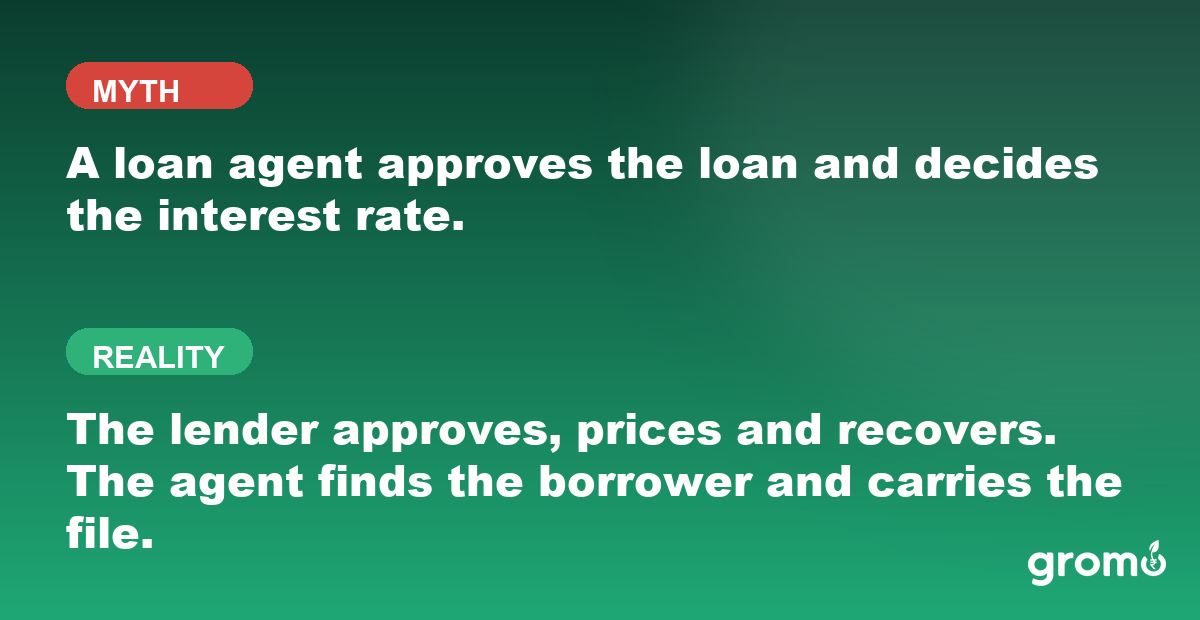
The commonest misunderstanding about the job, settled early.
Loan agents exist because acquiring borrowers is expensive. A bank branch reaches the people who walk into it. An agent reaches a shopkeeper who has never opened a banking app, a salaried employee facing a wedding bill, and a small manufacturer who needs working capital before a festival order. That reach is what the commission pays for.
Regulation treats you as an extension of the lender, not as a separate business. RBI's outsourcing and digital lending rules make the regulated entity answerable for how its agents behave, which is why lenders run their own onboarding and why a single mis-selling complaint can end an agent's code. Read the rules once as your job description rather than as legal background reading. Anyone comparing this with other commission work will find the same accountability pattern in becoming a GroMo Partner.
What Does a Loan Agent Do?
Day to day, the job is five things.
- Find people who actually need credit. You are not pitching everyone you know, and not all of them at once.
- Match the borrower to a lender. Salary account, credit score, income proof and city all change which lender is likely to say yes.
- Explain the real cost. Interest rate, processing fee, tenure, and what happens on a missed EMI.
- Collect and check documents. A clean file moves in days. A file with a blurred Aadhaar and a mismatched address bounces back twice.
- Follow the application through. Verification calls, a query from the credit team, a re-upload. Somebody has to chase these, and it is you.
What a loan agent does not do is approve loans, negotiate rates, collect EMIs or handle recovery. Those stay with the lender.
How Does a Loan Agent Work?
The flow is the same whether you work with one bank or through a platform.
You identify a borrower and check basic fit. You share the product and the borrower applies, usually on their own phone. The lender runs KYC, credit checks and underwriting. If the loan is approved and disbursed, your commission is recorded. Payout follows the lender's cycle, or the platform's.
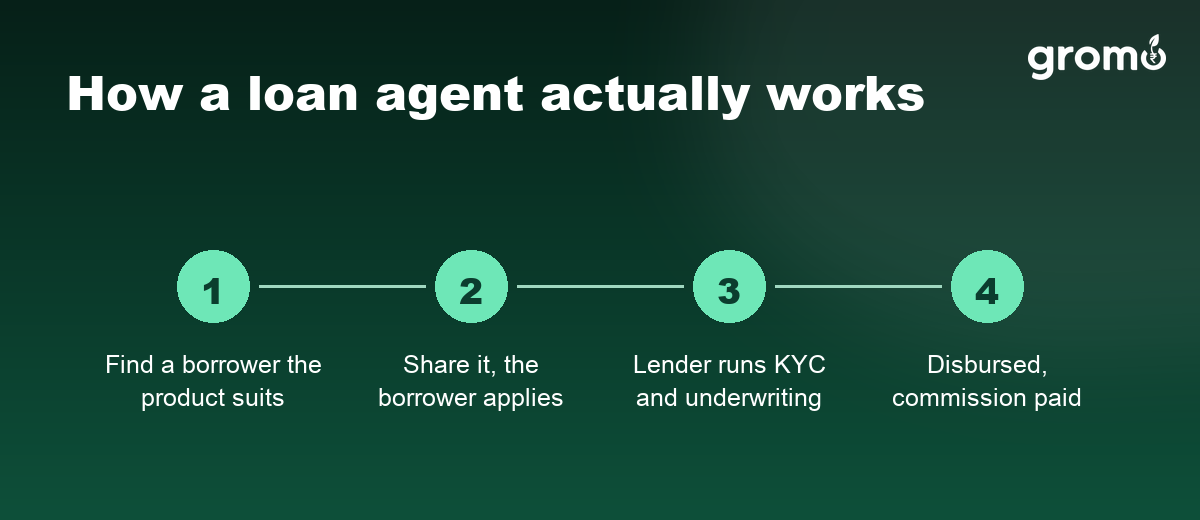
The agent owns the first two steps and the last one. The middle belongs to the lender.
One part of this is worth reading twice, because new agents get it wrong and it is the fastest way to lose the work permanently. Exactly Rs 0 of the loan should ever pass through your hands. Under RBI's rules for digital lending, loan money moves directly from the lender to the borrower's bank account and repayments move straight back, with no pass-through account in between. Fees owed to an agent or a service provider are paid by the regulated lender, not deducted from the borrower. A Key Fact Statement showing the all-in annual cost has to reach the borrower before the agreement is signed.
So if anyone ever asks you to collect a "file charge" or a "processing amount" in cash, that is not how the business works. Say no.
How Do Loan Agents Earn Money?
Loan agents earn a commission per disbursed case. There is no salary, no fixed retainer and no payment for effort that does not convert.
Two commission structures are common in India. Bank and NBFC DSA contracts usually pay a percentage of the disbursed amount, which is why loan agents chase ticket size. App-based distribution platforms usually pay a flat amount per approved case, which is easier to predict and much easier to explain to a new agent.
Here is the arithmetic, using round numbers rather than a quoted rate:
| Structure | Example basis | What one case pays |
|---|---|---|
| Percentage of disbursal | 1% on a Rs 5,00,000 business loan | Rs 5,000 |
| Percentage of disbursal | 1% on a Rs 80,000 personal loan | Rs 800 |
| Flat per approved case | Fixed payout, any ticket size | Same on every approval |
Please note. The percentages above are illustrative arithmetic, not rates offered by any lender or by GroMo (illustrative example, 12 August 2026). Live commissions sit on the product card inside the GroMo app and change with campaigns.
Run the same 1% through two ticket sizes and the difference is the whole reason business loans get chased: Rs 5,000 on a Rs 5,00,000 disbursal against Rs 800 on a Rs 80,000 one (illustrative arithmetic, retrieved 2026-08-12). Neither figure is a rate anybody has offered you. Both are just the multiplication.
Two details decide whether the income is real. First, payout is on disbursal, so a rejected or dropped application earns zero however much work went into it. Second, many lender contracts carry a clawback: if the borrower forecloses very early or defaults on the first few EMIs, the commission is reversed. Sell to people who can repay, and clawback stops being a word you think about.
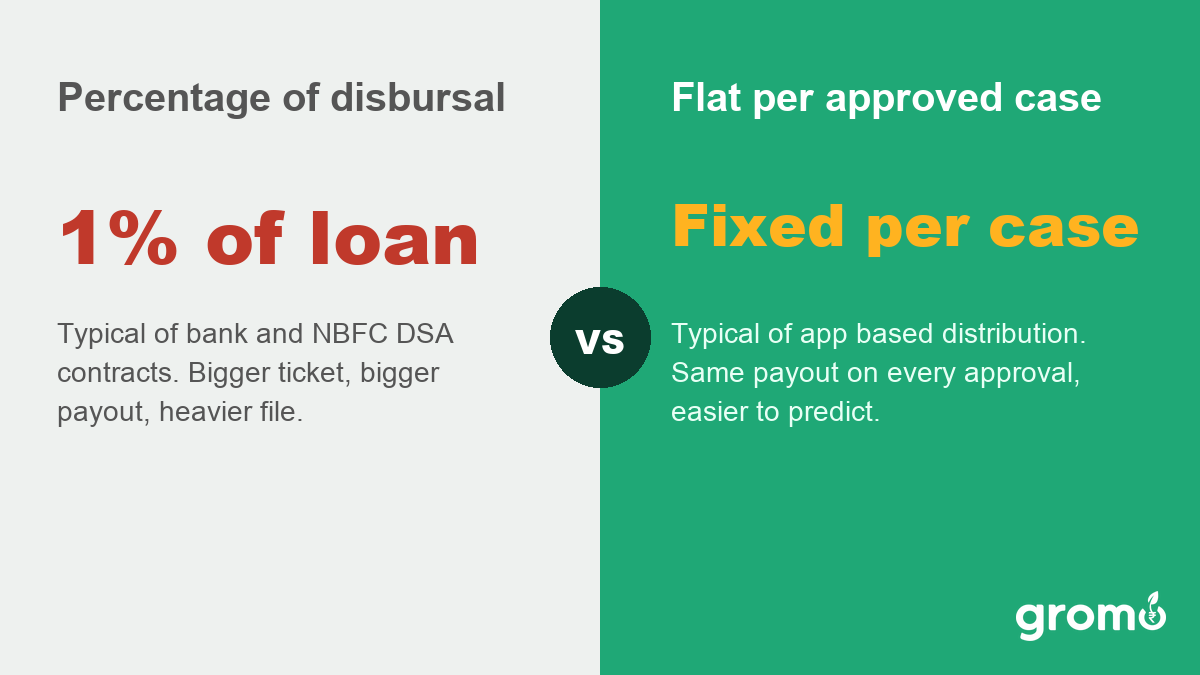
Percentage payouts reward ticket size. Flat payouts reward volume and predictability.
Types of Loans You Can Sell as a Loan Agent
Four lending products cover most of the retail market, and they are not equally easy to sell.
| Loan type | Secured? | Typical ticket size | Documentation load | On GroMo today |
|---|---|---|---|---|
| Personal Loan | No | Small | Light | Yes |
| Business Loan | No | Medium to large | Heavy | Yes |
| Credit Line | No | Small, drawn as needed | Light | Yes |
| Home Loan | Yes, the property | Large | Very heavy | No |
| Loan Against Property | Yes, an owned property | Large | Very heavy | No |
Personal Loan
Unsecured, no collateral, decided almost entirely on income and credit score. Ticket sizes are small, approvals are quick, and demand is constant because the reasons are ordinary. Medical bills. A wedding. A deposit on a rented flat.
Best for agents starting out, because the sales conversation is short and the customer usually already knows they want one.
Business Loan
Unsecured credit for a shop, trader, manufacturer or service business. Documentation is heavier, with bank statements, GST returns and business vintage all in play. Ticket sizes are larger, so a percentage-based payout is larger too.
Best for agents who already know local business owners. Cold-selling a business loan is hard work.
Home Loan
Secured against the property, with tenures that run 15 to 30 years and the lowest interest rates in retail lending. Files are heavy: title documents, legal check, technical valuation. A single case can take weeks.
Worth being direct here. Home loans are not part of GroMo's catalogue (GroMo product catalogue, retrieved 2026-08-12). If home loans are the business you want, you will need a direct DSA arrangement with a bank or a housing finance company.
Loan Against Property
Also secured, this time by pledging a residential or commercial property you already own. Rates sit below personal loans and above home loans, and borrowers are usually business owners raising working capital.
Same caveat applies. Loans against property are not carried by GroMo either, and pretending otherwise would only waste your time.
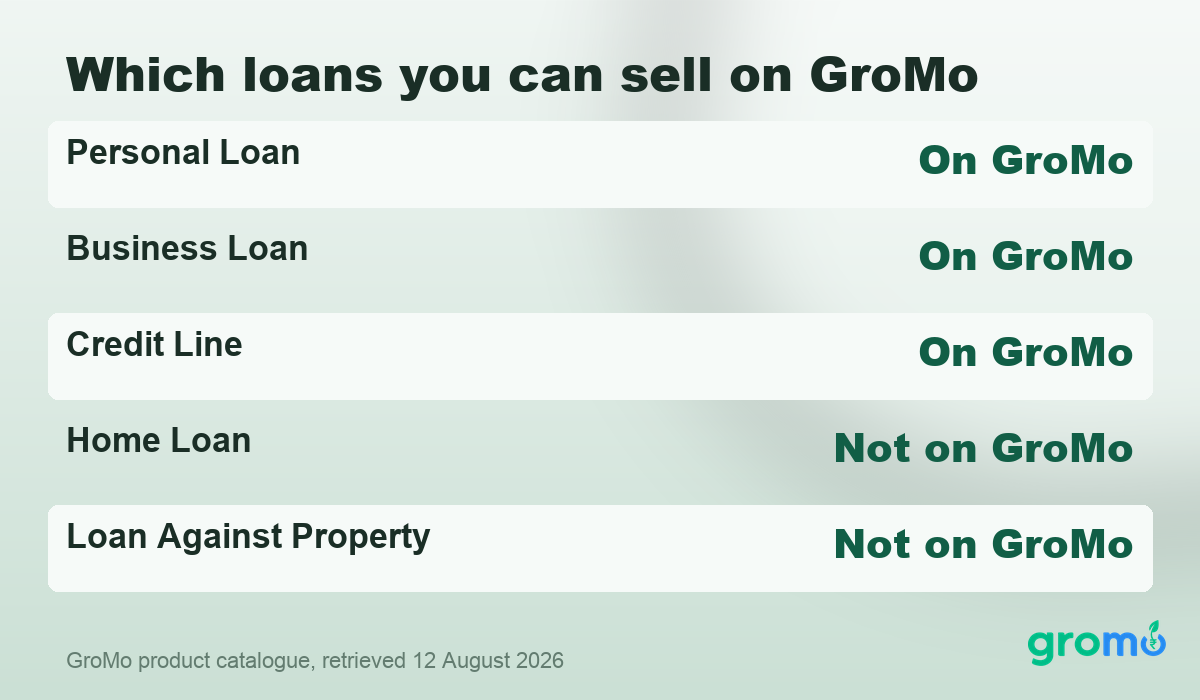
What GroMo carries today, and what it does not.
Other Financial Products
Most agents who stay in this line do not stay pure lending. The same customer who takes a personal loan often needs a credit card, a savings account or a demat account, and every one of those pays its own commission. GroMo's lending shelf is Personal Loan, Business Loan and Credit Line, sitting alongside credit cards, savings accounts, demat accounts and insurance in one catalogue (GroMo product catalogue, retrieved 2026-08-12).
Selling more than one category is also protection. When a lender pauses a campaign, an agent with one product has nothing to sell that month. Anyone weighing this against other side incomes can compare it with the options in this list of ways to earn money from home as a GroMo Partner.
Who Can Become a Loan Agent?
Almost anyone with a smartphone, a bank account and people who trust them.
The people who do well are rarely finance graduates. Shopkeepers see cash flow problems before the borrower admits to one. Insurance agents and mutual fund distributors already discuss money for a living. Chartered accountants and tax practitioners know exactly which client needs working capital. Salaried employees sell to colleagues who ask the same questions every appraisal season. Homemakers and students bring a network that no bank branch can reach.
One check before you start. If you are salaried, read your employment contract on outside work and paid engagements. Some employers require written permission, and it is a much easier conversation before the first commission than after it.
Loan Agent Eligibility
Baseline requirements are modest.
- Age: 18 or above.
- Nationality: Indian resident.
- Identity: PAN and Aadhaar, with the name matching across both.
- Bank account: in your own name, for commission credit.
- Education: no minimum on distribution platforms. Direct bank DSA empanelment often asks for a graduate degree.
- Credit history: platforms generally do not run a credit check on you. Banks often do before empanelling a DSA.
- Registration: either lender by lender, or once on a platform that already holds the tie-ups.
There is no exam or national licence for loan agents. Insurance is different, where a POSP has to clear IRDAI-mandated training before selling, so do not assume the two work the same way.
Documents Required to Become a Loan Agent
For a platform like GroMo, the list is short:
- PAN card
- Aadhaar card, for KYC
- Bank account details or a cancelled cheque
- A mobile number linked to Aadhaar for OTP verification
- A recent photograph
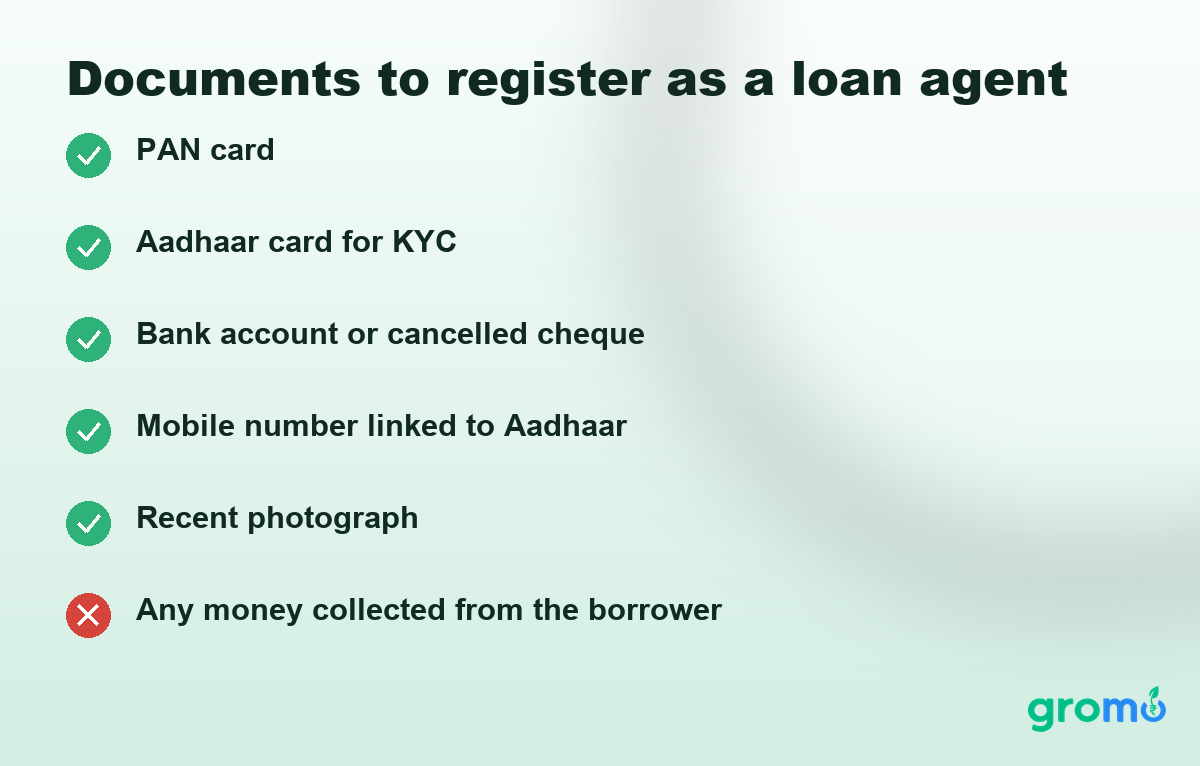
Platform onboarding is a KYC job, not a paperwork project.
Direct empanelment with a bank or NBFC is a heavier process. Expect a signed DSA agreement, business registration or a shop and establishment certificate if you are applying as a firm, GST registration where applicable, office address proof, cancelled cheque, a credit check on the applicant, and in some cases a security deposit or empanelment fee. Timelines run in weeks rather than minutes.
The gap in effort is why most new agents start on a platform and approach banks directly only once they have volume worth negotiating with.
Skills Every Successful Loan Agent Needs
Listening before pitching. The borrower's actual problem is often not the loan they asked for. Someone wanting Rs 50,000 for a laptop may be better served by a credit line.
Plain product knowledge. Interest rate, processing fee, tenure, prepayment terms, and what a missed EMI does to a credit score. Know these cold.
Comfort with rejection. Most applications you touch will not convert. That is the job, not a sign you are bad at it.
Documentation discipline. Clear photos, matching addresses, complete bank statements. A tidy file gets approved while a sloppy one dies in a query loop.
Honesty about credit scores. Telling someone with a 590 score that approval is unlikely costs you one application and earns you the referral they send next year.
Follow-up without pestering. One reminder on day three beats six messages in one evening.
How GroMo Helps You Become a Loan Agent
GroMo is an Indian financial products distribution app. Partners recommend loans, credit cards, savings accounts, demat accounts and insurance from a single catalogue, and earn a commission when an application is approved.
For a new loan agent, the practical value is that four hard problems are already solved. Lender tie-ups exist, so you skip empanelment. Training sits inside GroMo Academy, free, in Hindi and English. Live commission rates show on each product card, so nobody has to trust a rumour about payouts. And the same account carries non-lending products, so a customer who does not qualify for a loan is not a wasted conversation.
Joining costs nothing. What you earn depends entirely on approvals, and no honest platform can promise otherwise.

How to Start Selling Loans Through GroMo
- Install the GroMo app and verify your mobile number.
- Finish KYC with PAN and Aadhaar. Keep the name spelling identical on both.
- Add your bank account so commissions have somewhere to land.
- Complete the GroMo Academy module for one lending product. One, not all of them.
- Open that product's card and read the live commission and the eligibility rules.
- Share your product link with one person who genuinely needs it.
- Track the application in the app until it is disbursed or declined, and learn from the ones that fail.
Most people rush step four and skip step five. Then they cannot answer the first question a borrower asks, and the lead goes cold.
How to Get Your First Customer
Start with the people who already call you for advice, not a broadcast list and definitely not a WhatsApp group of strangers.
Ask a better question. "Do you need a loan?" gets a no. "Is the shop stock loaded up before Diwali, or are you waiting on payments?" gets a real conversation.
Sit with them while they apply. First-timers abandon applications at the OTP or income proof step. Ten minutes of company converts far more files than a link and a hopeful message.
Be visible where credit questions come up. Local trader groups, RWA groups, your building's WhatsApp community. Answer questions without pitching, and the pitch becomes unnecessary.
Ask for one referral, once, after disbursal. A borrower whose loan came through is the warmest lead source you will ever have.
Say no when it does not fit. Turning down a customer with three ongoing EMIs protects your approval rate and your reputation.
How Much Can a Loan Agent Earn?
Honestly? Anywhere between nothing and a full-time income, and the variable is not effort. Approvals decide it.
Three numbers set your income: how many applications you source, what share of them get approved, and what each approved case pays. Sourcing improves fast with practice. Approval rate improves when you stop pushing files that were never going to clear. Payout per case is set by the lender and moves with campaigns.
Watch your own funnel rather than anyone's industry average. If 10 applications turn into 4 disbursals, your approval rate is 40%, and doubling that rate earns more than doubling your effort ever will (illustrative arithmetic, retrieved 2026-08-12).
A useful way to think about it: one disbursed business loan can be worth more than a month of small-ticket work, while ten personal loan applications from unqualified friends can be worth zero. Volume without fit is just unpaid data entry.
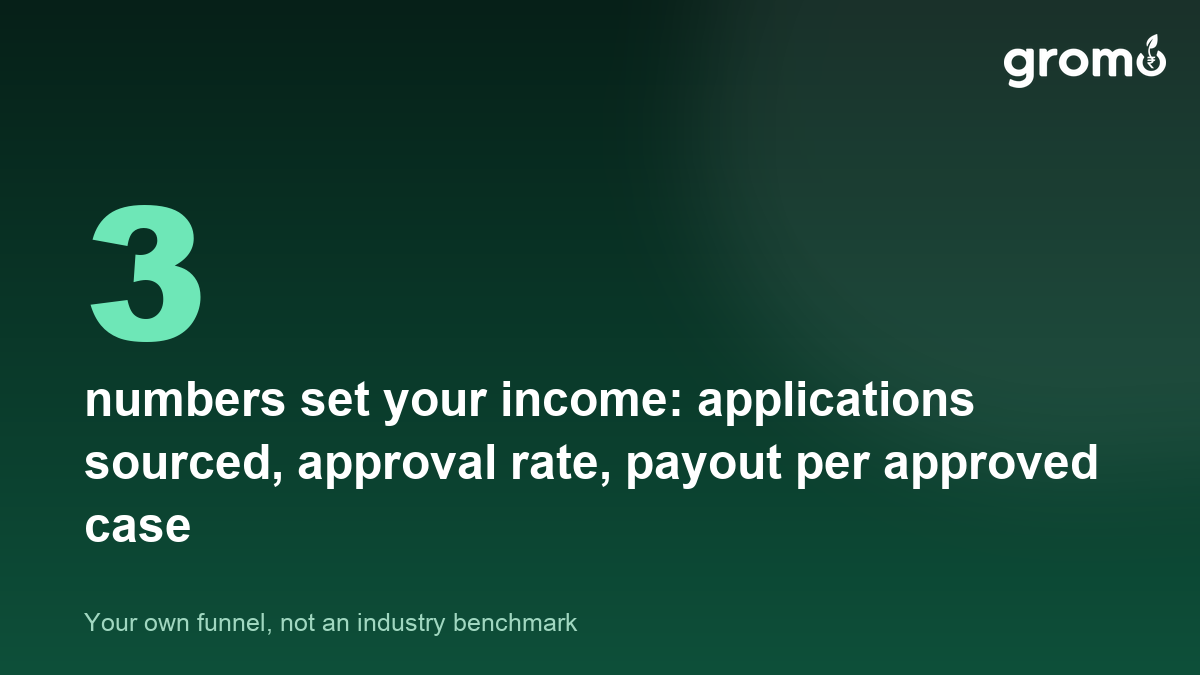
Three numbers, and only two of them are in your hands.
Check the live rate on the product card before you quote anything to anyone (GroMo product catalogue, retrieved 2026-08-12). Rates that were correct last quarter are not a promise you can make this quarter. Agents who cross-sell beyond lending tend to earn more steadily, which is the same pattern visible in the payouts across demat account referral programmes.
Common Mistakes New Loan Agents Should Avoid
- Promising approval. You cannot approve anything. Say "you look eligible" and never "it will be approved".
- Collecting money from a borrower. No fees, no deposits, no cash for a file. Lenders pay agents, and borrowers pay lenders.
- Quoting an interest rate from memory. Rates change and vary by profile. Show the screen instead.
- Applying to five lenders at once. Every application is a hard credit enquiry, and a burst of them lowers the score you were relying on.
- Selling to whoever will listen. Rejections cost you nothing in commission and everything in credibility.
- Sharing screenshots of somebody's documents. Aadhaar, PAN and bank statements stay inside the lender's flow. Nowhere else.
- Chasing ticket size over fit. A borrower talked into a bigger loan than they need is a clawback waiting to happen.
- Going quiet after disbursal. The customer you never followed up with is the referral you never got.
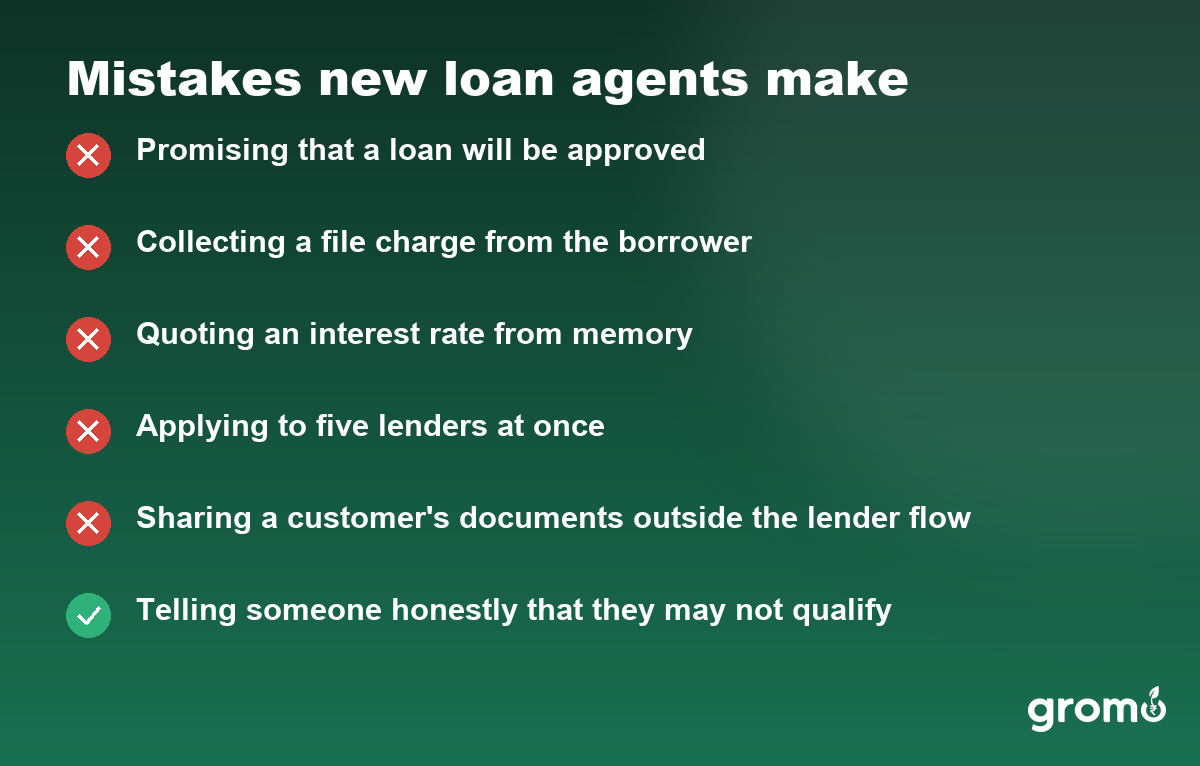
Every one of these is recoverable except the last two.
Conclusion
A loan agent is a distributor of credit, paid on results, carrying none of the lending risk and none of the capital cost. Entry is genuinely open. Registration on a platform takes minutes and needs PAN, Aadhaar and a bank account, while direct bank empanelment is a slower and more demanding route to the same commission.
What separates agents who last from those who quit in month two is not network size. It is fit. Learn one product properly, sell it only to people it suits, and let the approvals build the income. If lending is where you want to start, GroMo carries Personal Loan, Business Loan and Credit Line today, with the rest of the catalogue available the moment a customer needs something else.
One last piece of perspective. Distribution pays per outcome, so a slow month is genuinely slow, and anyone who needs small guaranteed amounts instead may prefer the lighter options in this comparison of apps that pay you to complete tasks. Loan agency pays more per conversation and asks more of you in return.
Disclaimer
Nothing in this article is a guarantee of income. Loan agent commissions are set by banks, NBFCs and distribution partners, and they change as campaigns change, so any figure that is accurate today may be different next month. The percentage examples used above are arithmetic for illustration and are not rates offered by any lender or by GroMo.
What you actually earn depends on approvals. An application that fails KYC, or a borrower a lender declines, pays nothing however well you handled it. Loan approval, interest rate and final terms rest entirely with the lender.
Everything above is general information, not financial or legal advice. Check the live commission on the product card in the GroMo app before quoting anything, and read your own employment contract before taking up agency work alongside a job.
Frequently Asked Questions
What is a loan agent in simple words?
A loan agent is someone who brings borrowers to a bank or an NBFC and earns a commission when the loan is disbursed. The lender approves the loan and lends the money. The agent finds the customer and helps with the application.
Is a loan agent the same as a DSA?
Yes. DSA stands for Direct Selling Agent, which is the term banks and NBFCs use in their contracts. Loan agent is the everyday word for the same role.
Do I need a licence to become a loan agent in India?
No national licence exists for loan agents. You register with each lender individually, or once on a distribution platform that already holds those tie-ups. Insurance is different, where a POSP must complete IRDAI-mandated training before selling.
How much investment is needed to start as a loan agent?
None on a platform like GroMo, where registration is free and needs only PAN, Aadhaar and a bank account. Direct DSA empanelment with a bank can involve an empanelment fee or a security deposit, which varies by lender.
Can a salaried person work as a loan agent?
Usually yes, and many do it alongside a job. Check your employment contract for clauses on outside work or paid engagements first, because some employers require written permission before you take on agency work.
Which loans can I sell through GroMo?
Personal Loan, Business Loan and Credit Line (GroMo product catalogue, retrieved 2026-08-12). Home loans and loans against property are not currently in the catalogue, though credit cards, savings accounts, demat accounts and insurance are.