
E-Mitra Services List and How Kiosk Operators Earn More
E-Mitra services list: what Rajasthan's e-Mitra kiosks offer, how service charges work, how to open a kiosk, and how operators can add bank products.

The e-Mitra services list covers five groups: utility bills and payments, online application forms and fee deposits, grievances and information, certificates and land record copies, and prepaid services such as recharges and ticket booking. e-Mitra is the Government of Rajasthan's service platform, run by DoIT&C through RajCOMP Info Services Limited (RISL). More than 600 services reach citizens through more than 7,800 kiosks, the e-Mitra app, the web portal and e-Mitra Plus machines (RISL notice, 19 March 2026).
Every e-Mitra service charge is fixed by the State Government, so a kiosk earns a set amount per transaction. Many kiosk customers also need a bank account, a card or a loan. e-Mitra does not provide those. GroMo is a free app where partners earn commission when banks, NBFCs and brokers approve the accounts, cards and loans they refer. Below: the services, the charges, how a kiosk is opened, and how an operator can add bank products.
What Is e-Mitra and Who Runs It?
e-Mitra is a Government of Rajasthan project that brings government and selected private services to citizens under one roof, so people do not have to visit many offices. DoIT&C owns the project and RISL implements it. RISL's July 2025 tender describes three levels: DoIT&C and RISL at the top, private Local Service Providers (LSPs) selected by tender in the middle, and kiosk owners appointed by the LSPs at the counter (RISL e-Mitra LSP tender, 8 July 2025).
District e-Governance Societies manage the kiosks day to day in each district. Citizens can use e-Mitra in four ways:
| Channel | How the citizen uses it |
|---|---|
| e-Mitra kiosk | Visits a counter run by a local kiosk operator |
| e-Mitra mobile app | Applies or pays from their own phone |
| e-Mitra web portal | Applies or pays online |
| e-Mitra Plus machine | Uses a self-service machine |
A kiosk operator is not a government employee. In fact, the July 2025 tender says the kiosk owner, admin and operator must not be in any government service.
What Is on the e-Mitra Services List?
The e-Mitra services list has more than 600 services from government departments, public sector units and private service providers (RISL notice, 19 March 2026). RISL's July 2025 tender put the figure at 650+ services from about 100 departments, PSUs and private providers (RISL tender, 8 July 2025). Both documents use the same five groups:
| Service group | Examples at the counter |
|---|---|
| Utility bills and payment collection | Electricity and water bills, government dues |
| Online application forms and fee deposits | Applications for government schemes, jobs and exams, with the fee |
| Grievances and information | Filing complaints and checking application status |
| Certificates and land records | Certificates and copies of land records |
| Prepaid services | Mobile and DTH recharges, ticket booking |
The full, current list of services is published on the official e-Mitra portal at emitra.rajasthan.gov.in. Service names change often. Departments add and move services, so check the portal or ask your LSP before you advertise a service at your counter. For a similar model in other states, see our guide to CSC Jan Seva Kendra extra income.
How Much Can an e-Mitra Kiosk Charge for a Service?
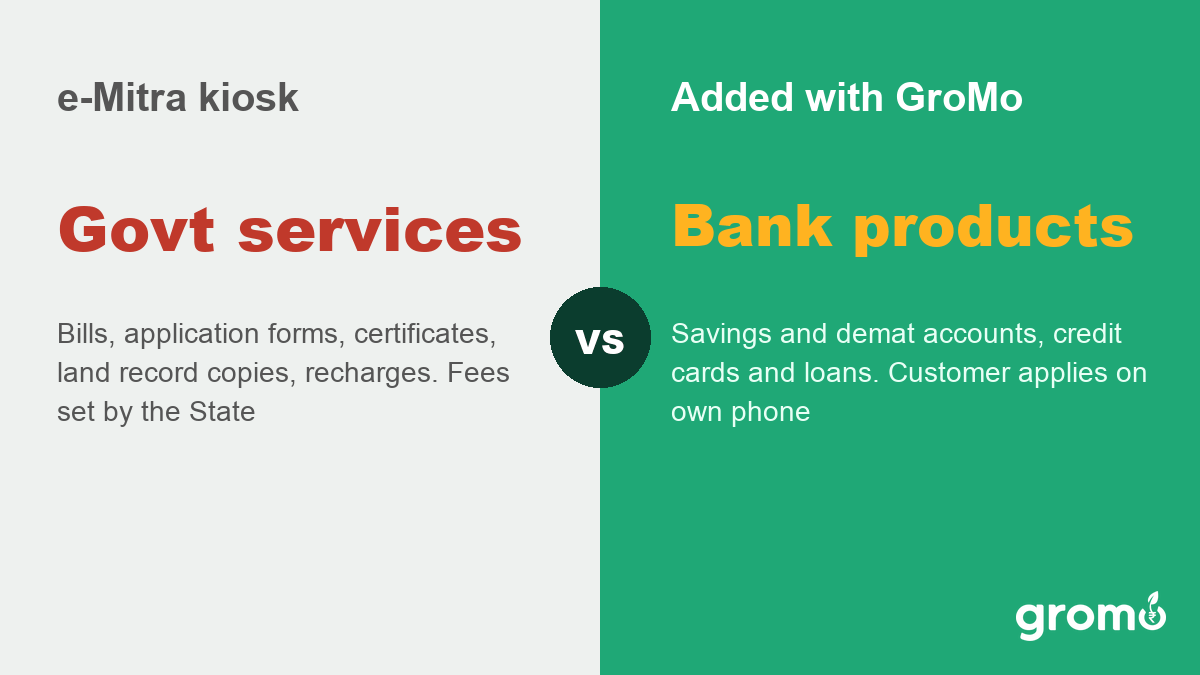
An e-Mitra kiosk can charge only the service charge fixed by the State Government. Nothing more. RISL's July 2025 tender says e-Mitra service charges for each service "are decided by the State Government which are distributed among RISL, LSP and e-Mitra kiosks", and points to a unified rate circular (Circular 35) for the full list. There is no capital subsidy: kiosks run on these per-transaction charges alone.
Three rules shape what a kiosk earns and charges:
- A visible rate list. Every kiosk must display a co-branded banner and an e-Mitra rate list banner of 3x5 feet (RISL tender, 8 July 2025). A new kiosk that does not upload photos of both within 30 days is deactivated.
- No overcharging. Complaints of overcharging, financial irregularities or document tampering go to the SDM or SDO under a DoIT&C order of 31 August 2022, and RISL can suspend or close the kiosk.
- Commission through the e-Wallet. RISL pays the kiosk's commission into the kiosk owner's e-Wallet after deducting TDS, on behalf of the LSP.
Rates differ by service. They are revised by circular. For the current charge of any service, read the rate list banner at an authorised kiosk or the service charges page on the official e-Mitra portal.
How Do You Open an e-Mitra Kiosk?
You open an e-Mitra kiosk by applying on the e-Mitra portal under a Local Service Provider, who verifies your documents and approves the application. The July 2025 tender sets these minimum rules for a kiosk owner:
| Requirement | Rule in the July 2025 tender |
|---|---|
| Education | 10th pass or equivalent |
| Age | At least 18 |
| Residence | Permanent resident of Rajasthan |
| Character | Digital police verification certificate and no history of fraud or default |
| Documents | Jan Aadhaar card, PAN card, bank passbook, photo, 10th pass certificate, date of birth proof, affidavit, SSO ID, mobile number, landlord's no objection for the premises |
| Application fee | ₹1,500 to RISL, non-refundable; the LSP may not charge any other fee |
| Limit | One person may own only one kiosk |
The application fee is ₹1,500, paid to RISL, of which ₹500 goes to the LSP for processing (RISL tender, 8 July 2025). After approval, the LSP geo-tags the kiosk with photos of the banner and rate list. The District e-Governance Society then has 10 working days to approve or reject the photos (RISL tender, 8 July 2025). No action means automatic activation.
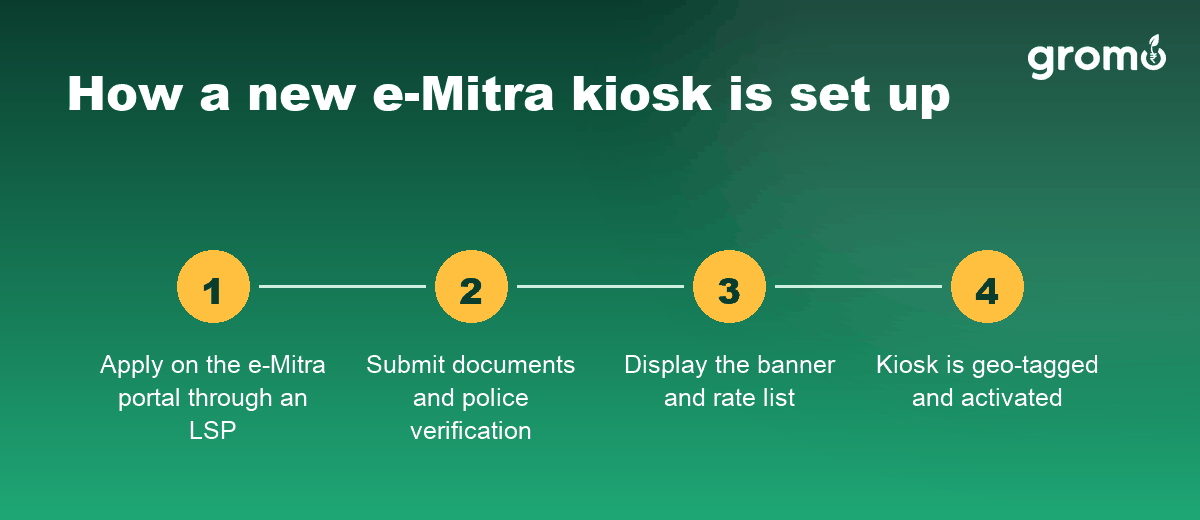
To start: 1. Create an SSO ID on the Rajasthan SSO portal if you do not have one. 2. Apply for a kiosk on the e-Mitra portal and choose an LSP for your division. 3. Upload your documents and police verification, and pay the application fee to RISL. 4. Put up the co-branded banner and rate list, and complete geo-tagging.
Fees and rules can change with each new tender, so confirm the current fee on the official portal before you pay.
Why Do e-Mitra Operators Look for Extra Income?
e-Mitra operators look for extra income because each transaction pays a fixed, small charge that the operator cannot raise. In RISL's pre-bid query document for the 2025 tender, one bidder's query states that "the state government has not increased the service fee (commission) of e-Mitra Kiosk for the last 5 years" (RISL pre-bid queries, 5 August 2025). That is a bidder's statement, not a government finding, but it shows the pressure many kiosks describe. In the same document, RISL set the range LSPs could bid for their share of service charges at 12% to 17% for all divisions (RISL pre-bid queries, 5 August 2025).
Footfall, the service mix and the season decide a kiosk's income. Exam forms, scheme deadlines and bill dates bring rushes. Quiet weeks follow. The customers who come for a certificate or a bill are often the same people who need a bank account, a debit card, a credit card or a small loan, and e-Mitra does not offer those products itself.
Bank products give an operator a second source of income from customers who already trust the counter. The work is similar to what a bank mitra or CSP does for one bank, but through one app for many providers.
Can an e-Mitra Operator Offer Financial Products Through GroMo?
Yes, an e-Mitra operator can become a GroMo partner as an individual, provided their kiosk agreement allows it. GroMo is not part of e-Mitra, DoIT&C, RISL or the Government of Rajasthan. The kiosk's agreement with its LSP sets out roles, commercial terms and tie-ups, so read it, or ask your LSP, before you offer any product that is not an e-Mitra service.
Keep the two businesses apart:
- No e-Mitra branding. Never present a bank account or card as an e-Mitra or government service.
- No extra charge. Do not charge the customer for a bank product; GroMo pays you when the provider approves the account.
- The customer's own phone. The customer applies with their own mobile number and documents, and the bank or broker decides approval.
- Separate records. Keep GroMo work outside the e-Mitra portal and e-Wallet.
Our comparison of Jan Seva Kendra and GroMo commission shows how counter businesses in other states weigh the same choice.
How Is e-Mitra Kiosk Income Different from GroMo Partner Income?
e-Mitra kiosk income comes from fixed government service charges shared with RISL and the LSP. GroMo partner income comes from commissions that banks, NBFCs and brokers pay for approved products. The table compares the two as they work in November 2026.
| Point | e-Mitra kiosk | GroMo partner |
|---|---|---|
| Who you sign with | A Local Service Provider, under RISL rules | GroMo, a distribution platform; each product comes from its own regulated provider |
| What you offer | Government and selected private services | Savings and demat accounts, credit cards, personal and business loans, credit lines |
| How you earn | Fixed service charge per transaction, shared with RISL and the LSP | Commission per approved product, shown in the app before you share a link |
| Joining cost | ₹1,500 application fee (July 2025 tender) | Free to join |
| What you need | A shop, documents, police verification, computer and printer | An Android phone, PAN and a bank account in your name |
| Where you work | At the approved kiosk location | Anywhere, including your kiosk |
| Who sets the price | State Government | The provider sets the payout; the customer pays you nothing |
The two routes fit together. e-Mitra brings people to the counter. Bank products add income from the same visits.
Which Products Should an e-Mitra Operator Start With?
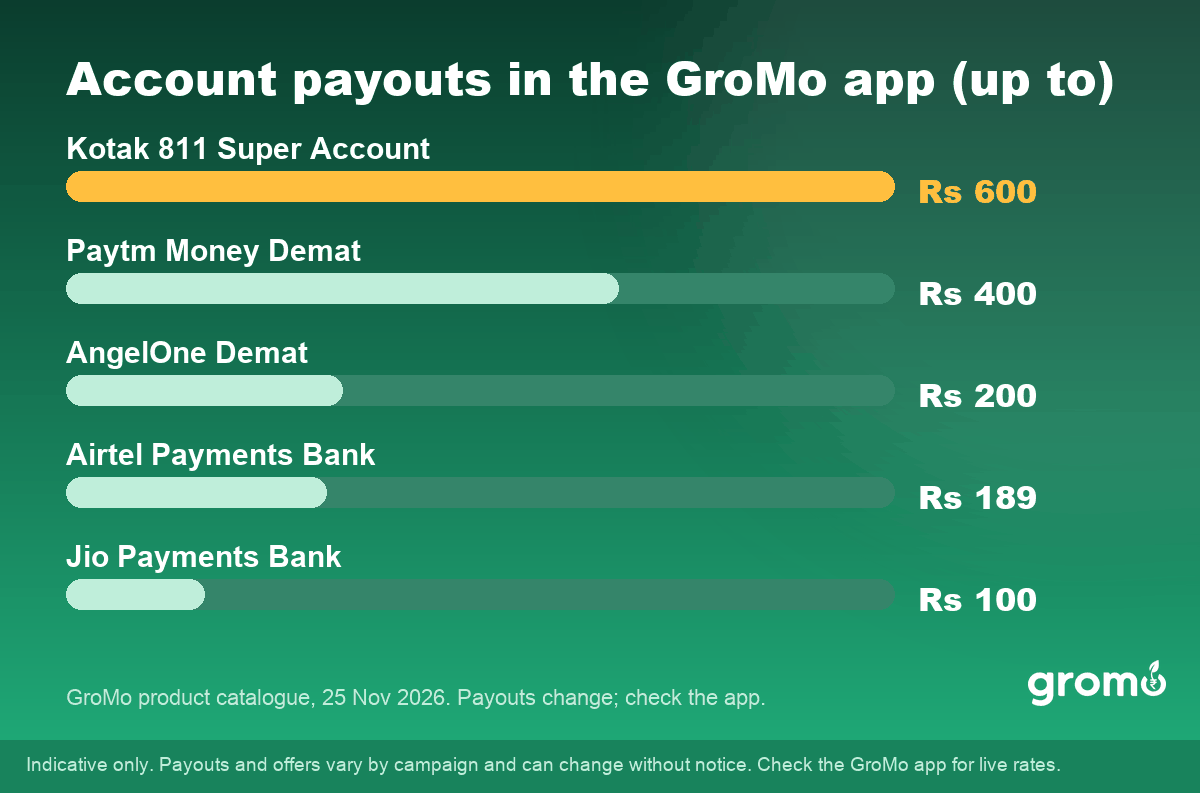
An e-Mitra operator should start with zero-balance savings accounts and demat accounts, because the customer pays nothing to open them and the steps are short. On 25 November 2026, the GroMo product catalogue listed these payouts:
| Product in the GroMo app | Type | Payout per successful account (up to) | When it counts |
|---|---|---|---|
| Kotak 811 Super Account | Savings account | ₹600 | Aadhaar-linked mobile and a serviceable pin code |
| Paytm Money Demat Account | Demat account | ₹400 | Customer funds the account and makes a first trade within 30 days |
| AngelOne Demat Account | Demat account | ₹200 | New Angel One customer who trades within 7 days of opening |
| Airtel Payments Bank | Savings account | ₹189 | As shown in the app for the product |
| Jio Payments Bank | Savings account | ₹100 | As shown in the app for the product |
Source: GroMo product catalogue, retrieved 2026-11-25.
Please note: payouts change often and differ by product and city. Most products pay less than the top figure shown here. Commission is paid only when the provider confirms the account under its own conditions, and the provider alone decides approval. Always check the live payout and conditions in the app before you share a link.
The same app lists credit cards, such as the SBI Credit Card at up to ₹2,000 per approved card (GroMo product catalogue, retrieved 2026-11-25), plus personal loans and credit lines. Cards and loans pay more. They are also approved less often, so explain that the bank decides. For customers who want a basic account, our guide to the zero balance savings account explains the options.
How Much Could an e-Mitra Kiosk Earn by Adding Accounts?
Here is a simple monthly example for a busy kiosk in a district town. The figures use base payouts from the GroMo product catalogue (retrieved 2026-11-25) and assume every account below is completed under the provider's conditions.
| Product | Successful accounts in the month | Payout each (up to) |
|---|---|---|
| Kotak 811 Super Account | 4 | ₹600 |
| Airtel Payments Bank | 4 | ₹189 |
| Paytm Money Demat Account | 2 | ₹400 |
Each payout above is the base figure for one completed account, as the app listed it on 25 November 2026, before any campaign bonus or change.
Together, the 10 completed accounts would add ₹3,956 in the month (base payouts from the GroMo product catalogue, retrieved 2026-11-25). That figure is an illustration only. It is not typical and not guaranteed. Many customers who start an application never finish it, some will not meet a provider's conditions, and payouts change. An operator who explains each product clearly and helps customers finish on their own phones will complete more accounts than one who only shares links.
A demat payout counts only after the customer's own first trade, so offer it to customers who already want to invest, as our guide to demat account refer and earn explains.
What Mistakes Should an e-Mitra Operator Avoid?
An e-Mitra operator who adds bank products usually makes the same few mistakes in the first month. Each one costs a payout, a customer's trust or the kiosk itself.
| Mistake | What to do instead |
|---|---|
| Calling a bank account an e-Mitra service | Say clearly that the account comes from a bank, through GroMo |
| Charging the customer for a bank product | Never charge; e-Mitra rules punish overcharging, and GroMo pays the partner |
| Opening an account with your own mobile number | Use the customer's own Aadhaar-linked number; accounts on your number usually do not count |
| Storing customers' Aadhaar or PAN copies for GroMo work | The customer enters details on their own phone; keep no copies |
| Promising a loan or card approval | The bank or NBFC decides; approval is never promised |
Protect the kiosk first. No single payout is worth more than your e-Mitra ID.
Add Bank Products to Your e-Mitra Counter
An e-Mitra kiosk already has what most new sellers lack: a trusted counter and daily walk-in customers. Adding savings accounts, demat accounts, cards and loans gives those customers more help and gives the operator income that does not depend on a fixed government charge. GroMo is free to join, shows the payout for every product before you share a link, and works from any Android phone, which is why shopkeepers, bank mitras and kiosk operators use it, as our guide on who can earn money with GroMo explains.
FAQ: e-Mitra Services List
What is the full e-Mitra services list?
The official e-Mitra portal at emitra.rajasthan.gov.in publishes the current list. RISL documents group more than 600 services into utility bills and payments, application forms and fees, grievances and information, certificates and land records, and prepaid services such as recharges and ticket booking.
Who runs e-Mitra in Rajasthan?
e-Mitra is a project of the Department of Information Technology and Communication, Government of Rajasthan, implemented by RajCOMP Info Services Limited (RISL). Private Local Service Providers selected by tender appoint and support the kiosks.
What is the fee to open an e-Mitra kiosk?
RISL's July 2025 tender sets a non-refundable application fee of ₹1,500 for a new kiosk, paid to RISL. The LSP may not charge the applicant any other fee. Confirm the current fee on the official portal before you pay.
Who can open an e-Mitra kiosk?
A permanent resident of Rajasthan aged at least 18, with at least a 10th pass, a digital police verification certificate and no history of fraud or default. The kiosk owner and operator must not be in government service, and one person may own only one kiosk.
Can an e-Mitra operator charge more than the rate list?
No. Service charges are fixed by the State Government and must be displayed on the rate list banner. Overcharging complaints go to the SDM or SDO, and RISL can suspend or close the kiosk.
Can an e-Mitra operator join GroMo?
Yes, as an individual, if the kiosk agreement with the LSP allows it. GroMo is not part of e-Mitra or the Government of Rajasthan, so never present GroMo products as e-Mitra services, and never charge customers for them.
Disclosures
GroMo (Vitrak Technologies Pvt Ltd) is a distribution platform. GroMo is not a bank, NBFC or investment adviser and is not part of e-Mitra, DoIT&C, RISL or the Government of Rajasthan. All products are offered by their respective RBI or SEBI-regulated providers, who alone decide approval, interest rates and terms. Brand names are trademarks of their owners and are named here only for information.
Loans and credit cards are issued by RBI-regulated banks and NBFCs. Approval is at the lender's sole discretion and is never promised. GroMo does not lend money.
Demat accounts are offered by SEBI-registered brokers. Investments in securities are subject to market risks; read all related documents carefully before investing.
Partner earnings depend on effort, product mix and customer eligibility. Any figures shown are illustrative examples. They are not typical and are not guaranteed. GroMo does not guarantee any level of income.
Disclaimer
The information on this page is for general information only and is not financial, legal or investment advice. Details of the e-Mitra project come from official RISL and DoIT&C documents dated 8 July 2025, 5 August 2025 and 19 March 2026, and may have changed; confirm them on the official e-Mitra portal or with your LSP. Payouts in the GroMo app change often; check the live figure in the app. You must be 18 or older to join GroMo.


