
DSA Loan Agent Registration: Process, Documents & Fees 2026
DSA loan agent registration explained: the free universal online process for all banks, eligibility, documents, commissions, and a step-wise way to start.

DSA loan agent registration is the formal doorway into one of India's most accessible financial careers. A DSA (Direct Selling Agent), also called a loan agent, sources loan customers for a bank or NBFC, helps them apply with the right documents, and earns a commission on every disbursed loan. No office, no degree requirement, no capital: your network and follow-up discipline are the business. This guide explains the universal registration method that applies across virtually all banks and NBFCs, the eligibility and documents you need, what it costs (usually nothing), and how commissions work, so you can register once and start sourcing confidently.
What a Loan DSA Actually Does
- Finds borrowers: from your network, referrals, and local outreach, you identify people who genuinely need personal loans, business, home, or vehicle loans.
- Prepares the file: you help collect KYC and income documents and submit a complete application, which is why lenders value good DSAs: complete files get approved faster.
- Earns on disbursal: the lender pays a commission, typically 0.5% to 2%+ of the disbursed loan amount depending on the product, when the loan is paid out.
- Stays compliant: registered DSAs work under the lender's code of conduct: honest representation of rates and fees, no guarantee promises, and customer data protection.
The Universal DSA Registration Method (Works for All Banks)
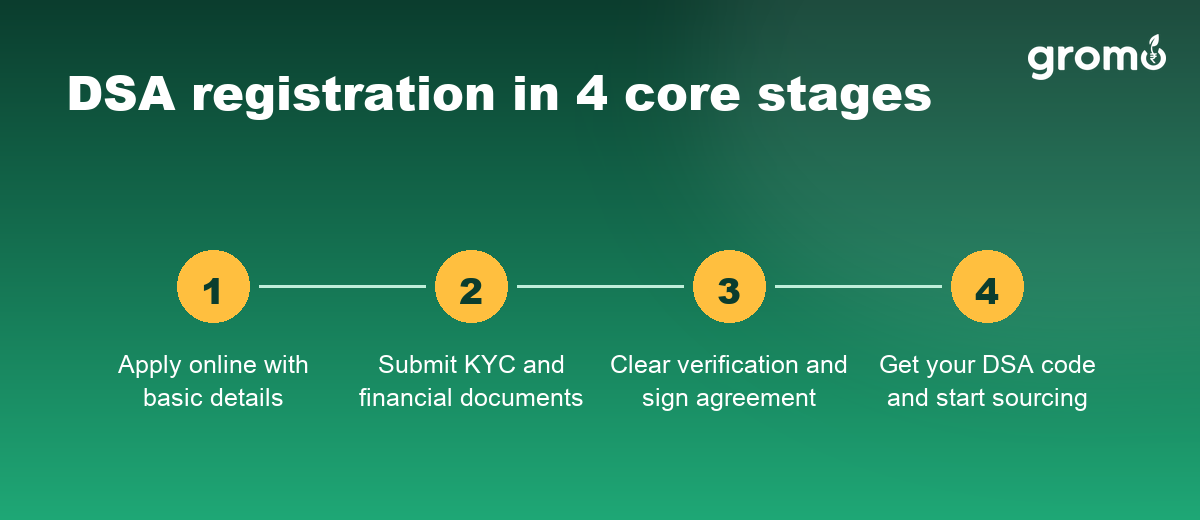
Bank names differ; the process barely does. Whether you search for SBI, HDFC, ICICI, Axis, or any NBFC DSA program, registration follows the same universal sequence:
- Choose your route: register directly with one bank or NBFC through its DSA/partner page, or register with a distribution platform that connects you to many lenders at once.
- Fill the online application: basic personal details, location, and whether you are registering as an individual or a business entity.
- Submit KYC and financial documents: the standard set listed in the next section, uploaded digitally on most portals.
- Clear verification: the lender checks your documents, credit history, and background. A reasonable CIBIL score helps since lenders prefer agents who manage their own credit well.
- Sign the DSA agreement: the contract covering commission rates, payout cycles, code of conduct, and data handling. Read the payout and clawback clauses carefully.
- Receive your DSA code: once approved, you get a unique code or partner ID that tags every application you source, plus onboarding on the lender's processes.
- Start sourcing: submit your first files, track them through the lender's portal, and commissions follow disbursals per the agreed cycle.
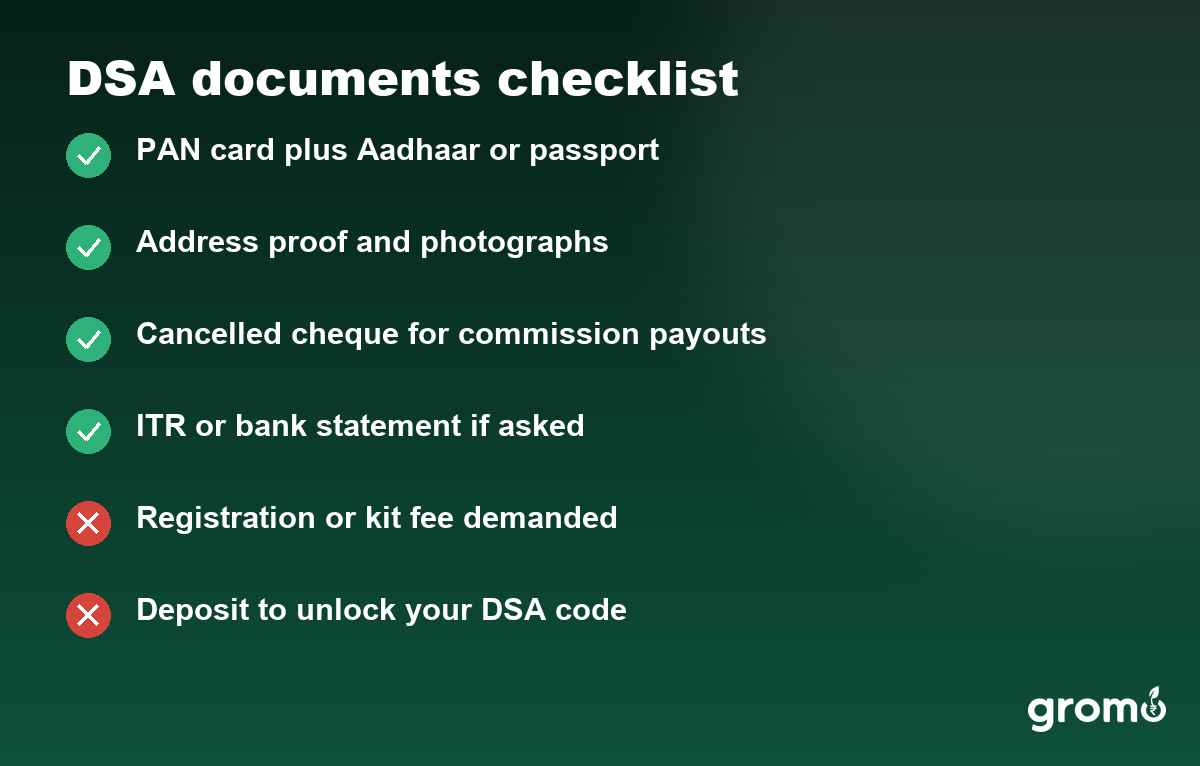
The full cycle usually takes a few days to a few weeks depending on the lender's verification. Genuine registration is free; treat any demand for a registration fee, kit charge, or training deposit as a red flag, because legitimate lenders and platforms earn when you source loans, not when you sign up.
DSA Registration Eligibility
- Age: 18 years or above (some lenders prefer 21+).
- Citizenship and location: Indian resident; some programs are region-specific.
- Education: no fixed degree requirement at most lenders; basic financial literacy and communication matter more.
- Credit history: a clean record helps clear verification; some lenders screen your CIBIL report.
- Occupation: open to salaried people, self-employed professionals, shop owners, homemakers, and students above the age bar. Existing insurance agents, accountants, and property consultants convert especially well.
Documents Required for DSA Loan Agent Registration
- Identity proof: PAN card (mandatory) plus Aadhaar, passport, or voter ID.
- Address proof: Aadhaar, utility bill, passport, or rent agreement.
- Photographs: recent passport-size photos or a digital selfie for e-KYC.
- Bank details: a cancelled cheque or passbook copy of the account where commissions will be paid.
- Financial documents: some lenders ask for recent ITRs or bank statements, mainly for business-entity registrations.
- Business proof (if registering as a firm): GST registration, shop establishment licence, or incorporation documents.
How DSA Commissions Work
- Payout basis: a percentage of the disbursed amount, not the applied amount. Personal loan referrals commonly pay 1-2.5%, business loans similar, home loans lower percentages on larger tickets.
- Payout cycle: monthly is typical, after the lender reconciles disbursals tagged to your DSA code.
- Clawbacks: if a loan is cancelled or defaults very early, part of the commission may be reversed per your agreement, which is why sourcing quality borrowers beats sourcing volume.
- Scaling: established DSAs build referral chains, tie up with CAs and property dealers, and add products beyond loans to serve the same customer repeatedly.
Direct Bank DSA vs Multi-Lender Platform: Which Route?
- Direct with one bank: deeper relationship with one lender and its processes, but you can only offer that lender's products and rates. A borrower rejected there is a lost customer.
- Multi-lender platform: one registration covers many banks and NBFCs, so you match each customer to the lender most likely to approve them, and a rejection becomes a redirect instead of a dead end. For beginners, this route removes the biggest early frustration: losing customers to eligibility mismatches.
Want to Sell Loans, Credit Cards, Demat and Savings Accounts Together? Use GroMo
If your goal is bigger than loans alone, a single-bank DSA code is a narrow start. GroMo gives you one free registration to distribute loans, credit cards, demat accounts, and savings accounts from multiple banks and NBFCs in one app: 30+ lending partners on the loan side alone, plus card and account products the same customer will need next (the credit card agent side of the same business). Free training replaces the guesswork, the dashboard tracks every application like a DSA portal, and commissions are paid to your bank account per product campaign.
Step-wise guide to start on GroMo:
- Download the GroMo app from the Play Store or App Store.
- Register free with your phone number and complete KYC with your PAN and bank details.
- Finish the free in-app training for the products you want to sell first.
- Pick a product (personal loan, credit card, savings account, or demat) and share its application link with a customer.
- Track the application status in the dashboard, exactly like a DSA portal.
- Receive the commission in your bank account after approval or disbursal, and ask every satisfied customer for one referral.
The practical difference from a classic DSA code: nothing to negotiate, no single-lender lock-in, and the same customer who took a loan today becomes your credit card, demat, or savings account customer tomorrow. Register through the universal method above if you want a specific bank's DSA program; start with GroMo if you want the whole financial products shelf from day one.
Once you are registered, the next question is earnings. Our detailed guide on DSA loan agent commission breaks down the payout rates lender by lender.
FAQ: DSA Loan Agent Registration
How do I register as a DSA loan agent online?
Follow the universal method: pick your route (a single bank's DSA page or a multi-lender platform), fill the online application, upload KYC and financial documents, clear the lender's verification, sign the DSA agreement, and receive your DSA code. The process is digital at most lenders and takes a few days to a few weeks.
Is DSA loan agent registration free?
Genuine DSA registration is free at banks, NBFCs, and legitimate platforms; they earn when you source loans, not when you sign up. Treat any demand for a registration fee, kit charge, or refundable deposit as a scam signal and walk away. Your only real investments are time, KYC documents, and follow-up discipline.
What documents are required for DSA registration?
The standard set: PAN card (mandatory), Aadhaar or another identity proof, address proof, recent photographs, and a cancelled cheque for commission payouts. Some lenders also ask for ITRs or bank statements, and business-entity registrations need GST or incorporation documents. Keep digital copies ready and the process moves fast.
Can I do all bank DSA registration online at once?
There is no single government portal covering every bank, so 'all bank DSA registration online' practically means one of two things: registering separately with each bank you want, or joining a multi-lender distribution platform where one registration gives access to many banks and NBFCs. The platform route is faster and lets you match customers to the lender most likely to approve them.
How much does a DSA loan agent earn?
Commissions typically run 0.5-2.5% of the disbursed loan amount depending on the product and lender, paid on monthly cycles. An agent disbursing Rs 10 lakh of personal loans a month at 1.5% earns about Rs 15,000. Income scales with file quality and referrals; early clawback clauses make sourcing genuine, repayment-capable borrowers the smartest strategy.
Do I need a licence or exam to become a loan DSA?
No government licence or exam is required for loan DSA work; you operate under the lender's DSA agreement and code of conduct after verification. This differs from insurance (IRDAI exam) and mutual fund distribution (NISM certification). Basic financial literacy, honest communication, and knowledge of loan products are the real qualifications.
Disclaimer
Nothing here is a guarantee of income or of DSA approval. Commission rates, payout cycles, eligibility norms, and registration processes vary by bank, NBFC, product, and campaign, and change without notice; the lender's DSA agreement and official pages are the only authoritative source. GroMo commissions are set by partner banks and financial institutions and are paid only on approved or disbursed applications; check the live commission in the GroMo app before relying on any figure. GroMo is a distribution platform, not a lender, and is available only to users aged 18 and above.
Everything above is general information, not financial, legal, or career advice. Never pay a registration fee or deposit to become a DSA, and represent every product's rates and terms to customers accurately.


