
Zero‑Investment Ideas Mumbai: Earn ₹50K+ Monthly No Rent


Most business advice for Mumbai ignores the obvious: rent will bankrupt you before you make your first rupee. Commercial space in the city costs ₹150–₹500 per square foot. A 200-square-foot hole-in-the-wall in a decent area? That's ₹30,000–₹1,00,000 a month before you even turn on the lights.
This is why the smartest operators in 2026 aren't renting shops. They're running zero-investment digital businesses from their phones pulling in ₹50,000–₹1,00,000 monthly without inventory, staff, or a lease. GroMo's model is the clearest example: 6 million partners across India distribute credit cards, loans, and demat accounts, earning commissions on every sale. The infrastructure is already there; you just plug into it.
This guide covers Mumbai-specific opportunities that require zero capital, skip the rent trap, and actually scale.
Why Mumbai Needs Zero-Investment Business Models in 2026
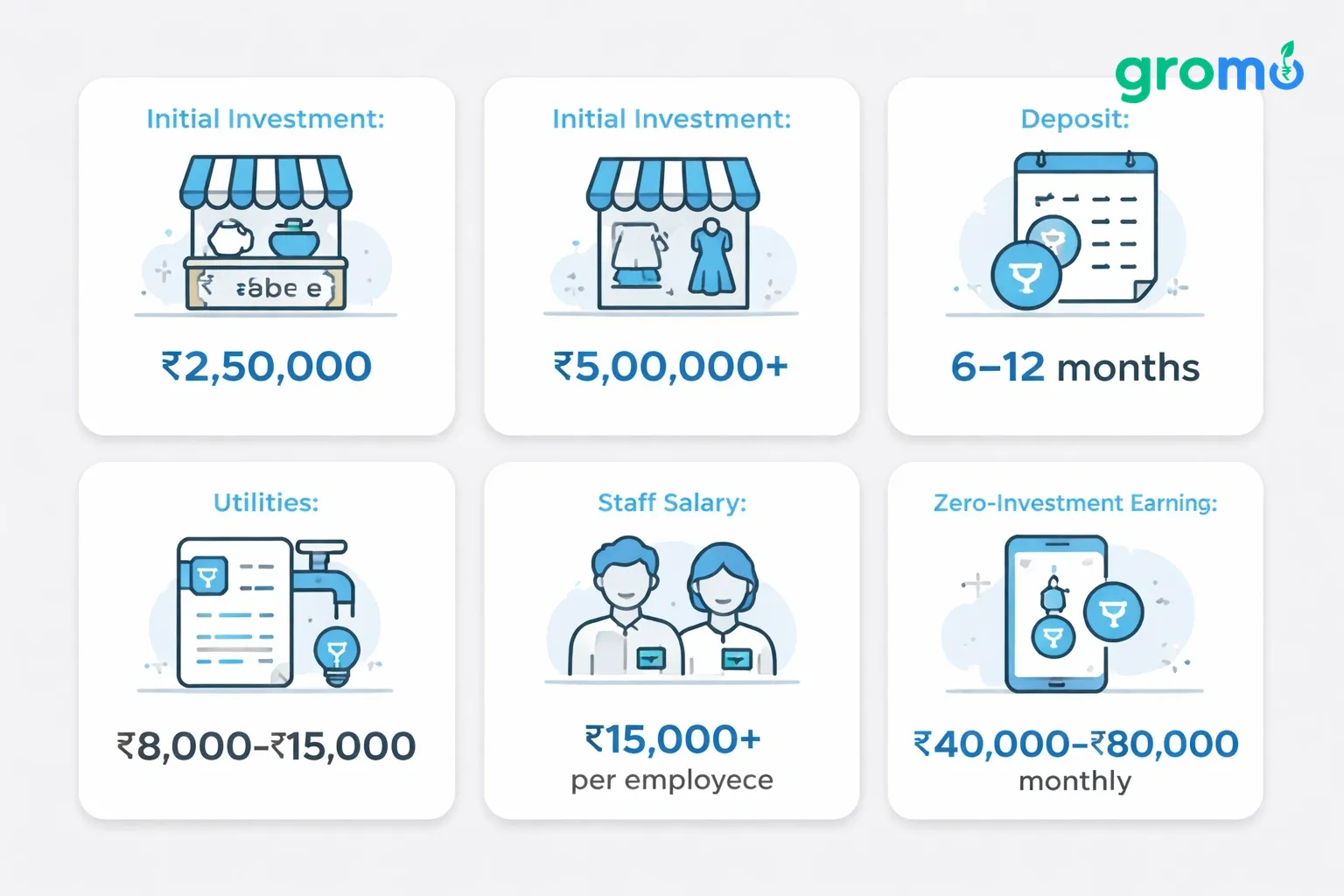
Let's look at the math. To open a tea stall in Dadar, you need ₹2,50,000 upfront. A small clothing boutique in Malad? ₹5,00,000+. Add in the 6–12 month rental deposit, utilities (₹8,000–₹15,000), and mandatory staff salaries (₹15,000+ per employee), and you're in the hole before selling a single cup or kurta.
Zero-investment models cut all of that. GroMo partners in Borivali and Thane earn ₹40,000–₹80,000 monthly selling financial products without renting a single square foot. The platform handles the inventory, compliance, and customer service. You focus on one thing: finding customers.
Mumbai's infrastructure makes this easier than anywhere else. The city has 22.5 million daily local train commuters and 8.7 million smartphone users. That's unmatched density. A partner in Kandivali recently shared Kotak 811 account links in 12 WhatsApp groups housing society, gym, school parents, family chats and earned ₹18,000 in her first month from 45 account openings. That's the power of network effects in a crowded city. Start your zero-investment business with GroMo.
Top 5 Zero-Investment Business Ideas for Mumbai Residents
1. Financial Product Distribution via GroMo
This is the most direct path. You connect Mumbai residents with credit cards, savings accounts, demat accounts, and loans. GroMo pays commissions ranging from ₹180 (Aditya Birla Money demat account) to ₹2,400 (premium credit cards) per approved application.
Why Mumbai works for this: The city houses 40% of India's mutual fund investors and processes 28% of national credit card transactions. The average Mumbaikar holds 2.3 credit cards versus a 1.1 national average. People here are financially literate and actively looking for products Kotak 811's zero-balance accounts, Upstox demat accounts, Poonawalla business loans.
How to start: Download GroMo, complete the free certification (2–3 hours of video training), and start sharing personalized links. Target specific needs: Tide Business Account links (₹250–₹400 per approved account) in entrepreneur WhatsApp groups, Upstox demat links in investment communities, or loan options with shop owners in Crawford Market.
Income trajectory:
- Month 1: ₹8,000–₹15,000 (figuring it out, initial network).
- Month 3: ₹25,000–₹40,000 (repeat customers, better pitch).
- Month 6+: ₹50,000–₹1,00,000 (team building, systematic follow-ups).
Learn how to earn ₹1 lakh monthly while working full-time.
2. Hyperlocal Consulting Services
Mumbai's bureaucracy is legendary. Shop licenses, GST registration, FSSAI permits, society NOCs residents pay ₹2,000–₹10,000 just to navigate the paperwork. If you're willing to learn the process, you can consult for free.
Mumbai niches:
- Society documentation: Help housing societies in Powai and Goregaon draft bye-laws and manage AGM compliance (₹5,000–₹15,000 per society).
- Small business licensing: Assist kirana stores and salons with trade licenses and GST filing (₹3,000–₹8,000 per business).
- Rental agreements: Draft leave-and-license agreements and handle police verification (₹1,500–₹3,000 per agreement; 15–20 agreements monthly = ₹30,000–₹60,000).
Skill building: Use free resources Maharashtra government websites, YouTube tutorials, GroMo's financial compliance training. Join Facebook groups like "Mumbai Housing Society Management" (68,000+ members) to find clients.
3. Content Creation for Mumbai-Centric Brands
Mumbai has 4,200+ cafes, 1,800+ salons, and 12,000+ retail stores. Most need Instagram reels and Google My Business updates but can't afford ₹25,000+ agency retainers. Freelance creators charge ₹2,000–₹8,000 per project using just a smartphone.
Service menu:
- Instagram reels: 15-second product showcases for Linking Road boutiques or Colaba cafes (₹1,500–₹3,000 per reel).
- Google My Business posts: Weekly updates with photos and offers (₹2,000/month per client).
- Product photography: Flat-lay shots for jewelry stores in Zaveri Bazaar (₹3,000–₹5,000 per set).
Equipment: A smartphone with a 12MP+ camera and free apps (CapCut, Snapseed). Invest ₹0 initially. Buy a ring light after you have 5 clients.
Explore remote work opportunities in India 2026.
4. Skill-Based Online Tutoring
Mumbai has 2.8 million school students and 450,000+ college students. Between board exams (ICSE/CBSE), professional exams (CA, CFA, UPSC), and skill training, the demand for tutoring is endless. Online sessions eliminate the commute. You charge ₹300–₹1,200 per hour.
High-demand subjects:
- Board exam prep: Science/Math for Std X–XII (₹500–₹800/hour; 15 hours weekly = ₹30,000–₹48,000 monthly).
- CA/CFA tutoring: Specialized commerce subjects command ₹800–₹1,200/hour.
- Spoken English: Business communication for professionals in BKC (₹400–₹600/hour).
Platform strategy: List on Urban Pro, Superprof, and Vedantu. Create a YouTube channel demonstrating your teaching style. Post in "Mumbai Parents Network" Facebook groups (18,000+ members).
5. Reselling and Affiliate Marketing
This model uses existing e-commerce infrastructure. Manufacturers handle inventory and logistics; you earn 5–30% commission promoting products. Mumbai has 5.2 million online shoppers.
Product categories:
- Office supplies: Target startups in Lower Parel and BKC with bulk stationery and tech accessories via Amazon affiliate links (8–12% commission).
- Fitness equipment: Sell yoga mats and protein powder to Bandra and Powai residents via Instagram (15–25% commission from brands like HealthKart).
- Home organization: Mumbai's 85 sq ft average apartment creates demand for storage solutions (10–20% Flipkart affiliate commission).
Zero-cost setup: Join Amazon Associates and Flipkart Affiliate. Create an Instagram account, join neighborhood WhatsApp groups, and share curated recommendations.
Discover why GroMo beats money-earning games.
Mumbai-Specific Advantages for Digital Businesses
Network Density and Social Capital
Mumbai packs 227 people per hectare (versus 135 national urban average). A Chembur resident's WhatsApp contacts school parents, society members, office colleagues, extended family represent potential customers. Priya, a Kandivali housewife, joined GroMo in January 2026. She shared Kotak 811 links in 8 WhatsApp groups. Within 23 days, 37 people opened accounts. That's ₹18,500 in month one. By March, she was earning ₹64,000 from repeat customers applying for credit cards and loans.
Network density compounds with Mumbai's 89% smartphone penetration. Digital businesses scale faster here because trust transfers instantly through mutual connections.
Financial Product Market Size
Mumbai accounts for 35% of India's banking transactions and 42% of mutual fund AUM despite being 1.6% of the population. The average household holds ₹8.2 lakh in financial assets versus ₹3.1 lakh nationally. People have money, and they're looking for products.
Product demand:
- Credit cards: 67% of Mumbai professionals seek premium rewards cards versus 34% nationally.
- Demat accounts: Upstox and Aditya Birla Money see 3.2× application volume from Mumbai versus Tier-2 cities.
- Business loans: Self-employed Mumbaikars (38% of workforce) need working capital. Poonawalla Business Loans approve 55% of Mumbai applications versus 32% nationally.
Learn about financial product distribution in India.
Infrastructure Enabling Remote Work
Mumbai's 4G/5G coverage reaches 94% of residential areas. Co-working spaces (890+ locations) offer day passes (₹200–₹500). Local train connectivity allows partners to meet customers across the city within 60–90 minutes. A Borivali-based partner meets Andheri clients during lunch breaks and Bandra prospects after work.
Step-by-Step: Launching a Zero-Investment Business in Mumbai
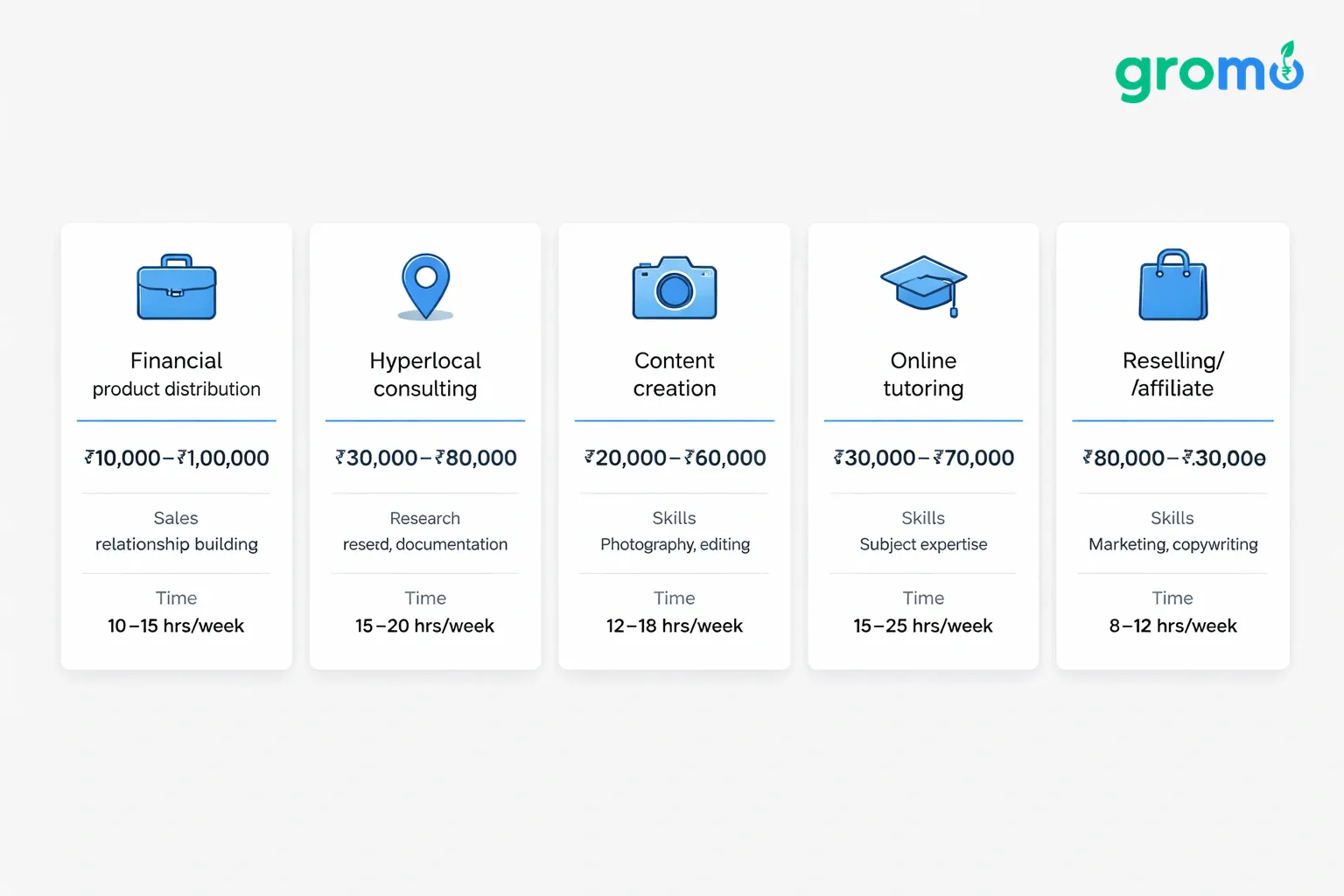
Step 1: Choose Your Business Model (Days 1–3)
Evaluate income potential versus time commitment:
| Business Model | Monthly Income | Skills Needed | Time Investment |
|---|---|---|---|
| Financial product distribution | ₹10,000–₹1,00,000 | Sales, relationship building | 10–15 hours/week |
| Hyperlocal consulting | ₹30,000–₹80,000 | Research, documentation | 15–20 hours/week |
| Content creation | ₹20,000–₹60,000 | Photography, editing | 12–18 hours/week |
| Online tutoring | ₹30,000–₹70,000 | Subject expertise | 15–25 hours/week |
| Reselling/affiliate | ₹5,000–₹30,000 | Marketing, copywriting | 8–12 hours/week |
Match your existing network (financial distribution works best with professional contacts), skills (tutoring requires subject mastery), and available time.
Step 2: Complete Free Training (Days 4–7)
- GroMo Academy: 8 video modules (2–3 hours) covering product knowledge, sales techniques, and compliance. Certification unlocks all products.
- YouTube skills: Search specific niches "Mumbai housing society consultant" or "Instagram reels for Mumbai businesses."
- Government resources: Maharashtra government's MSME portal offers free courses on business registration.
Understand zero-investment business models in 2026.
Step 3: Build Digital Presence (Days 8–14)
Minimum viable presence:
- WhatsApp Business account: Professional profile with services and quick replies.
- Google My Business listing: Free local SEO for searches like "financial consultant Andheri."
- LinkedIn profile: 250+ connections from Mumbai professionals; post weekly tips.
GroMo setup: Download app, complete KYC (PAN + Aadhaar; 10 minutes), generate referral links, and practice your pitch with 3 family members.
Step 4: Customer Acquisition (Days 15–30)
Warm outreach (80% of early customers): Send personalized WhatsApp messages to 50 contacts. Share value-first posts in community groups ("5 ways to improve CIBIL score for Mumbai residents" with a link in bio). Request referrals.
Cold outreach (20%, scales faster): Comment on relevant posts in "Mumbai Entrepreneurs" or "Andheri West Residents" Facebook groups. DM Instagram users engaging with finance content.
Conversion timeline: 50 contacts → 15 interested → 5 applications → 3 approvals. 3 approvals × ₹800 average = ₹2,400 first-week income.
Explore how to earn ₹50,000+ monthly with zero investment.
Step 5: Systematize and Scale (Month 2+)
Automation tools (all free):
- WhatsApp broadcasts: Send updates to 256 contacts simultaneously.
- Google Sheets: Track leads and follow-up dates.
- Calendly: Schedule calls without back-and-forth.
Team building: GroMo's referral program pays ₹500–₹1,500 for recruiting partners who complete training. Your team's earnings add 5–15% to your income.
Common Challenges for Mumbai Entrepreneurs
Challenge 1: Time Scarcity in 3-Hour Daily Commutes
Solution: Micro-tasking during transit. Mumbai's local trains offer connectivity. Send WhatsApp follow-ups (5 minutes), respond to inquiries (10 minutes), watch training videos (15 minutes) during the 90-minute commute. A Borivali-to-Churchgate commuter converts 3 hours of transit into 15–20 customer touchpoints.
Alternatively, focus hyperlocal. Kandivali residents serve only Kandivali customers. Digital-first businesses require zero in-person meetings.
Challenge 2: Housing Society Restrictions
Solution: Digital businesses are invisible. Financial product distribution, content creation, and affiliate marketing operate entirely online. You're not receiving foot traffic or storing inventory. If questioned, present it as "freelance consulting," which societies typically permit.
Challenge 3: High Competition
Solution: Hyperlocal specialization. Don't be a generic "financial consultant." Position as "Andheri East Startup Financial Advisor" or "Thane Housing Society Compliance Expert." A Goregaon-based partner targets only 15 housing societies within 2 km, becoming the trusted advisor for 4,200 families.
Challenge 4: Language and Cultural Diversity
Solution: Tailored communication. Mumbai's linguistic mix (42% Marathi, 22% Hindi, 18% Gujarati) requires different pitches. Gujarati families in Ghatkopar respond to "investment for children's future" messaging for demat accounts. South Indian professionals in Chembur prefer "tax-saving benefits" angles.
Read about legitimate ways to make money online in India.
Legal and Tax Considerations
No Business Registration Required Below ₹20 Lakh
Indian tax law doesn't mandate private limited company registration for freelance/commission income under ₹20 lakh annually. Report earnings as "Income from Other Sources" or "Business Income" in ITR-3 or ITR-4.
GST registration is optional below ₹20 lakh annual revenue for services.
Deductible Expenses
Even without registration, claim deductions:
- Mobile/internet bills: 40–60% of monthly cost (₹400–₹800 monthly).
- Co-working/café costs: Day passes and coffee meetings (₹2,000–₹5,000 monthly).
- Professional development: Courses and books (₹1,000–₹3,000 monthly).
₹3,000 monthly deductions × 12 months = ₹36,000 annual deduction; at 20% tax rate, saves ₹7,200.
GroMo Commission Tax Treatment
GroMo payouts are commission income. TDS doesn't apply to most GroMo commissions since individual partners aren't registered vendors. Maintain records of all payments for ITR filing.
Learn about top legitimate apps to earn money in 2026.
Success Metrics: What to Track Monthly
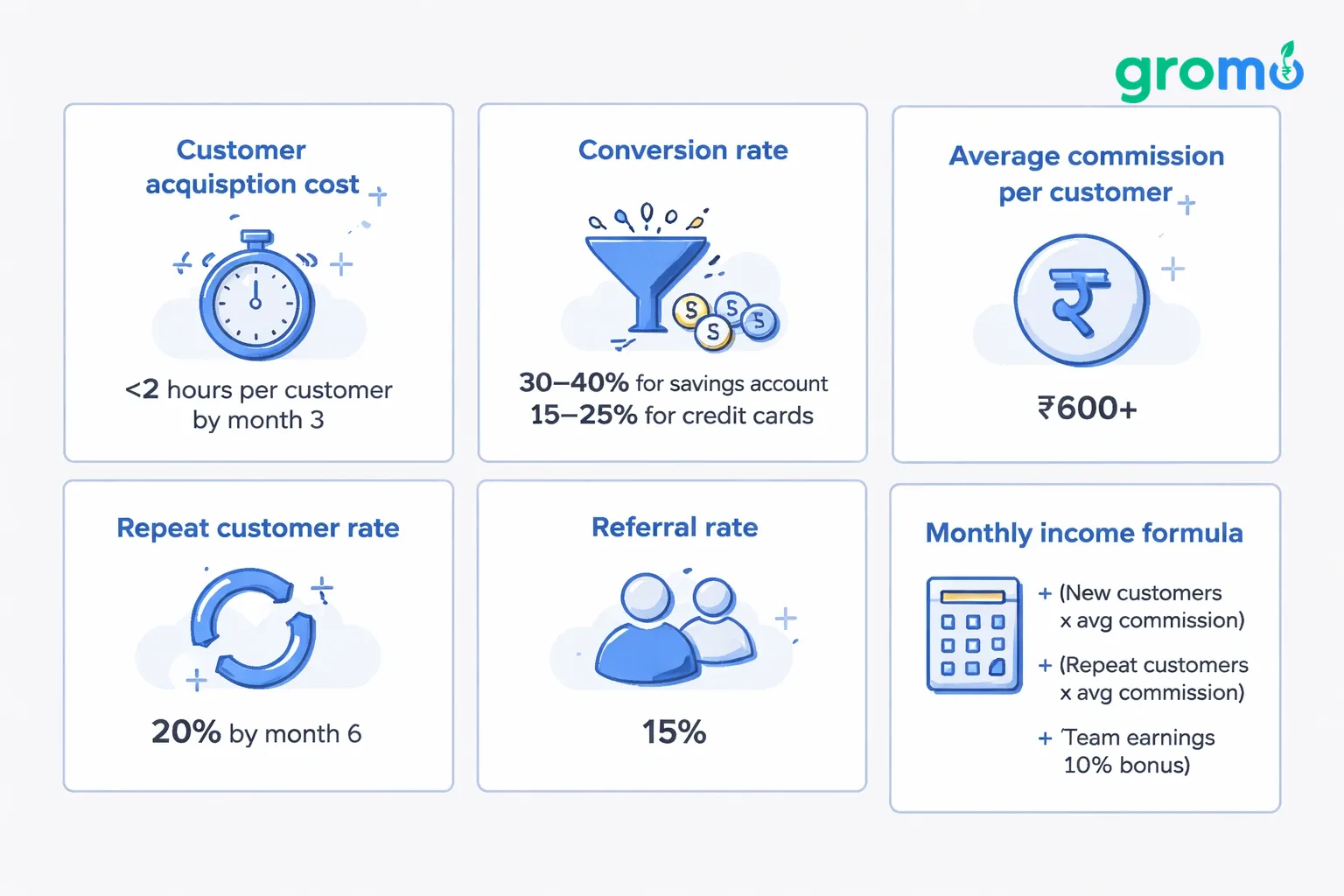
- Customer acquisition cost: Time invested ÷ customers acquired. Target: <2 hours per customer by month 3.< li>
- Conversion rate: Applications ÷ interested leads. Target: 30–40% for savings accounts, 15–25% for credit cards.
- Average commission per customer: Total earnings ÷ total customers. Target: ₹600+.
- Repeat customer rate: Customers who buy 2+ products ÷ total customers. Target: 20% by month 6.
- Referral rate: New customers from referrals ÷ total customers. Target: 15%.
Monthly income formula: (New customers × avg commission) + (Repeat customers × avg commission) + (Team earnings × 10% bonus) = total income. A mature GroMo partner in month 6: (30 new × ₹700) + (8 repeat × ₹1,200) + (₹60,000 team earnings × 10%) = ₹36,600.
Real Income Potential: Mumbai Case Studies
Case 1: Rajesh, Andheri IT Professional (Side Hustle)
- Background: Software engineer, 28, ₹12 lakh annual salary.
- Time: 8–10 hours weekly (evenings + weekends).
- Strategy: Shares GroMo links in office WhatsApp groups (150+ colleagues), alumni network (320 contacts), and apartment society (180 families).
- Income: Month 1: ₹11,200. Month 3: ₹34,600. Month 6: ₹58,400.
- Annual projection: ₹6,00,000 additional income; total compensation ₹18 lakh (50% increase).
Case 2: Meera, Borivali Homemaker (Primary Income)
- Background: MBA graduate, 34, not employed outside home due to childcare.
- Time: 15–20 hours weekly during school hours.
- Strategy: Targets housing society networks (12 societies, 3,600 families), school parent groups, and kitty party circles.
- Income: Month 1: ₹8,900. Month 3: ₹42,300. Month 6: ₹87,600.
- Annual projection: ₹9,00,000 income, exceeding many corporate salaries.
Case 3: Arjun, Dadar College Student (Pocket Money)
- Background: Commerce student, 21.
- Time: 6–8 hours weekly (college breaks, evenings).
- Strategy: Targets college peers (1,200 students) for first demat accounts and credit cards; expands to parents (business loan leads).
- Income: Month 1: ₹4,200. Month 3: ₹18,700. Month 6: ₹31,200.
- Annual projection: ₹3,00,000 saved by graduation startup capital or study-abroad fund.
Read how students earn ₹300–₹5,000 daily with GroMo.
Long-Term Vision: From Side Hustle to Scalable Enterprise
Zero-investment businesses offer three growth paths:
Path 1: Premium Freelancer (₹1–3 lakh monthly). Specialize deeply become "Mumbai's Top Business Loan Consultant." Charge consulting fees (₹5,000–₹15,000) plus GroMo commissions.
Path 2: Agency Owner (₹3–8 lakh monthly). Build a 20–50 person GroMo team across Mumbai's suburbs. Your 5–15% team bonus on ₹30 lakh monthly team earnings = ₹1.5–4.5 lakh passive income.
Path 3: Platform Creator (₹10 lakh+ monthly). Develop educational content (YouTube, online courses) teaching financial product distribution. GroMo income becomes proof-of-concept; content becomes primary revenue source.
All paths begin with the same zero-investment foundation.
Frequently Asked Questions
Q: Can I really start a business in Mumbai with zero investment? A: Yes, for digital models like GroMo, online tutoring, and affiliate marketing. You need a smartphone (92% of Mumbaikars already have one), internet (₹300–₹600 monthly), and time. Optional costs come later (premium tools, courses), but the launch requires ₹0.
Q: How much can I earn in the first three months? A: First month: ₹5,000–₹15,000 (learning curve). Second month: ₹12,000–₹30,000. Third month: ₹20,000–₹50,000. GroMo data shows Mumbai partners average ₹8,200 first month, ₹22,400 by month three, and ₹41,600 by month six with 10–15 hours weekly.
Q: Do I need special licenses to sell financial products through GroMo? A: No. GroMo holds aggregator licenses; partners operate under the platform's compliance umbrella. You must complete GroMo's free certification training (2–3 hours). If you charge separate advisory fees beyond commissions, SEBI RIA registration (₹50,000+) may apply. Stick to commission-based distribution to stay simple.
Q: What happens if my customers default on loans? A: You are not liable for defaults. GroMo operates a commission clawback policy: if a customer defaults within the first 3 EMIs, your commission is reversed. Your exposure is limited to the commission, not the loan principal. Mumbai partners report 8–12% clawback rates versus 15–18% nationally better customer quality reduces risk.
Q: Can I run this while working full-time? A: Yes 62% of GroMo's Mumbai partners are working professionals. Morning commute prospecting, lunch-break follow-ups, evening closures. Weekends handle volume. 8–10 hours weekly yields ₹20,000–₹40,000 monthly.
Q: What is the best business for someone with zero experience? A: Financial product distribution via GroMo. The platform provides training, manages backend operations, and requires skills you already have (talking to people, sharing links). Start with simple products Kotak 811 savings accounts and Axis Bank credit cards before progressing to business loans or demat accounts.


