
Zero-Investment Businesses 2026: Earn with GroMo


Zero-investment businesses let you start earning without spending money upfront. In April 2026, platforms like GroMo lead this space connecting 60 lakh+ partners with financial products, paying instant commissions, and requiring zero capital to begin. You sell credit cards, loans, and accounts through your smartphone, keeping 100% of earnings.
The traditional business model demanded inventory, office space, and working capital. Today's digital infrastructure removes these barriers entirely. This matters because India's gig economy now supports 7.7 million workers, and commission-based platforms are the fastest-growing segment. Understanding which zero-investment models actually deliver sustainable income separates opportunity from noise.
Why Zero Investment Models Work in 2026
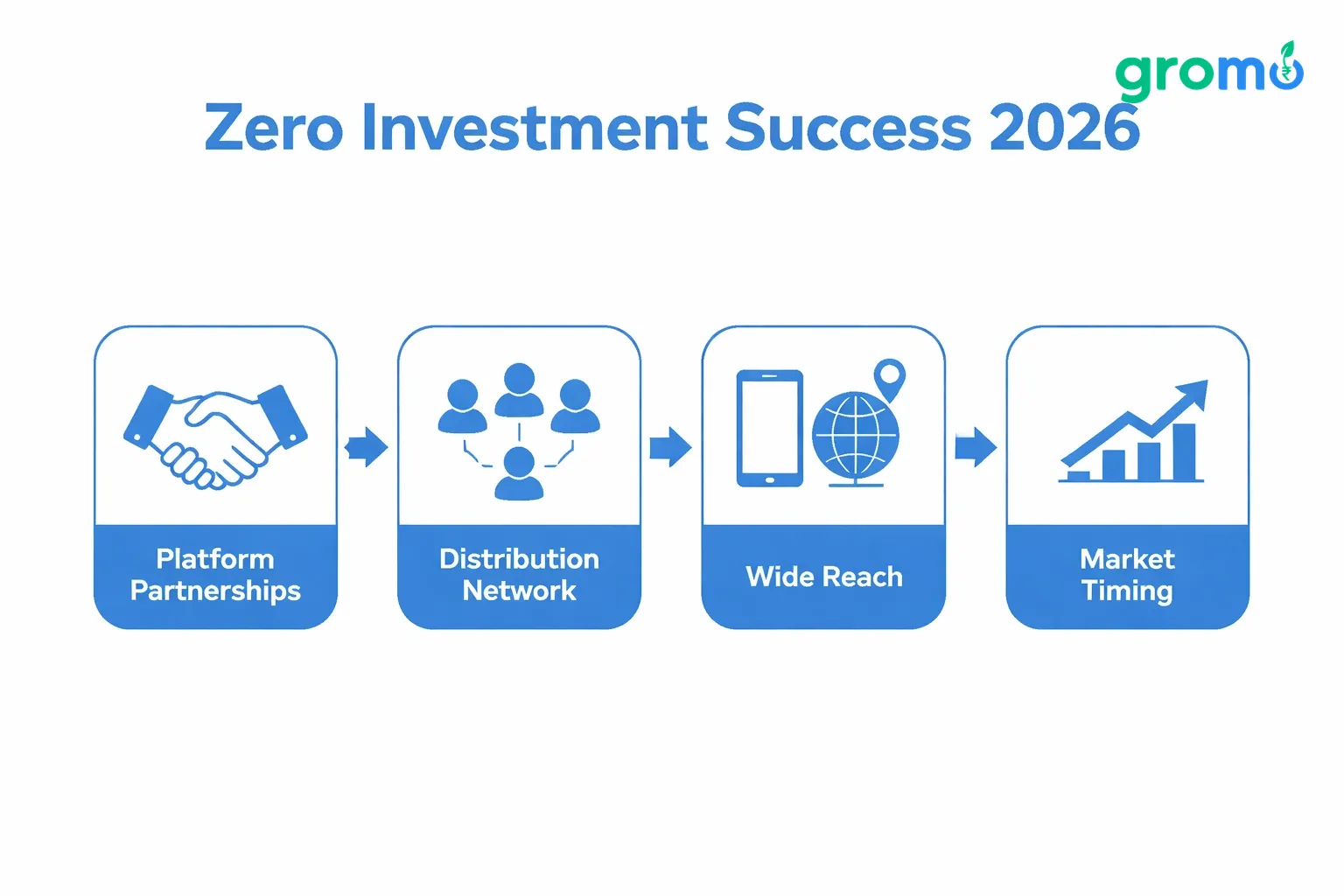
Zero-investment businesses work because they eliminate financial risk while using existing digital infrastructure. You use platforms that already secured brand partnerships, built technology, and handled compliance. Your role focuses on distribution connecting people you know with products they need.
Platform economics make this possible. Financial companies pay customer acquisition costs ranging from ₹500 to ₹5,000 per conversion. Instead of spending this budget on television ads or billboards, they channel it through distribution partners. You become that partner through apps like GroMo, which aggregates multiple financial brands under one interface.
The smartphone penetration rate in India reached 78% in 2026, creating reach that didn't exist before. A housewife in Indore or a college student in Kochi accesses the same earning tools as a Mumbai professional. Geography no longer constrains business potential. Your network friends, family, WhatsApp groups becomes your customer base.
Market timing reinforces this advantage. India's fintech sector crossed $150 billion in transaction value, and digital lending alone grew 28% year-over-year. Financial products moved from bank branches to mobile apps, and customers now expect digital-first experiences. This transition created demand for digital distributors who understand local contexts and build trust.
Start Your Zero-Investment Business Today
Best Zero-Investment Business Models for 2026
Financial product distribution is the highest-earning zero-investment model today. Platforms like GroMo connect you with 20+ financial brands Axis Bank, Kotak, Upstox, Bajaj Finserv. You earn ₹300-₹2,000 per credit card approval, 1.5%-2% on loans disbursed, and ₹100-₹500 per savings account opened.
The model works through link sharing. You complete free certification courses in the GroMo app, receive personalized content and landing pages, then share product links via WhatsApp, SMS, or social media. When someone applies and gets approved, commission hits your account within 24-72 hours. No inventory storage, no customer service handling, no payment collection headaches.
Affiliate marketing expanded beyond traditional blogging into micro-influencer territory. Instagram creators with 2,000 genuine followers monetize through Amazon Associates, Flipkart Affiliate, and niche programs. Fashion, electronics, home goods any product category works. Commissions range 2%-15% depending on category, with some partners earning ₹30,000-₹80,000 monthly.
Success requires content consistency rather than viral moments. Daily stories, genuine product reviews, and audience interaction build trust. The zero-investment aspect comes from using your existing smartphone and free social media accounts. No website hosting fees, no domain purchases, no advertising spend necessary initially.
Educational content creation monetizes expertise through platforms like Unacademy, Vedantu, or YouTube. Subject matter experts teaching competitive exams, coding, languages, or professional skills earn through revenue sharing. Unacademy pays ₹10,000-₹1,00,000 per course depending on enrollments. YouTube ad revenue plus sponsorships add supplementary income.
The barrier to entry dropped to near-zero. Screen recording software comes free, smartphone cameras shoot HD video, and platform infrastructure handles payment processing. Your investment is time creating curriculum, recording lessons, engaging with students. After initial content creation, courses generate passive income as new students enroll.
How GroMo Outperforms Other Zero-Investment Options
GroMo differs through instant payout architecture the shortest cycle in financial distribution. Most affiliate programs hold commissions 30-60 days for verification. GroMo releases payments within 24-72 hours post-approval. This cash flow advantage lets partners reinvest in marketing or simply access earnings faster.
The platform operates on tested fintech infrastructure, being Y Combinator backed and featured on Shark Tank India. This backing translates to reliable technology, strong brand partnerships, and legal compliance built into every transaction. You avoid the shady apps promising quick money but disappearing with earnings a common problem documented in this analysis of legitimate earning apps.
Multi-product portfolio creates earning diversity unavailable in single-product businesses. Your customer needs a credit card today, a personal loan next month, a demat account eventually. GroMo lets you serve all these needs through one platform. Each product category offers different commission structures:
Product Type | Commission Range | Approval Time | Repeat Potential |
|---|---|---|---|
Credit Cards | ₹300-₹2,000 | 7-15 days | Medium (card upgrades) |
Personal Loans | 1.5%-2% of loan amount | 2-5 days | Low (yearly refi) |
Savings Accounts | ₹100-₹500 | Instant-3 days | Very Low (one-time) |
Demat Accounts | ₹300-₹800 | 5-10 days | Low (occasional funding) |
Business Loans | 1.75%-2% of loan amount | 3-7 days | Medium (repeat borrowers) |
The free certification program converts beginners into credible advisors. Courses cover product knowledge, compliance basics, sales techniques, and customer objection handling. This education increases conversion rates trained partners close 30-40% more applications than untrained ones. Certifications also add legitimacy when pitching products to potential customers.
Support infrastructure removes common friction points. Customer management tools track application status, automated reminders ensure follow-ups, and personalized marketing collateral presents you as a professional distributor. Data security protocols protect customer information, eliminating legal exposure that comes with informal selling.
Comparing alternatives clarifies GroMo's position. Money-earning game apps promise ₹5,000-₹10,000 daily but function as gambling dressed as skill games. Survey apps pay ₹5-₹20 per hour below minimum wage. Refer-and-earn schemes offer one-time bonuses but lack sustainable income potential.
Join 60 Lakh+ Partners Earning with GroMo
Step-by-Step: Starting Your Zero-Investment Business Today

Download and register on the GroMo app through official channels. Registration takes five minutes mobile number, email, PAN card, and Aadhaar for KYC compliance. Verification completes within 24 hours, giving access to the full product suite and commission dashboard.
Avoid third-party websites claiming GroMo registration with upfront fees. The authentic app stays free forever. Some users confuse it with PAN card agency work, but GroMo's model differs fundamentally from those traditional agency structures requiring deposits.
Complete certification courses in the GroMo Academy section. Four core modules cover financial product basics, compliance requirements, digital selling techniques, and customer relationship management. Each module takes 20-30 minutes, includes video lessons and quizzes, culminating in a certificate. This certificate displays on your profile, building customer confidence.
Advanced courses dive deeper into specific products credit card eligibility criteria, loan underwriting basics, demat account features. Take these based on which products your network needs most. Urban professionals want credit cards and investment accounts; small business owners need business loans. Match your expertise to your audience.
Identify your initial customer pool through existing networks. List 20-30 people who might need financial products within three months. Categories include:
Friends/family members planning large purchases
Colleagues discussing credit card rewards or loans
WhatsApp group members sharing financing questions
Social media contacts posting about financial needs
Small business owners in your locality
Approach these conversations naturally. Instead of direct pitches, position yourself as a resource: "I help people find the right credit cards and loans now. If you ever need suggestions, let me know." This soft approach generates warm leads who trust your recommendations.
Share product links through multiple channels. GroMo generates unique tracking links for each product. When a customer clicks your link, applies, and gets approved, the system attributes that conversion to you. Distribution channels include:
WhatsApp Status: Share product highlights with call-to-action
Instagram Stories: Create engaging graphics using GroMo collateral
Facebook Groups: Answer financial questions with product suggestions
SMS: Send personalized recommendations to contacts
Email: For professional networks, send detailed comparisons
The key is personalization. Generic "Apply for this card" messages get ignored. Better: "Hey Rajesh, I remember you mentioned wanting travel rewards. This Axis credit card gives 10 reward points per ₹100 plus airport lounge access. Let me know if you want details."
Follow up systematically using GroMo's customer management tools. The app tracks application status pending, approved, rejected, documents required. Set reminders to check with customers, help with document uploads, and answer questions. Follow-up discipline separates ₹20,000/month earners from ₹1,00,000/month earners.
Application rejections happen credit score issues, income mismatches, documentation gaps. Instead of abandoning these customers, suggest alternatives. Low credit score? Recommend secured credit cards or credit-building products. Income too low for premium cards? Suggest entry-level options. This consultative approach builds long-term relationships and repeat business.
Track performance through dashboard analytics. GroMo shows clicks, applications, approvals, and earnings by product type. Analyze which products convert best in your network. If demat accounts see high interest but low applications, your pitch needs refinement. If personal loans convert well, double down by finding more borrowers.
Monthly earning patterns emerge after 60-90 days. Typical progressions show ₹5,000-₹15,000 in month one (learning phase), ₹20,000-₹40,000 in month two (network penetration), and ₹50,000+ from month three onwards as referrals and repeat customers multiply. Top performers reaching ₹1 lakh+ monthly usually build sub-networks through GroMo's referral program.
Scaling from ₹20,000 to ₹1,00,000 Monthly
Build a sub-network through GroMo's referral system. You earn override commissions when people you refer become active partners. The structure rewards team building your referrals' earnings boost your income without capping theirs. This creates exponential growth unavailable in solo businesses.
Recruit people with different networks. If your contacts are urban professionals, find partners accessing self-employed segments, rural customers, or specific communities. Diversity expands total addressable market. Provide training support using the same academy courses you completed, plus weekly group calls to share best practices.
Override commissions add ₹10,000-₹30,000 monthly for partners managing teams of 10-20 active sub-partners. Some leaders with 50+ active sub-partners earn ₹50,000-₹1,00,000 purely from overrides, before counting their direct selling earnings. This model resembles network marketing but without joining fees or mandatory purchases.
Specialize in high-ticket products like business loans and premium credit cards. Business loans pay 1.75%-2% commission on disbursed amounts. A ₹5 lakh business loan nets ₹8,750-₹10,000 commission. Compare this to savings accounts paying ₹100-₹500. Volume strategy works initially, but value strategy scales earnings faster.
Building business loan expertise requires understanding SME financing needs. Take specialized courses on business loan products, learn GST requirements, Udyam registration processes, and cash flow analysis basics. Position yourself as a business financing advisor rather than generic product pusher.
Target industries with consistent financing needs retail shops needing working capital, restaurants expanding seating, logistics operators buying vehicles, manufacturers purchasing equipment. Create case studies showing how similar businesses benefited from specific loan products. Data-driven recommendations convert better than feature lists.
Create content systematically to generate inbound leads. Start a WhatsApp broadcast list sharing financial tips weekly credit score improvement, loan eligibility criteria, credit card fee comparisons. Value-first content builds authority. After three months, subscribers proactively ask for product recommendations.
Instagram and Facebook pages work similarly. Post educational content 5 days weekly infographics on interest rate differences, videos explaining loan application processes, stories answering common questions. Include subtle CTAs: "DM for personalized recommendations." These digital marketing approaches compound over time as your follower base grows.
YouTube monetization adds a parallel income stream. Create tutorials on financial topics "How to improve CIBIL score in 6 months," "Choosing the right credit card for travel rewards," "Small business loan application guide." SEO-optimized videos attract organic search traffic. After meeting YouTube Partner requirements, ad revenue supplements commission earnings.
Leverage seasonal demand by anticipating customer needs. Diwali season (October-November) sees high credit card applications for shopping. Tax-saving season (January-March) drives investment account openings. Wedding season (November-February) spikes personal loan demand. Summer (April-June) increases travel credit card interest.
Prepare marketing campaigns ahead of these cycles. Create festive-themed content, special offers from partner brands, and targeted outreach to relevant customer segments. This proactive approach captures demand when it peaks rather than reacting after the season ends.
Common Mistakes That Kill Zero-Investment Businesses
Making unrealistic income promises ranks as the fastest way to lose credibility and violate platform policies. Claims like "Earn ₹50,000 in first week guaranteed" or "Everyone makes ₹1 lakh monthly" damage trust and break compliance rules. GroMo and similar platforms monitor partner communications, banning users who make false guarantees.
Realistic framing works better long-term: "Partners typically earn ₹5,000-₹15,000 monthly in the first 60 days as they learn the platform. With consistent effort and network building, ₹50,000-₹1,00,000 becomes achievable in 6-12 months." This honesty attracts serious individuals rather than get-rich-quick seekers who quit after two weeks.
Neglecting compliance training leads to rejected applications and reversed commissions. Each financial product carries eligibility criteria and documentation requirements. Pushing a premium credit card to someone earning ₹15,000 monthly wastes everyone's time minimum income is ₹30,000. Applying for a secured business loan without GST registration gets auto-rejected.
Learn product eligibility inside-out. Pre-qualify customers before sending application links. Ask screening questions: "What's your monthly income?" "Do you have an existing credit card?" "What's your CIBIL score range?" These questions prevent wasted applications and improve conversion rates from 15-20% to 40-50%.
Focusing solely on new customers ignores relationship value. A person who took a credit card from you has proven trust. They'll need loans, investment accounts, or insurance eventually. Maintain relationships through periodic check-ins, sharing relevant financial tips, and proactive suggestions as their needs evolve.
Customer lifetime value in financial distribution spans 3-7 years. The initial ₹500 credit card commission becomes ₹5,000-₹15,000 over multiple products as you serve their changing needs. Database management even a simple Excel sheet tracking customer product history and upcoming needs multiplies long-term earnings.
Ignoring data privacy creates legal exposure and platform penalties. You handle sensitive information PAN numbers, Aadhaar details, bank statements, income documents. Mishandling this data violates platform terms and potentially breaks laws like the Digital Personal Data Protection Act 2023.
Store customer information only within platform-provided tools. Don't screenshot and share Aadhaar photos in WhatsApp groups. Don't discuss specific customer applications publicly. Don't sell customer data to third parties. GroMo's infrastructure encrypts data and limits access, but partner discipline matters equally.
Giving up during the learning curve prevents most people from reaching earning potential. The first 15 applications might generate only 2-3 approvals. Initial earnings of ₹3,000-₹5,000 after two weeks of effort discourages many. They conclude "this doesn't work" and quit, missing the compounding phase starting months 3-4.
Success follows a J-curve flat or declining initially as you learn, then exponential as skills and network effects kick in. Partners who push through the first 90 days almost universally reach ₹20,000+ monthly. Those who quit in week 3 never discover the business's true potential. Sustainable zero-investment income requires patience alongside effort.
Tax and Legal Considerations for Zero-Investment Businesses

Commission income is taxable under "Income from Business or Profession" or "Income from Other Sources" depending on activity scale. If financial product distribution is your primary income source or you operate systematically (multiple daily applications, team building, branded identity), it qualifies as business income. Occasional referrals treating it as supplementary income fall under Other Sources.
Business income allows expense deductions smartphone costs, internet charges, marketing expenses, travel for customer meetings. Maintain basic records commission payment screenshots, expense receipts, customer lists. These deductions reduce taxable income significantly. Consult a CA to structure this optimally, especially when earnings cross ₹10 lakhs annually.
GST registration becomes mandatory when aggregate turnover exceeds ₹20 lakhs (₹10 lakhs for special category states) in a financial year. Commission earnings count toward this threshold. Registration involves online application through the GST portal, typically completing in 7 days. Compliance requires quarterly or monthly returns depending on turnover.
Many partners operating below this threshold don't need GST registration. However, some B2B customers prefer GST-registered distributors for input tax credit claims. Voluntary registration below the threshold is permitted and sometimes strategic for positioning yourself as a serious business entity.
Platform commissions fall under TDS provisions when annual payments exceed ₹15,000 from a single source. GroMo and similar platforms deduct TDS before payment or issue Form 16A for partners to claim credit against total tax liability. Maintain these documents for ITR filing, ensuring you don't pay tax twice on the same income.
If your total income including commissions stays below the basic exemption limit (₹3 lakhs for individuals, ₹5 lakhs for senior citizens), file ITR to claim TDS refunds. Even zero-tax situations require return filing when turnover exceeds ₹60 lakhs or for claiming various deductions.
Business insurance protects against risks uncommon in zero-investment models but worth considering at scale. Professional indemnity insurance covers claims arising from professional advice unlikely but possible if a customer alleges mis-selling. Cyber insurance protects against data breaches if you store customer information on personal devices.
Most individual partners skip insurance initially, adding coverage when monthly earnings stabilize above ₹50,000-₹75,000. At that scale, business continuity matters enough to warrant ₹5,000-₹10,000 annual insurance premiums. Evaluate based on risk tolerance and business size.
Alternative Zero-Investment Models Worth Considering
Freelance services monetize existing skills through platforms like Fiverr, Upwork, Freelancer, and Toptal. Writing, graphic design, programming, video editing, virtual assistance any digital skill finds buyers. Earnings range ₹20,000-₹2,00,000+ monthly depending on skill level and client acquisition consistency.
The zero-investment aspect requires existing skill. A graphic designer needs no capital beyond laptop and software (often available free). A writer needs only internet access. The investment is skill development time, not money. Build a portfolio through free projects initially, then transition to paid work as reviews accumulate.
Platform fees eat 10-20% of earnings, and payment processing adds another 2-3%. Account for these when setting rates. International clients pay better but require PayPal or Payoneer accounts with their fee structures. Domestic clients simplify payment but often negotiate harder on pricing.
Content creation across YouTube, Instagram, and blogging monetizes attention. YouTube pays ₹8,000-₹25,000 per million views through AdSense, plus sponsorships adding ₹15,000-₹1,00,000+ per integration. Instagram creators with 10,000-50,000 followers earn ₹5,000-₹50,000 per sponsored post depending on niche and engagement.
The zero-investment claim assumes you already own a smartphone. Additional costs are optional lighting equipment, editing software subscriptions, thumbnail design tools. Many successful creators started with smartphone cameras and free editing apps, upgrading only after monetization began.
Patience defines this path. Most channels take 6-12 months to reach monetization thresholds (1,000 subscribers and 4,000 watch hours for YouTube). Instagram growth depends on algorithm luck and content quality. Unlike GroMo's immediate commissions, content creation offers delayed but potentially higher returns.
Online tutoring through Vedantu, Unacademy, Chegg, Tutor.com, or independent sessions lets subject experts monetize knowledge. Rates range ₹200-₹2,000 per hour depending on subject, student level (school/competitive exam/professional), and platform. Monthly earnings reach ₹30,000-₹1,50,000 for full-time tutors.
Zero-investment applies if teaching from home using existing internet and devices. Whiteboard apps and screen sharing replace physical teaching aids. Some platforms provide curriculum and materials, eliminating preparation work. Others expect tutors to create content, increasing time investment but potentially raising earnings through content ownership.
Digital product sales involve creating e-books, courses, templates, or tools once and selling repeatedly. A well-made course or e-book on platforms like Gumroad, Teachable, or Amazon Kindle generates passive income for years. Initial creation takes 40-200 hours, but subsequent sales require minimal effort.
This model needs expertise worth packaging and audience to sell to. A programmer creates coding tutorials. A fitness trainer sells workout plans. A marketer offers social media templates. Validation matters test demand through free content before investing 100+ hours creating paid products.
Comparing these alternatives to GroMo's financial distribution model shows different effort-to-income timelines. Freelancing offers quick income but trades time for money. Content creation builds assets but demands patience. Online tutoring provides steady income but caps at available hours. Financial distribution combines quick initial earnings with scaling potential through team building.
Real Success Stories: From ₹0 to ₹1 Lakh Monthly
Priya Sharma, 28, Mumbai worked as an HR executive earning ₹35,000 monthly. She discovered GroMo in January 2025, initially skeptical about zero-investment claims. Started by sharing credit card links with office colleagues during lunch breaks. First commission of ₹450 arrived after 12 days, validating the model.
Month 1: ₹6,800 from 3 credit cards and 2 personal loans. Month 2: ₹18,500 by expanding to her apartment society WhatsApp groups. Month 3: ₹32,000 after completing advanced certification and focusing on business loans. Month 6: ₹78,000 including override commissions from 8 recruits. Month 12: ₹1,24,000, surpassing her salary. She didn't quit her job but treated GroMo as serious side income funding her wedding savings.
Key lesson: Priya succeeded by treating it like a real business despite zero investment. Dedicated 90 minutes daily 30 minutes content creation, 30 minutes follow-ups, 30 minutes learning. Consistency mattered more than hustle.
Rajesh Kumar, 35, Jaipur ran a small mobile accessories shop earning ₹25,000-₹30,000 monthly. Shop location was poor, limiting footfall. Discovered GroMo through a Facebook ad in March 2025. Realized he already had customer relationships people buying phone cases might need credit cards or loans.
Started recommending financial products during regular transactions: "Sir, ye case ke saath, agar aapko credit card chahiye to main help kar sakta hoon." His existing credibility as a shopkeeper converted leads efficiently. Month 1: ₹12,000. Month 3: ₹45,000. Month 6: ₹89,000. Month 9: ₹1,32,000.
Key lesson: Rajesh leveraged existing business relationships rather than cold outreach. His shop became a financial product distribution point alongside mobile accessories, with zero additional overhead. This hybrid model suits any local business kirana stores, salons, pharmacies where customer interactions already occur.
Anjali Mehta, 42, Pune was a homemaker wanting income without office commitments. Skeptical initially, thinking "these apps are scams." Her daughter researched GroMo's Y Combinator backing and Shark Tank feature, convincing her to try. Started slowly, sharing links in housing society ladies' WhatsApp groups.
Month 1: ₹3,200 from 2 approvals. Considered quitting, but husband encouraged persistence. Month 2: ₹9,800 as word spread. Month 3: ₹16,500. Month 6: ₹52,000 by recruiting 5 other homemakers and earning overrides. Month 12: ₹94,000. Month 18: ₹1,18,000 managing a network of 23 active partners.
Key lesson: Anjali's story breaks stereotypes about digital earning requiring tech expertise. She learned smartphone skills alongside building the business. Her success inspired other homemakers in her network, creating a supportive community that shared leads and strategies.
Frequently Asked Questions
Q: Which business is best for 0 investment?
A: Financial product distribution through platforms like GroMo ranks as the best zero-investment business in 2026, offering instant payouts of ₹300-₹10,000 per transaction, requiring only a smartphone and internet connection. Unlike content creation or freelancing that need months to monetize, you earn commissions within days of your first successful referral. The model combines immediate income with scaling potential through team building, making it suitable for students, working professionals, and homemakers alike.
Q: What business has a 90% success rate?
A: No legitimate business model has a 90% success rate that's a red flag for scams. In reality, zero-investment businesses like GroMo see 30-40% of registered users earning consistently after 90 days of active effort. Success correlates with consistency partners dedicating 60-90 minutes daily, completing certifications, and maintaining follow-up discipline achieve ₹20,000+ monthly within 3-6 months. The failure comes primarily from unrealistic expectations and quitting during the first 30 days before network effects compound.
Q: Who are Gen Z entrepreneurs?
A: Gen Z entrepreneurs are individuals born 1997-2012 who leverage digital platforms, social media fluency, and creator economy tools to build businesses. They favor zero-investment, location-independent models dropshipping, content creation, affiliate marketing, financial distribution, and digital services. Unlike previous generations starting traditional businesses, Gen Z entrepreneurs monetize through apps like GroMo, Instagram, YouTube, and freelance platforms, often running multiple income streams simultaneously while maintaining flexibility.
Q: How to start a business with RS 50,000?
A: With ₹50,000 capital, focus on digital businesses offering high returns relative to investment: (1) E-commerce reselling source products from wholesalers, list on Amazon/Flipkart; (2) Freelance agency hire 2-3 specialists, resell services at markup; (3) Hyperlocal delivery service partner with local stores using gig delivery workers; (4) Digital marketing agency invest in tools and client acquisition. However, consider testing zero-investment models like GroMo first to validate entrepreneurial aptitude before risking capital many successful business owners start with commission-based platforms to build skills and capital before launching traditional businesses.


