
What Is Credit Line? Meaning, How It Works and Who Gets One
What is credit line? A pre-approved limit you draw from repeatedly, paying interest only on what you use. Meaning, costs, eligibility and loan comparison.

What is credit line, in one sentence: it is a pre-approved borrowing limit that you can draw from as often as you like, where interest is charged only on the amount you actually use, not on the full limit.
Draw a small amount from a larger sanctioned limit and you pay interest on the drawn amount alone. Repay it, and that headroom becomes available to borrow again.
Refilling is what separates a credit line from every other borrowing product in India. A loan is a one-time lump sum that shrinks as you repay. A line of credit refills.
| Question | Short answer |
|---|---|
| Credit line meaning | A pre-approved limit you can borrow from repeatedly |
| Interest charged on | Only the amount drawn, not the sanctioned limit |
| Does the limit refill | Yes, as you repay |
| Limit size | Set by the lender, based on your profile |
| Collateral needed | Usually none |
| Best suited to | Irregular or unpredictable expenses |
Key takeaways
- A credit line charges interest only on what you draw. An unused limit costs nothing in interest, though some lenders charge a small annual or processing fee.
- The limit is revolving: repaying restores your available balance, unlike a personal loan, which closes once repaid.
- Lenders decide the limit from your credit score, income and repayment history. Approval is not guaranteed and the limit offered is often lower than the maximum advertised.
- GroMo partners earn up to ₹600 per approved case on credit line products, the highest being the Bajaj Finserv Insta EMI card (GroMo product catalogue, read 29 September 2026).
What Is Credit Line in Simple Terms?
A credit line, also written as a line of credit, is a standing approval to borrow up to a fixed ceiling. The lender assesses you once and sets the ceiling. After that, you draw money whenever you need it, in whatever amounts you want, up to that ceiling.
Three features define it:
Revolving. Repay what you drew and the limit is restored. You do not reapply.
Pay for use. Interest accrues on the drawn amount from the day you draw it. An untouched limit accrues no interest.
Flexible drawing. Most lenders let you draw in parts, on different days, rather than forcing you to take the whole sanctioned amount at once.
In India these are offered by banks and NBFCs, and increasingly through apps that route the limit to your UPI or to an EMI card.
Types of Credit Line in India
The same revolving idea shows up in five forms, and knowing which one you are being offered tells you what it will cost.
- Personal credit line apps. App-based limits from NBFCs, drawn to your bank account in parts. Convenient, usually priced above personal loans.
- Credit line on UPI. Since 2023 the RBI has allowed pre-sanctioned bank credit lines to be linked to UPI, so you can pay merchants from a credit limit the way you pay from a savings account.
- EMI cards. A pre-approved limit for converting purchases into EMIs at partner stores, such as the Bajaj Finserv Insta EMI card.
- Loan against securities or mutual funds. Your investments are pledged as collateral and the limit is set as a share of their value, typically at lower rates because the lender is secured.
- Business overdraft. A bank limit on a current account for traders and small businesses to cover working capital gaps.
How Does a Credit Line Work, Step by Step?
- You apply once. The lender checks your credit score, income and existing obligations.
- A limit is sanctioned. Nothing is transferred yet, and nothing is owed.
- You draw what you need. A part of the limit hits your account or is paid to a merchant.
- Interest starts on the drawn amount only, not on the sanctioned ceiling.
- You repay, usually in EMIs or as a flexible repayment. Your available limit climbs back up.
- You draw again whenever needed, without a fresh application.
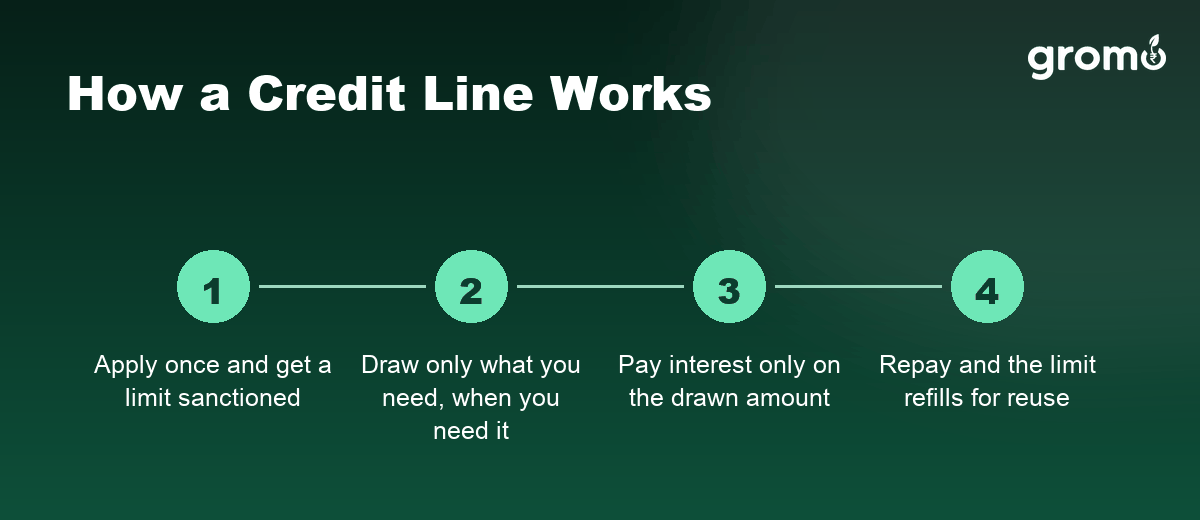
Repayment works like any other borrowing, through instalments whose size depends on the drawn amount, rate, and tenure, the same maths behind every EMI calculation.
Credit Line vs Personal Loan: What Is the Difference?
Borrowers weighing these two are really asking one question: is the expense one-off or recurring?
| Credit line | Personal loan | |
|---|---|---|
| Disbursal | Draw as needed | One lump sum upfront |
| Interest on | Only the drawn amount | The full loan amount, reducing as you repay |
| Limit after repayment | Refills, reusable | Closes, reapply for more |
| Best for | Irregular, unpredictable costs | A single known expense |
| Interest rate | Usually higher | Usually lower |
| Approval | Once, then reusable | Each time you borrow |
The trade-off is plain. A credit line costs more per rupee borrowed but you only borrow what you need, when you need it. For a single large planned expense, a personal loan is almost always cheaper. For a shop owner covering irregular stock purchases, the credit line usually wins.
How Is a Credit Line Different From a Credit Card or BNPL?
Revolving limits are common to all three products, which is why they get confused. The differences are in how you spend and what you pay.
A credit card gives you a revolving limit tied to a card you swipe, with an interest-free period if you pay the bill in full.
A credit line usually gives you cash or a UPI limit, and interest typically starts from day one. Cards themselves come in several forms, from cashback to travel, and the types of credit cards in India differ mainly in fees and rewards.
Buy Now Pay Later is narrower still. A BNPL limit attaches to purchases at partner merchants and is usually repaid in a handful of short instalments, often interest-free if you pay on time. You cannot generally take BNPL as cash, and the limit tends to be smaller than a credit line's.
A credit line sits between the two. Broader than BNPL, because it is not tied to a merchant list. More cash-like than a card, because the money can reach your bank account or UPI rather than only paying a merchant terminal.
The cheapest option depends on how quickly you repay. Pay a card bill in full each month and it doesn't cost you anything in interest.
Carry a balance on that same card and it becomes one of the most expensive ways to borrow in India. A credit line charges from day one but usually at a lower rate than a revolved card balance, which is why people carrying month-to-month balances often move to one.
For purchases at partner merchants only, buy now pay later is the narrower, often interest-free alternative.
What Does a Credit Line Actually Cost?
Look past the headline interest rate at four things:
- Interest rate. Quoted monthly or annually. Always convert to annual before comparing.
- Processing fee. Charged at sanction, sometimes again on each drawdown.
- Annual maintenance. Some lenders charge for keeping the limit open even if you never draw.
- Late payment charges. Typically the most expensive line item.
A limit you never use shouldn't cost you much at all. If a lender is charging meaningfully for an idle limit, that is a reason to look elsewhere.
Who Can Get a Credit Line in India?
Lenders differ, but the common bar is:
- Age: 21 to 60 for most lenders.
- Income: A verifiable income, salaried or self-employed. Bank statements usually suffice.
- Credit score: Most mainstream lenders want 700 or above. Below that, expect a lower limit or a decline.
- Documents: PAN, Aadhaar, and bank statements or salary slips.
If your score is the obstacle, understand that no lender is obliged to approve you and no agent can override a credit decision. Anyone promising guaranteed approval on a credit line isn't describing how the product works.
How GroMo Partners Earn on Credit Lines
GroMo is an Indian financial-products distribution platform where individuals sell credit cards, loans, savings accounts, demat accounts and credit lines from partner banks and NBFCs, and earn a commission on each approved case.
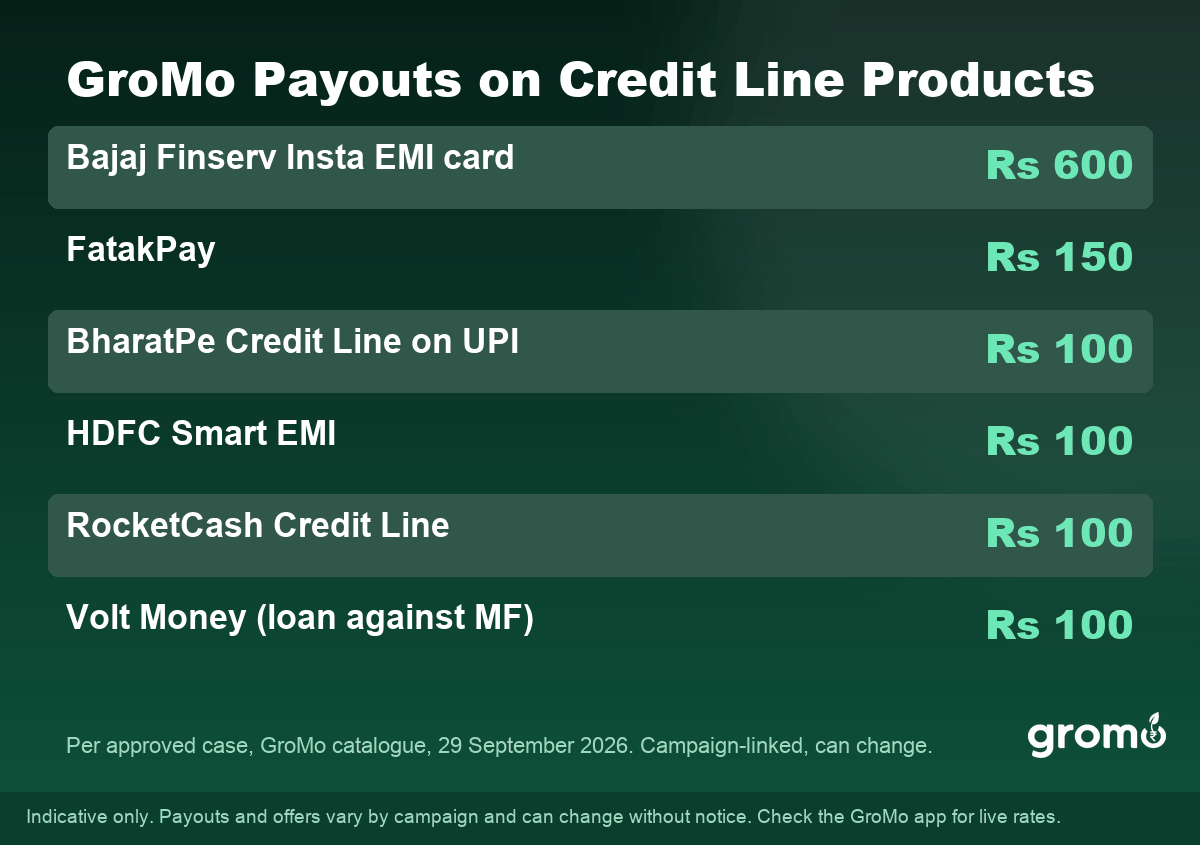
Credit lines sit in GroMo's catalogue alongside cards and loans. Current payouts (GroMo product catalogue, read 29 September 2026):
| Product | Payout per approved case |
|---|---|
| Bajaj Finserv Insta EMI card | ₹600 |
| FatakPay | ₹150 |
| BharatPe Credit Line on UPI | ₹100 |
| HDFC Smart EMI | ₹100 |
| RocketCash Credit Line | ₹100 |
| Volt Money (Loan Against Mutual Fund) | ₹100 |
Please note.
Credit lines convert well for one specific reason: the customer does not have to want money today. A limit that sits unused costs them little, so the decision is easier than committing to a loan.
- Download the GroMo app and register with your mobile number.
- Complete KYC with PAN, Aadhaar and bank account details.
- Share the credit line product with people whose expenses are irregular, like shopkeepers, freelancers, and small traders.
- Commission is credited once the case is approved.
Three Mistakes to Avoid
Treating the limit as savings. A sanctioned limit is debt waiting to happen, not money you own.
Ignoring the drawdown fee. A per-drawdown processing fee can make many small draws far costlier than one larger one.
Comparing monthly rates to annual rates. A monthly rate multiplied by twelve is the annual cost. Convert before you compare anything.
Borrowers with irregular needs usually find a credit line fits better than an instant loan, which is structured as a single one-time disbursal and closes once repaid.
Frequently Asked Questions
What is credit line in simple words?
A credit line is a pre-approved borrowing limit you can draw from repeatedly. Interest applies only to the amount you draw, and repaying restores the limit so you can use it again without reapplying.
What is a line of credit loan?
A line of credit loan is the same product described with the word "loan" attached. Unlike a standard loan, which pays out a single lump sum, a line of credit lets you borrow in parts up to a ceiling and charges interest only on what you take.
Is a credit line better than a personal loan?
Neither is better in general. A personal loan usually carries a lower interest rate and suits one known expense. A credit line costs more per rupee but lets you borrow small amounts repeatedly, which suits irregular expenses.
Does an unused credit line cost anything?
Usually very little. No interest accrues on an undrawn limit, though some lenders charge an annual maintenance or processing fee regardless of use. Check the fee schedule before accepting a limit.
What credit score do I need for a credit line in India?
Most mainstream lenders look for 700 or above. A lower score does not always mean rejection, but it typically means a smaller limit or a higher rate. The lender makes the final decision.
What is a credit line on UPI?
It is a pre-sanctioned credit limit from a bank that you link to a UPI app and spend from like a bank account, paying merchants by scanning QR codes. Interest and fees depend on the issuing bank, and the limit is subject to its approval.
Disclaimer
Payout figures in this article are indicative and were read from the GroMo product catalogue on 29 September 2026. Commissions are campaign-linked and can change without notice.
Earnings depend on how many of your customers are approved by the lender, and GroMo does not guarantee any level of income. Credit line sanction, limit and interest rate decisions rest entirely with the bank or NBFC.
Borrowing costs money, so read the lender's terms before drawing. This article is for information only and is not financial advice. GroMo is available only to users aged 18 and above.


