
15 Side Business Ideas for Salaried Employees in India 2026
Low cost ideas that fit after office hours, what each needs, and what your job contract allows.


The best side business ideas for salaried employees in India need little money and work outside office hours: selling financial products on commission, freelancing, tutoring, affiliate marketing, and small online selling. Choose one that doesn't compete with your employer, and check your job contract first. For a wider list, see our guide to side income sources.
Below are 15 side business ideas with what each costs, how much of your time it takes and the steps to start. Earnings depend on effort and vary widely, so we make no income promises. Where an idea has a risk, we say so.
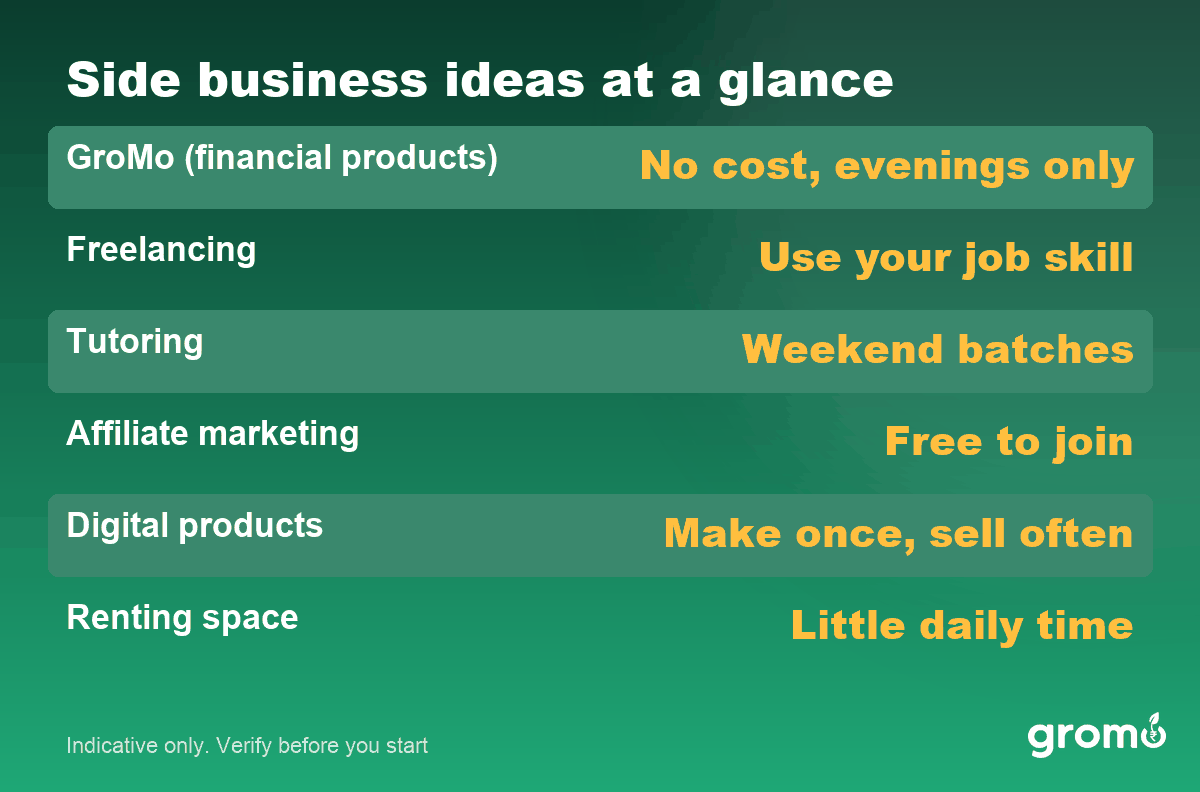
| # | Idea | Starting cost | Skills needed | Best for |
|---|---|---|---|---|
| 1 | Selling Financial Products With GroMo | None | Basic phone use; free training in the app | Anyone 18 or older |
| 2 | Freelancing in Your Job Skill | None | Your current professional skill | Writers, designers, coders, accountants |
| 3 | Online Tutoring or Coaching | Very low | Subject or career knowledge | Experienced professionals |
| 4 | Affiliate Marketing | None | Writing or social media | People with an audience |
| 5 | Virtual Assistant Work | None | Organisation, email, spreadsheets | Detail-minded employees |
| 6 | Content Creation | Low | Consistency, on-camera or writing | People with a clear niche |
| 7 | Online Selling or Reselling | Low | Selling, basic packing | People with a spare room |
| 8 | Dropshipping | Low | Store setup, basic ads | People who enjoy e-commerce |
| 9 | Renting Out Space | Low | Basic upkeep | People with a spare room or parking |
| 10 | Home Tiffin Service With a Partner | Medium | Cooking, or a family partner | Families near offices |
| 11 | Event Planning on Weekends | Low | Contacts, planning | Sociable, organised people |
| 12 | Local Repair and Service Business | Medium | Managing people | People with trade contacts |
| 13 | Online Courses and Digital Products | Very low | Expertise, simple tools | Experts in a niche |
| 14 | Bookkeeping or Tax Filing Help | Very low | Accounting basics | Accountants and finance staff |
| 15 | Wholesale Trading From Home | Medium | Sourcing, negotiation | People with local market contacts |
Starting-cost labels are our own rough estimates: None, Very low, Low and Medium. Actual costs depend on your city and setup.
How this list is ranked: GroMo comes first because it needs no money, no stock and no fixed hours. The rest follow the ideas that keep appearing in the top-ranking Indian guides for this search, with the ones that fit evenings and weekends placed higher.
1. Selling Financial Products With GroMo: Bank-paid commissions, no stock
Starting cost: None | Skills: Basic phone use; free training in the app | Best for: Anyone 18 or older
Selling financial products with GroMo tops this list because it costs nothing to start and needs only a smartphone. GroMo is a free app where you help people apply for credit cards, savings accounts, loans and demat accounts from partner banks, and you earn a commission when the application is approved. On GroMo, credit cards pay up to ₹2,000, savings accounts up to ₹1,000, demat accounts up to ₹450, and personal loans up to 4.5% of the loan amount (GroMo catalogue, retrieved 2026-11-06). Your office colleagues, neighbours and relatives are natural first customers, and you can work in the evenings with no fixed hours. The pay is commission only, with no fixed salary, and only approved applications earn; you must be 18 or older.
How to start:
- Download the GroMo app and register free with your phone number.
- Finish the one-time verification and the free in-app training.
- Share a product link with someone who genuinely needs it, then track the application in the app.
2. Freelancing in Your Job Skill: Sell what you already do
Starting cost: None | Skills: Your current professional skill | Best for: Writers, designers, coders, accountants
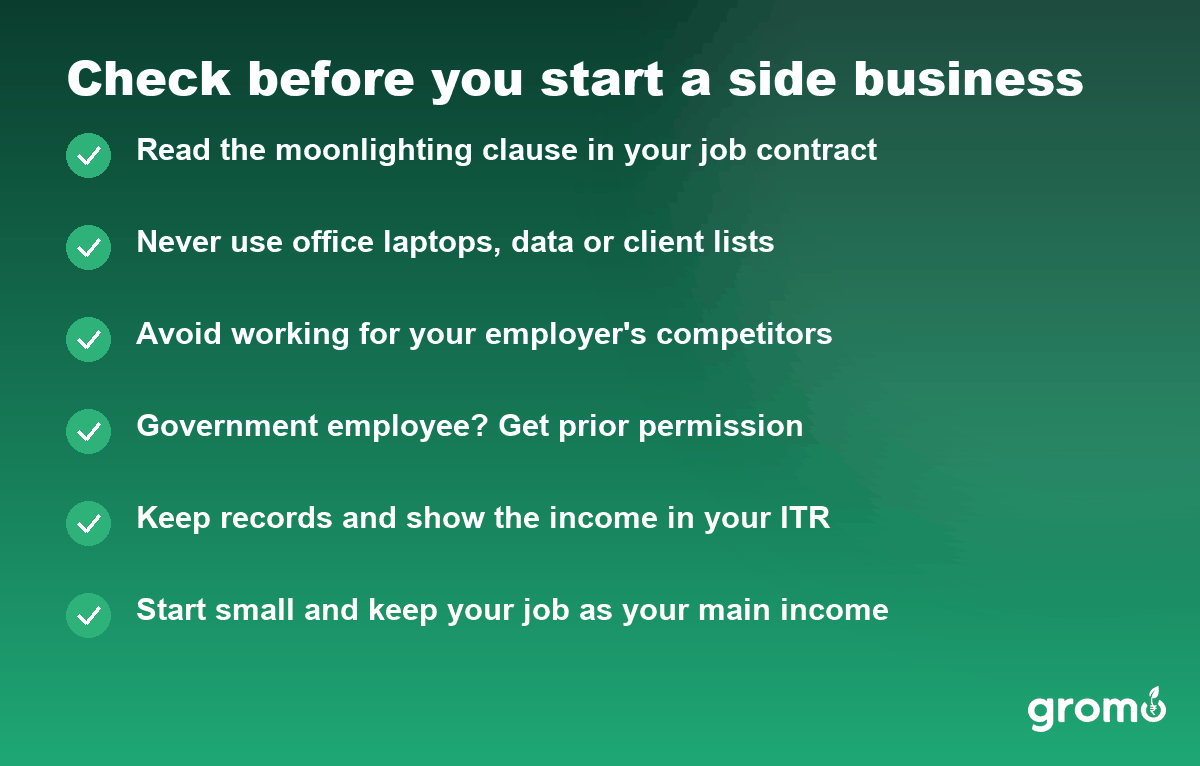
Freelancing lets you sell the skill you already use at work to other clients on evenings and weekends. Stay clear of your employer's competitors and clients, because that is where most contract problems begin.
How to start:
- List one service you can deliver in your free hours.
- Create a profile on a freelancing site.
- Take one small project to test your schedule.
3. Online Tutoring or Coaching: Teach on weekends
Starting cost: Very low | Skills: Subject or career knowledge | Best for: Experienced professionals
Online tutoring can mean school subjects, but working professionals often earn more by teaching a work skill such as Excel, accounting or spoken English. Weekend batches fit a full-time job well.
How to start:
- Pick one skill people pay to learn.
- Run one free weekend demo class.
- Open a small paid batch.
4. Affiliate Marketing: Recommend products you trust
Starting cost: None | Skills: Writing or social media | Best for: People with an audience
Affiliate marketing pays a commission when someone buys through your link. Most programmes are free to join, which makes it low risk, but income grows slowly until you have regular readers or followers.
How to start:
- Choose one topic you know well.
- Join a relevant affiliate programme.
- Publish honest reviews and disclose your links.
5. Virtual Assistant Work: Handle tasks for busy owners
Starting cost: None | Skills: Organisation, email, spreadsheets | Best for: Detail-minded employees
Virtual assistant work means handling email, scheduling and small admin tasks for business owners online. You can usually do it in fixed evening slots, which suits a day job better than work with urgent deadlines.
How to start:
- List three tasks you can do reliably.
- Offer a small weekly package to one founder.
- Ask for a testimonial, then raise your rate.
6. Content Creation: YouTube, reels or a blog
Starting cost: Low | Skills: Consistency, on-camera or writing | Best for: People with a clear niche
Content creation earns through ads, brand deals and affiliate links, but it often takes many months before money arrives. Check your contract too, since some employers restrict public content about your work.
How to start:
- Pick a narrow topic not tied to your employer.
- Publish weekly for three months.
- Add income sources once your audience grows.
7. Online Selling or Reselling: Sell on WhatsApp or marketplaces
Starting cost: Low | Skills: Selling, basic packing | Best for: People with a spare room
Online selling works well after hours because orders can wait until evening. Start with reselling or a small product range, and avoid heavy stock until you know what really moves. More options are in our guide to business ideas from home.
How to start:
- Pick one small product category.
- Sell to your own circle first.
- List on a marketplace once you have repeat buyers.
8. Dropshipping: Store without holding stock
Starting cost: Low | Skills: Store setup, basic ads | Best for: People who enjoy e-commerce
Dropshipping lets a supplier hold and ship the stock while you run the store. Customer complaints still come to you, and thin margins are common, so test one product with a small budget.
How to start:
- Find one product with clear demand.
- Build a simple store page.
- Test with a small ad budget and track returns.
9. Renting Out Space: Earn from what you already own
Starting cost: Low | Skills: Basic upkeep | Best for: People with a spare room or parking
Renting out a spare room, parking space or shop space is one of the few side incomes that needs very little daily time. Use a written agreement, and check your society rules first.
How to start:
- List what you can rent out.
- Check society and legal rules.
- Use a written agreement for every tenant.
10. Home Tiffin Service With a Partner: Run it with family
Starting cost: Medium | Skills: Cooking, or a family partner | Best for: Families near offices
A tiffin service is popular near offices and PG hostels, but it needs daily cooking, so it works best when a family member runs the kitchen. Any food business needs FSSAI registration, which starts at about ₹100 a year (IncorpX, retrieved 2026-11-06).
How to start:
- Test one menu with five regular customers.
- Get FSSAI registration.
- Use WhatsApp for daily orders.
11. Event Planning on Weekends: Weddings, birthdays and parties
Starting cost: Low | Skills: Contacts, planning | Best for: Sociable, organised people
Event planning fits salaried people because most events happen on weekends. You earn a planning fee for coordinating vendors, and your first jobs usually come from your own family and friends.
How to start:
- Help with one family event.
- Build a list of reliable vendors.
- Offer fixed-fee packages.
12. Local Repair and Service Business: Run it, don't do it
Starting cost: Medium | Skills: Managing people | Best for: People with trade contacts
Local services such as AC repair, cleaning or appliance fixing can be run with a trained worker while you handle calls and bookings. It takes more management than most side ideas, so start with one service and one worker.
How to start:
- Pick one service in demand nearby.
- Partner with one reliable technician.
- Take bookings through WhatsApp.
13. Online Courses and Digital Products: Sell templates or guides
Starting cost: Very low | Skills: Expertise, simple tools | Best for: Experts in a niche
Digital products such as templates, spreadsheets or short courses are made once and sold many times. They suit a day job well because selling doesn't need your time at fixed hours.
How to start:
- Find one problem you can solve in a guide.
- Make a simple version first.
- Sell through your network, then improve it.
14. Bookkeeping or Tax Filing Help: Seasonal, skill-based work
Starting cost: Very low | Skills: Accounting basics | Best for: Accountants and finance staff
Bookkeeping and tax filing help for small shops and freelancers pays well in filing season and needs only a laptop. Stick to what you're qualified to do, and avoid your employer's clients.
How to start:
- List the services you're qualified to offer.
- Start with two small local shops.
- Set a clear yearly or monthly fee.
15. Wholesale Trading From Home: Supply small local shops
Starting cost: Medium | Skills: Sourcing, negotiation | Best for: People with local market contacts
Wholesale trading means buying low-cost daily-use items in bulk and supplying local shops. Demand is steady, but it ties up money in stock, so it is riskier than the service ideas above and needs careful testing.
How to start:
- Find one item local shops buy often.
- Start with a small trial order.
- Reinvest only after your first orders pay back.
How Much Does GroMo Pay for Each Product?
| Product on GroMo | Pays partners up to |
|---|---|
| SBI Credit Card | ₹2,000 per approved card |
| HDFC Secured Credit Card | ₹1,750 per approved card |
| Axis Saving Account | ₹1,000 per account |
| Digi Credit Personal Loan | 4.5% of the loan amount |
| Kotak 811 Super Account | ₹600 per account |
| Kotak Securities Demat Account | ₹450 per account |
The SBI Credit Card pays partners up to ₹2,000 per approved card (GroMo catalogue, retrieved 2026-11-06). Commission is paid only on approval.
The Axis Saving Account pays up to ₹1,000 per successful account (GroMo catalogue, retrieved 2026-11-06). Many other products pay less.
The Digi Credit Personal Loan pays up to 4.5% of the loan amount, and most other lenders pay less (GroMo catalogue, retrieved 2026-11-06). Check the live payout in the app.
Can a salaried employee legally run a side business in India?
Usually yes for private-sector employees, but your employment contract decides. One guide notes that no Indian law bans a private employee from running a side business; moonlighting clauses, competing work and using employer resources can still cause trouble (BigIdeasDB and Bajaj Finserv Markets, retrieved 2026-11-06). Government employees generally need prior permission. Read your contract, and ask HR or a lawyer if a clause looks unclear.
How much time does a side business need?
Most side businesses need about 5 to 10 hours a week to start, which is our rough estimate, and some need far more once orders grow. Choose work that can wait until evening. Tiffin services and local repairs need daytime attention, so they suit you only with a partner.
Do you have to pay tax on side business income?
Yes, side income is taxable and must be shown in your income tax return along with your salary. Keep records of what you earn and spend, and speak to a CA if your income grows, because the rules depend on your business type. Commission income may also have TDS deducted, which you can claim when filing.
See how a commission earning app works if you're comparing commission-based options.

GroMo is a free app where partners help customers apply for credit cards, loans, savings accounts and demat accounts from partner banks, and earn a commission on approval.
FAQ: Side Business Ideas
What is the best side business for salaried employees?
Selling financial products with GroMo, freelancing in your job skill and weekend tutoring suit most salaried people because they need little money and work outside office hours.
Which side business can I start with no investment?
Selling financial products on commission, freelancing, affiliate marketing and virtual assistant work can all start with no real investment.
Is a side business allowed while doing a job?
For private jobs, it depends on your employment contract. Government employees generally need prior permission. Avoid competing with your employer or using its resources.
Do I need to tell my employer about my side business?
Check your contract. Some contracts require you to disclose outside work or ban it. When the contract is unclear, ask HR or a lawyer before starting.
Is side business income taxable?
Yes. Show it in your income tax return along with your salary, and keep simple records of income and costs.
How much can I earn from GroMo as a side business?
That depends on approved applications. Credit cards pay up to ₹2,000 each and personal loans up to 4.5% of the loan amount, and many products pay less.
GroMo (Vitrak Technologies Pvt Ltd) is a distribution platform. GroMo isn't a bank, NBFC, insurer or investment adviser. All products are offered by their respective RBI, IRDAI or SEBI-regulated providers.
Partner earnings depend on effort, product mix and customer eligibility. Any figures shown are illustrative. They aren't typical and aren't promised.
Sources: Top-ranking guides checked: Godrej Capital, Bajaj Finserv, YourStory, Kotak Securities, BigIdeasDB and Franchise Bazar, retrieved 2026-11-06. GroMo product catalogue, commission rates by product, retrieved 2026-11-06.
Disclaimer
GroMo doesn't promise any level of income. Commissions are set by partner banks, vary by product and campaign, and are paid only on approved applications; check the live commission in the GroMo app. Starting-cost labels are our own rough estimates, and any pay figures from other sites or job listings are what those sources state, not a guarantee. GroMo is available only to users aged 18 and above. Everything above is general information, not financial, legal or career advice.


