
Top 25 Profitable Business Ideas from Home in India 2026
25 profitable business ideas from home in India 2026 — minimum investment, expected monthly income, time to stable earnings, and steps to start each one.

The best business ideas from home share three traits: they start with money you already have, they use a skill or space you already own, and they can grow from pocket money to a full income without ever renting a shop. India in 2026 is the best time yet to run one — UPI makes payments instant, WhatsApp is a free storefront, and delivery apps reach customers your grandmother's generation never could.
This guide covers 25 genuine home business ideas — real businesses people run profitably today, not vague internet gigs. For every idea you get the minimum investment, time required, expected monthly income, and how long it takes to become stable, plus how to start. Figures are realistic Indian ranges for a serious part-time effort; every one of them grows with consistency.
How to Start Any Home Business: 5 Steps
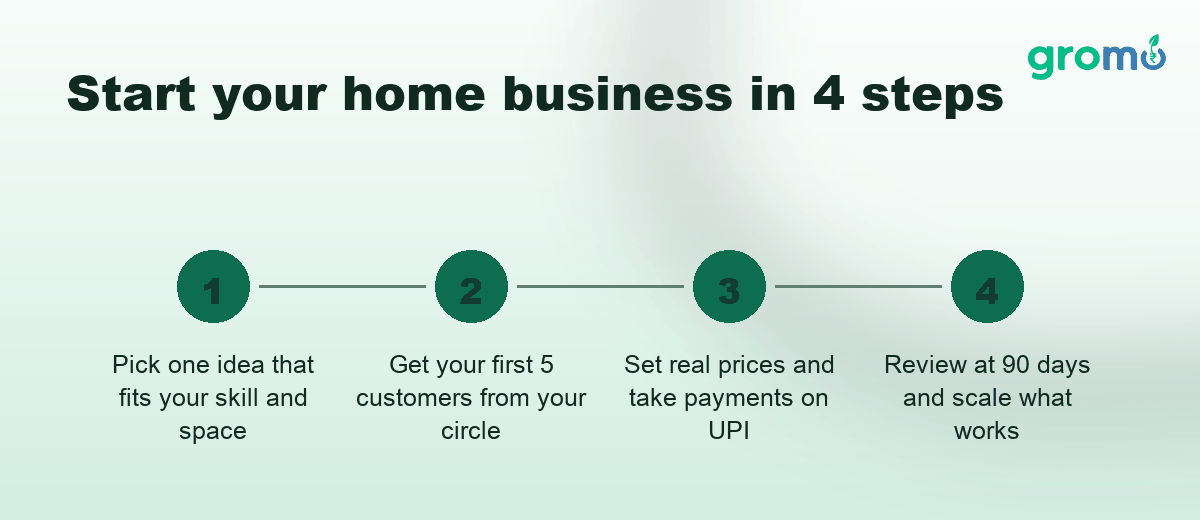
- Pick one idea that matches a skill, space, or network you already have — not the one trending on Instagram.
- Start with 5 customers from your own circle before spending anything on marketing.
- Set real prices — cost + your time + margin. Underpricing is the most common home business killer.
- Put everything on WhatsApp and UPI — a catalogue, a payment QR, and quick replies are your infrastructure.
- Review at 90 days — double down if income is growing; change the offer (not the business) if it is flat.
Financial Services from Home
1. Sell Financial Products with GroMo
For years, the way to earn from financial services in your neighbourhood was to run a cyber cafe, CSC, or Jan Seva Kendra — a shop, a computer, electricity bills, and long hours helping people with forms. GroMo is that same trusted-helper business without the shop. From your phone, you help people get savings accounts, credit cards, loans, demat accounts, and insurance from India's leading banks and regulated companies — and the institutions pay you a commission on every approved application. A single credit card approval can pay ₹1,000–₹2,000+, and customers return for their next product, so the business compounds like a good kirana store — on trust.
How to start: download the GroMo app, complete the free training, list 20 people you know who need a financial product, and help the first five this week.
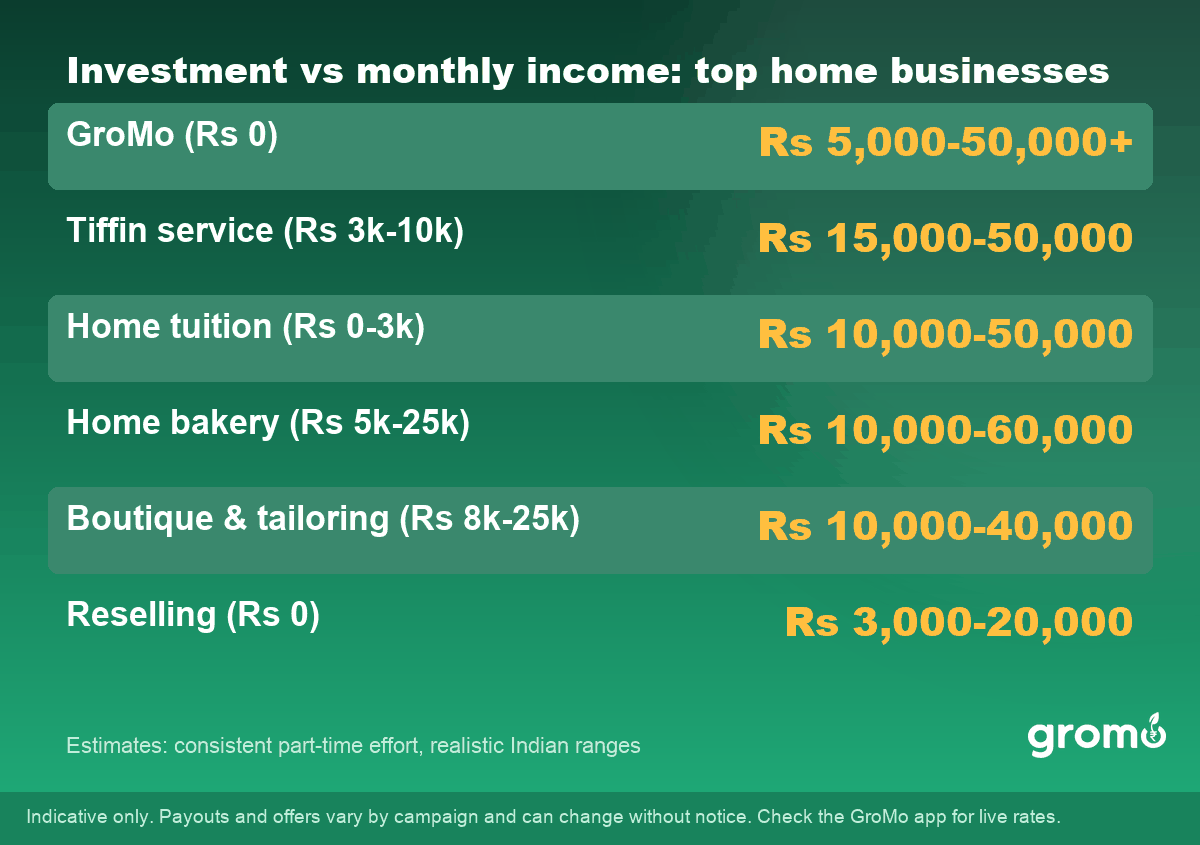
Investment: ₹0 | Time: 2–4 hrs/day | Monthly income: ₹5,000–₹50,000+ | Stable in: 2–4 months
Food and Kitchen Businesses
2. Tiffin and Dabba Service
Office workers, students, and PG residents pay reliably for home-style food. Start with one meal a day for 5–10 customers within delivery distance, take weekly advance payment, and grow purely on taste and punctuality. Get the basic FSSAI registration (about ₹100/year) early.
Investment: ₹3,000–₹10,000 | Time: 4–6 hrs/day | Monthly income: ₹15,000–₹50,000 | Stable in: 2–3 months
3. Home Bakery and Cloud Kitchen
Cakes, brownies, and snack boxes ordered via Instagram and WhatsApp, or a focused menu listed on Swiggy/Zomato as a cloud kitchen. Margins on baked goods run 40–60%. Start with weekend orders; move to delivery apps once daily volume justifies commissions.
Investment: ₹5,000–₹25,000 | Time: 3–6 hrs/day | Monthly income: ₹10,000–₹60,000 | Stable in: 3–6 months
4. Pickles, Papad, Masala and Snacks
Homemade achar, papad, spice blends, and namkeen have loyal repeat buyers — the classic household business that modern packaging and courier services have made scalable. Sell locally first, then via Instagram and marketplaces. Shelf-stable products mean you can produce in batches on your schedule.
Investment: ₹2,000–₹8,000 | Time: 2–4 hrs/day | Monthly income: ₹8,000–₹30,000 | Stable in: 3–6 months
5. Festival Sweets and Custom Chocolates
Seasonal but explosive: Diwali, Rakhi, and wedding seasons bring bulk gift orders. Custom chocolate boxes cost little to make and sell at gift prices. Book corporate and society orders a month before each festival; the rest of the year, supply local events.
Investment: ₹3,000–₹10,000 | Time: flexible, seasonal peaks | Monthly income: ₹5,000–₹40,000 (festival months much higher) | Stable in: 2 festival cycles
Making and Craft Businesses
6. Candle and Soap Making
Scented candles and artisanal soaps are giftable, Instagram-friendly, and cheap to make — raw material kits cost under ₹3,000. Sell through Instagram, local boutiques, and exhibition stalls. Differentiate with fragrance and packaging, not price.
Investment: ₹3,000–₹8,000 | Time: 2–3 hrs/day | Monthly income: ₹5,000–₹25,000 | Stable in: 4–6 months
7. Handmade Jewellery and Crafts
Terracotta, beadwork, resin, and thread jewellery sell steadily on Instagram and at flea markets. Craft buyers pay for story and finish — good photos matter as much as good products. Start with 15–20 pieces and one reel a day.
Investment: ₹2,000–₹6,000 | Time: 2–4 hrs/day | Monthly income: ₹5,000–₹25,000 | Stable in: 4–6 months
8. Plant Nursery and Terrace Gardening Kits
Urban India is buying plants like never before. A terrace or balcony can run a micro-nursery of easy-care indoor plants, and curated "beginner gardening kits" sell well as gifts. Propagate from mother plants to keep costs near zero after setup.
Investment: ₹3,000–₹15,000 | Time: 1–3 hrs/day | Monthly income: ₹5,000–₹30,000 | Stable in: 4–8 months
9. Organic Microgreens and Sprouts
Microgreens grow in trays in 7–14 days and sell to health-conscious families, gyms, and cafes at premium prices. A shelf with grow lights is a complete farm. Consistency of supply is the whole business — start with 10 weekly subscribers.
Investment: ₹5,000–₹15,000 | Time: 1–2 hrs/day | Monthly income: ₹6,000–₹25,000 | Stable in: 3–5 months
10. Gift Hampers and Packing Service
Corporates, weddings, and festivals need curated hampers and elegant packing. You assemble products from wholesale markets into themed baskets with margins of 30–50%. Tie up with 2–3 local businesses (bakeries, boutiques) for a steady pipeline.
Investment: ₹5,000–₹15,000 | Time: flexible, order-based | Monthly income: ₹8,000–₹35,000 | Stable in: 3–6 months
Selling and Retail from Home
11. Reselling with Meesho and WhatsApp
Share catalogue products with your margin added; the platform handles delivery, payment, and returns — a boutique with zero inventory. The skill is curation: know your audience's taste and share a focused selection daily.
Investment: ₹0 | Time: 1–3 hrs/day | Monthly income: ₹3,000–₹20,000 | Stable in: 2–4 months
12. Selling on Amazon and Flipkart
A spare room can be a warehouse: source one focused product line from wholesale markets (Sadar Bazaar, Surat textiles, local manufacturers) and list it online. Start with 1–2 products you understand, learn the listing game, and reinvest profits into stock.
Investment: ₹10,000–₹50,000 | Time: 2–4 hrs/day | Monthly income: ₹10,000–₹1,00,000+ | Stable in: 6–12 months
13. Home Boutique and Tailoring
Stitching, alterations, blouse and dress design from a home machine — demand never dips, and good tailors are always overbooked. Add a WhatsApp catalogue of your designs and festival-season fashion to move from repairs to premium orders.
Investment: ₹8,000–₹25,000 (machine) | Time: 4–6 hrs/day | Monthly income: ₹10,000–₹40,000 | Stable in: 2–4 months
14. Thrift and Preloved Fashion Online
Gen Z buys curated second-hand fashion enthusiastically. Source quality pieces from export surplus and wholesale lots, photograph them well, and drop weekly collections on an Instagram page. Low capital, high margin, very 2026.
Investment: ₹3,000–₹10,000 | Time: 2–3 hrs/day | Monthly income: ₹5,000–₹30,000 | Stable in: 3–6 months
Services You Can Run from Home
15. Home Tuition and Coaching Classes
Two batches of five students each, an hour apiece in the evening, out-earns many office jobs. Strong demand for classes 6–12 maths/science, spoken English, and exam prep. Results are your marketing — parents talk.
Investment: ₹0–₹3,000 | Time: 2–4 hrs/day | Monthly income: ₹10,000–₹50,000 | Stable in: 1–3 months
16. Beauty Parlour at Home
A spare room, a chair, and certified skills (short courses cost ₹5,000–₹15,000) start a parlour whose overheads are near zero compared to a rented salon. Festival and wedding seasons multiply income; home-visit services raise your rates further.
Investment: ₹10,000–₹30,000 | Time: 4–6 hrs/day | Monthly income: ₹10,000–₹50,000 | Stable in: 3–6 months
17. Mehendi and Makeup Artist
Bridal mehendi alone pays ₹3,000–₹15,000 per booking; wedding-season weekends book out months ahead. Build an Instagram portfolio from every client, and partner with local parlours and photographers for referrals.
Investment: ₹2,000–₹10,000 | Time: event-based | Monthly income: ₹5,000–₹40,000 (season peaks higher) | Stable in: 1–2 wedding seasons
18. Daycare and Creche
Working parents in apartment societies urgently need trustworthy childcare. A safe, clean room and genuine care for 4–6 children generates steady monthly fees of ₹3,000–₹8,000 per child. Trust and safety records are the entire brand.
Investment: ₹10,000–₹30,000 | Time: 8–9 hrs/day | Monthly income: ₹15,000–₹50,000 | Stable in: 2–4 months
19. Pet Boarding and Grooming
Pet parents pay ₹500–₹1,500 per day for trusted home boarding during travel, and grooming adds per-session income. If you genuinely love animals, this business markets itself in every society WhatsApp group.
Investment: ₹5,000–₹20,000 | Time: flexible | Monthly income: ₹8,000–₹40,000 | Stable in: 3–6 months
20. Event and Balloon Decoration
Birthdays, baby showers, and society functions need decorators every single weekend. Materials are cheap, themes repeat, and one weekend event pays ₹2,000–₹10,000. Build a photo portfolio and tie up with cake shops for referrals.
Investment: ₹5,000–₹15,000 | Time: weekend-heavy | Monthly income: ₹8,000–₹35,000 | Stable in: 3–5 months
Online Businesses from Home
21. YouTube Channel in Your Language
Cooking, crafts, farming, repair, local finance — regional-language channels are still underserved and monetise through ads, sponsorships, and affiliate income. Upload twice weekly in one niche; treat the first six months as planting season.
Investment: ₹0–₹3,000 | Time: 1–2 hrs/day | Monthly income: ₹0 early, then ₹5,000–₹1,00,000+ | Stable in: 8–18 months
22. Print-on-Demand Merchandise
Design t-shirts, mugs, and posters; a print partner produces and ships each order so you hold no stock. Niche down hard — one college, profession, or fandom — and pair the store with a meme or content page that markets it free.
Investment: ₹0–₹2,000 | Time: 1–2 hrs/day | Monthly income: ₹2,000–₹25,000 | Stable in: 4–8 months
23. Digital Products: Recipes, Notes and Courses
Package what you know — a regional recipe e-book, exam notes, stitching patterns, a mini course — and sell it endlessly with near-100% margins. Effort is front-loaded; income continues while you sleep. Distribution is the real work: build a small audience first.
Investment: ₹0 | Time: heavy upfront, then 1 hr/day | Monthly income: ₹2,000–₹30,000 | Stable in: 4–8 months
24. Social Media Handling for Local Shops
The salon, bakery, and coaching centre near you all need Instagram managed. Offer a simple monthly package — posts, replies, a monthly report — starting with one shop you already know. Three retainers is a solid home income.
Investment: ₹0 | Time: 2–3 hrs/day | Monthly income: ₹9,000–₹45,000 (₹3,000–₹15,000 per client) | Stable in: 2–4 months
25. Hobby Classes: Art, Music, Yoga, Stitching
Teach what you love — drawing, keyboard, yoga, embroidery — to batches at home or on video calls. Hobby learning is a family budget line now, and small batches of 6–10 students at ₹500–₹1,500 each add up quickly.
Investment: ₹0–₹5,000 | Time: 2–3 hrs/day | Monthly income: ₹8,000–₹40,000 | Stable in: 2–4 months
Which Home Business Should You Choose?
- Zero investment to start today: GroMo, reselling, tuition, social media handling, digital products.
- Best for women at home: tiffin service, home bakery, boutique and tailoring, beauty parlour, mehendi, daycare, hobby classes — and GroMo, which thousands of homemakers run purely on WhatsApp. Choose by the hours you control: order-based businesses (bakery, mehendi, hampers) flex around family time; subscription businesses (tiffin, daycare, tuition) pay steadily but fix your schedule.
- Fastest to stable income: tuition, tiffin, and GroMo — all can be steady within 2–3 months.
- Highest ceilings: Amazon/Flipkart selling, YouTube, cloud kitchen, and GroMo — each can cross ₹50,000/month with 1–2 years of consistency.
- Love meeting people? Parlour, mehendi, events, daycare. Prefer working quietly? Microgreens, crafts, digital products, print-on-demand.
One final rule that separates businesses from hobbies: track your numbers weekly — what came in, what went out, which customer came back. Every idea above stays small when run casually and grows when run like a business. Start with the one that fits your skill, space, and hours; give it 90 honest days; and let your first repeat customer tell you it is working. If your strength is trust in your community and you want the lowest-cost start of all, become a GroMo Partner and turn that trust into a financial services business from your phone.
FAQ: Business Ideas from Home
Which is the cheapest business to start from home?
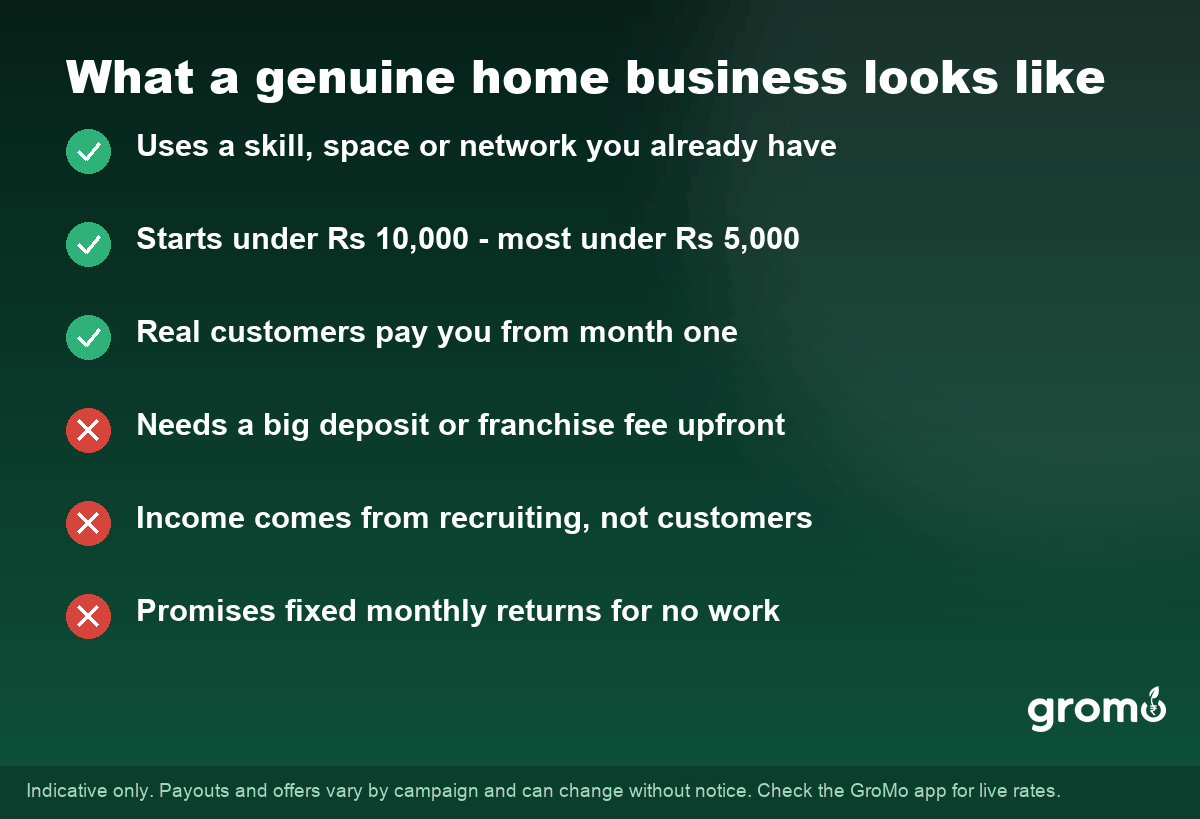
Several genuine home businesses start at Rs 0: selling financial products with GroMo, reselling through Meesho and WhatsApp, home tuition, social media handling for local shops, and digital products. Even production businesses like pickles, candles, or a tiffin service start under Rs 10,000. If an opportunity demands a large deposit or franchise fee, treat it as a red flag.
What are the best business ideas for women at home in India?
The most proven ones are tiffin and dabba services, home bakery, boutique and tailoring, beauty parlour at home, mehendi artistry, daycare, hobby classes, and reselling. GroMo is also run successfully by thousands of homemakers entirely on WhatsApp — helping their circle get financial products and earning Rs 5,000-50,000 monthly with zero investment. Choose order-based work for flexible hours or subscription-based work for steady income.
How much investment does a home business need in India?
Less than most people think. Around half the ideas in this guide start at Rs 0-5,000, and almost all stay under Rs 30,000 including equipment. The pattern that works: start with the minimum, prove there is demand with your first five customers, and only then invest more. The exception is marketplace selling on Amazon or Flipkart, where Rs 10,000-50,000 of starting stock helps.
How long does it take for a home business to become stable?
Service businesses with existing demand — tuition, tiffin, GroMo, tailoring — commonly stabilise in 2-4 months. Product businesses like bakery, crafts, and microgreens take 3-6 months to build repeat customers. Content-led businesses like YouTube take 8-18 months but have the highest ceilings. In every case, the first 90 days of consistency decide the outcome.
Do I need a licence or registration to run a home business?
Most home businesses can start informally as an individual with a PAN and bank account, declaring income in your tax return. Food businesses should get the basic FSSAI registration early — it costs about Rs 100 a year and unlocks delivery platforms. Register under GST or as a business entity once turnover grows, and daycare or parlour work benefits from basic certification for customer trust.
Disclaimer
Nothing here is a guarantee of income. All investment figures, income ranges, and stabilisation timelines are indicative estimates for typical consistent effort; actual results vary with your location, pricing, demand, and execution. GroMo commissions are set by partner banks and financial institutions, vary by product and campaign, and are paid only on approved applications — check the live commission in the GroMo app before relying on any figure.
Everything above is general information, not financial, legal, or tax advice. Verify current licensing requirements for your state before starting food, childcare, or beauty services, and never pay a deposit or joining fee to any platform that promises earnings.


