
Top 10 Best Commission Earning Apps in India
Top 10 best commission earning apps in India: real commission rates for loans, recharges, reselling and referrals, plus how to spot fake apps.

A commission earning app pays you a cut every time a sale happens through you: a financial product approved, a recharge done, a catalogue product ordered, or a purchase made through your link. Genuine commission earning apps in India are free to join and need zero investment; you earn from real transactions, not from deposits, which makes commission work one of the most reliable ways to make money on internet.
This guide covers the top 10 best commission earning apps in India, the commission rates for loans, agent work, mobile recharges, and shopping, and how to tell a real commission app from a fake one.
Commission Earning Apps: Quick Facts
| Question | Answer |
|---|---|
| What is a commission earning app | An app that pays a percentage or fixed amount per successful sale or transaction you generate |
| Are they real or fake | The 10 apps in this list are real, established companies; fakes exist and always demand money upfront |
| Investment needed | Zero on genuine apps; never pay a joining fee or deposit |
| Typical earnings | Rs 2,000 to Rs 30,000+ per month depending on app, product, and effort |
| Highest per-sale commissions | Financial products: a few hundred to a few thousand rupees per approved sale |
| Best for recharge commission | Retailer apps like PayNearby and Spice Money |
Types of Commission You Can Earn
Commission earning apps fall into four families, and the type decides how much each sale pays:
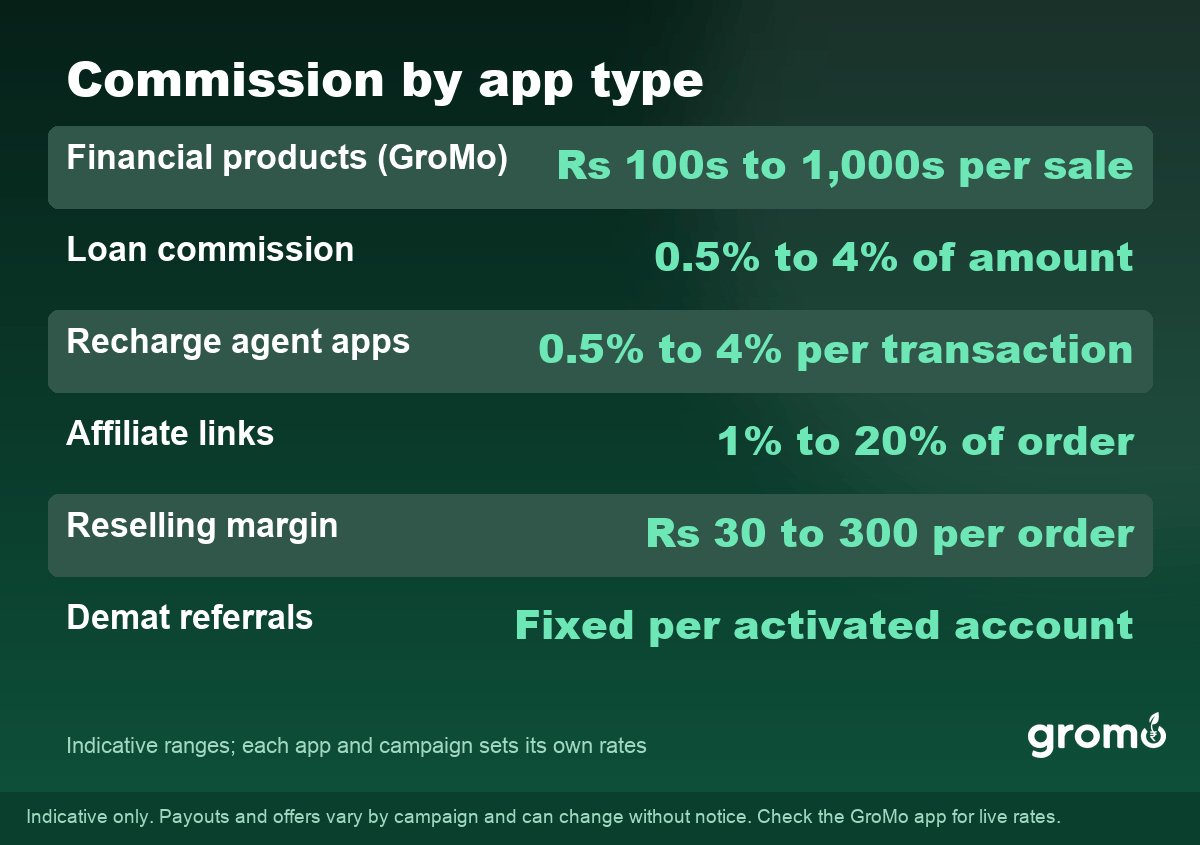
- Financial product commission (highest per sale). Selling credit cards, savings accounts, loans, and demat accounts as an agent. Loan commissions typically run 0.5% to 4% of the disbursed amount, and credit cards pay flat amounts of a few hundred to a couple of thousand rupees per approved card.
- Reselling margin. Sharing catalogue products on WhatsApp and keeping the margin you add on every order.
- Affiliate and cashback commission. Earning a percentage when someone shops through your shared link, usually 1% to 20% depending on category.
- Recharge and banking agent commission. Earning 0.5% to 4% on mobile recharges, bill payments, and small banking services done for customers, usually through retailer apps.
Top 10 Commission Earning Apps Compared
| # | App | Commission type | Typical earning per sale |
|---|---|---|---|
| 1 | GroMo | Financial products | A few hundred to a few thousand rupees |
| 2 | Meesho | Reselling margin | Rs 30 to Rs 300 per order |
| 3 | EarnKaro | Affiliate links | 1% to 20% of order value |
| 4 | CashKaro | Cashback and referrals | 1% to 10% back per purchase |
| 5 | PayNearby | Recharge and banking agent | 0.5% to 4% per transaction |
| 6 | Spice Money | Recharge and banking agent | 0.5% to 4% per transaction |
| 7 | Shopsy | Reselling margin | Rs 30 to Rs 250 per order |
| 8 | GlowRoad | Reselling margin | Rs 30 to Rs 250 per order |
| 9 | Upstox partner program | Demat referrals | Fixed payout per activated account |
| 10 | Angel One partner program | Demat referrals | Fixed payout per activated account |
1. GroMo
| Commission type | Financial products: credit cards, savings accounts, loans, demat accounts from 100+ brands |
| Commission rates | Loans typically 0.5% to 4% of disbursed amount; cards and accounts pay flat payouts per approval |
| Who it suits | Anyone with a network and willingness to learn; training is free |
| Withdrawal | Payouts to your bank account, tracked live in the app |
GroMo tops this list because its per-sale commissions are the highest of any app here. One approved credit card or loan can pay what reselling or affiliate apps pay for dozens of orders.
You pick products you understand, share your link with people who need them, and earn on every approval. Free GroMo Academy lessons teach product knowledge and selling, so it is also one of the friendliest commission apps for beginners with no sales experience.
Pros: highest per-sale payouts; free structured training; builds a real distribution career.
Cons: commissions come only on approved products, so effort and approvals decide income.
2. Meesho
| Commission type | Reselling margin on clothes, home items, and accessories |
| Commission rates | Your own margin, usually Rs 30 to Rs 300 per order |
| Who it suits | Homemakers, students, anyone with active WhatsApp groups |
| Withdrawal | Margin paid to bank after delivery completes |
Meesho made reselling a household earning method in India and remains one of the best mobile apps to make money from your phone. You share catalogue products with your price added, the app handles delivery and payment, and you keep the difference.
Pros: zero stock and zero risk; scales with your network.
Cons: thin margins per order; returns delay payouts.
3. EarnKaro
| Commission type | Affiliate commission on shopping links from major sites |
| Commission rates | Roughly 1% to 20% of order value by category |
| Who it suits | People who share deals in groups, deal pages, and status updates |
| Withdrawal | Confirmed commission to bank; confirmation follows return windows |
EarnKaro converts links from popular shopping sites into commission links. Share a deal, and when anyone buys through it, a percentage lands in your account.
Pros: no selling conversation needed; works with deals you already forward.
Cons: commissions confirm only after return periods pass; rates change per campaign.
4. CashKaro
| Commission type | Cashback on your own shopping plus referral commission |
| Commission rates | Typically 1% to 10% back, plus a share of referred friends' earnings |
| Who it suits | Regular online shoppers |
| Withdrawal | Confirmed cashback to bank or as gift vouchers |
CashKaro is the sister app of EarnKaro focused on your own purchases: route your shopping through it and part of the price returns to you. Referrals add a second stream from friends who join through you, the same model that powers the top refer and earn apps without KYC.
Pros: money back on spending you were doing anyway.
Cons: cashback confirmation takes weeks; not an income by itself.
5. PayNearby
| Commission type | Retailer agent commission: recharges, bill payments, AePS banking, money transfer |
| Commission rates | Roughly 0.5% to 4% per transaction depending on service and operator |
| Who it suits | Shop owners and anyone serving walk-in customers |
| Withdrawal | Commission settles into your retailer wallet and bank |
PayNearby turns a local shop into a mini banking point. Customers pay you for recharges, bill payments, cash withdrawal through AePS, and transfers, and you earn a commission on every transaction.
Pros: steady daily volume if you have footfall; many services in one app.
Cons: built for shopkeepers more than individuals; per-transaction commission is small, volume is the game.
6. Spice Money
| Commission type | Adhikari agent commission: recharges, bills, AePS, travel bookings |
| Commission rates | Roughly 0.5% to 4% per transaction by service |
| Who it suits | Rural and small-town entrepreneurs serving their locality |
| Withdrawal | Commission to wallet and linked bank account |
Spice Money runs one of India's largest rural agent networks. Its Adhikari app covers recharges, bill payments, banking services, and travel bookings, with commissions on each service a customer pays for.
Pros: strong in small towns where banking access is thin; low entry barrier.
Cons: serious earnings need a physical point where customers reach you.
7. Shopsy
| Commission type | Reselling margin on Flipkart's low-price catalogue |
| Commission rates | Your margin, usually Rs 30 to Rs 250 per order |
| Who it suits | Resellers who want Flipkart's delivery network behind them |
| Withdrawal | Margin paid after delivery |
Shopsy is Flipkart's reselling app: the same share-and-earn model as Meesho, backed by Flipkart's catalogue and logistics. Good as a second catalogue source alongside Meesho.
Pros: Flipkart-backed reliability and delivery reach.
Cons: same thin-margin, returns-delay economics as all reselling.
8. GlowRoad
| Commission type | Reselling margin, now part of the Amazon ecosystem |
| Commission rates | Your margin, usually Rs 30 to Rs 250 per order |
| Who it suits | Resellers focused on fashion and home categories |
| Withdrawal | Margin to bank after delivery |
GlowRoad is another established reselling platform, acquired by Amazon. Catalogue sharing, margin setting, and doorstep delivery work the same way as its rivals, so most serious resellers run two or three of these apps together and share whichever catalogue fits the customer.
Pros: Amazon-backed; easy parallel use with Meesho and Shopsy.
Cons: nothing unique in economics; margins stay modest.
9. Upstox Partner Program
| Commission type | Fixed payout per activated demat account you refer |
| Commission rates | Fixed per-account payouts that vary by campaign |
| Who it suits | People whose circle is starting to invest |
| Withdrawal | Payouts to bank per the program's cycle |
Stock broking apps pay well for new customers, and Upstox's partner program is among the established ones. You refer someone, they open and activate a demat account, and you earn a fixed payout.
Pros: decent fixed payouts; investing interest is growing in India.
Cons: payouts need account activation, not just signup; terms change by campaign.
10. Angel One Partner Program
| Commission type | Demat referral payouts, with a long-running sub-broker model |
| Commission rates | Fixed per-account payouts; authorised-person tie-ups can earn brokerage shares |
| Who it suits | People building a serious investing-referral side business |
| Withdrawal | Payouts to bank per program terms |
Angel One runs both a simple refer-and-earn and a deeper authorised-person model where committed partners share in brokerage. The simple tier suits beginners; the deeper tier suits people treating financial distribution as a business.
Pros: a growth path from referrals to a licensed partnership.
Cons: the deeper tier has onboarding requirements; simple referrals depend on activation.
Best Recharge Commission App: PayNearby vs Spice Money
For pure mobile recharge commission, retailer apps beat consumer apps: PayNearby and Spice Money both pay roughly 0.5% to 4% per recharge depending on the operator, while consumer recharge apps pay users little or nothing beyond occasional cashback offers.
Choose PayNearby if you run an urban or semi-urban shop with walk-in customers and want the widest service menu. Choose Spice Money if you serve a rural or small-town area, where its agent network and support are strongest.
Recharge commission alone is small money per transaction. Agents earn meaningfully by stacking services: recharges plus bill payments, AePS cash withdrawals, and transfers, so the same customer pays you three or four commissions a visit.
Loan and Agent Commission: How the Bigger Money Works
The highest commissions in this space come from financial products, which is why agent-model apps top this list. Loan commissions in India typically run 0.5% to 4% of the disbursed amount: a Rs 2,00,000 personal loan at 2% pays Rs 4,000 from one customer.
Exact DSA loan agent commission rates differ lender by lender and product by product.
Credit cards pay flat payouts per approved card, and demat accounts pay fixed amounts per activation. On GroMo you can distribute all of these from one app, and payouts are tracked transparently against each application.
Commission Earning App: Real or Fake? How to Check
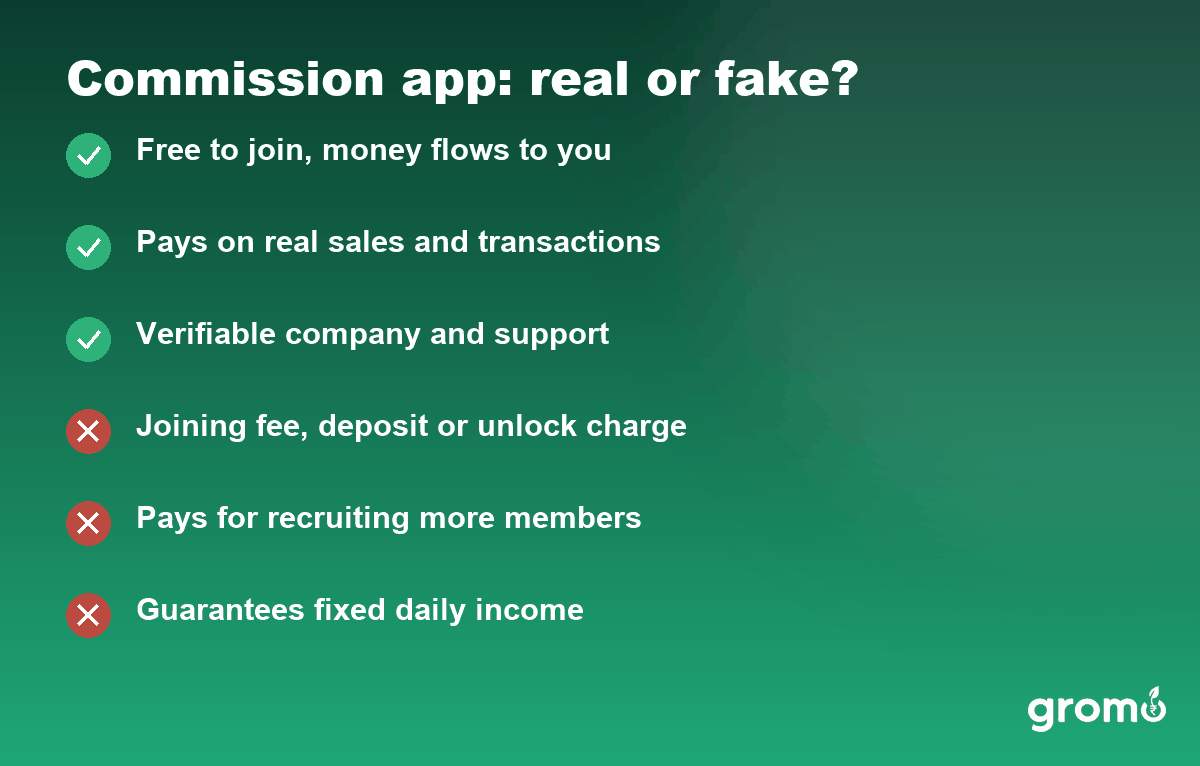
Every app named in this list is a real, established company, but fake "commission apps" are common and follow one script: pay a joining fee or deposit, do meaningless tasks, then find you cannot withdraw. Run any new app through this check:
- Money flows to you, never from you. Genuine commission apps are free; any deposit, kit, or unlock fee is the scam itself.
- Commission comes from real transactions. Real apps pay on actual sales, recharges, or approvals, not on "watching videos" or recruiting more members.
- The company is verifiable. A registered company name, working support, an office, and consistent recent reviews are the minimum.
- Withdrawals work small and early. Cash out your first Rs 100 to Rs 200 before investing serious time.
- No income guarantees. Real commission income varies with effort; "guaranteed Rs 3,000 daily" is always fraud.
How to Choose Your App and Start Earning
- Match the app to what you have: a trusted network suits GroMo, WhatsApp groups suit a WhatsApp earning app setup like reselling and affiliate sharing, a shop or footfall location suits PayNearby or Spice Money.
- Start with one app and learn its products properly before adding a second; commission apps also pair well with other online work and earn money daily options.
- Share with people who genuinely need the product; trust is the engine of commission income.
- Track what converts and double down on those products and customers.
- Withdraw regularly and keep records of every payout.
If you want the highest earning ceiling, start with GroMo: financial products pay the most per sale, the training is free, and the skills transfer to any selling career. Alongside it, a reselling or cashback money earning app gives you smaller but faster wins.
FAQ: Commission Earning Apps
What is a commission earning app?
A commission earning app pays you a percentage or fixed amount every time a real transaction happens through you: a financial product approved, a recharge completed, a catalogue order delivered, or a purchase made through your link. Genuine apps are free to join; your earning comes from sales, never from deposits.
Are commission earning apps real or fake?
Both exist. Apps run by established companies, like GroMo, Meesho, EarnKaro, CashKaro, PayNearby, and Spice Money, are real and pay on actual transactions.
Fake apps follow one script: charge a joining fee or deposit, show fake earnings, then block withdrawals. If an app asks for money upfront, pays for recruiting members, or guarantees fixed daily income, it is fake.
Which is the best commission earning app in India?
GroMo has the highest per-sale commissions because it deals in financial products: one approved loan or credit card can pay a few hundred to a few thousand rupees, against Rs 30 to Rs 300 per order on reselling apps. The best app for you depends on what you have: a trusted network suits GroMo, WhatsApp groups suit Meesho and EarnKaro, and a shop suits PayNearby or Spice Money.
Which is the best recharge commission app?
PayNearby and Spice Money are the strongest recharge commission apps, paying roughly 0.5% to 4% per recharge depending on the operator, along with commissions on bill payments, AePS banking, and transfers. PayNearby suits urban and semi-urban shops; Spice Money is strongest in rural and small-town areas.
Consumer recharge apps pay users little beyond occasional cashback.
How much commission can I earn from loans and financial products?
Loan commissions in India typically run 0.5% to 4% of the disbursed amount, so a Rs 2,00,000 personal loan at 2% pays Rs 4,000. Credit cards pay flat payouts per approved card and demat accounts pay fixed amounts per activation.
Rates are set by each bank, platform, and campaign, so always check the live commission in the app before relying on a figure.
Do commission earning apps need any investment?
No. Every genuine commission app is free to download and join, and you never deposit money to unlock earnings; every genuine free earning app works on the same rule.
The only investments are your time, your network, and, for retailer apps like PayNearby, optionally a small float of cash to serve banking customers. Any app demanding a registration fee or security deposit should be uninstalled immediately.
What is a commission app?
A commission app is any app that pays you a share of a sale you helped complete, instead of a fixed salary. You recommend a product, someone buys it or gets approved, and the app credits your cut. GroMo is the best-known example in India, paying commission on credit cards, savings accounts, loans, and insurance directly to your bank account.
Disclaimer
This article is general information, not financial or career advice. All commission rates, payouts, and app features are indicative at the time of writing; each app, bank, and campaign sets its own rates, which change frequently, and no income is guaranteed. Verify every app and check its live commission terms before relying on any figure, and never pay a fee or deposit to start earning.
GroMo is a financial product distribution platform, not a bank or lender; payouts are set by partner brands and paid on approved transactions, and the app is available only to users aged 18 and above. App and brand names are trademarks of their respective owners.


