
How to Sell Credit Cards Through Your Own Website
How to sell credit cards through your own website in India: niche, setup, content that ranks, agent links, SEO basics and the honest income timeline.


Selling credit cards through your own website is the slowest channel to start and the strongest to own: while WhatsApp reaches your contacts and YouTube reaches subscribers, a website earns from strangers searching Google at 2 a.m., for years, from content you wrote once.
This guide covers exactly how to sell credit cards through your own website in India: what to build, the content that ranks, how the money flows through your agent links, and the honest timeline from zero to steady income.
Quick Facts
| Question | Answer |
|---|---|
| Investment needed | Rs 500 to Rs 3,000 a year (domain plus basic hosting) |
| Skills needed | Clear writing; no coding required |
| How money flows | Reader clicks your agent link, applies, card approved, you earn the payout |
| Time to first income | Usually 3 to 6 months as articles start ranking |
| Earning ceiling | High; ranked pages convert daily without more work |
| Best paired with | WhatsApp for warm leads while the site's search traffic builds |
Why a Website Beats Renting Your Audience
Every other channel borrows someone's platform and rules. Your website is owned distribution: search traffic compounds, one good comparison page can convert for years, and the site itself becomes proof of expertise that makes every offline conversation easier.
The trade is patience. Google takes months to trust a new site, which is why the smartest agents run a website for the long game while working warm channels like WhatsApp for immediate income; the split is explained well by the economics of offline vs online credit card sales.
Step 1: Pick a Niche, Not Everything
"All credit cards" is a losing fight against big finance portals. A focused niche ranks: cards for students, cards for a specific city's professionals, fuel cards, lifetime free cards, or first cards for young earners.
Pick the niche whose customers you understand best, because your real advantage over the big portals is writing like someone who actually knows the reader's situation.
Step 2: Set Up the Site in a Weekend
- Buy a domain with your niche in mind, a few hundred rupees a year.
- Choose simple hosting and install WordPress, or use a site builder; templates make design a non-problem.
- Create five core pages: home, about (who you are and why readers should trust you), contact, a privacy and disclosure page, and your first article.
- Keep the design plain and fast. Readers come for answers; loading speed and clean tables convert better than fancy design.
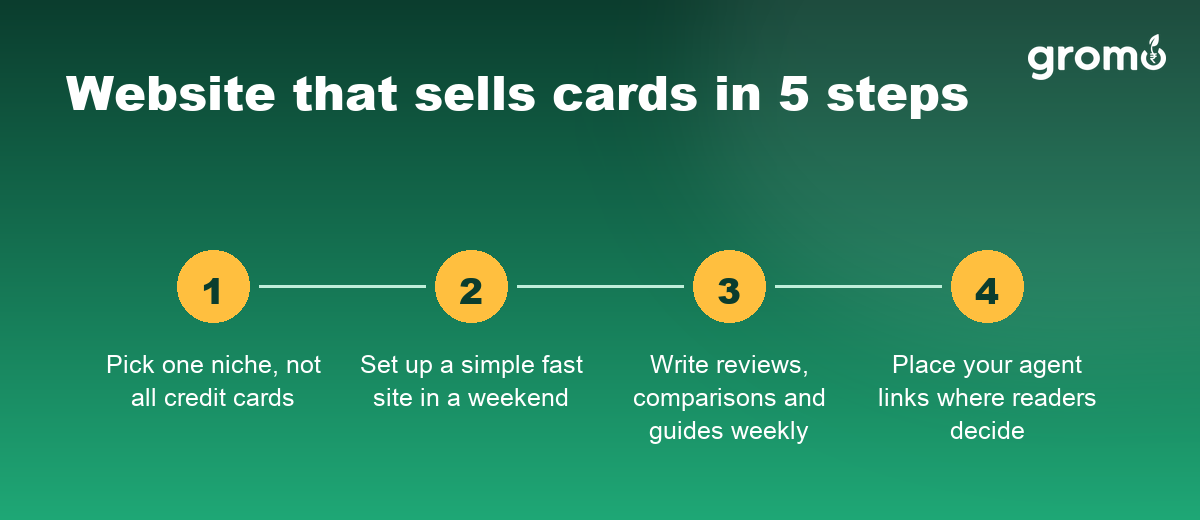
Step 3: Write Content That Matches Real Searches
Every article should answer one search completely. The four content types that convert for card sites:
- Single-card reviews: fees, waiver condition, rewards math, who it suits, who should skip it.
- Comparisons: card A vs card B, or best cards for one use case, with an honest table.
- Decision guides: explainers on the types of credit cards, fees, and eligibility, written simply.
- Problem posts: what to do after rejection, how approval works, how to avoid charges; these build trust that converts later.
Before writing any page, list the five questions a reader would ask next and answer each in its own section. Pages that complete the whole need outrank pages that chase one keyword, and they are also what AI search engines quote.
Step 4: Plug In Your Agent Links
This is where the website becomes a business. Register as an agent, the credit card agent registration on GroMo is free and digital, and place your application links naturally where a convinced reader would want them: after the verdict in a review, inside the comparison table, at the end of a decision guide.
Through GroMo you can offer 30+ cards from different banks from one dashboard, which matters for a website: whatever niche the reader arrives from, you have a matching card to link, and every application is tracked in the app.
Step 5: The Only SEO That Matters Early
- One search intent per page, with the question answered plainly in the first paragraph.
- Descriptive titles and headings that use the words people actually search.
- Internal links between your pages with anchors that describe the destination.
- Publish weekly. Consistency over months is the entire algorithm for new sites.
- Get listed where your niche lives: answer questions in relevant forums and communities with genuine help, linking your deeper article.
Honesty and Compliance Rules
- Disclose that you earn from applications. A one-line disclosure on every money page protects trust and follows advertising norms.
- Never promise approval or limits; approval is always the bank's decision.
- Keep facts current. Fees and offers change; an outdated page that misleads a reader costs more trust than ten good pages build.
- No fake urgency, fake reviews, or bank impersonation. Your site's entire value is that readers can trust it more than a telecaller.
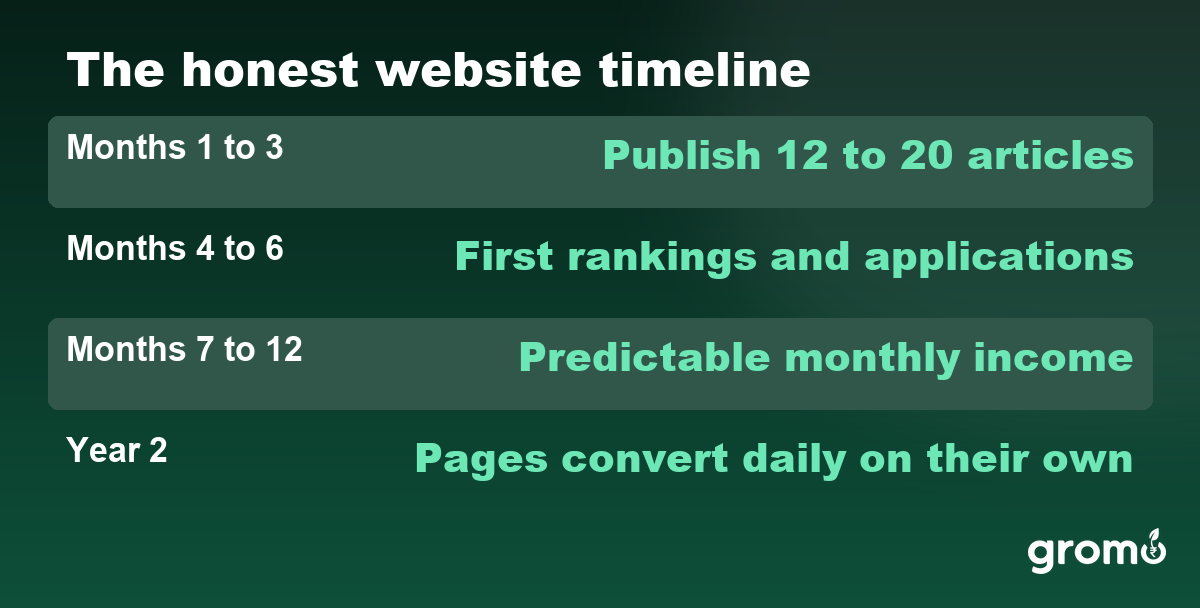
The Honest Timeline
| Phase | What happens |
|---|---|
| Months 1 to 3 | You publish 12 to 20 articles; traffic is near zero; this is normal |
| Months 4 to 6 | Long-tail pages start ranking; first applications trickle in |
| Months 7 to 12 | Comparison pages climb; income becomes monthly and predictable |
| Year 2 | Ranked pages convert daily; updating old content beats writing new |
While the site matures, run your warm channels in parallel; the same product knowledge powers both, and methods like selling credit cards through WhatsApp pay from week one.
How GroMo and GroMo Academy Fit
A card website needs two engines: content that ranks and products to link. GroMo supplies the second completely, 30+ cards across banks, digital application links, live tracking, and payouts per approved card, while free GroMo Academy lessons cover the product knowledge your reviews and comparisons are built from.
Write like the trusted credit card agent of your niche rather than a coupon site, and the website becomes the rare asset in this business: one that earns while you sleep.
FAQ: Sell Credit Cards Through Your Own Website
Can I sell credit cards through my own website in India?
Yes. You register free as a card agent on a platform like GroMo, build a niche website with honest reviews, comparisons, and guides, and place your digital application links where readers decide.
When a reader applies through your link and the bank approves the card, you earn the payout. No banking licence is needed; you are distributing, not issuing.
How much does it cost to start a credit card website?
Rs 500 to Rs 3,000 a year covers a domain and basic hosting, and free templates handle the design. The real investment is content: 12 to 20 well-written articles in your first three months. No coding is required, and the agent registration and product training through GroMo Academy are free.
How long before a card website makes money?
Typically 3 to 6 months for the first applications, as long-tail pages start ranking, and 7 to 12 months for predictable monthly income. New sites earn Google's trust slowly, which is why agents run WhatsApp or offline selling in parallel while the site matures into an asset that converts daily.
What content works best for selling credit cards online?
Four types: single-card reviews with honest fee math, card-vs-card comparisons with a clear verdict, decision guides explaining card types and eligibility, and problem posts like what to do after rejection. Pages that answer the reader's next five questions in one place outrank thin keyword pages and get quoted by AI search.
Do I need to disclose that I earn from card applications?
Yes. A one-line disclosure on every page with application links, stating you earn a payout when readers apply, protects reader trust and follows advertising norms. Never promise approval or limits; approval is always the issuing bank's decision, and saying so plainly makes your site the credible one in its niche.
Disclaimer
This article is general guidance, not financial, legal, or tax advice. Card features, fees, eligibility criteria, approval decisions, and agent payouts are decided by the issuing banks and platforms, vary by product and profile, and change over time; no income or approval is guaranteed. Follow each platform's policies and applicable advertising disclosure norms when promoting financial products.
GroMo is a financial product distribution platform, not a bank or lender, and is available only to users aged 18 and above. Bank, card, platform, and brand names are trademarks of their respective owners.


