
What Is a Credit Card Agent? Types, Eligibility & Documents
Real commissions, real paperwork, and what the job asks of you before it pays.

A credit card agent is a commission-paid intermediary who helps people apply for credit cards from banks and NBFCs, and gets paid when a card is approved and issued. The bank decides who qualifies. The agent finds the applicant, matches them to a card that suits their spending, and keeps the application moving. On GroMo the whole setup takes PAN and Aadhaar, and cards pay up to Rs 2,000 per approved application.
Key Takeaways
- SBI Credit Card pays up to Rs 2,000 per approved application, the highest paying product in the entire GroMo catalogue, not just among cards.
- GroMo lists 34 credit cards, all live, with the better paying ones starting around Rs 700 and going up to Rs 2,000 per approved card.
- Onboarding needs PAN and Aadhaar KYC. Bank details are only needed when you withdraw what you have earned. No fee, no office, no empanelment paperwork.
- Cards are the easiest financial product to start with because most adults already understand them, unlike a demat account or a business loan.
- The advertised number on a card is not always the commission. Quote the rate showing on the product card when you share it, and use "up to" only when you are quoting a label.
Table of contents
- What Is a Credit Card Agent?
- What Does a Credit Card Agent Do?
- How Does a Credit Card Agent Work?
- How Do Credit Card Agents Earn Money?
- Types of Credit Cards You Can Sell
- Who Can Become a Credit Card Agent?
- Credit Card Agent Eligibility
- Documents Required to Become a Credit Card Agent
- Skills Every Credit Card Agent Should Have
- How GroMo Helps You Become a Credit Card Agent
- How to Start Selling Credit Cards Through GroMo
- How to Get Your First Credit Card Customer
- How Much Can a Credit Card Agent Earn?
- Common Mistakes New Credit Card Agents Should Avoid
What Is a Credit Card Agent in India?
A credit card agent is a person appointed, directly or through a distribution platform, to source credit card applicants for banks and card issuers. Banks call the role a DSA, short for Direct Selling Agent. Everyone else calls it selling cards.
Three things belong to the bank and never to you. Approval, the credit limit, and the interest rate are all decided by the issuer's underwriting, using the applicant's credit score, income and existing debt. What belongs to you is finding the right person, picking a card that fits how they actually spend, and being honest about the annual fee before they sign.
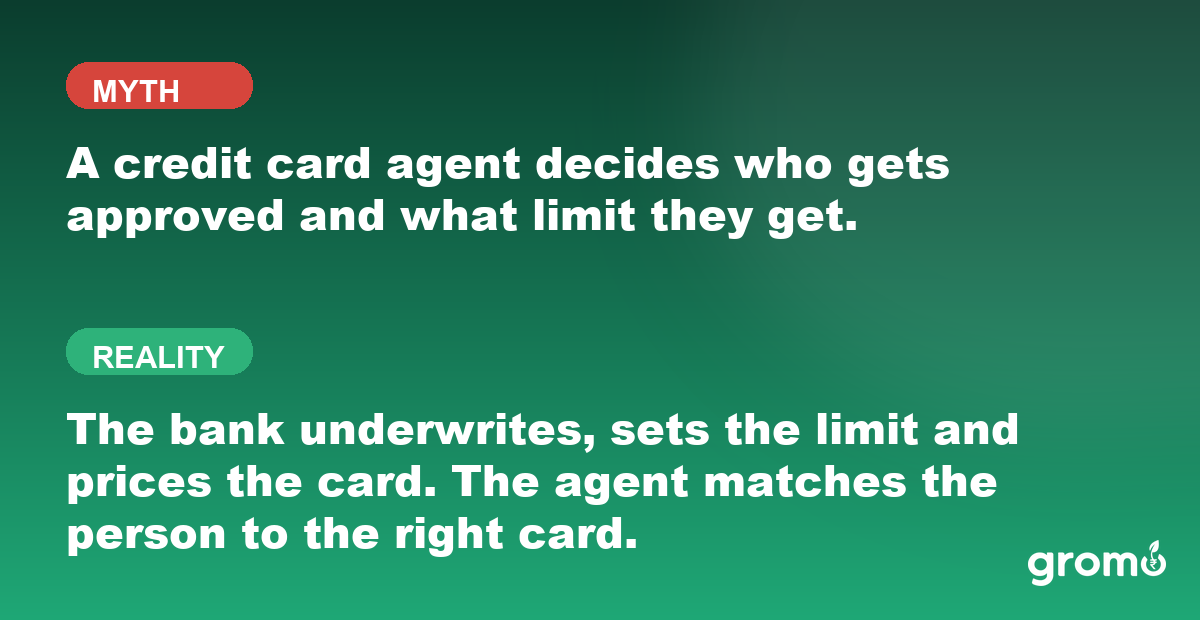
Where the agent's job ends and the bank's begins.
Cards are usually where new agents start, and there is a simple reason. Most adults already know what a credit card is. You are not explaining a demat account or a working capital loan from scratch, so the conversation starts halfway done. That familiarity is the single biggest reason this product is easier to sell than anything else on the shelf. The equivalent role in lending, described in this guide to what a loan agent does, asks far more of a beginner.
What Does a Credit Card Agent Do?
The work is five things, in order.
- Find people who would use a card well. Someone who already spends on fuel, groceries or online shopping, and pays bills on time.
- Match the person to the right card. A fuel card for a daily commuter beats a premium travel card they will never use.
- Be straight about the costs. Joining fee, annual fee, the spend threshold that waives it, and what interest applies if they revolve a balance.
- Help them finish the application. Most drop-offs happen at OTP, income proof or the video KYC step.
- Follow it through to issue. Approval is not payday. The card has to be issued, and sometimes activated or first-swiped, before the commission is confirmed.
What a credit card agent does not do is approve applications, set limits, negotiate fees or handle collections. Those belong to the issuer.
How Does a Credit Card Agent Work?
The flow is short. You share a card with someone it suits, they apply on their own phone, the bank runs KYC and a credit check, and the card is approved or declined. Your commission is recorded once the card is issued and, for some issuers, once it has been used.
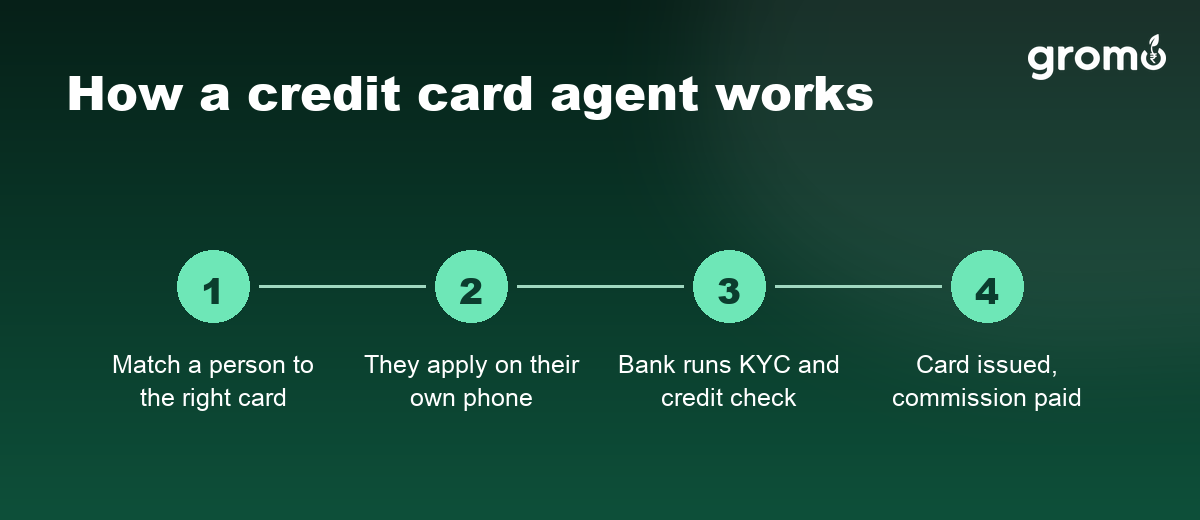
You own the first step and the last one. The bank owns the middle.
Two rules keep you out of trouble. You never collect money from an applicant, because the issuer pays the agent and the applicant pays only the fees printed in the card's own schedule. Never touch someone's OTP, PIN or card details either, however helpful it seems. RBI's rules on outsourcing make the bank answerable for its agents' conduct, which is why a single complaint about mis-selling can end an agent code permanently.
Card applications are also the one product where document quality decides everything. A blurred PAN, an address that does not match the Aadhaar, or an income proof from the wrong month can turn an approval into a rejection.
How Do Credit Card Agents Earn Money?
Credit card agents are paid a fixed commission per approved and issued card. There is no salary and no payment for applications that get declined.
GroMo lists 34 credit cards, and the commission range across them is wide. Here is the top of the rate card:
| Card on GroMo | Commission per approved card |
|---|---|
| SBI Credit Card | Up to Rs 2,000 |
| AMEX Platinum Reserve Credit Card | Up to Rs 1,500 |
| Indian Oil Axis Bank Credit Card | Up to Rs 1,500 |
| Axis Flipkart Credit Card | Up to Rs 1,499 |
| IndianOil RBL Bank XTRA Credit Card | Up to Rs 1,399 |
| RBL Shoprite Credit Card | Up to Rs 1,100 |
Please note. Every rate above is read from the app (GroMo product catalogue). Commissions are campaign-linked, so they move up and down and can change without notice. The rate showing on the product card when you share it is the one you get paid.
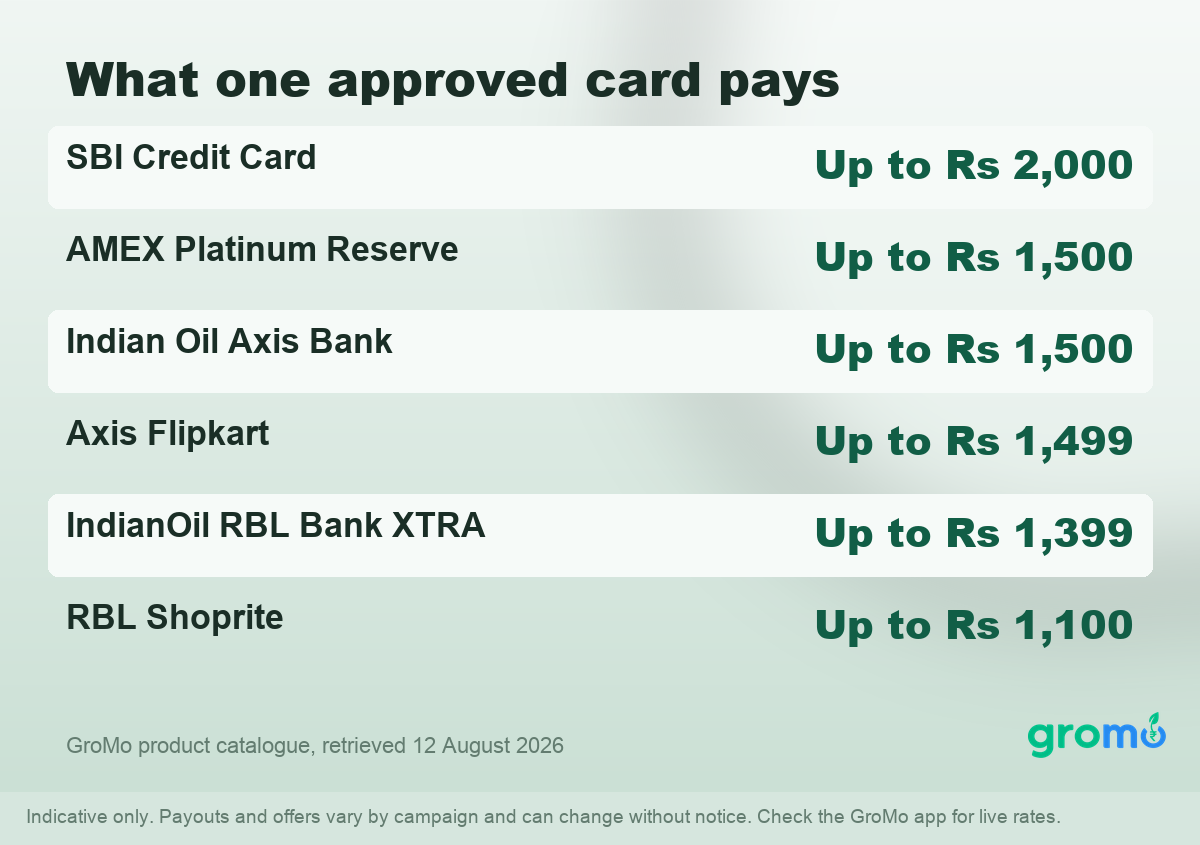
The top of the card rate card, read on 12 August 2026.
Now the part nobody tells new agents. Every figure here is a maximum, not a flat fee. Campaign rates move, some cards pay a higher rate only on certain variants, and the amount you see on the product card at the moment you share it is the one that applies. Quoting a bigger number to a friend you have recruited is how trust gets broken, so read the card, not the marketing line.
Cards also sit at the top of GroMo's whole catalogue. No savings account, demat account or loan on the platform pays more per approval than the best credit card does. That is worth knowing before you decide what to learn first.
Types of Credit Cards You Can Sell
Match the card to the spending, and approval rates and customer satisfaction both improve.
| Card type | Who it suits | On GroMo |
|---|---|---|
| Cashback | Everyday spenders who want simple returns | Yes |
| Rewards | Regular online shoppers | Yes |
| Travel | Frequent flyers, lounge users | Yes |
| Fuel | Daily commuters, drivers | Yes |
| Lifestyle | Dining, entertainment, premium spenders | Yes |
| Secured, against an FD | First-timers and low credit scores | Yes |
| Business | Registered businesses, GST-filing firms | No |
Cashback Credit Cards
Money back on spending, usually as a statement credit. No points to decode and no expiry to track, which makes these the easiest cards to explain to someone getting their first card.
Best for salaried beginners who want a card that pays them for groceries and bills.
Rewards Credit Cards
Points on every rupee spent, with accelerated rates on chosen categories. Axis Flipkart Credit Card is one of the higher paying cards on GroMo, at up to Rs 1,499 per approved application, and it sells easily to anyone who shops online every month.
Best for regular e-commerce buyers who will actually redeem the points.
Travel Credit Cards
Air miles, lounge access and travel insurance, usually with a higher annual fee to match. Scapia Federal Bank Credit Card and AMEX Platinum Reserve both sit in this space on GroMo.
Best for people who fly several times a year. Selling a lounge card to someone who takes one train a year is how you earn a complaint instead of a referral.
Fuel Credit Cards
Surcharge waivers and accelerated points at petrol pumps. GroMo carries several, and they sit high on the rate card, with Indian Oil Axis Bank Credit Card among the best paying at up to Rs 1,500 per approved card.
Best for anyone with a daily commute, cab drivers, and small delivery businesses. This is the easiest category to sell in tier 2 and tier 3 towns.
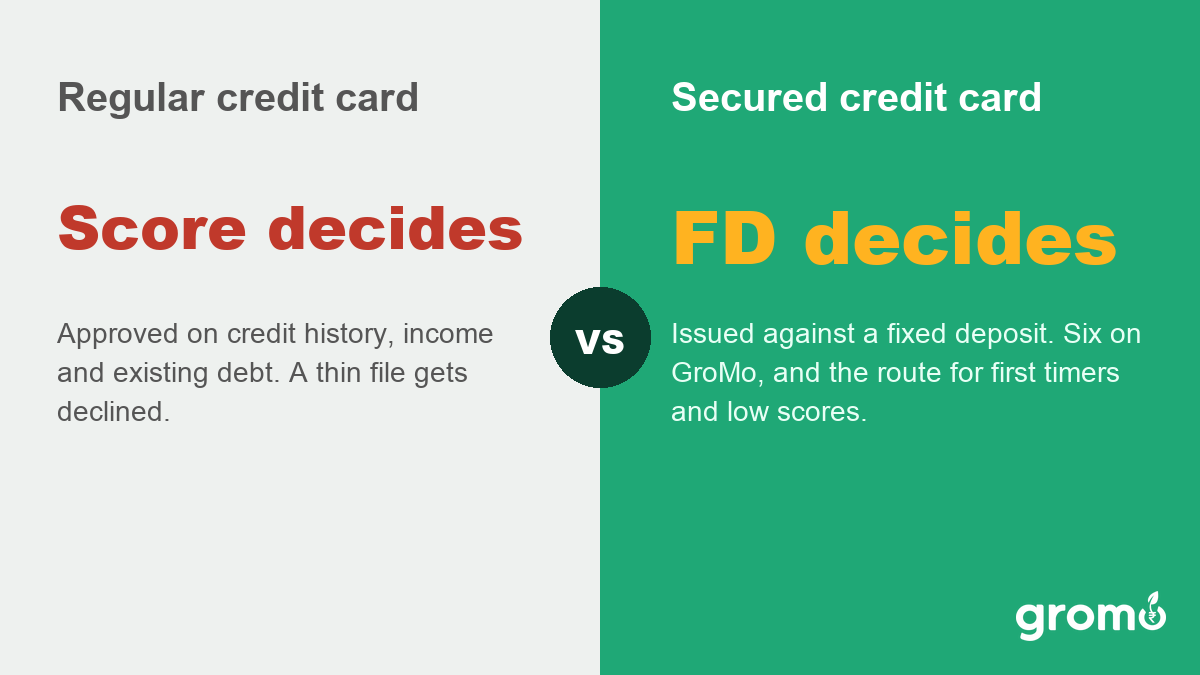
Two routes to the same plastic. One of them turns your rejections into income.
Lifestyle Credit Cards
Dining discounts, movie tickets, shopping vouchers and concierge benefits. Premium versions carry real annual fees, so the honest pitch always includes the spend needed to waive it.
Best for urban professionals who already eat out and book tickets on card offers.
Business Credit Cards
Corporate and small business cards run on the entity's credentials rather than a salary slip, with GST filings and business vintage in the file. Worth knowing this category well, because you will get asked.
Being direct about the gap: business credit cards are not part of GroMo's catalogue today. GroMo's card shelf is consumer cards plus six secured cards. If a shop owner needs a business card, refer them to their bank and keep the relationship for something you can actually place.
Secured Credit Cards, the Category Most Agents Ignore
Cards issued against a fixed deposit, approved on the FD rather than a credit score. GroMo lists six of them, with IDFC WOW! BLACK paying up to Rs 500 per approved card.
Secured cards turn your rejections into income. Every applicant declined for a thin credit file is a secured card customer, and they build a score that makes them eligible for a regular card next year. There is more on that path in this guide to credit cards for a low CIBIL score.
Who Can Become a Credit Card Agent?
Anyone over 18 with a smartphone, a bank account and people who trust their advice.
Shopkeepers and kirana owners see who spends what, every day. Insurance agents and mutual fund distributors already talk money for a living. Salaried employees have a colleague group that discusses cards every appraisal season. Students with a campus network, homemakers with a neighbourhood one, delivery riders who know fifty drivers. Every one of those is a real distribution channel.
One check first. If you are salaried, read your employment contract on outside work before you start, because some employers require written permission.
Credit Card Agent Eligibility
- Age: 18 or above.
- Nationality: Indian resident.
- Identity: PAN and Aadhaar, name matching across both.
- Bank account: in your own name, needed at withdrawal rather than at signup.
- Education: no minimum on a distribution platform. Bank empanelment often asks for a graduate degree.
- Own credit card: not required. You do not need to hold a card to recommend one.
- Credit score: yours is not checked to join GroMo. Banks do check it before empanelling a DSA directly.
No licence or exam exists for credit card agents. Insurance works differently, where a POSP has to complete IRDAI-mandated training before selling, so do not assume the rules carry across.
Documents Required to Become a Credit Card Agent
On GroMo the list is genuinely short:
- PAN card
- Aadhaar card, for KYC
- Bank account details, needed only when you withdraw your earnings
- A mobile number linked to Aadhaar for OTP
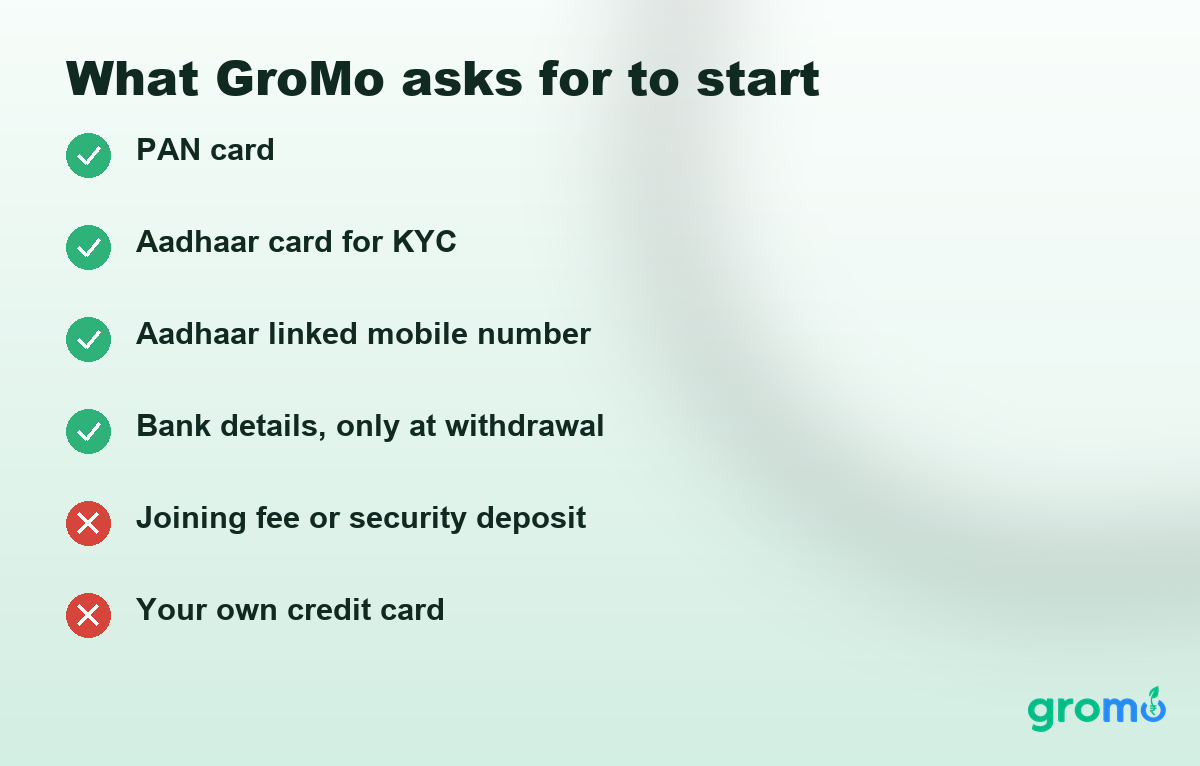
Onboarding is a KYC step, not a paperwork project.
Compare that with direct bank empanelment, which typically wants a signed DSA agreement, business or shop registration, GST registration where applicable, office address proof, a cancelled cheque, a credit check on you, and sometimes a security deposit. Weeks, not minutes.
The gap is the whole reason platform distribution exists. You get the bank tie-ups without the empanelment, and you can start on a Tuesday afternoon instead of next quarter.
Skills Every Credit Card Agent Should Have
Reading spending patterns. Ask where the money goes each month, then pick the card that pays back on exactly that.
Fee honesty. Say the annual fee out loud, along with the spend that waives it. Every complaint in this business starts with a fee nobody mentioned.
Basic credit literacy. Know what a hard enquiry does, why five applications in a week is a bad idea, and how a missed payment shows up for years.
Patience with rejection. Thin files and low scores get declined. That is underwriting doing its job, not you failing at yours.
Document discipline. Clear photos, matching addresses, current income proof. Sloppy files die in query loops.
Knowing when to say no. Someone already revolving a balance on two cards does not need a third. Saying so earns you the referral later.
How GroMo Helps You Become a Credit Card Agent
GroMo is an Indian financial products distribution app. Partners recommend credit cards, loans, savings accounts, demat accounts and insurance from one catalogue, and earn a commission when an application is approved.
Four things make cards easy to start with here. The bank tie-ups already exist, so there is no empanelment. Onboarding is PAN and Aadhaar, with bank details needed only at withdrawal. Live commissions show on every product card, so you never have to guess or trust a rumour. And GroMo Academy training is free, in Hindi and English, so you can learn one card properly before you pitch it.
The catalogue depth matters too. With 34 cards live, a customer declined for one card can often be placed on another, or on a secured card against an FD. An agent tied to a single bank has nowhere to go after the first no.

How to Start Selling Credit Cards Through GroMo
- Install the GroMo app and verify your mobile number.
- Finish KYC with PAN and Aadhaar, keeping the name spelling identical on both.
- Complete the GroMo Academy module for one card. One card, learned properly.
- Open that card's product page and read the live commission, the eligibility rules and the fee structure.
- Share the product link with one person whose spending genuinely fits that card.
- Sit with them through the application and stay until the video KYC is done.
- Add your bank account when you are ready to withdraw. It is not needed to start.
- Track the application to issue, and study every rejection.
Learn card two only after card one has been approved for somebody. Agents who memorise ten cards and place none are the most common failure in this business. There is a fuller walkthrough of the workflow in this guide to selling credit cards with GroMo.
How to Get Your First Credit Card Customer
Start with the people whose spending you already know.
Ask about spending, not about cards. "Where does most of your monthly spend go, fuel or online?" opens a real conversation. "Do you want a credit card?" closes one.
Use the fee waiver as the hook. Most people assume every card costs money forever. Showing the spend that waives the annual fee changes the answer immediately.
Sit with them while they apply. Video KYC is where first-timers abandon. Ten minutes of company converts more applications than any amount of follow-up messaging.
Go where spending is visible. Fuel pumps, kirana shops, office cafeterias, local trader groups. Someone filling their tank every second day is a fuel card customer.
Ask for one referral after the card arrives. A satisfied cardholder holding a physical card in their hand is the warmest lead you will ever get. Choosing the right card for each person is easier if you keep a shortlist of the best credit cards in India in your head.
How Much Can a Credit Card Agent Earn?
Between nothing and a real monthly income, and approvals decide which.
Three numbers set the total: how many applications you source, what share of them get approved and issued, and what each card pays. The third is set by the bank. The first two are yours.
The spread across cards is wide enough to matter. The better paying ones start around Rs 700 and reach up to Rs 2,000 per approved card, and the ones at the top are frequently the ones with the strictest approval criteria. Chasing only the highest paying card and getting declined every time earns less than placing mid-tier cards that actually get approved.
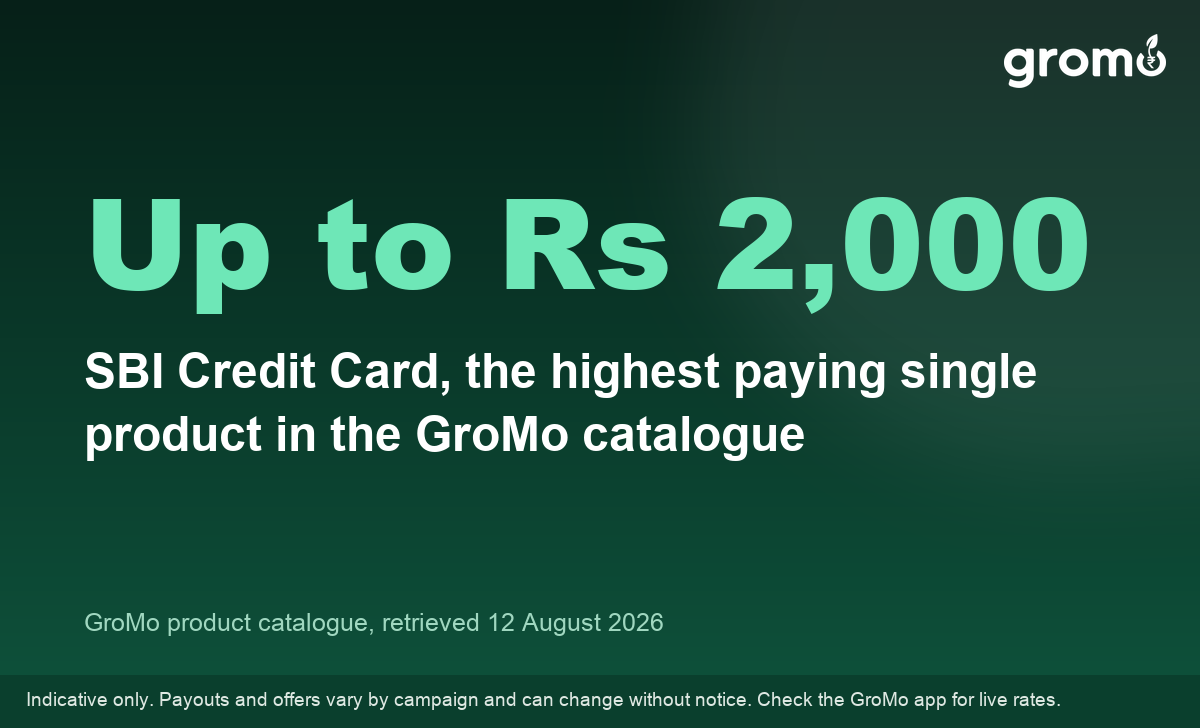
The highest paying single product on the platform, as of 12 August 2026.
Watch your own funnel rather than anyone's industry average. If 20 applications become 8 issued cards, that ratio is the number to improve, and lifting it pays better than doubling your outreach ever will.
Common Mistakes New Credit Card Agents Should Avoid
- Promising approval. You cannot approve anything. "You look eligible" is honest. "It will be approved" is not.
- Hiding the annual fee. It appears on the first statement, and the customer remembers who did not mention it.
- Applying to several banks at once. Each application is a hard enquiry, and a burst of them drops the score the application depends on.
- Selling a premium card to someone who cannot use it. A lounge card for a person who never flies is a fee with no benefit.
- Handling OTPs, PINs or card numbers. Never, for any reason, however convenient it seems.
- Quoting the advertised label as the commission. Read the rate on the product card at share time.
- Pushing a card on someone already revolving debt. A third card does not fix the first two.
- Ignoring secured cards. Every rejection is a secured card customer you did not place.
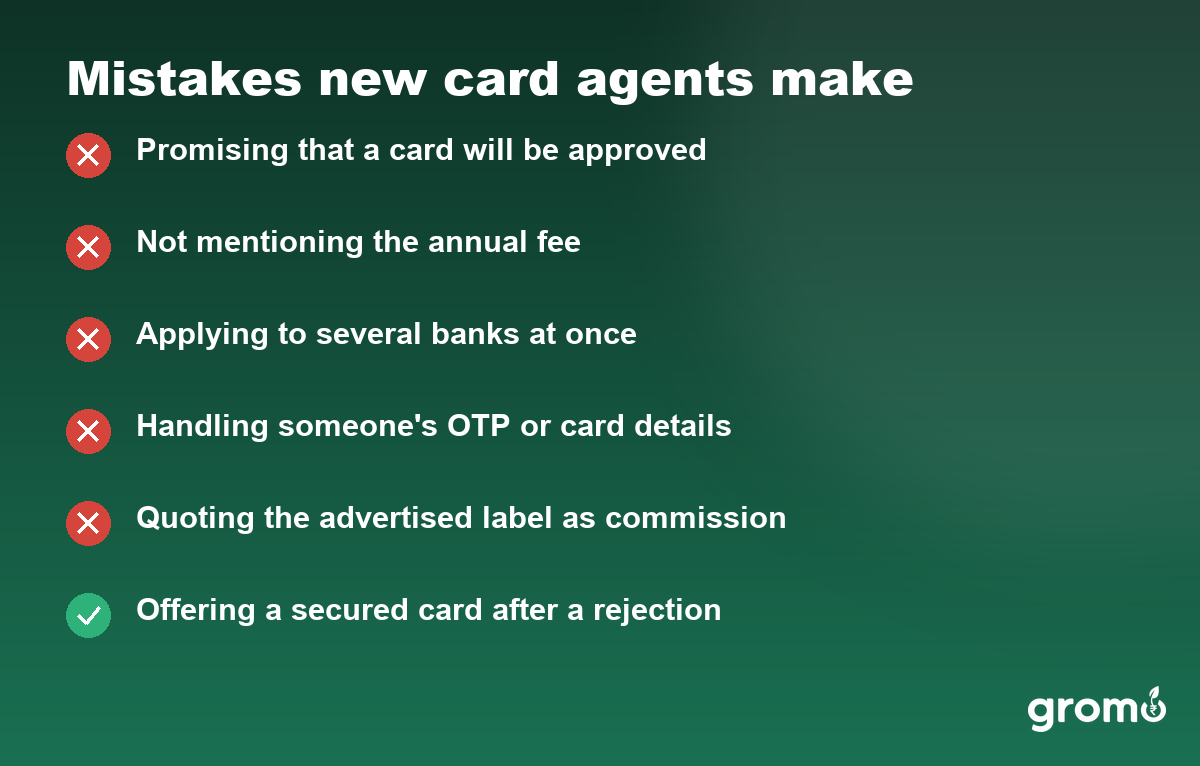
The first two cost you referrals. The fifth can cost you the account.
Frequently Asked Questions
What is a credit card agent?
A credit card agent helps people apply for credit cards from banks and NBFCs and earns a commission when a card is approved and issued. The bank decides approval, the credit limit and the interest rate. The agent sources the applicant and guides the application.
Do I need my own credit card to become a credit card agent?
No. Holding a card is not a requirement to recommend one. You need PAN and Aadhaar for KYC, and a bank account when you want to withdraw your earnings.
How much commission does a credit card agent get in India?
On GroMo cards pay up to Rs 2,000 per approved card. The card at the top of that range today is SBI Credit Card, and the better paying cards on the shelf sit well above the lowest ones. Rates are campaign-linked and change, so check the live figure on the product card before quoting it.
What documents are required to become a credit card agent?
On GroMo, PAN and Aadhaar for KYC, a mobile number linked to Aadhaar, and bank details at the point of withdrawal. Direct bank empanelment asks for considerably more, including a DSA agreement, business registration and a credit check.
Is selling credit cards legal in India?
Yes. Banks distribute cards through agents and platforms as a matter of routine, and the issuer stays responsible for the agent's conduct under RBI's outsourcing rules. Never collect money from an applicant and never handle their OTP or card credentials.
Can a salaried person become a credit card agent?
Usually yes, and many do it alongside a job. Check your employment contract for clauses on outside work first, since some employers require written permission.
Conclusion
A credit card agent is a distributor of cards, paid on approvals, carrying none of the credit risk and none of the setup cost. It is the easiest financial product to begin with, because the customer already knows what a credit card is and usually already wants one.
The economics support starting here too. Cards hold the highest payout in GroMo's catalogue, the shelf runs 34 cards deep so a decline can be redirected rather than lost, and onboarding is PAN and Aadhaar with bank details left until withdrawal. What decides your income is not how many cards you memorise. It is how well you match a card to how somebody actually spends.

Disclaimer
Nothing here is a guarantee of income. Credit card commissions are set by the issuing banks and revised as campaigns change, so a figure that is accurate today can be different next month. Every commission quoted in this article is indicative only and was read from the app on 12 August 2026 (GroMo product catalogue, retrieved 2026-08-12).
What you earn depends on approvals. An application that fails KYC, or an applicant the bank declines, pays nothing however well you handled it. Approval, credit limit, fees and interest rates are decided entirely by the issuer.
Everything above is general information, not financial advice. Check the live commission on the product card in the GroMo app before quoting anything, and read your employment contract before taking up agency work alongside a job.


