
Offline vs Online Credit Card Sales: Which Strategy Works Better?
Offline vs online credit card sales compared on trust, reach, cost and conversion, with a hybrid playbook that helps agents earn from both.

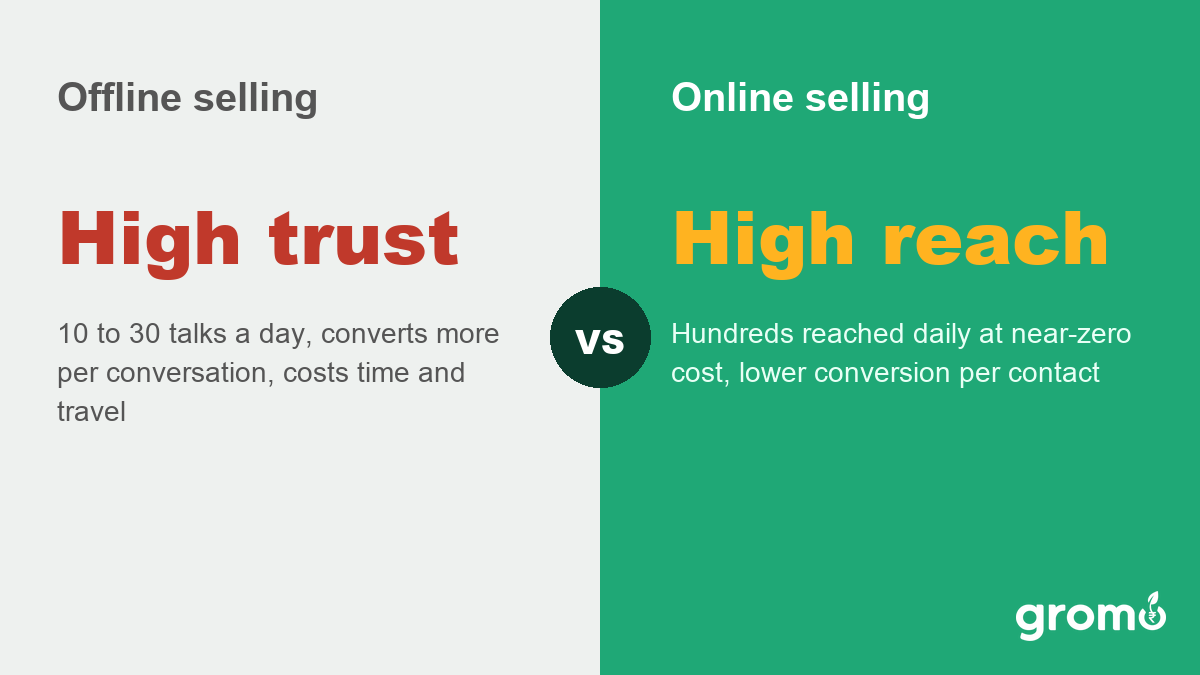
Neither offline nor online credit card sales is "better" on its own: offline selling converts more because of face-to-face trust, while online selling reaches far more people at almost zero cost. The credit card agents who earn the most run a hybrid: they build trust offline and scale reach online, with the application itself always digital.
Whichever channel you pick, the core skill of selling credit cards stays the same; this guide compares both strategies point by point, shows exactly when each one wins, and gives you a simple hybrid playbook to combine them.
Offline vs Online: Quick Comparison
| Factor | Offline sales | Online sales |
|---|---|---|
| Trust building | Very high; face-to-face answers doubts instantly | Slower; built through content and consistency |
| Reach per day | 10 to 30 real conversations | Hundreds through WhatsApp, Instagram, groups |
| Cost | Travel, time, sometimes venue permissions | Almost zero; data pack and time |
| Conversion rate | Higher per conversation | Lower per contact, higher in volume |
| Speed to first sale | Fast if your network is warm | Slower start, then compounding |
| Best for | High-value customers, premium cards, small towns | Scale, young digital-first customers, repeatability |
What Counts as Offline and Online Selling?
Offline credit card sales means finding and convincing customers in person: office visits, shop tie-ups, market areas, events, and referrals collected face to face. The conversation happens physically, even if the application is submitted digitally.
Online credit card sales means the whole funnel runs on screens: WhatsApp status and groups, Instagram content, referral links, and follow-ups on chat. The customer may never meet you, and the card link travels wherever your message does.
Strengths of Offline Credit Card Sales
- Trust converts. Sitting across from someone, showing the card comparison on your phone, and answering doubts on the spot removes the fear that stops online applications midway.
- Better for premium cards. High-income customers buying lifetime memberships or premium travel cards want a person accountable to them, not a link.
- Instant qualification. Two minutes of conversation tells you income, city, and intent, so you stop wasting effort on ineligible leads early.
- Warm referral chains. A happy customer introduces you to their office floor or market line the same week; offline referrals carry personal weight.
- Less competition in small towns. Tier 2 and tier 3 customers are underserved offline while every online space is crowded with links.
Weaknesses of Offline Selling
Offline selling costs time and travel, and your reach is capped by how many people you can physically meet in a day. Income stops when you stop moving, permissions are needed for malls, offices, and events, and a bad day of walking can produce zero conversations that matter.
Strengths of Online Credit Card Sales
- Reach without limits. One WhatsApp status reaches your entire contact list; one reel can reach thousands you have never met.
- Near-zero cost. No travel, no venue, no printed material; a data pack is the whole budget.
- It works while you rest. A good post or a shared link keeps collecting clicks at midnight; offline effort has no such shelf life.
- Perfect records. Every lead, click, and application sits in chat history and app dashboards, so follow-ups never depend on memory.
- Young customers live there. First-card customers in their 20s research and apply entirely on their phones and prefer a link over a meeting.
Weaknesses of Online Selling
Online, you are one message among fifty, so attention is scarce and trust is thin. Conversion per contact is much lower, spam-like sharing burns your reputation fast, and doubts that a face-to-face chat would settle in seconds can stall a digital application forever.
Which Strategy Wins in Which Situation?
| Your situation | Better strategy | Why |
|---|---|---|
| Brand new agent, warm local network | Offline first | Trust you already have converts fastest |
| Small town or tier 3 area | Offline first | Underserved customers, personal trust decides |
| Big city, large online following | Online first | Reach and content leverage beat door-to-door |
| Selling premium and travel cards | Offline | High-value customers want a person |
| Selling first cards to students and young earners | Online | They research and apply on their phones |
| Limited free time (job plus side income) | Online | Works in gaps, no travel needed |
| Building a long-term agent business | Hybrid | Offline trust plus online scale compounds |
The Hybrid Playbook: Best of Both
Top agents do not choose; they sequence. Here is the combination that works:
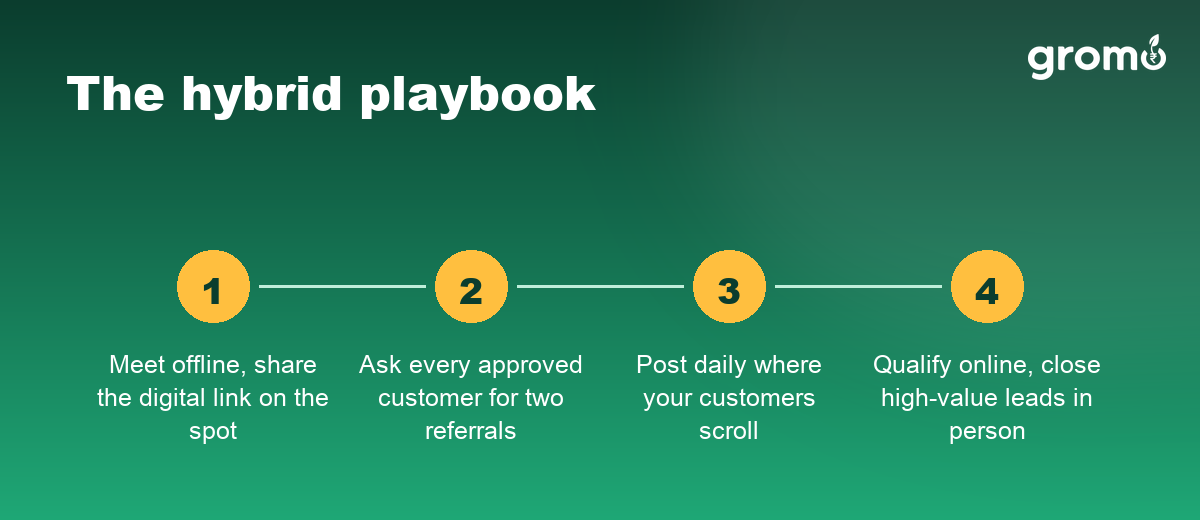
- Meet offline, apply online. Build trust in person, then share the digital application link on the spot so the customer applies in minutes while intent is hot.
- Turn every offline customer into an online node. After approval, ask for two referrals and permission to add them to your broadcast list for future offers.
- Post daily where your customers scroll. One WhatsApp status and one short post a day about card benefits keeps you visible between meetings.
- Use online to qualify, offline to close. Let interested leads come through the methods that get credit card leads online, then offer a call or short meeting to the high-value ones who hesitate.
- Follow up on chat within 24 hours of every conversation, offline or online, because both channels lose leads to silence, not rejection.
How GroMo Supports Both Strategies
The GroMo app is built for exactly this hybrid: you can sit with a customer anywhere, compare 30+ credit cards from different banks, check eligibility on the spot, and share a digital application link that works whether the customer is across the table or across the country. Every lead and application is tracked in the app, so offline conversations and online shares land in one pipeline, and you earn a payout on every approved and activated card.
FAQ: Offline vs Online Credit Card Sales
Which works better for credit card sales, offline or online?
Offline converts better per conversation because face-to-face trust settles doubts instantly, while online reaches far more people at almost zero cost. For most agents the highest-earning answer is a hybrid: build trust offline, scale reach online, and always complete the application digitally.
Is offline credit card selling still worth it in 2026?
Yes, especially for premium cards and in tier 2 and tier 3 towns where customers are underserved and personal trust decides. One good office visit or shop tie-up can produce more approvals than a week of cold online sharing, and offline referral chains compound fast.
How do I sell credit cards online without spamming people?
Share value, not just links: one WhatsApp status and one short post a day about a real card benefit, answers to common doubts, and honest comparisons. Send links personally only to people whose need you know, and follow up within 24 hours on chat.
Blasting the same link into every group burns your reputation and gets you muted.
Which strategy should a brand new agent start with?
Start where your trust already exists. If you have a warm local network, go offline first and convert friends, family, and colleagues while learning the products. If your network lives on social media, start online with daily content. Either way, add the other channel within your first two months.
Can the credit card application itself happen offline?
Card applications today are digital almost everywhere: even in a face-to-face meeting, the customer applies through a link or app in minutes. That is what makes the hybrid model work; the trust-building can be offline while the paperwork, tracking, and payout all stay online.
Disclaimer
This article is general guidance for credit card agents, not financial or legal advice. Conversion patterns and earnings vary by agent, product, and market, and no income is guaranteed. Always take the venue's permission for offline selling, follow platform rules for online sharing, and explain card fees honestly; approval is always the bank's decision.
GroMo is a financial product distribution platform, not a bank or lender, and is available only to users aged 18 and above. Bank, card, and brand names are trademarks of their respective owners.


