
How to Sell Credit Cards Through WhatsApp
How to sell credit cards through WhatsApp: Business setup, status strategy, broadcast lists, message scripts, a 30-minute daily routine and no-spam rules.

WhatsApp is the highest-converting channel most credit card agents will ever use, because everyone on it already knows you. No algorithm, no ad budget, no waiting for rankings: your status is seen by hundreds of people who trust you, and a well-run broadcast list beats any cold-calling operation.
This guide covers exactly how to sell credit cards through WhatsApp: the setup, the daily routine, the message scripts that work, and the etiquette that keeps you welcome instead of blocked.
Quick Facts
| Question | Answer |
|---|---|
| Investment needed | Zero; WhatsApp Business is free |
| Time needed | 30 to 60 minutes a day |
| Time to first income | 1 to 3 weeks with an active contact list |
| How money flows | Contact clicks your shared link, applies, card approved, you earn |
| Main tools | Status, broadcast lists, catalogue, quick replies, labels |
| The one rule | Be useful daily, never spam; blocked numbers earn nothing |
Why WhatsApp Converts So Well
Card selling runs on trust, and WhatsApp is where your trust already lives. A status update reaches your entire contact list without sending anyone a message, replies open one-to-one conversations at the customer's own pace, and the application itself travels as a simple link.
The channel's weakness is its ceiling: your contacts are finite. That is why serious agents pair WhatsApp with a reach channel, growing new contacts through the methods in how to get credit card leads and feeding them into the WhatsApp routine below.
Step 1: Set Up WhatsApp Business Properly
- Install WhatsApp Business (free) on your working number, or a second number kept professional.
- Complete the profile: your real name and photo, "Financial products advisor" style description, and your city; anonymous profiles read as fraud.
- Build the catalogue: add the 4 or 5 cards you sell as items, each with a benefit-first description and its key fee.
- Create quick replies for the questions you will answer daily: fees, documents, eligibility, how to apply.
- Set up labels: New lead, Interested, Applied, Approved, Follow up. This is your free CRM.
Step 2: The Status Strategy
Status is your daily storefront, and the rule is one useful status a day, not ten salesy ones. Rotate four types across the week:
- Benefit math: "Spending Rs 4,000 a month on fuel? The right card saves you about Rs 480 a year. Ask me which one."
- Myth-busting: "Credit cards create debt only if you pay the minimum due. Full payment on time = 20 to 50 days of free credit."
- Offer updates: current joining bonuses or waiver conditions, stated honestly with the fee visible.
- Proof: "Helped a friend get his first card approved this week. First-timers, happy to guide you too."
End each status with a soft ask: "Reply for details." The people who reply are warm leads who invited the conversation.
Step 3: Broadcast Lists, Not Groups
Groups die of spam and mute buttons. Broadcast lists deliver your message as a personal chat to each contact, and only to people who have saved your number, which keeps the audience self-selected and warm.
Build separate lists by profile, salaried friends, business owners, family circle, and send one genuinely useful message a week per list, not daily. Match the card angle to the list: cashback math for salaried lists, business card benefits for shop-owner lists.
Step 4: The One-to-One Conversation
When someone replies, slow down. Ask two questions before pitching anything: what do you spend most on monthly, and do you already have a card?
Then recommend one card with the math from their answers, state the fee and its waiver upfront, and share your application link with a simple line: "Takes two minutes, and I will help at every step."
Handle doubts with acknowledgment first; the scripts for every common pushback are in credit card sales objections and how to handle them. And follow up within 24 hours of every conversation; on WhatsApp a gentle "sharing that comparison I promised" message revives most quiet leads.
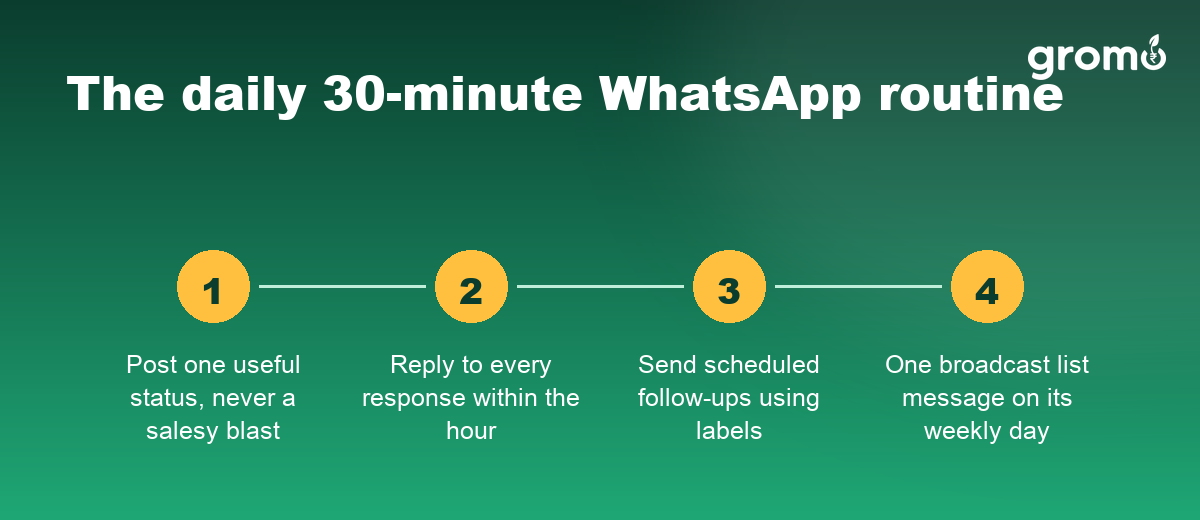
Step 5: The Daily 30-Minute Routine
- Post one status (5 minutes).
- Reply to every status response and pending chat (10 minutes).
- Send scheduled follow-ups using your labels (10 minutes).
- Message one broadcast list if it is that list's day (5 minutes).
Thirty consistent minutes beats three hours of random forwarding, every week of the year.
What Gets Agents Blocked (Never Do These)
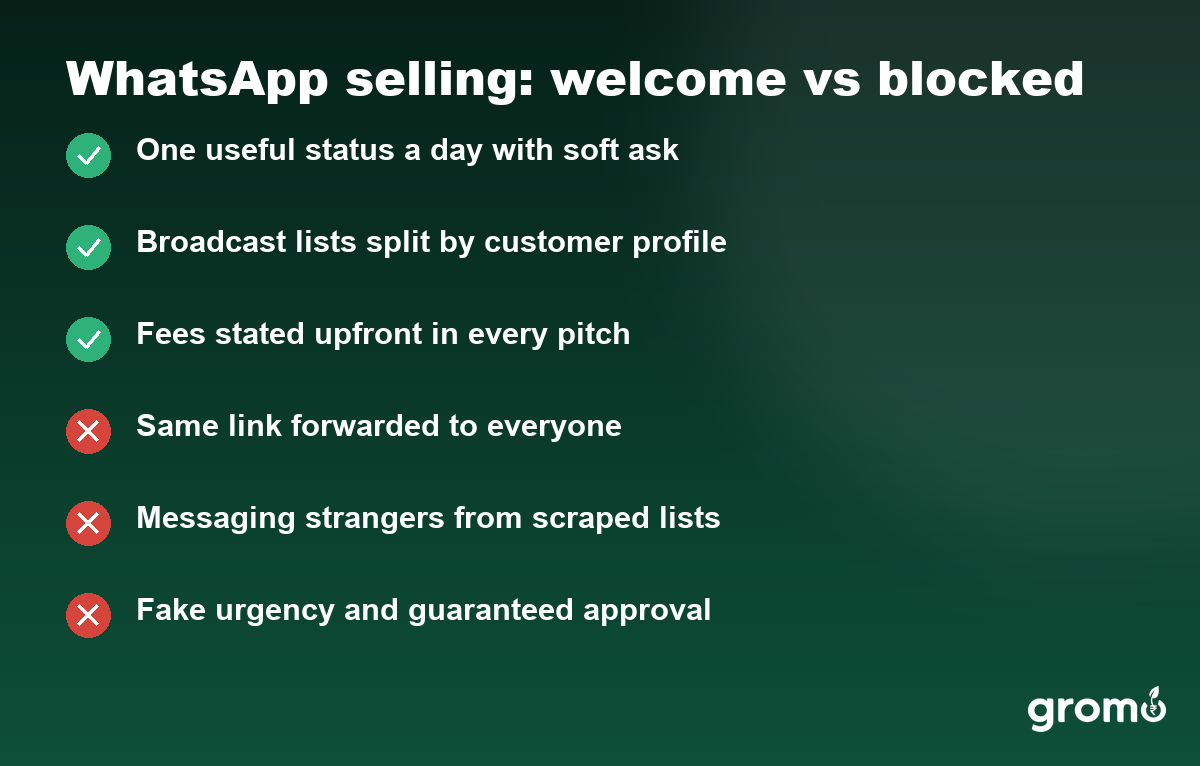
- Forwarding the same link to everyone. Untargeted links are spam even from a friend.
- Messaging strangers from scraped lists. It violates WhatsApp policy and destroys the trust the channel runs on.
- Fake urgency and fake offers. "Only today, guaranteed approval" costs you contacts permanently; approval is always the bank's decision.
- Asking for OTPs or documents in chat. Applications and uploads go through the official link only; your chat is for guidance.
- Ignoring "not interested". Mark the label, stop pitching, keep the relationship; people's needs change within a year.
How GroMo and GroMo Academy Fit
GroMo makes WhatsApp selling practical: 30+ cards from different banks in one app, so every contact profile has a matching card, digital application links built for sharing in chat, and live tracking so your labels always reflect reality. Payouts land on every approved and activated card.
Free GroMo Academy lessons cover the pitch, objection handling, and follow-up systems this routine runs on. Start with credit card agent registration, wire the routine into your mornings, and scale reach later with a YouTube channel for selling credit cards or a website that sells credit cards; WhatsApp will convert the audiences both of them build.
FAQ: Sell Credit Cards Through WhatsApp
How can I sell credit cards on WhatsApp?
Set up WhatsApp Business with a complete profile and card catalogue, post one useful status daily with a soft ask, run broadcast lists split by customer profile, and move replies into one-to-one conversations where you match a card to their spending and share your agent application link. Payouts come on every approved card.
Is selling credit cards on WhatsApp allowed?
Yes, as long as you message people who know you or have opted in. Messaging strangers from scraped lists violates WhatsApp policy and gets numbers banned. The compliant model is status updates seen voluntarily, broadcast lists of saved contacts, and conversations the customer starts by replying.
What should I post on WhatsApp status to sell cards?
Rotate four types: benefit math on real spending, myth-busting about interest and fees, honest offer updates with the fee visible, and proof stories of people you helped. One status a day with a soft closing line like reply for details keeps you useful instead of spammy, and the repliers become your warm leads.
How do I follow up on WhatsApp without annoying people?
Fix the next step in the conversation itself, then follow up within 24 hours with something promised: the comparison, an answer, the current offer. Use labels to schedule day-3 and day-7 touches, and stop pitching anyone who says not interested; keep the relationship, because needs change within a year.
Which app should agents use to share card applications on WhatsApp?
A multi-bank platform beats single-bank links because every contact profile gets a matching card. Through the GroMo app you can compare 30+ cards from different banks, share a digital application link in chat, and track each application's status, while free GroMo Academy lessons cover the pitch and objection handling the routine needs.
Disclaimer
This article is general guidance, not financial, legal, or tax advice. Card features, fees, eligibility criteria, approval decisions, and agent payouts are decided by the issuing banks and platforms, vary by product and profile, and change over time; no income or approval is guaranteed. Follow each platform's policies and applicable advertising disclosure norms when promoting financial products.
GroMo is a financial product distribution platform, not a bank or lender, and is available only to users aged 18 and above. Bank, card, platform, and brand names are trademarks of their respective owners.


