
DSA vs Loan Connector vs Sub-DSA: Roles, Payouts and Risks
DSA vs loan connector vs sub-DSA: who signs with the lender, who pays you, which RBI rules apply, the risks of each route and how to choose in 2026.

A DSA (Direct Selling Agent) has a written agreement and a code from a bank or NBFC, and the lender pays it. A loan connector has no lender agreement: it passes leads to a DSA for a share of the DSA's payout. A sub-DSA works under a main DSA's code through a written sub-agreement. RBI's directions do not define "connector" or "sub-DSA". Searches for "loan connector" in India rose 52% in a year (Google Keyword Planner, retrieved 2026-11-25).
Why does it matter? The role decides who owes you money and who checks your work. It also decides what you can do when a payout does not arrive. The sections below compare the three roles, explain the RBI rules behind them and end with a checklist to use before you work under any DSA.
What Is the Difference Between a DSA, a Loan Connector and a Sub-DSA?
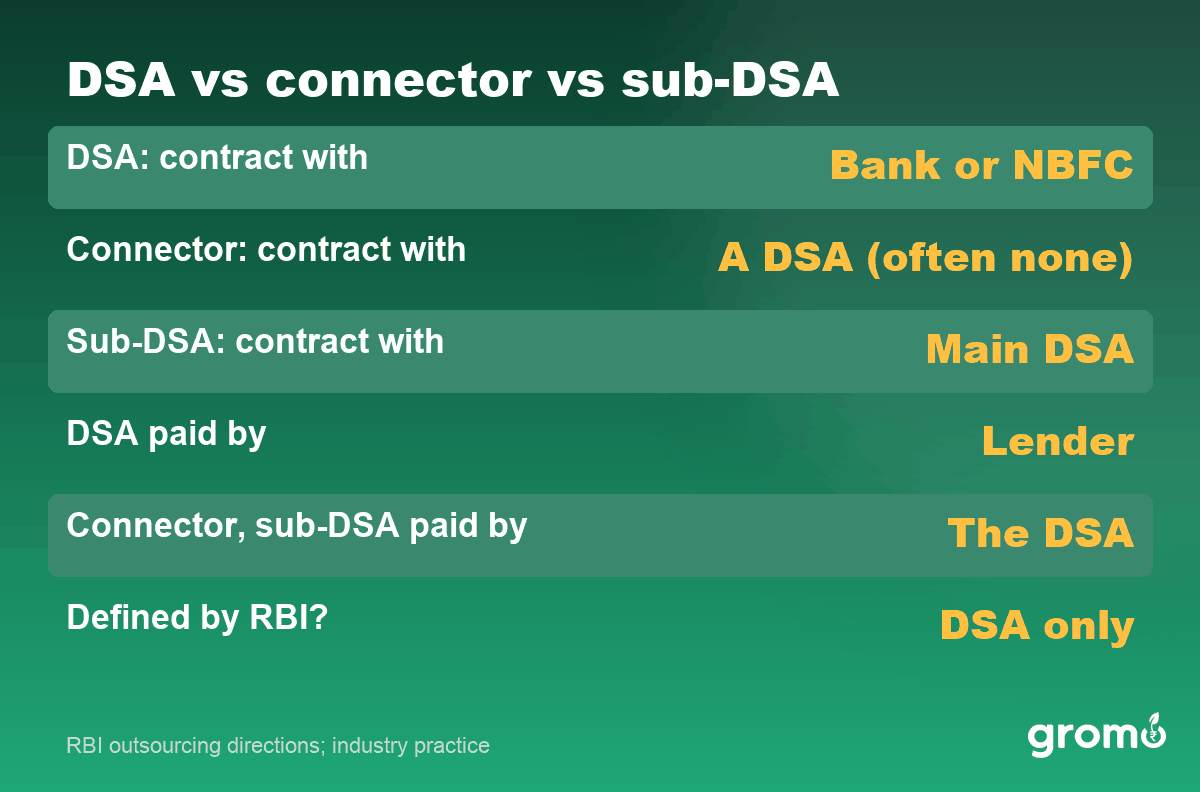
The difference between a DSA, a loan connector and a sub-DSA is who you have a contract with. A DSA contracts with the lender itself, so the bank or NBFC knows the DSA, trains them and pays them. A sub-DSA contracts with a main DSA and works under that DSA's code. A loan connector often has no written contract at all and simply refers customers to a DSA in return for a share of the payout. Only the DSA appears in RBI's outsourcing directions, which make the lender responsible for its Direct Sales Agents. Connectors and sub-DSAs sit one level further away. Their payout depends on the DSA, not the lender. The table compares all three with an app-based partner route.
| Point | DSA | Sub-DSA | Loan connector | GroMo partner |
|---|---|---|---|---|
| Contract with | The bank or NBFC | A main DSA | A DSA, often only verbal | GroMo (Vitrak Technologies) |
| Code or ID | Own DSA code from each lender | Works under the main DSA's code | None from the lender | GroMo partner ID |
| Setup | Lender's empanelment, KYC, documents | Main DSA's onboarding | Usually informal | Free app signup, PAN and bank KYC |
| Who pays you | The lender | The main DSA | The DSA | GroMo, to your in-app wallet |
| Share of payout | Full payout under the lender's agreement | Part of the DSA's payout | Part of the DSA's payout | Fixed per product, shown in the app |
| Number of lenders | One code per lender | Only the main DSA's lenders | Only the DSA's lenders | Many banks and NBFCs in one app |
| Main risk | Targets, paperwork, clawbacks | Main DSA delays or disputes | No written terms to enforce | Approval and payout depend on the provider |
| Named in RBI directions | Yes | No | No | No |
What Does a Loan Connector Do, and How Does a Connector Earn?
A loan connector finds people who need a loan and hands their details to a DSA, who then files the application with a bank or NBFC. Connectors are often property dealers, car dealers, chartered accountants, shop owners or former bank sales staff who meet borrowers in their daily work. The connector earns only when the loan is disbursed and the lender pays the DSA, because the connector's money comes out of the DSA's payout. No lender code, office or target is needed. That is why the route looks easy. Its weak point is the agreement. When the share is fixed on a phone call or a WhatsApp message, the connector has no document to show if the DSA pays late, pays less or says the loan came from someone else. A connector who wants a steady income usually moves to a written sub-DSA agreement or applies for a DSA code of their own.
Connectors usually do three jobs: - Find borrowers and check their basic eligibility (income, age, credit score range). - Collect documents and pass them to the DSA, with the customer's consent. - Follow up with the customer until disbursement.
What Is a Sub-DSA, and Does RBI Allow Sub-DSAs?
A sub-DSA is an agent who works under a main DSA's code through a written sub-agreement, sourcing loans for the lenders the main DSA is tied to. RBI does not use the word "sub-DSA", but it does set the rule that decides whether the arrangement is proper. RBI's outsourcing directions for banks (3 November 2006) and for NBFCs (9 November 2017) say the outsourcing contract should require the lender's prior approval or consent before the service provider uses subcontractors for all or part of the outsourced work. A DSA is such a service provider. So a sub-DSA arrangement is in order only when the lender has agreed to it. Ask first. Before you sign as a sub-DSA, ask the main DSA to confirm in writing that each lender has approved sub-agents. If the main DSA cannot, your leads may be rejected or your payout disputed.
RBI's NBFC outsourcing directions (9 November 2017) also say that "NBFCs would therefore be responsible for the actions of their service provider including Direct Sales Agents/ Direct Marketing Agents and recovery agents". Lenders carry the blame. So they want to know who is sourcing their customers.
Who Pays a DSA, a Connector and a Sub-DSA, and How Much?
The lender pays only the party it has a contract with. Nobody else. A bank or NBFC pays its DSA a payout set in the DSA agreement, usually after the loan is disbursed. The DSA then pays its sub-DSAs and connectors from that payout, at a share the DSA decides. RBI does not set DSA payout rates, and lenders do not publish them, so any figure you see online for "DSA commission" is a claim by that website, not a rule. Two practical results follow. Each level keeps a cut. First, a connector or sub-DSA always earns less per loan than the DSA above them, because each level keeps a part. Second, every delay adds up: if the lender pays the DSA late, or claws back a payout because the borrower closed the loan early, the delay or cut reaches you too. Our guide to DSA loan agent commission covers how lender payouts are usually structured.
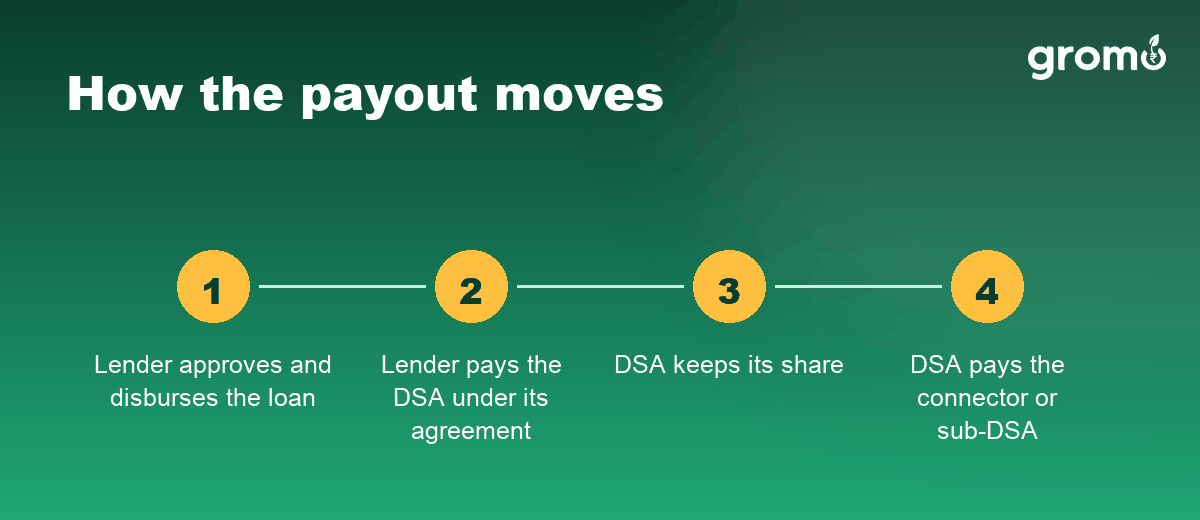
A simple way to see the chain: 1. The lender approves and disburses the loan. 2. The lender pays the DSA under its agreement. 3. The DSA keeps its share. 4. The DSA pays the sub-DSA or connector.
What RBI Rules Apply to DSAs, Connectors and Sub-DSAs in 2026?
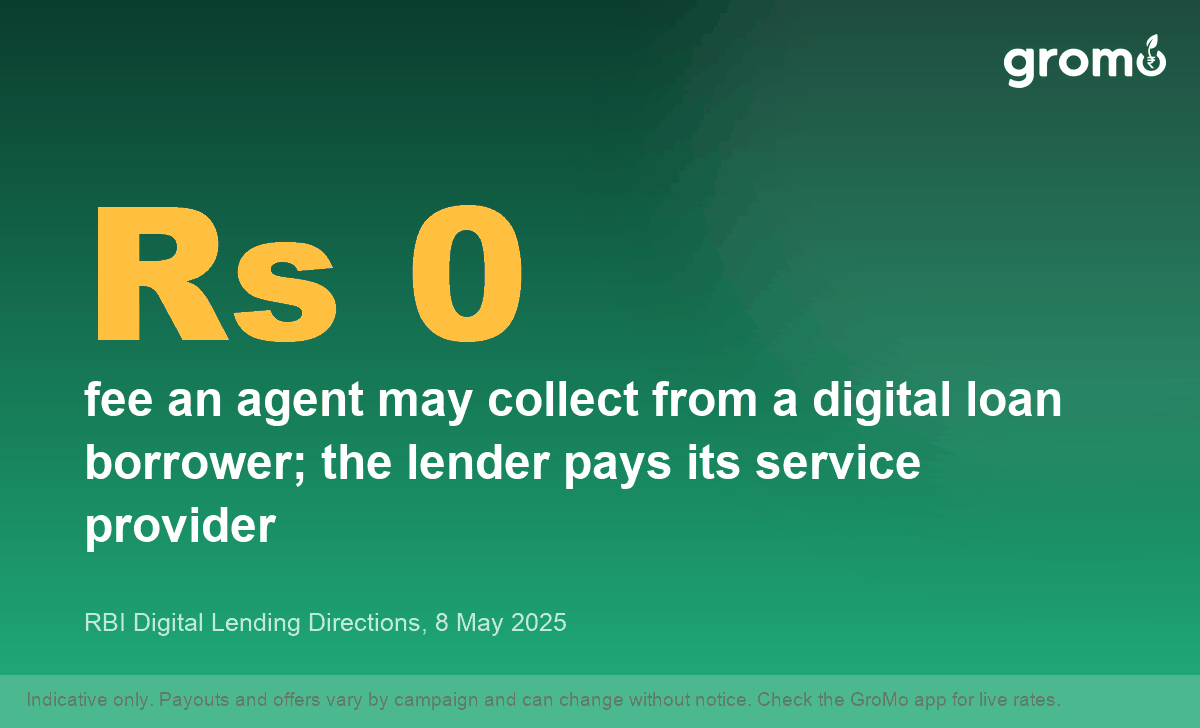
Three sets of RBI rules shape this work in 2026, and they apply through the lender. The outsourcing directions make the bank or NBFC responsible for its DSAs, require training on how to approach customers, calling hours, customer privacy and stating correct terms, and ask lenders to have a code of conduct that DSAs sign. The Fair Practices Code governs how loans are explained and how dues are collected. The RBI Digital Lending Directions, 2025 (8 May 2025) cover any agent who sources or services digital loans, called a Lending Service Provider (LSP). Under those directions, any fee payable to an LSP must be paid directly by the lender and must not be charged to or collected from the borrower. The borrower gets a Key Fact Statement and a cooling-off period of at least 1 day to exit a digital loan (RBI, Digital Lending Directions, 8 May 2025). For a connector or sub-DSA, the safe reading is simple. Never take money from a borrower.
| Rule | What it says | What it means for you |
|---|---|---|
| Outsourcing directions (banks 2006, NBFCs 2017) | Lender stays responsible for its DSAs; contract should need lender's consent for subcontractors | Sub-DSA work needs the lender's approval through the main DSA |
| Code of conduct for DSAs | Training on soliciting, calling hours, privacy, correct product terms | No pressure selling, no late-night calls, no sharing customer data |
| Digital Lending Directions, 2025 | LSP fees paid by the lender, not the borrower; KFS; cooling-off of at least 1 day | Never collect a "file charge" from a borrower |
| Grievance redressal | Lender and LSP must name nodal grievance officers | Customers can complain to the lender about how they were sold a loan |
The digital lending directions put the principle plainly: an outsourcing agreement "shall in no manner dilute or absolve the RE of its obligations", and the lender "shall remain fully responsible and liable for all acts and omissions of the LSP" (RBI, Digital Lending Directions, 8 May 2025).
What Are the Risks of Working as a Connector or Sub-DSA?
The biggest risk for a connector or sub-DSA is not being paid in full or on time, because you depend on a DSA who depends on a lender. Payout disputes usually start in one of five places. The DSA says the lead was already in the lender's system from another source. The loan is disbursed but the lender's payout to the DSA comes weeks later. The borrower prepays or closes the loan early and the lender claws back the payout. The DSA changes your share after the loan is done. Or the DSA's code is suspended, and with it every pending payout. Connectors with no written terms carry all five risks. They have no record to rely on. Sub-DSAs carry fewer, because a sub-agreement can fix the share, the payout date and the clawback rule. Many full DSAs face the same delays, as our post on why DSA agents struggle with commission payment delays shows.
Other risks to watch: - Data risk: carrying PAN, Aadhaar and bank statements on personal phones or chats puts customer data and your reputation at risk. - Conduct risk: a connector who promises "sure approval" or takes a fee from a borrower can get the DSA's code suspended, which hurts every agent under it. - Concentration risk: one DSA usually means a few lenders, so customers who do not fit are lost.
Which Route Should You Choose: DSA, Sub-DSA or Connector?
Choose the route that matches your volume and your paperwork. In India, "dsa for loans" is searched about 2,400 times a month (Google Keyword Planner, retrieved 2026-11-25), so many people weigh this same choice. A full DSA code suits someone who sources loans every week, can meet lender targets and has the documents for empanelment, such as a registered business, GST where required and a clean credit record. A sub-DSA agreement suits someone who sources loans regularly but cannot yet meet a lender's direct criteria, as long as the sub-agreement is written and the lender has approved it. Connector work suits someone who meets borrowers only now and then, such as a property dealer or accountant, and wants a small extra income without setup. If you want many lenders without signing up with each one, an app-based route is another option. Our step-by-step guide to DSA loan agent registration explains what lenders ask for when you apply directly.
| Your situation | Route that usually fits |
|---|---|
| Source loans every week, have business documents | Own DSA code with one or more lenders |
| Source loans regularly, cannot meet lender criteria yet | Written sub-DSA agreement under an established DSA |
| Meet borrowers occasionally through your main work | Connector with written payout terms, or an app-based route |
| Want many lenders without separate tie-ups | App-based partner route |
| Want to build a team of agents | DSA code first, then a franchise-style team |
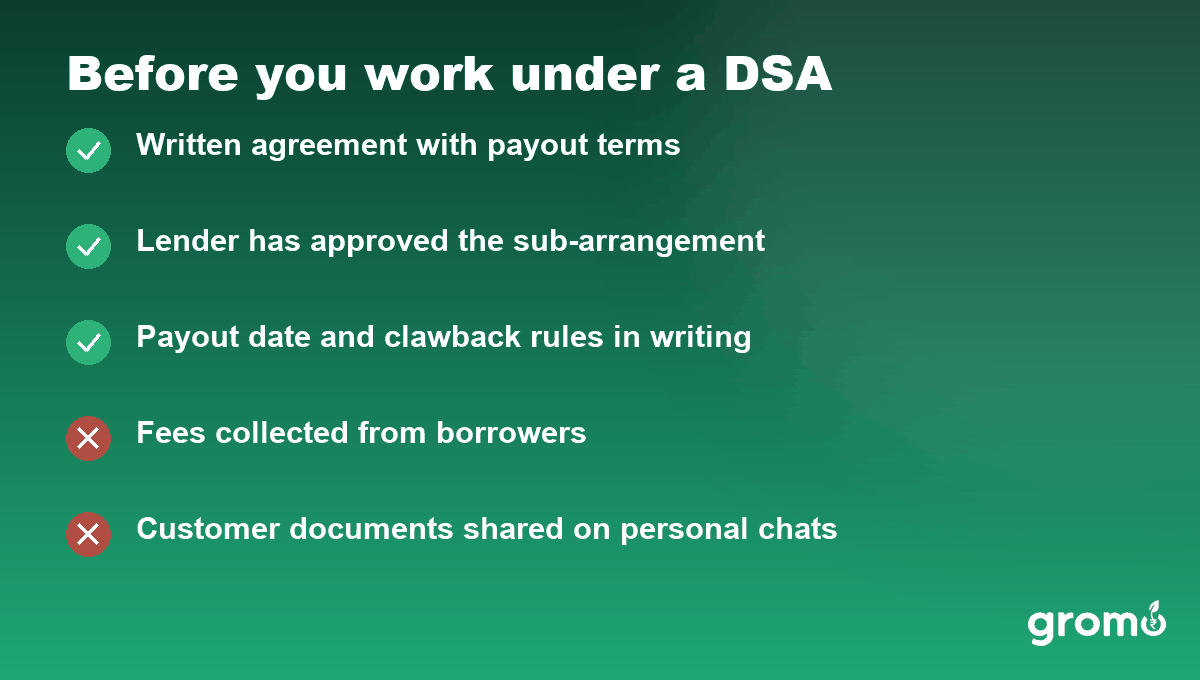
Ten questions to ask any DSA before you send them a single customer: 1. Will you sign a written agreement with my payout share for each lender? 2. Has each lender approved sub-agents under your code? Can I see it in writing? 3. When is my payout paid: on disbursement, on your receipt from the lender, or monthly? 4. What happens to my payout if the borrower prepays or the loan is cancelled? 5. How do you record that a lead came from me, and can I see that record? 6. Which lenders and products can I source for? 7. Who handles customer documents, and how are they stored? 8. Do you take any fee from borrowers? (The answer should be no.) 9. Is TDS deducted on my payout, and will I get a certificate? 10. How can either of us end the arrangement, and what happens to pending payouts?
Where Does a GroMo Partner Fit Among These Routes?
A GroMo partner refers customers for loans, credit cards and other financial products through the GroMo app, without a DSA code or a sub-agreement with each lender. You register free with your PAN and a bank account in your own name, choose a product, and share its link with a customer. The bank or NBFC alone decides approval and terms. When the provider confirms the sale, the payout shown in the app is credited to your GroMo wallet, and you withdraw it to your bank account. In practice the role is closest to a connector's. The difference is fixed payouts shown before you share a link and each lead tracked in the app. The route suits connectors who want more than one DSA's lenders, and anyone who wants to start before applying for a DSA code. Our page on who can earn with GroMo covers the 16 profiles that use it.
| Loan-related category on GroMo | Highest base payout | Highest app label |
|---|---|---|
| Personal Loan (28 products) | Up to ₹500 (Lendingplate Personal Loan) | Up to 3.5% |
| Credit Line (5 products) | Up to ₹600 (Bajaj Finserv Insta EMI Card) | Up to ₹600 |
| Business Loan (2 products) | Up to ₹100 (InstaVyapaar, ClickPe) | Up to 1% |
Source: GroMo product catalogue, retrieved 2026-11-25.
Please note: payouts change often and differ by product, lender and city. Most products pay less than the highest figure shown. Commission is paid only after the bank or NBFC approves and confirms the customer, and the lender alone decides approval. Check the live payout and how it is calculated in the app before you share a link.
A simple example: a property dealer refers four people in a month. Two are approved for a Prefr personal loan, which pays a ₹250 base payout (GroMo product catalogue, 25 November 2026). So the dealer earns two payouts that month. Small, but real. The example is for illustration only. It is not typical and not guaranteed.
Start with the Route That Protects Your Payout
GroMo partners have earned more than ₹100 crore in total, as reported by Moneycontrol, The Economic Times and Business Standard in February 2024. Whichever route you pick, the rule is the same: get your payout terms in writing, never take money from a borrower, and send each customer only to a lender whose rules fit them. Our guide to becoming a private loan agent covers the day-to-day work in more detail.
GroMo is a free app by Vitrak Technologies Pvt Ltd where partners help customers apply for credit cards, loans, savings accounts, demat accounts and investment products from RBI and SEBI-regulated providers, and earn a commission on each approval.
FAQ: DSA, Loan Connector and Sub-DSA
People choosing between these roles ask these questions most often.
Is a loan connector the same as a DSA?
No. A DSA has a direct agreement and a code from a bank or NBFC and is paid by the lender. A loan connector refers customers to a DSA and is paid a share by that DSA, usually without any agreement with the lender.
Is loan connector work legal in India?
Referring customers to a DSA is not banned, but RBI does not define the connector role. The lender stays responsible for how its loans are sourced, so a connector must follow the DSA's code of conduct and must never collect money from a borrower.
Does RBI allow sub-DSAs?
RBI does not use the term. Its outsourcing directions say the lender's contract should require the lender's prior approval or consent before a service provider such as a DSA uses subcontractors. A sub-DSA arrangement is proper only when the lender has agreed to it.
Who pays a sub-DSA?
The main DSA pays the sub-DSA from the payout it receives from the lender, at a share set in their sub-agreement. The lender does not pay the sub-DSA directly.
Can a connector charge the borrower a fee?
No. Under RBI's Digital Lending Directions, 2025, fees due to a lending service provider are paid by the lender and must not be collected from the borrower. Any agent asking a borrower for a file charge is a warning sign.
Do I need a DSA code to refer loans through GroMo?
No. GroMo partners register on the app with PAN and a bank account and share product links. The bank or NBFC decides approval, and the payout shown in the app is credited after the sale is confirmed.
Disclosures
GroMo (Vitrak Technologies Pvt Ltd) is a distribution platform. GroMo is not a bank, NBFC, insurer or investment adviser. All products are offered by their respective RBI or SEBI-regulated providers, who alone decide approval, interest rates and terms.
Loans and credit cards are issued by RBI-regulated banks and NBFCs. Approval is at the lender's sole discretion and is never promised.
Partner earnings depend on effort, product mix and customer eligibility. Any figures shown are illustrative examples. They are not typical and are not guaranteed. GroMo does not guarantee any level of income.
Disclaimer
The information on this page is for general information only and is not financial, legal or tax advice. RBI rules summarised here are as read on rbi.org.in on 25 November 2026; check the current text before relying on it. Commission rates are set by lenders and providers and change often; check the live figure in the app. You must be 18 or older to join GroMo.


