
Direct Selling Agent vs MLM in India: What Is the Difference?
A direct selling agent (DSA) earns commission from banks for approved loans and cards. MLM pays for recruiting. Rules, red flags and a side-by-side table.

A direct selling agent (DSA) is a person or firm that a bank or NBFC engages to find customers for its loans, credit cards and accounts, and gets paid a commission for each approved customer. Direct selling, in the MLM sense, is a different business: a company sells goods such as health or beauty products through a network of independent sellers, governed by the Consumer Protection (Direct Selling) Rules, 2021. A direct selling agent never pays to join, holds no stock and earns nothing from recruiting other people. The 2021 rules ban pyramid schemes and any entry fee in direct selling, and from 1 January 2027 RBI rules make commercial banks publish the list of DSAs they engage.
What Is a Direct Selling Agent (DSA)?
A direct selling agent is an outside person or firm, not a bank employee, that a bank or NBFC engages to bring in customers for its financial products. The DSA meets or calls customers, explains the product, helps them apply, and the lender alone decides approval. The lender pays the DSA a commission for each approved customer. Money flows from the bank to the agent. Never the other way.
Since June 2026 the role has a written definition. RBI's amendment to the bank conduct rules, dated 15 June 2026, says:
"Direct Selling Agent (DSA) / Direct Marketing Agent (DMA) means an entity or individual (other than a bank's own employee) engaged by a bank, irrespective of the contractual designation / nomenclature used for such engagement (such as Business Correspondent (BC), Loan Service Provider (LSP), etc.), to sell or market / promote / influence customers for purchase of its own or third-party product / service." Reserve Bank of India, Commercial Banks (Responsible Business Conduct) Second Amendment Directions, 2026
People also say "loan agent" or "loan DSA" for the same job. If you only need the meaning of the abbreviation, our guide to the DSA full form in banking covers it in two minutes.
What Is Direct Selling, and How Is MLM Different?
Direct selling is the sale of goods or services to consumers away from a shop, usually by independent sellers who visit homes or sell through their own contacts. Products are typically household goods, cosmetics, health supplements and similar items. India regulates direct selling under the Consumer Protection (Direct Selling) Rules, 2021, notified as G.S.R. 889(E) under the Consumer Protection Act, 2019 (Gazette of India, 28 December 2021).
MLM (multi-level marketing) is one model of direct selling in which sellers can also earn on the sales of people they bring in, building "levels" below them. MLM itself is not banned. What the 2021 rules outlaw is a pyramid scheme, where money comes mainly from enrolling new members rather than from selling real products to real customers.
A bank DSA sits outside this world. You sell financial products made by RBI-regulated lenders. There are no levels, and the direct selling rules do not cover you at all.
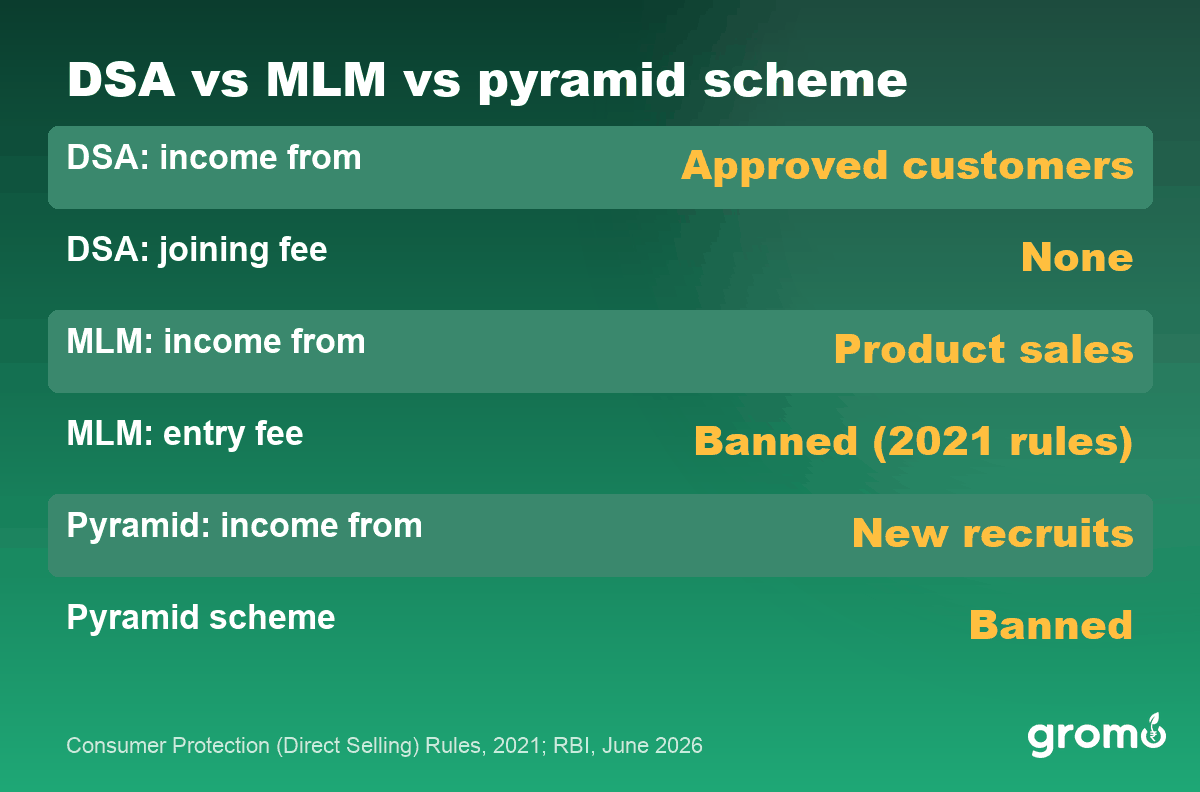
Direct Selling Agent vs Direct Seller vs Pyramid Scheme: Side-by-Side
The table compares the three on the points that matter when someone offers you an "agent" opportunity.
| Point | Bank or NBFC direct selling agent (DSA) | Direct seller (direct selling or MLM company) | Pyramid or money circulation scheme |
|---|---|---|---|
| What you sell | Loans, credit cards, savings and other financial products of a regulated lender | Goods or services of the direct selling company | Often nothing real, or products with no genuine demand |
| Who sets the rules | RBI rules for banks and NBFCs, plus the lender's code of conduct | Consumer Protection (Direct Selling) Rules, 2021 | Banned under the 2021 rules and the Prize Chits and Money Circulation Schemes (Banning) Act, 1978 |
| Joining fee | None from a genuine lender or platform | Entry fee or subscription fee is banned by rule 7 of the 2021 rules | Usually asks for a joining fee or a "starter kit" payment |
| Stock you must buy | None | Depends on the company; check the contract and return terms | Pressure to buy stock or packages to "qualify" |
| Where income comes from | Commission from the lender for each approved customer | Margin or commission on genuine product sales | Money paid by new members you recruit |
| Recruiting others | Not a source of income | Allowed, but income must come from sales | The main source of income |
| Written contract | Agreement with the bank, NBFC or platform | Written contract with the direct selling entity is mandatory | Often vague or none |
Ask one question: where does the money come from? If your income depends on customers getting approved for a real financial product, you are doing DSA work. If it depends on how many people join under you and how much they pay, walk away.
Who Regulates a DSA, and Who Regulates Direct Selling?
Two different regulators are involved. RBI sets the rules for banks and NBFCs, and lenders pass them on to their agents through a written agreement and a code of conduct. Direct selling companies and their sellers are regulated by the Department of Consumer Affairs under the Consumer Protection (Direct Selling) Rules, 2021, and every State Government must set up a mechanism to monitor them.
RBI's Second Amendment Directions tighten the DSA side further for commercial banks from 1 January 2027 (rbi.org.in, 15 June 2026):
| New rule for banks and their DSAs (from 1 Jan 2027) | What it means for you |
|---|---|
| Banks must display an up-to-date list of DSAs on their website and update it within 7 calendar days of a change | Customers can check that an agent is genuine |
| Banks must take an undertaking from each DSA to follow the bank's code of conduct | Your agreement will spell out penalties for breaking it |
| Calls and visits normally only between 09:00 and 19:00 | No late-night calls unless the customer asks |
| No visit to a customer's home or office without explicit consent | Ask before you visit |
| Upfront disclosure of fees, charges and interest rate | Explain costs before the customer applies |
| DSAs must not pose as bank employees or mislead customers | Always say who you are and whom you work with |
If you plan to sign agreements directly with lenders instead, our DSA loan agent registration guide lists the documents and steps.
Is MLM Legal in India?
MLM as a business model is legal in India if it follows the Consumer Protection (Direct Selling) Rules, 2021. Pyramid schemes are not. Neither are money circulation schemes. Rule 10 of the 2021 rules bars direct selling entities and direct sellers from promoting a pyramid scheme, enrolling anyone into one, or taking part in a money circulation scheme "in the garb of doing direct selling business". Rule 7 separately bars them from charging any entry fee or subscription fee.
The rules define the banned model in plain terms:
"Pyramid Scheme means a multi layered network of subscribers to a scheme formed by subscribers enrolling one or more subscribers in order to receive any benefit, directly or indirectly, as a result of enrolment or action or performance of additional subscribers to the scheme." Consumer Protection (Direct Selling) Rules, 2021, rule 3, Gazette of India, 28 December 2021
A direct selling entity must also declare that it is not running such a scheme, have a registered office in India and keep a public list of sellers it has removed. The Prize Chits and Money Circulation Schemes (Banning) Act, 1978 separately bans promoting or joining money circulation schemes.
How Can You Spot a Fake "Agent" Offer Before You Join?
Searches for "direct sales agency" or "DSA job" mix genuine lender work with recruitment schemes. Five quick checks protect your money.
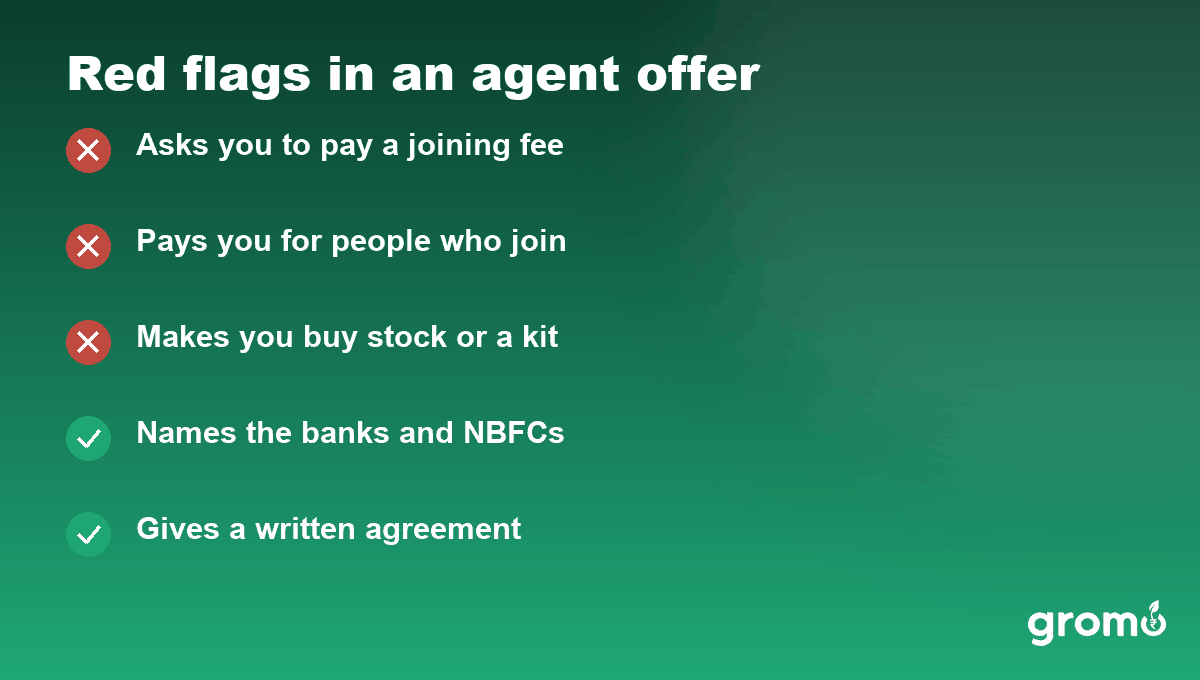
- A fee to start: a genuine lender or platform does not charge you to become its agent. The 2021 rules ban entry fees even for legal direct selling.
- Income from joining, not selling: if the pitch shows how much you earn when friends join, the model fits the pyramid definition above. Genuine commission-based jobs pay you after a real sale, never for sign-ups.
- Stock or packages to buy: loans and cards need no inventory. Any "starter kit" for a financial product is a warning sign.
- No named lender: a real DSA offer names the banks and NBFCs whose products you will sell.
- Promised approval or fixed income: only the lender decides approval, and commission depends on approved customers. A fixed monthly income is not how DSA work pays.
- No written agreement: both RBI rules for banks and the 2021 direct selling rules expect a written contract.
One more trap. Some "loan agent jobs" ask you to collect a fee from customers for faster approval. Stop there. The fee goes to the fraudster, and your customer loses money too.
How Does a Direct Selling Agent Earn Money?
A direct selling agent earns a commission from the lender, or from the platform it works through, each time a customer it referred is approved and the account or loan goes live. No salary. No joining fee. No income from people you bring in. Payouts differ by product, and on GroMo credit cards and secured cards pay more per approval than personal loans.
Each GroMo payout is fixed per product and shown in the app before you share a link. The table shows the highest payout in some categories in the GroMo product catalogue.
| Product category | Highest payout (up to) | Product with that payout |
|---|---|---|
| Credit Card | ₹2,000 | SBI Credit Card |
| Secured Credit Card | ₹1,750 | HDFC Secured Credit Card |
| Saving Account | ₹600 | Kotak 811 Super Account |
| Credit Line | ₹600 | Bajaj Finserv Insta EMI Card |
| Personal Loan | ₹500 | Lendingplate Personal Loan |
Source: GroMo product catalogue, retrieved 2026-11-25.
Please note: payouts change often and differ by product, bank and city. Most products pay less than the top figure shown here. Commission is paid only when the bank or provider approves the customer, and the provider alone decides approval. Always check the live payout in the app before you share a link.
A simple example shows the difference from MLM. The GroMo earnings calculator (gromo.in, retrieved 2026-11-19) uses five approved sales a week at an average commission of ₹500, which equals ₹2,500 a week, or about ₹10,000 a month. Every rupee in that sum comes from approved customers; nobody paid to join and nothing depends on recruits. Treat it as an illustration. Earnings depend on your effort, the products you sell and whether customers are approved, and these figures are not typical and are not guaranteed. Our guide to DSA loan agent commission explains how lenders set these rates.
Where Does GroMo Fit: DSA or Direct Selling?
Short answer: DSA-style work, not MLM. GroMo (Vitrak Technologies Pvt Ltd) is a distribution platform: partners help customers apply for credit cards, loans, savings accounts, demat accounts and investment products from RBI and SEBI-regulated providers, and earn a commission when the provider approves the customer. The provider, not GroMo and not the partner, decides approval.
Three points separate a GroMo partner from an MLM seller:
- No joining fee: GroMo charges no joining fee, no training fee and no fee for product links. Anyone asking you to pay to join GroMo is not GroMo, which is the quickest check on whether GroMo is real or fake.
- No stock: you share a product link; the customer applies on their own phone.
- Income from approved products: commission comes from approvals of real financial products.
You also skip the paperwork of a separate DSA agreement with each bank. For many new agents, that is the easier first step.
How Do You Start as a DSA-Style Partner Without Paying Anything?
Four steps. Zero cost. You need to be 18 or older with an Android phone, a PAN card and a bank account in your own name.
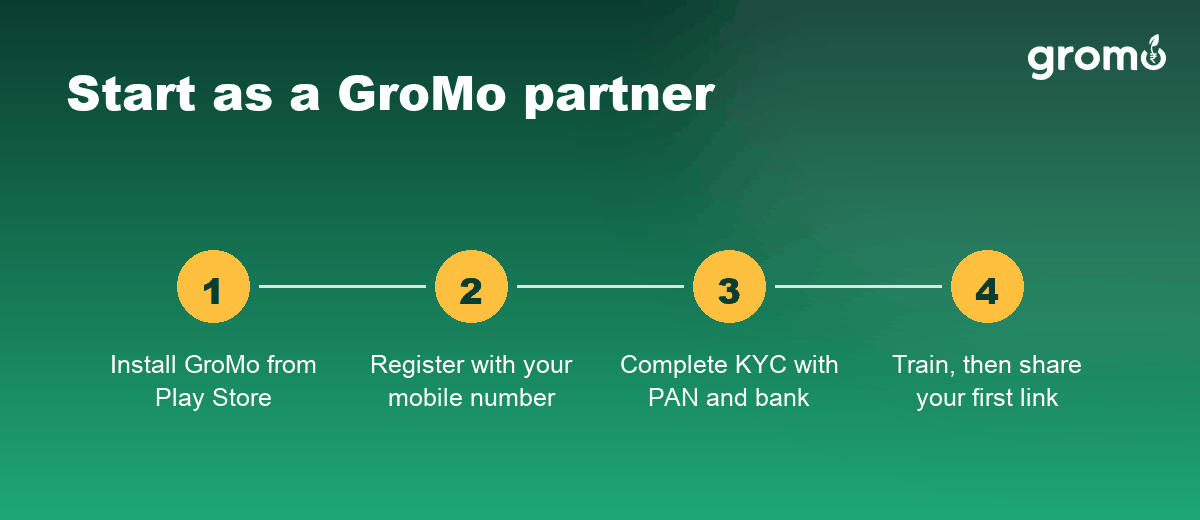
- Install the app: download GroMo from the Google Play Store.
- Register: sign up with your mobile number.
- Complete KYC: add your PAN card and the bank account where you want your commission.
- Train and share: finish the free in-app training for one product, then share the link with a customer who needs it.
Before you share any link, check the customer's eligibility in the app, tell them who you are and which provider they are applying with, and never ask for an OTP or password. If you are still deciding whether this suits you, who can earn money with GroMo matches 16 profiles to the products that fit them.

GroMo is a free app by Vitrak Technologies Pvt Ltd where partners help customers apply for credit cards, loans, savings accounts, demat accounts and investment products from RBI and SEBI-regulated providers, and earn a commission on each approval.
FAQ: Direct Selling Agent vs Direct Selling
Is a direct selling agent the same as a direct seller?
No. A direct selling agent works for a bank or NBFC and earns commission on approved financial products. A direct seller sells a direct selling company's goods under the Consumer Protection (Direct Selling) Rules, 2021.
Is DSA work a type of MLM?
No. DSA work has no levels and no income from recruiting. The agent is paid by the lender or platform only for approved customers.
Is MLM banned in India?
No. MLM that sells real products and follows the 2021 rules is allowed. Pyramid schemes and money circulation schemes are banned, and no direct selling entity may charge an entry fee.
Do I need to pay to become a loan DSA?
A genuine bank, NBFC or platform does not charge you to become its agent. GroMo charges no joining fee. Treat any demand for payment as a warning sign.
Who regulates direct selling agents in India?
The Reserve Bank of India regulates banks and NBFCs, and they control their agents through written agreements and a code of conduct. From 1 January 2027, commercial banks must publish the list of DSAs they engage.
How can I check if a loan agent is genuine?
Ask which bank or NBFC they work with, check that lender's website for its list of agents, and never pay an advance fee for a loan. Banks must keep this list current from 1 January 2027.
Does GroMo pay me for recruiting other partners?
GroMo commission comes from customers approved for real financial products. Check the app for the terms of any referral offer before you share it.
Disclosures
GroMo (Vitrak Technologies Pvt Ltd) is a distribution platform. GroMo is not a bank, NBFC, insurer or investment adviser. All products are offered by their respective RBI or SEBI-regulated providers, who alone decide approval, interest rates and terms.
Loans and credit cards are issued by RBI-regulated banks and NBFCs. Approval is at the lender's sole discretion and is never promised. Investments are subject to market risks; read all scheme-related documents carefully.
Partner earnings depend on effort, product mix and customer eligibility. Any figures shown are illustrative examples. They are not typical and are not guaranteed. GroMo does not guarantee any level of income.
Disclaimer
The information on this page is for general information only and is not financial, legal or investment advice. Rules quoted are as published on the dates shown; check the latest text with the regulator before you act. Commission rates are set by banks and providers and change often; check the live figure in the app. Product approval is decided only by the bank or provider. You must be 18 or older to join GroMo.


