
Private Loan Agent: How to Check If a Loan Agent Is Genuine
Private loan agent near me? 8 checks to know if a loan agent is genuine, fake loan agent red flags, and how to report loan fraud and get help in India.

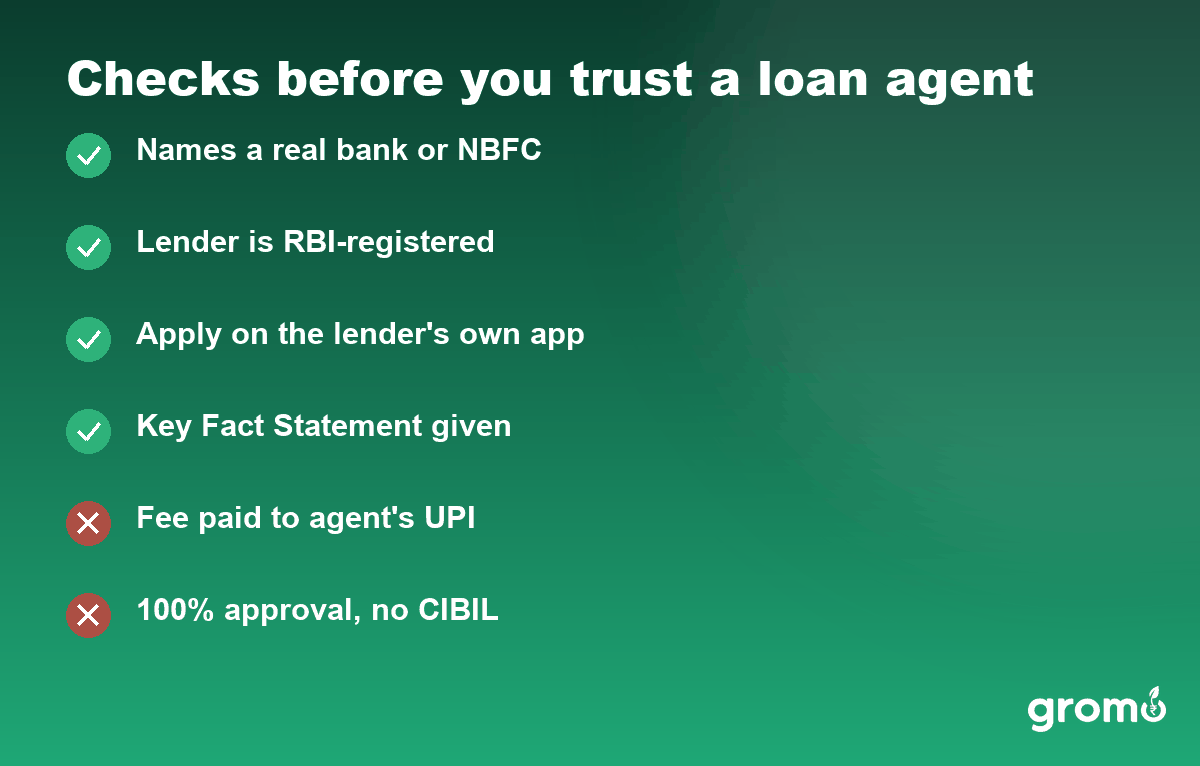
A genuine private loan agent works for a real bank or RBI-registered NBFC, can tell you that lender's name, and never asks you for money before your loan is disbursed. To check one, confirm the lender on RBI's NBFC list or the bank's website, apply only through the lender's official app or website, read the Key Fact Statement, and refuse any "processing" or "approval" fee paid to a person.
RBI has warned that fraudsters use fake RBI letters and demand processing fees from loan seekers (RBI press release, 29 August 2024). Already tried a loan app? Check our fake loan apps list.
Below are 8 checks to run before you share any document with a loan agent, the red flags of a fake one, and exactly where to report loan fraud. Where a check has limits, we say so plainly.
| Check | What to look for | Red flag |
|---|---|---|
| Lender name | A named bank or NBFC | "Private finance", no lender named |
| RBI registration | NBFC on RBI's registered list | Lender not found |
| Application channel | Lender's official app or website | Forms on WhatsApp or a random link |
| Fees | Only fees in the Key Fact Statement, charged by the lender | Fee paid to the agent's UPI or account |
| Sanction letter | Issued by the lender after checking you | Sent before any credit check |
| Agent identity | ID, lender authorisation, office address | No ID, only a mobile number |
| Promises | Realistic terms, lender decides | "100% approval", "no CIBIL needed" |
| Pressure | Time to read terms | "Pay today or the offer expires" |
How this list is ordered: checks start with who the lender is, then how you apply and pay, and end with the warning signs in how the agent behaves.
1. Ask for the Lender's Name
Genuine: names the bank or NBFC that will give the loan | Fake: "our private finance", "investor", no company name | Time: 1 minute
Every genuine loan comes from a regulated lender: a bank or an RBI-registered NBFC. A real agent, DSA or loan consultant will tell you which lender they are sending your application to. If an agent cannot or will not name the lender, stop there.
How to check:
- Ask, "Which bank or NBFC will give this loan?"
- Write down the exact company name.
- Search for the lender's official website yourself, not through the agent's link.
2. Confirm the Lender Is RBI-Registered
Banks: check the bank's official website | NBFCs: check RBI's registered NBFC list | Digital loans: check RBI's list of lending apps
If the lender is an NBFC, look it up on RBI's list of registered NBFCs, which RBI publishes as downloadable files (RBI NBFC list, dated 30 September 2026). For loan apps, RBI also runs a directory of Digital Lending Apps deployed by regulated lenders, found under Citizen's Corner on its website; RBI notes the list is uploaded by lenders and not verified by RBI. You can see the full NBFC list at rbi.org.in.
How to check:
- Open RBI's NBFC list and search the company name.
- Check it is in the registered list, not the cancelled one.
- For an app, check the lender's website lists that app.
3. Apply Only Through the Lender's Official Channel
Genuine: lender's app, website or branch | Fake: Google Forms, WhatsApp chats, unknown links | Why: your documents stay with the lender
A genuine agent sends you to the lender's own application process, where you complete KYC yourself. Under RBI's Digital Lending Directions, 2025, lenders must publish details of their lending service providers and apps on their own website (RBI Digital Lending Directions, 8 May 2025). If the agent wants your Aadhaar, PAN and bank statements on WhatsApp, be careful.
4. Never Pay a Fee to the Agent
Genuine: any processing fee is charged by the lender and shown in the loan terms | Fake: "file charge", "insurance", "GST" paid upfront to a person | Rule: lenders pay their agents
Of all eight, this check matters most. Under RBI's Digital Lending Directions, 2025, fees payable to a lending service provider must be paid by the lender and cannot be collected from the borrower by that provider (RBI Digital Lending Directions, 8 May 2025). A genuine processing fee comes from the lender. It is deducted from the loan or charged by the lender itself, as shown in your Key Fact Statement.
In one case reported in August 2026, a Thane businesswoman was offered a ₹40 lakh business loan by a fake "loan agent" and lost ₹13.5 lakh paid as commission and processing fees before the agent cut contact (PTI, 12 August 2026).
5. Read the Key Fact Statement Before You Sign
What it is: a standard summary of the loan's interest, fees and total cost | Rule: lenders cannot charge fees not in the KFS without your explicit consent | Ask for it: before you accept
RBI requires lenders to give borrowers a Key Fact Statement and says lenders cannot charge any fee that is not mentioned in it without the borrower's explicit consent (RBI circular on Key Facts Statement, 15 April 2024). If an agent cannot show you a KFS from the lender, do not proceed.
6. Check the Sanction Letter Comes From the Lender
Genuine: issued after the lender checks your credit and documents | Fake: arrives within minutes, often on WhatsApp, often with an "RBI" logo | RBI warning: fake RBI letterheads
A real sanction letter comes from the lender, after it has checked your credit report and documents. RBI has warned that fraudsters send letters on fake RBI letterheads to collect fees (RBI press release, 29 August 2024). RBI does not issue loan approval letters to individual borrowers.
7. Verify the Agent's Identity
Ask for: ID card, lender authorisation, office address | Check: call the lender's official customer care to confirm | Fake: only a mobile number and urgency
Ask the agent for their ID and proof that they are authorised by the lender or a registered DSA. Then call the lender's official customer care number, taken from its website, and ask whether the person or agency works with them.
8. Watch for Pressure and Too-Good Promises
Red flags: "guaranteed approval", "no CIBIL check", "loan waiver certificate", "offer ends today" | Genuine: realistic rate, time to think
Fraudsters rely on urgency and promises that no real lender makes. In May 2026, RBI also warned about fake loan waiver campaigns that issue "debt waiver certificates" and collect fees (RBI press release, 4 May 2026). If an offer sounds too easy, it is almost always a trap.
What Are the Most Common Fake Loan Agent Scams?
Most fake loan agent scams follow one of a few patterns.
Upfront fee scam
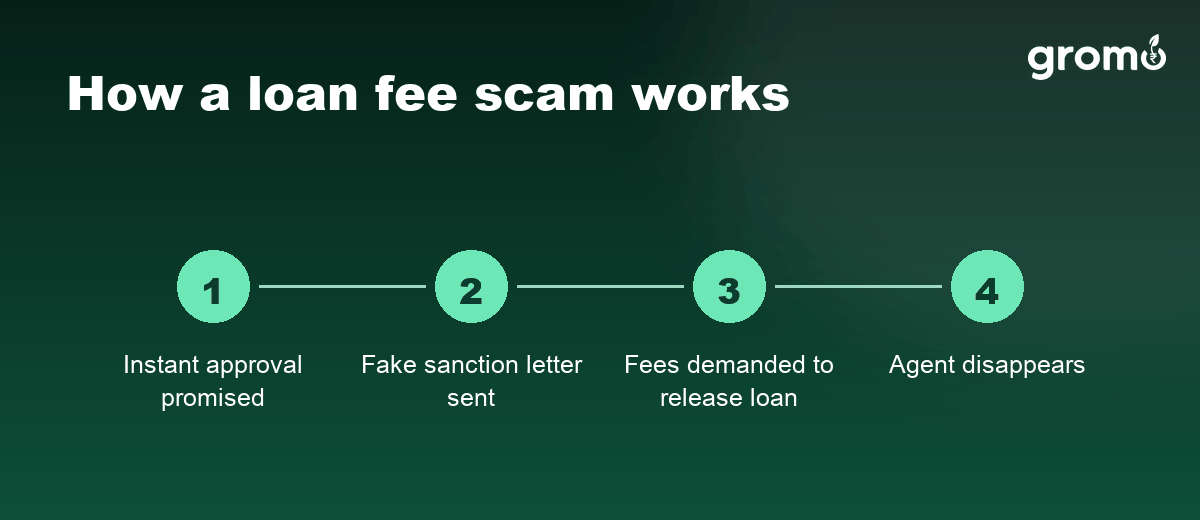
You are approved "instantly". Then you are asked to pay processing, insurance, GST or "file" charges to release the loan. After you pay, more fees appear. The loan never comes.
Fake RBI or bank letter scam
You receive a sanction letter or "RBI approval" with official-looking logos. RBI does not approve individual loans, and real lenders do not send approvals before checking you.
Loan waiver scam
You are told your existing loans can be waived for a fee, and given a "waiver certificate". RBI has warned against such campaigns (RBI press release, 4 May 2026).
Document misuse
Documents shared on WhatsApp get misused. Your Aadhaar, PAN and bank statements can be used to take loans or open accounts in your name.
Is a Private Loan Agent Legal?
Yes, loan agents and DSAs are legal when they work for a real bank or RBI-registered NBFC. The agent itself does not need an RBI licence, but the lender stays responsible for its agents under RBI's outsourcing rules. Lending money as a business without being a regulated lender, or collecting fees for loans that never come, is not legal. Read what a loan agent is to understand how genuine agents work.
Loan agent near me: how to find a genuine one
- Ask your bank branch which DSAs it works with.
- Prefer agents who send you to the lender's official app.
- Check reviews on the agent's Google Business Profile.
- Choose agents who explain the full cost and never ask for money.
How to Report Loan Fraud in India
If you have been cheated or asked to pay by a fake agent, act fast.
- Call 1930, the national cybercrime helpline, especially if you have just paid. Quick reporting helps freeze money.
- File a complaint at the national cybercrime portal, cybercrime.gov.in.
- Inform your bank to block any card or UPI you used and dispute the payment.
- Complain to the real lender if the agent used its name.
- Keep evidence: chats, call logs, payment receipts and the agent's number.
If a regulated bank or NBFC itself mistreats you, you can complain to it first and then to the RBI Ombudsman through RBI's complaint management system if it does not resolve your complaint within 30 days.
Important Safety Tips
- Never pay a person to get a loan: the lender charges its own fees, shown in the KFS.
- Never share your OTP, UPI PIN or net banking password: no lender needs them.
- Apply yourself: use the lender's official app or website.
- Do not trust "RBI approval" letters: RBI does not approve individual loans.
- Check before you share documents: run the 8 checks first.
Which Loan Agent Can You Trust?
- Names a real lender you can verify? Good start.
- Sends you to the lender's own app or website? Good sign.
- Explains the full cost and gives you a KFS? Genuine.
- Asks for any money before disbursal? Walk away.
- Promises approval without checking your CIBIL? Walk away.
A genuine loan agent helps you choose and apply, and is paid by the lender, never by you. Take five minutes to run these checks before sharing a single document, and you will avoid almost every loan scam.
GroMo is a financial products distribution app whose partners are paid by partner banks and lenders, never by customers. Every application goes through the lender's own official journey.

FAQ: Private Loan Agent
How do I know if a loan agent is genuine?
A genuine agent names a real bank or RBI-registered NBFC, sends you to the lender's official app or website, gives you a Key Fact Statement and never asks for money before disbursal.
Can a loan agent ask for a processing fee?
A genuine processing fee is charged by the lender and shown in the loan terms. Paying any fee to an agent's personal UPI or account is a major red flag.
Is it safe to take a loan through a private agent?
Taking a loan through a private agent can be safe, if the agent works with a real lender and you apply through the lender's official channel. Run the 8 checks before sharing documents.
What should I do if a fake loan agent cheated me?
Call 1930 immediately, file a complaint at cybercrime.gov.in, inform your bank and keep all evidence.
Does RBI give loan approval letters?
No. RBI does not approve loans for individuals. A letter claiming "RBI approval" for your loan is fake.
How can I check if an NBFC is RBI registered?
Search the company on RBI's list of registered NBFCs on rbi.org.in, and check it is not in the cancelled list.
Are loan agents paid by the borrower?
No. Genuine loan agents are paid commission by the lender. See how a DSA code works for how agents are appointed.
GroMo (Vitrak Technologies Pvt Ltd) is a distribution platform. GroMo is not a bank, NBFC, insurer or investment adviser. All products are offered by their respective RBI, IRDAI or SEBI-regulated providers.
Sources: RBI press release 2024-2025/998 on fake RBI letterheads and loan fraud (29 August 2024); RBI press release 2026-2027/199 on fake loan waiver campaigns (4 May 2026); RBI (Digital Lending) Directions, 2025 (8 May 2025); RBI circular on Key Facts Statement (15 April 2024); RBI list of registered NBFCs (30 September 2026); PTI report on Thane loan fraud (12 August 2026); all retrieved 2026-10-28.
Disclaimer
The information here is general and meant to help borrowers stay safe, not legal advice. Rules and complaint processes may change; check the latest guidance on RBI's website. If you have lost money, contact the police and your bank immediately. GroMo is available only to users aged 18 and above.


