
10 Skills You Need to Succeed as a Credit Card Agent
The 10 skills that separate high-earning credit card agents from quitting ones, why each pays, and a 30-day plan to build them, mostly free.

Success as a credit card agent is not luck or a silver tongue; it is a stack of 10 learnable skills. Some agents earn a few hundred rupees a month and quit; others build lakh-plus incomes from the same products and the same market.
The difference is always the same skill gaps. This guide covers the 10 skills you need to succeed as a credit card agent, why each one pays, and exactly how to build it, most of them free.
The 10 Skills at a Glance
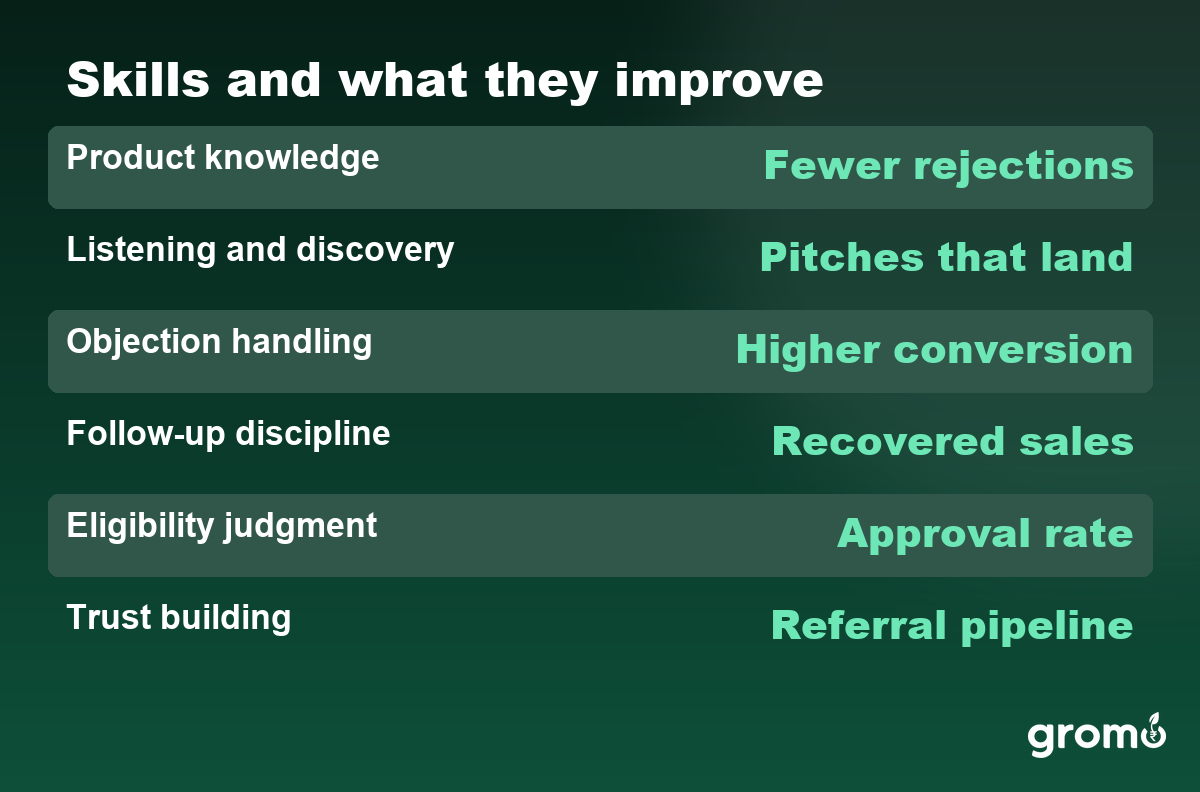
| # | Skill | What it directly improves |
|---|---|---|
| 1 | Product knowledge | Right card, right customer, fewer rejections |
| 2 | Need discovery and listening | Pitches that land the first time |
| 3 | Simple communication | Customers who actually understand and decide |
| 4 | Trust building | Referrals, the cheapest leads that exist |
| 5 | Objection handling | Conversion rate on hesitant customers |
| 6 | Lead generation | A pipeline beyond friends and family |
| 7 | Follow-up discipline | Sales recovered from "I'll think about it" |
| 8 | Digital fluency | Faster applications, cleaner tracking |
| 9 | Eligibility judgment | Approval rate, which is what actually pays |
| 10 | Compliance and data care | A career that survives and compounds |
1. Product Knowledge
You cannot match a card to a customer if you know only one card's brochure. Strong agents know 4 or 5 cards across the main types of credit cards, their fees, waiver conditions, reward structures, and who each suits.
Build it: study one card per day, fee page and terms included, and keep a one-line "who this is for" note per card. On the GroMo app, the comparison view across 30+ cards makes this study practical instead of theoretical.
2. Need Discovery and Listening
The best agents diagnose before they prescribe: two or three questions about spending, travel, and existing cards reveal exactly which card to pitch and which words will sell it.
Build it: start every conversation with questions, keep the customer talking more than half the time, and write down what you learn. The pattern across 20 customers teaches more than any course.
3. Simple Communication
Customers do not buy what they do not understand. "Fuel surcharge waiver" is jargon; "you save Rs 40 every time you fill the tank" is a sale. The skill is translating banking language into everyday money, in the customer's own language.
Build it: for every feature you learn, write its one-line money translation. Practise explaining a card to a family elder; if they follow, your pitch is ready.
4. Trust Building
Trust is the agent's real product. State fees before being asked, refuse to overpromise approval, and put the customer's interest above this month's payout, and the same customers return with family, colleagues, and neighbours.
Build it: adopt two rules permanently: never promise what the bank has not published, and always mention the fee yourself. Then keep every small commitment, called when you said, sent what you promised.
5. Objection Handling
"I don't need one", "cards create debt", "the fee is a waste": the same nine objections decide most conversations, and each has a response that works. Agents who learn them convert hesitant customers; agents who argue lose them.
Build it: learn the acknowledge-then-answer method and the scripts in credit card sales objections and how to handle them, then practise your top three aloud until they sound like you.
6. Lead Generation
Friends and family run out in a month. Sustainable agents build lead sources: WhatsApp and Instagram presence, shop and office tie-ups, events, and referral chains from every happy customer.
Build it: pick two online methods and two offline spots and work them weekly; the complete menu is in how to get credit card leads and the best places to find credit card customers offline.
7. Follow-Up Discipline
Most sales close on the second or third contact, and most agents never make it. A 24-hour follow-up habit, plus day-3 and day-7 touches, recovers leads that silence would have killed.
Build it: keep one tracker, notebook, sheet, or the GroMo app's lead tracking, with a next-action date on every lead, and clear it daily. Discipline here beats talent everywhere else.
8. Digital Fluency
Modern card selling is digital end to end: sharing application links, guiding document uploads, checking statuses, and running your pipeline from your phone. Agents fluent in the tools close in minutes; others lose customers to friction.
Build it: master your platform app completely, every screen, every status. Practise the full application flow on a friend so you can guide any customer through it smoothly.
9. Eligibility Judgment
Payouts come from approvals, not applications. The skill is pre-screening: age, income, city serviceability, and credit profile checked in two minutes of conversation before any application, so most files you submit convert.
Build it: learn each bank's basic criteria and the approval pipeline in how credit card approval works, and make "check first, apply second" an unbreakable rule. Your approval rate is your reputation with banks and customers alike.
10. Compliance and Data Care
You handle PANs, incomes, and phone numbers. Careless agents leak documents over personal chats and die by complaint; careful agents collect only what applications need, use official channels, take consent, and never touch a customer's OTP.
Build it: submit documents only through the official app or portal, delete local copies after submission, and treat every customer's data like your own bank password.
How to Build All 10: A 30-Day Plan
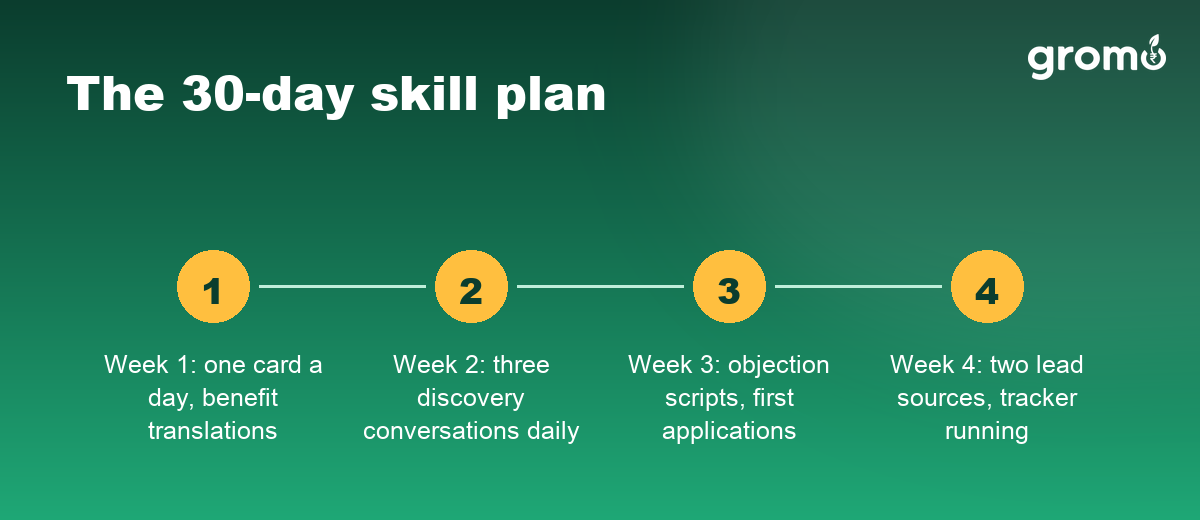
- Week 1: product knowledge and pitch translation, one card per day, one benefit line per feature.
- Week 2: conversations, 3 need-discovery chats daily with people you know, listening more than talking.
- Week 3: objections and closing, scripts practised aloud, first real applications with pre-screening.
- Week 4: pipeline, two lead sources activated, tracker running, every lead carrying a next-action date.
Free GroMo Academy lessons inside the GroMo app cover most of this stack, product training, pitching, objection handling, and compliance, built specifically for Indian financial product distribution. Pair the lessons with the 30-day plan, start as a registered agent through credit card agent registration, and the skills compound with every conversation.
FAQ: 10 Skills You Need to Succeed as a Credit Card Agent
What skills do you need to be a credit card agent?
Ten cover the job: product knowledge, need discovery and listening, simple communication, trust building, objection handling, lead generation, follow-up discipline, digital fluency, eligibility judgment, and compliance with data care. None need a degree; all are learnable within weeks of deliberate practice.
Which skill matters most for a new credit card agent?
Eligibility judgment pays first: payouts come from approvals, not applications, so two minutes of pre-screening age, income, city, and credit health before applying lifts your approval rate immediately. Product knowledge and honest communication follow close behind, because the right card explained simply converts without pressure.
Do credit card agents need any qualification or certification?
No degree or certificate is required to distribute credit cards through platforms in India; you need to be 18 or above with basic KYC. What replaces qualification is skill: platforms like GroMo provide free structured training through GroMo Academy, covering products, pitching, objections, and compliance.
How long does it take to become good at selling credit cards?
With deliberate practice, the basics land in about 30 days: a week each for product knowledge, discovery conversations, objection scripts with first applications, and pipeline building. Real fluency comes from volume, roughly your first 50 conversations, after which conversion and referrals compound.
How much can a skilled credit card agent earn?
Earnings are per approved and activated card, typically a few hundred to a couple of thousand rupees each depending on the card and platform campaigns. Skilled agents converting steadily and stacking referrals commonly build monthly incomes in the tens of thousands; income is effort-based and never guaranteed.
Disclaimer
This article is general guidance, not financial or legal advice. Card features, fees, eligibility criteria, approval decisions, and agent payouts are decided by the issuing banks and platforms, vary by product and profile, and change over time; the bank's official pages are the only authoritative source, and no income or approval is guaranteed.
GroMo is a financial product distribution platform, not a bank or lender, and is available only to users aged 18 and above. Bank, card, and brand names are trademarks of their respective owners.


