
16 Business Ideas for Students in India 2026 (Low Investment)
Low investment ideas you can run from a phone or hostel room, what each needs, how to start, and legal basics.

The best business ideas for students in India are low investment, flexible and easy to pause during exams: selling financial products on commission, tutoring, freelancing, social media management, and small online shops. You don't need a shop or a loan for most of them. Start with one idea that uses a skill you already have, and test it for a month before you spend money. For more ways to earn, see how to earn money online as a student.
Below are 16 student business ideas with what each costs, the skills it needs and the steps to start. Earnings depend on effort and vary widely, so we give no income promises. Where an idea has a risk or a legal step, we say so plainly.
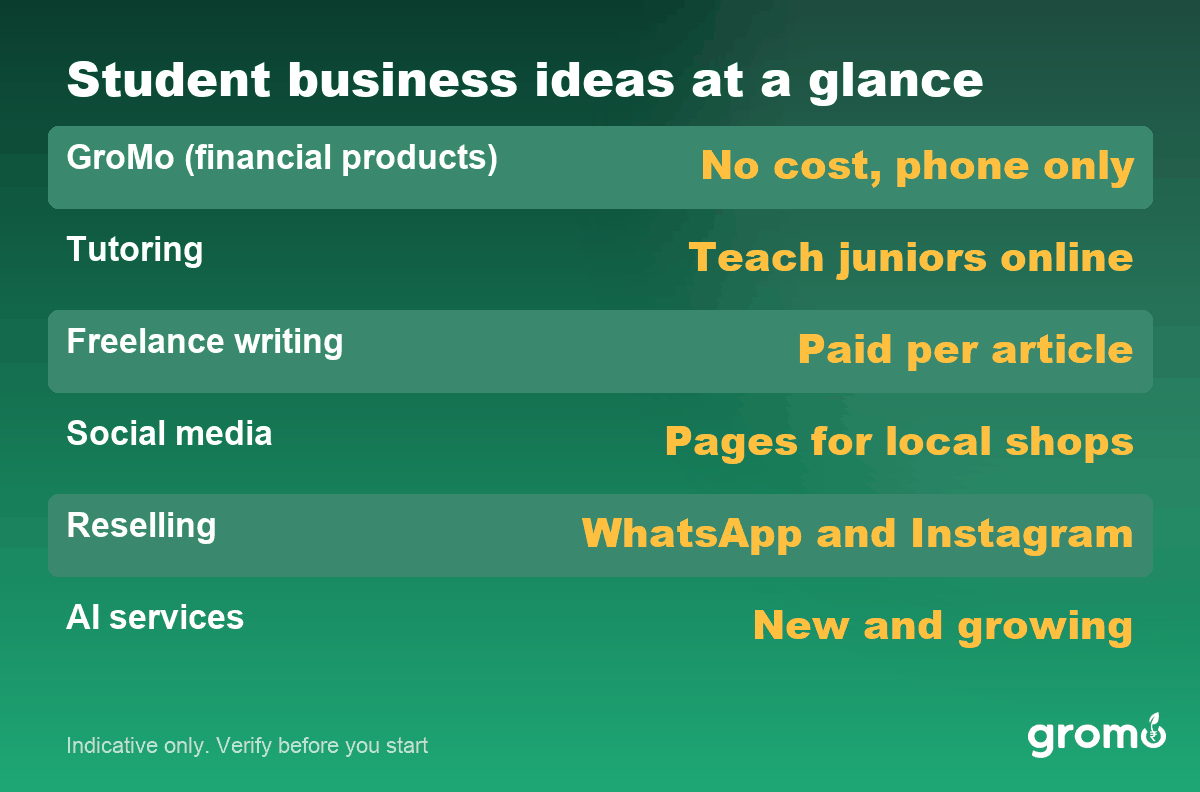
| # | Idea | Starting cost | Skills needed | Best for |
|---|---|---|---|---|
| 1 | Selling Financial Products With GroMo | None | Basic phone use; free training in the app | Anyone 18 or older |
| 2 | Online Tutoring | Very low | Strong school or exam subject | Students with good marks |
| 3 | Freelance Writing | Very low | Clear writing, basic research | Students who write well |
| 4 | Social Media Management | Very low | Instagram, basic Canva | Students who understand reels |
| 5 | Graphic Design | Very low | Canva or a design app | Creative students |
| 6 | Video Editing | Low | An editing app, patience | Students with a decent phone |
| 7 | Reselling Products | Low | Selling, customer replies | Students with a big friend circle |
| 8 | Dropshipping | Low | Basic ads, store setup | Students who like e-commerce |
| 9 | Print on Demand | Low | Basic design | Students with design sense |
| 10 | Blogging | Very low | Writing, patience, basic SEO | Students who can wait |
| 11 | Affiliate Marketing | None | Social media reach | Students with an audience |
| 12 | Photography | Medium | Good eye, a decent camera or phone | Students who own a good camera |
| 13 | Resume Writing | None | Good English, formatting | Final-year students |
| 14 | Event Management | Low | Planning, contacts | Students in fest committees |
| 15 | Home Food or Snacks for Hostels | Medium | Cooking, or a partner who cooks | Students near hostels |
| 16 | AI Services for Small Businesses | Very low | Comfort with AI tools | Tech-minded students |
Starting-cost labels are our own rough estimates: None, Very low, Low and Medium. Actual costs depend on your city and setup.
How this list is ranked: GroMo comes first because it needs no money or stock. The rest follow the ideas that keep appearing in the top-ranking Indian guides for this search, with the lowest-cost, phone-friendly ideas placed higher.
1. Selling Financial Products With GroMo: Bank-paid commissions, no stock
Starting cost: None | Skills: Basic phone use; free training in the app | Best for: Anyone 18 or older
Selling financial products with GroMo tops this list because it costs nothing to start and needs only a smartphone. GroMo is a free app where you help people apply for credit cards, savings accounts, loans and demat accounts from partner banks, and you earn a commission when the application is approved. On GroMo, credit cards pay up to ₹2,000, savings accounts up to ₹1,000, demat accounts up to ₹450, and personal loans up to 4.5% of the loan amount (GroMo catalogue, retrieved 2026-11-06). Students can help classmates and family open their first account or card between classes, with no targets. The pay is commission only, with no fixed salary, and only approved applications earn; you must be 18 or older.
How to start:
- Download the GroMo app and register free with your phone number.
- Finish the one-time verification and the free in-app training.
- Share a product link with someone who genuinely needs it, then track the application in the app.
2. Online Tutoring: Teach what you're good at
Starting cost: Very low | Skills: Strong school or exam subject | Best for: Students with good marks
Online tutoring lets you teach juniors over video calls, using only a phone and a notebook. It is listed in nearly every student business guide because the demand is steady and you can set your own hours around college.
How to start:
- Pick one subject and class level you can teach well.
- Offer a free demo to two juniors and ask for a review.
- Fix a monthly fee and add students slowly.
3. Freelance Writing: Write for websites and brands
Starting cost: Very low | Skills: Clear writing, basic research | Best for: Students who write well
Freelance writing pays you per article for blogs, brands and social media. Beginners should create two or three samples first, because clients judge your samples more than any certificate.
How to start:
- Write three sample articles in one topic.
- Create a free profile on a freelancing site.
- Pitch to small businesses, starting with easy jobs.
4. Social Media Management: Run pages for local shops
Starting cost: Very low | Skills: Instagram, basic Canva | Best for: Students who understand reels
Social media management means posting and replying for shops that have no time to do it. Local cafes, coaching centres and salons are the easiest first clients because you can meet them in person.
How to start:
- Make one sample page or set of posts.
- Show it to three local shops near your college.
- Charge a small monthly fee after a trial.
5. Graphic Design: Posters, logos and thumbnails
Starting cost: Very low | Skills: Canva or a design app | Best for: Creative students
Graphic design work includes posters, logos and YouTube thumbnails. College fests and small shops always need posters, so your first orders can come from people you already know.
How to start:
- Build five samples in Canva.
- Design a poster for a college club to get noticed.
- Share your samples on Instagram and WhatsApp.
6. Video Editing: Edit reels and YouTube videos
Starting cost: Low | Skills: An editing app, patience | Best for: Students with a decent phone
Video editing has steady demand because creators and small brands post short videos every week. A phone app is enough at the start, and you can move to a laptop once orders come in.
How to start:
- Learn one free editing app.
- Edit three sample reels.
- Send your samples to small creators and offer a first-job price.
7. Reselling Products: Sell without making anything
Starting cost: Low | Skills: Selling, customer replies | Best for: Students with a big friend circle
Reselling means buying or sourcing products and selling them to people you know, often through WhatsApp or Instagram. Start with products your own friends ask for, and avoid buying large stock until something sells.
How to start:
- Pick one category friends already buy, like fashion or accessories.
- Share products on WhatsApp Status and Instagram.
- Order from the supplier only after a customer pays.
8. Dropshipping: Online store without stock
Starting cost: Low | Skills: Basic ads, store setup | Best for: Students who like e-commerce
Dropshipping is an online store where the supplier stocks and ships the product. It needs little money upfront, but margins can be thin and delivery complaints come to you, so test one product before building a full store.
How to start:
- Choose one product with clear demand.
- Set up a simple store page.
- Test with a small budget and track returns.
9. Print on Demand: Custom T-shirts and mugs
Starting cost: Low | Skills: Basic design | Best for: Students with design sense
Print on demand lets you sell custom T-shirts and mugs that are printed only after an order comes in. College clubs and fest teams are natural first customers because they need matching merchandise.
How to start:
- Design three simple T-shirt ideas.
- List them on a print on demand platform.
- Pitch to college clubs and fest teams.
10. Blogging: Write once, earn over time
Starting cost: Very low | Skills: Writing, patience, basic SEO | Best for: Students who can wait
Blogging earns through ads and affiliate links, but income usually takes many months to appear. Treat it as a long-term skill rather than quick money, and choose a narrow topic you truly enjoy.
How to start:
- Pick one narrow topic.
- Publish on a free or low-cost blog platform.
- Add affiliate links once you have regular readers.
11. Affiliate Marketing: Earn by recommending products
Starting cost: None | Skills: Social media reach | Best for: Students with an audience
Affiliate marketing pays you a commission when someone buys through your link. Most programmes are free to join, but you need people who trust you, so recommend only what you would use yourself.
How to start:
- Join one affiliate programme.
- Share honest reviews in your own words.
- Tell readers clearly that it is an affiliate link.
12. Photography: Events and product shoots
Starting cost: Medium | Skills: Good eye, a decent camera or phone | Best for: Students who own a good camera
Photography work comes from college events, birthdays and small shops that need product photos. A recent phone can handle product shots, while events usually need a proper camera that you may be able to rent.
How to start:
- Shoot free for one college event.
- Build a small portfolio on Instagram.
- Offer fixed packages to local shops.
13. Resume Writing: Help seniors get placed
Starting cost: None | Skills: Good English, formatting | Best for: Final-year students
Resume writing is an easy service to sell on campus because every final-year batch needs it. You can add LinkedIn profile fixes and mock interviews once students start trusting your work.
How to start:
- Create two clean resume templates.
- Fix three resumes for free to get reviews.
- Share in college WhatsApp groups before placement season.
14. Event Management: Run small college and local events
Starting cost: Low | Skills: Planning, contacts | Best for: Students in fest committees
Event management grows naturally out of college fest experience. Start with small birthdays or society events, where you coordinate decorators, caterers and photographers and charge a planning fee.
How to start:
- Help with one small event for free.
- Build a list of trusted local vendors.
- Quote a clear fee for your next event.
15. Home Food or Snacks for Hostels: Tiffin and snacks near campus
Starting cost: Medium | Skills: Cooking, or a partner who cooks | Best for: Students near hostels
Home food businesses sell tiffins or snacks to hostel students who are tired of mess food. Any food business needs FSSAI registration, which starts at about ₹100 a year (IncorpX, retrieved 2026-11-06), so sort that out before taking regular orders.
How to start:
- Test demand with one menu for friends.
- Get FSSAI registration before selling regularly.
- Take orders on a WhatsApp group.
16. AI Services for Small Businesses: Use AI tools to save owners' time
Starting cost: Very low | Skills: Comfort with AI tools | Best for: Tech-minded students
AI services are newly popular in student business guides: using AI tools to write product descriptions, translate content or set up simple chatbots for small shops. Always check the output yourself, because AI makes mistakes that your client will blame you for.
How to start:
- Learn one or two useful AI tools well.
- Do one free job for a local shop.
- Offer a simple fixed-price package.
How Much Does GroMo Pay for Each Product?
| Product on GroMo | Pays partners up to |
|---|---|
| SBI Credit Card | ₹2,000 per approved card |
| HDFC Secured Credit Card | ₹1,750 per approved card |
| Axis Saving Account | ₹1,000 per account |
| Digi Credit Personal Loan | 4.5% of the loan amount |
| Kotak 811 Super Account | ₹600 per account |
| Kotak Securities Demat Account | ₹450 per account |
The SBI Credit Card pays partners up to ₹2,000 per approved card (GroMo catalogue, retrieved 2026-11-06). Commission is paid only on approval.
The Axis Saving Account pays up to ₹1,000 per successful account (GroMo catalogue, retrieved 2026-11-06). Many other products pay less.
The Digi Credit Personal Loan pays up to 4.5% of the loan amount, and most other lenders pay less (GroMo catalogue, retrieved 2026-11-06). Check the live payout in the app.
Which business is best for students with no money?
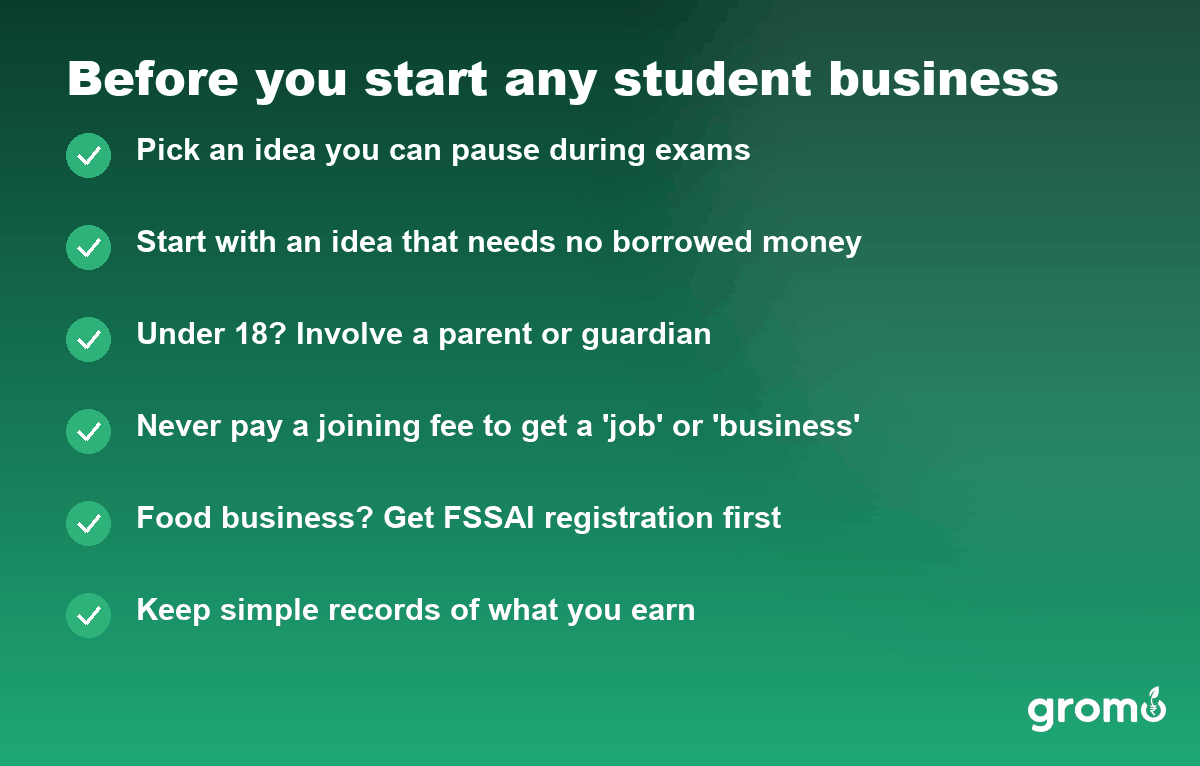
Selling financial products on commission, tutoring, freelance writing and affiliate marketing are the best student business ideas with no money, because none of them needs stock or a shop. They need time and skill instead. Pick the one closest to what you already do well, and keep your studies first by fixing the hours you will work each week.
More low-cost options are in our list of small business ideas.
Can a student legally run a business in India?
Yes, a student can legally run a small business in India, but a few rules depend on your age and business type. Minors generally can't sign binding contracts, so under-18 students should involve a parent. Food businesses need FSSAI registration, and free Udyam registration can help eligible small businesses (Razorpay and IncorpX guides, retrieved 2026-11-06). Income above the tax limit must be reported, so keep simple records from day one.
How do you balance a business with studies?
Fix a weekly limit, such as 10 hours, and choose an idea you can pause during exams. Service work like tutoring or design pauses easily, while food or stock businesses don't. Tell clients your exam dates early, and avoid any idea that needs you to invest borrowed money.
For more ideas that fit a student timetable, see ways to make money as a student.
GroMo is a free app where partners help customers apply for credit cards, loans, savings accounts and demat accounts from partner banks, and earn a commission on approval.
FAQ: Business Ideas for Students
What is the best business idea for students?
There is no single best idea. Selling financial products with GroMo, online tutoring and freelancing suit most students because they need little or no money and can pause during exams.
Which business can a student start with no investment?
Selling financial products on commission, tutoring, freelance writing, resume writing and affiliate marketing can all start with no real investment, only your time and a phone.
How much can a student earn from a small business?
Earnings vary widely with time, skill and customers, so no fixed figure is honest. Treat the first few months as learning, and be careful of anyone promising a guaranteed amount.
Can a student use GroMo?
Yes, if you're 18 or older. Joining and training are free, and you earn only when a customer's application is approved.
Do students need to register a small business?
Very small service work often starts without registration, but food businesses need FSSAI registration, and income must still be reported when it crosses the tax limit. Ask a CA if you're unsure.
Are online jobs that ask for a joining fee real?
Treat them as a scam. Genuine work doesn't ask you to pay to start. Our rule: never pay a fee to get a job or task.
GroMo (Vitrak Technologies Pvt Ltd) is a distribution platform. GroMo isn't a bank, NBFC, insurer or investment adviser. All products are offered by their respective RBI, IRDAI or SEBI-regulated providers.
Partner earnings depend on effort, product mix and customer eligibility. Any figures shown are illustrative. They aren't typical and aren't promised.
Sources: Top-ranking guides checked: Razorpay, Bajaj Finserv, BML Munjal University, Digital Nest, Physics Wallah, GUVI and IncorpX, retrieved 2026-11-06. GroMo product catalogue, commission rates by product, retrieved 2026-11-06.
Disclaimer
GroMo doesn't promise any level of income. Commissions are set by partner banks, vary by product and campaign, and are paid only on approved applications; check the live commission in the GroMo app. Starting-cost labels are our own rough estimates, and any pay figures from other sites or job listings are what those sources state, not a guarantee. GroMo is available only to users aged 18 and above. Everything above is general information, not financial, legal or career advice.


