
Zero-Investment Income Ideas in Bangalore 2026

Bangalore runs on services. You don't need a factory or a storefront to make money here; you just need a skill and a smartphone. The "zero-investment" pitch usually points toward financial product distribution, consulting, content creation, or referral income. The city's average salary crosses ₹50,000, English is the default business language, and people are open to trying new financial products.
This guide covers ten models that reliably generate ₹30,000–₹1,00,000 monthly without requiring rent, inventory, or licensing fees.
Financial Product Distribution: The ₹1 Lakh Opportunity in Plain Sight
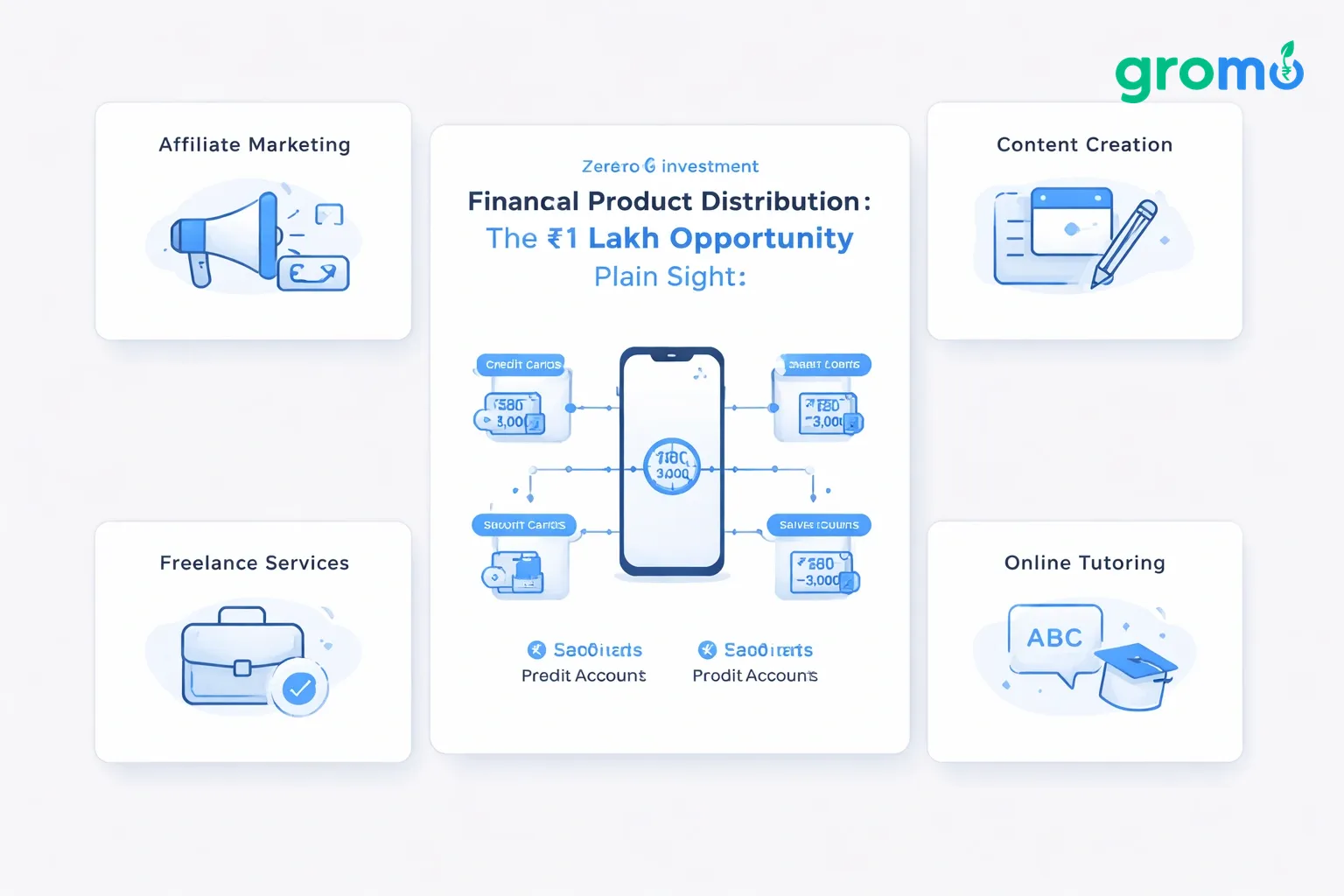
Financial product distribution is essentially turning your network into revenue. You connect people with credit cards, loans, demat accounts, and savings products. Platforms like GroMo handle the payouts typically ₹180–₹3,000 per approved application. You just need a smartphone and a basic understanding of what you're selling.
Bangalore's professional crowd where 40% of households earn above ₹10 lakhs annually always needs premium credit cards, investment accounts, and business loans. Once you get the hang of it, closing 15–25 applications a month is normal. That translates to ₹40,000–₹75,000 in commissions.
Why it works here: the average credit score is over 750, so approvals come easier. Tech workers are comfortable doing everything on their phones, and the startup ecosystem creates constant demand for business loans. IT parks make offline networking simple, too.
The financial product distribution model cuts out the traditional costs. You get training, product catalogues, and customer management tools for free. Payouts happen within 48 hours of document verification, which is a lot faster than insurance models that make you wait 30–90 days.
Digital Consulting Services: Selling What You Already Know
If you work in Bangalore, you probably have specialized knowledge in software, digital marketing, HR, or finance that people will pay ₹1,500–₹5,000 an hour to access. Platforms like Topmate, Clarity.fm, and LinkedIn let you package that into 30-minute sessions. You don't need a website or payment gateway.
You just need stable internet and a video conferencing tool. Marketing happens on LinkedIn, Twitter, or niche communities channels where Bangalore's English-speaking workforce already spends time.
What actually pays in 2026: Product management roadmap reviews (₹3,000–₹8,000/session), technical interview prep for FAANG roles (₹2,500–₹6,000/session), startup pitch deck refinement (₹5,000–₹15,000/deck), and personal finance planning for salaried professionals (₹1,500–₹4,000/session).
This scales when you record it. A single 90-minute masterclass sold at ₹999 to 50 students brings in ₹49,950. Bangalore's startup scene gives you built-in distribution through accelerator networks and alumni groups.
Content Creation for Regional Audiences: The Kannada Gap
Kannada digital content consumption grew 340% between 2023–2026, but there still aren't enough quality creators compared to Hindi or Tamil markets. Once you cross 1,000 subscribers on YouTube or Instagram, monetization kicks in through AdSense, brand partnerships, and affiliate commissions.
Bangalore creators are making ₹30,000–₹2,00,000 monthly in niches like personal finance, tech reviews in Kannada, city guides, and real estate. Focusing on the regional language lowers the competition and taps an audience that English-only creators ignore.
The timeline usually looks like this: Month 1–3, you upload 20–30 videos to find your rhythm. By Month 4–6, you hit 1,000 subscribers and enable AdSense (₹8,000–₹15,000/month). Month 7–12 is when you land the first brand deals (₹20,000–₹50,000/campaign). After that, you can launch digital products or courses.
You don't need much gear. A ₹15,000 smartphone shoots 4K, CapCut is free for editing, and natural light works fine for talking heads. Zero-investment business models trade time for capital, making this ideal for professionals building side income streams.
Referral Program Stacking: Using Multiple Apps at Once
Strategic referral participation can bring in ₹20,000–₹60,000 monthly if you promote apps and services your network actually uses. Programs pay ₹50–₹2,400 per conversion; financial products pay the most.
Bangalore has dense social networks apartment complexes, alumni groups, fitness communities that provide warm leads. A single complex of 200 units might yield 30–50 conversions for UPI apps or investment platforms.
Referral payouts in 2026 hover around ₹800–₹2,400 for credit card approvals, ₹250–₹400 for demat accounts, 1.5%–3% of the sanctioned amount for business loans, and ₹200–₹500 for savings account activations.
The GroMo platform puts 15+ financial product referral programs in one dashboard. You don't have to manage separate relationships. Earnings from Axis Bank credit cards, Paytm Money demat accounts, and Poonawalla Fincorp loans all compound in one payout system.
Successful referrers in Bangalore see about 40% conversion rates by being specific: premium credit cards for IT professionals, business loans for Udyam-registered MSMEs, and demat accounts for first-time investors during IPO season.
Freelance Writing and Translation: Using Your Language Skills
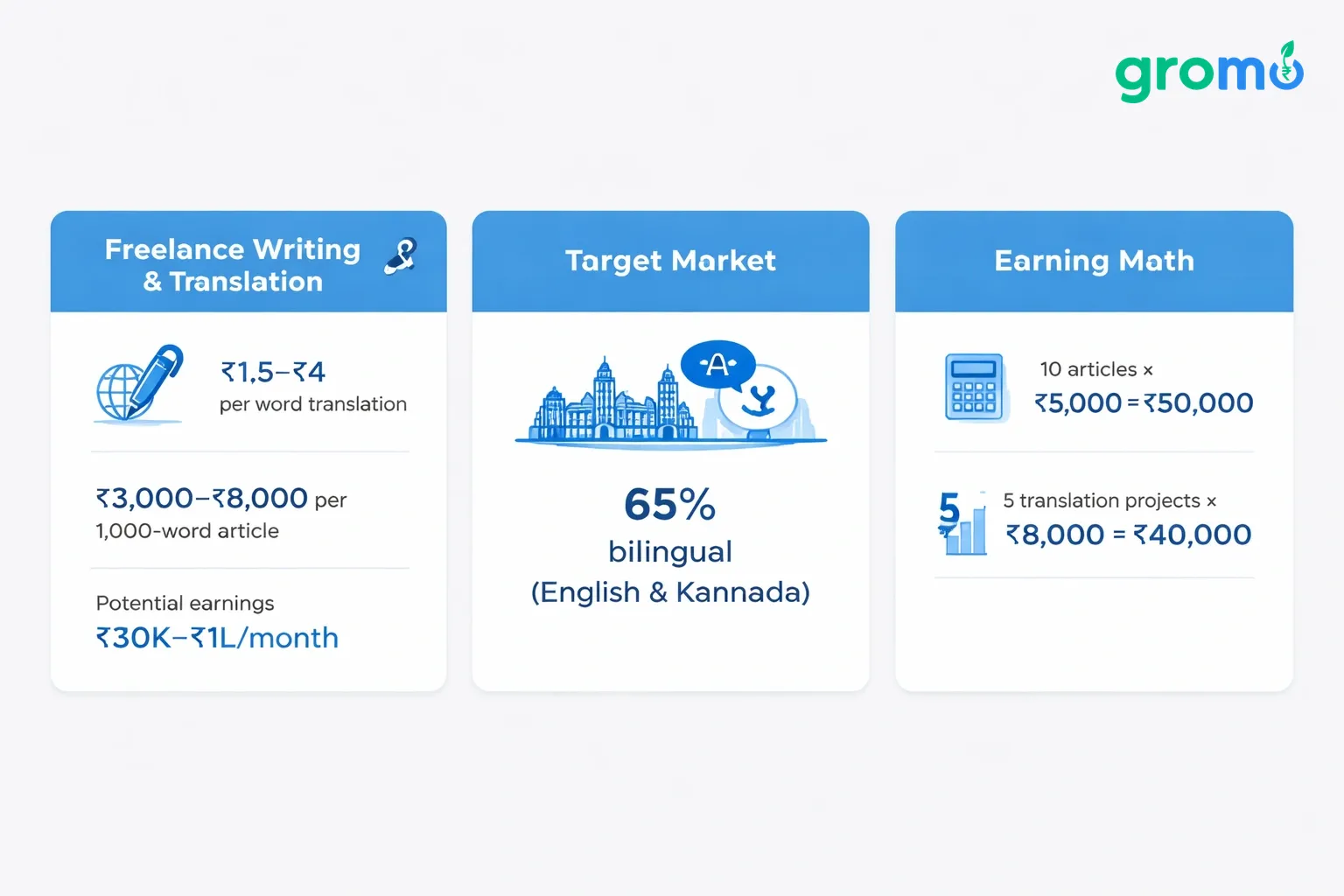
Bangalore's bilingual population (about 65% speak both English and Kannada) opens up translation projects that pay ₹1.5–₹4 per word. Global companies entering Karnataka need websites, apps, and marketing materials translated.
Technical writing for B2B SaaS companies pays ₹3,000–₹8,000 per 1,000-word article. If you have domain expertise in cloud infrastructure, AI/ML, or fintech regulations knowledge you probably already have from your day job you can access this market.
The math is straightforward. Ten articles monthly at ₹5,000 average is ₹50,000. Five translation projects at ₹8,000 average is another ₹40,000. Two white papers quarterly at ₹25,000 each adds roughly ₹16,667/month.
Building a portfolio costs nothing. Medium, LinkedIn articles, and Substack newsletters show off your writing while building SEO. First clients usually come from people you know former colleagues or startup founders in your building.
Online Tutoring and Skill Training: Teaching What You Do
Bangalore professionals monetize workplace skills on Unacademy, Udemy, and Skillshare, earning ₹25,000–₹1,50,000 monthly. IT employees teach programming, analysts offer Excel masterclasses, and finance professionals run CFA prep bootcamps.
India's online education market hit ₹5,800 crores in 2026, with professional upskilling taking 42% of that. Courses priced ₹999–₹4,999 sell to people wanting certifications for promotions or career switches.
Popular course categories include Python for data science (₹2,499), financial modeling in Excel (₹3,999), AWS Solutions Architect prep (₹4,999), and digital marketing fundamentals (₹1,999).
You can create courses with free tools OBS Studio for recording, Canva for slides, Audacity for audio. Marketing happens on LinkedIn, YouTube, and relevant Slack or Discord communities.
First-time creators usually make ₹15,000–₹30,000 in initial sales. As reviews build up, platform algorithms boost visibility, and monthly income can climb to ₹60,000+. It works similarly to Mumbai's zero-investment approaches but targets Bangalore's specific crowd.
Social Media Management for Local Businesses: Filling the Gap
Bangalore has 87,000+ restaurants, salons, gyms, and retail outlets that need social media presence but don't have the staff for it. Social media managers charge ₹10,000–₹30,000 monthly per client for content, scheduling, and engagement. You can do it all with free tools like Meta Business Suite and Canva.
Three clients put you at ₹30,000–₹90,000 monthly. It takes 2–3 hours a day: visiting client locations for content, designing posts, and replying to comments. No office, no equipment purchases, no employees.
How to get clients: Target businesses within 3km of your house. Offer a free 15-day trial to show follower growth. Build a portfolio with 2–3 pro-bono clients first. Get video testimonials that talk about revenue impact.
Bangalore's food scene alone sees 120+ new restaurants opening monthly. If you niche down boutique fitness studios, specialty coffee, organic groceries you can charge 40% more because you understand the audience.
Scaling means hiring freelance creators at ₹300–₹500 per post. You keep 50% margins while expanding to 8–10 clients. This matches strategies in earning ₹1 lakh monthly guides focused on service models.
Affiliate Marketing for Tech Products: The Early Adopter Advantage
Bangalore residents pick up new tech 6–9 months before tier-2 cities. That creates affiliate opportunities for SaaS tools, productivity apps, and gadgets. Amazon Associates, Flipkart Affiliate, and SaaS referral programs pay 5%–30% commissions.
Tech blogs, YouTube channels, or Twitter accounts with 10,000+ monthly visitors can generate ₹20,000–₹80,000 monthly. Content includes product comparisons and tutorials that naturally include affiliate links.
High-converting categories include productivity software like Notion (20% recurring commission), web hosting (₹3,000–₹8,000 per sale), premium smartphones (3%–5% of device price), and online course platforms (30% of first purchase).
Building affiliate income takes consistency over 6–12 months. Early earnings of ₹2,000–₹5,000 compound as content ranks in search results. Successful affiliates in Bangalore focus on specific problems "best CRM for 5-person startups" or "laptop for data scientists under ₹80,000."
It runs entirely on free channels: WordPress, YouTube, Twitter. Paid ads are optional. Organic traffic can get you to ₹50,000+ monthly once your domain authority builds.
Virtual Event Management: Handling the Hybrid Shift
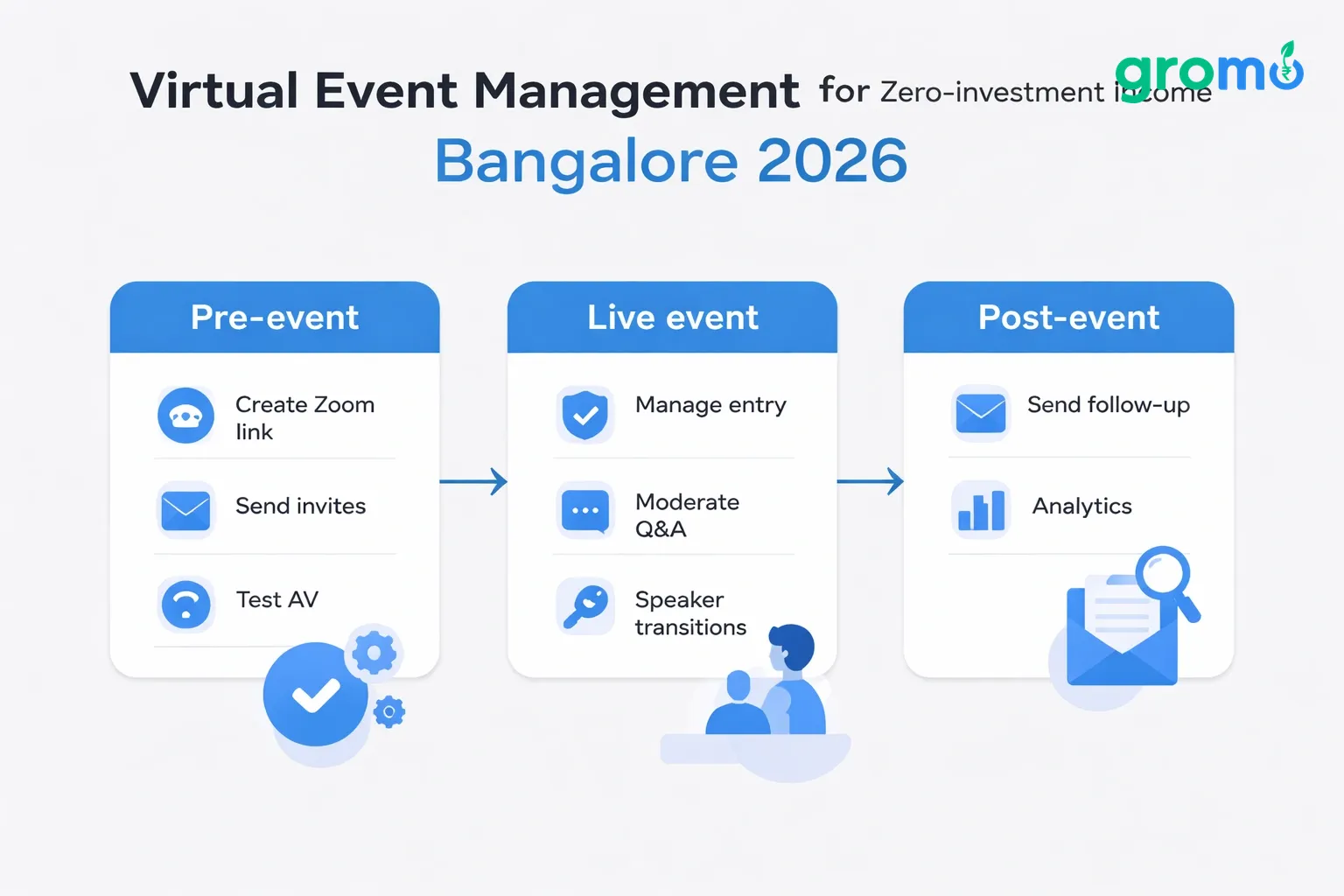
Corporate hybrid events need coordinators to manage Zoom logistics, attendee engagement, and troubleshooting. Event managers charge ₹5,000–₹15,000 per event for 3–4 hour sessions, working from home with free conferencing tools.
Bangalore's startup ecosystem hosts 200+ networking events, product launches, and conferences monthly. You handle pre-event promotion, registration, live moderating, and post-event follow-up.
What you actually do: Pre-event, you create the Zoom link, send invites, and test AV. Live, you manage entry, moderate Q&A, and handle speaker transitions. Post-event, you send recordings, gather feedback, and compile analytics.
Monthly retainers with 4–6 events generate ₹30,000–₹75,000. Find clients through LinkedIn outreach to startup founders and HR managers.
Zoom's free tier handles 100 participants for 40 minutes, which works for most networking events. It builds on remote work opportunities familiar to Bangalore professionals.
Commission-Based Business Loan Facilitation: Serving MSMEs
Bangalore has 2.3 lakh registered MSMEs needing working capital, equipment financing, and expansion credit. Business loan facilitators earn 1.5%–3% of the sanctioned amount by connecting entrepreneurs with digital lenders like ClickPe, Poonawalla Fincorp, and Aditya Birla Capital.
One ₹10 lakh loan approval gets you ₹15,000–₹30,000. Facilitators using GroMo's platform handle 8–12 applications monthly, earning ₹60,000–₹1,50,000 depending on ticket sizes.
Who needs loans in Bangalore: Udyam-registered manufacturers needing equipment, restaurant owners opening second locations, retail shops digitizing inventory, and salons or gyms upgrading facilities.
You just need a phone: collect documents (GST, Udyam, bank statements), submit through lender apps, and coordinate video KYC. You're not liable for the loans lenders handle underwriting and collection.
Success comes from building referral networks with CA firms and business associations. Facilitators often bundle loan referrals with credit card applications to maximize per-customer earnings to ₹8,000–₹12,000.
Starting Your Zero-Investment Business: 30-Day Plan
Week 1: Skill and Market Assessment List three skills you can sell to Bangalore's market. Check freelance platform prices for each. Identify two financial products your network needs. Download the GroMo app and finish the training.
Week 2: Digital Presence Setup Update LinkedIn to highlight monetizable skills. Set up a Google Business Profile for local services. Join five Bangalore-specific Facebook groups in your niche. Design Canva templates for posts.
Week 3: Pilot Client Acquisition Reach out to 20 contacts for free trials. Share financial product recommendations with 10 qualified prospects. Publish three LinkedIn posts. Attend two virtual networking events.
Week 4: Delivery and Refinement Complete first paid engagement or approved referral. Get a testimonial. Calculate time spent versus earnings. Adjust pricing based on data.
This timeline follows approaches in ₹50K monthly earning guides, adjusted for Bangalore.
Risk Mitigation and Compliance
Zero-investment models have low financial risk, but you still need to handle taxes, data privacy, and platform rules. Earnings above ₹2.5 lakhs annually mean income tax obligations and quarterly advance payments.
Compliance basics: Register for GST if turnover exceeds ₹20 lakhs. Keep invoices for all transactions. File ITR-4 if eligible for presumptive taxation. Consider professional indemnity insurance for consulting (₹5,000–₹12,000/year).
Financial product distribution through platforms like GroMo avoids regulatory complexity you aren't handling funds or making credit decisions. The platform handles KYC and underwriting.
Data privacy matters when collecting info for loan applications. Use encrypted communication (WhatsApp Business), store documents in password-protected folders, and delete customer data after the transaction per RBI guidelines.
Don't violate platform policies submitting fake documents or misrepresenting products triggers account suspension. Stick to the training and compliance protocols.
Frequently Asked Questions
Can I run a zero-investment business while employed full-time in Bangalore? Yes. Most models require 10–15 hours weekly. Financial product distribution, affiliate marketing, and consulting offer flexible scheduling. Avoid conflicts of interest don't target your employer's customers. Many partners earn ₹1 lakh monthly while keeping 9–6 jobs by working evenings and weekends.
How long before I generate ₹50,000 monthly? It depends on the model. Financial product distribution can hit ₹50,000 in 3–4 months with consistent effort. Content creation takes 8–12 months to build an audience. Consulting can reach ₹50,000 in the first month if you already have a professional reputation.
Do I need GST registration in Bangalore? GST registration is mandatory once annual turnover crosses ₹20 lakhs for service businesses. Below that, it's optional but recommended for B2B work where clients need GST invoices. Consult a CA for your specific situation.
Which business works best for non-technical professionals? Financial product distribution requires no technical skills just smartphone literacy and communication. Social media management for local businesses also needs minimal technical knowledge, as free tools handle most complexity. Multiple options exist across skill levels.
Can I combine multiple income streams? Yes. Successful entrepreneurs often stack 2–3 models financial product distribution on weekdays, content creation on weekends. Master one stream to ₹20,000–₹30,000 first before adding another. Complementary models (consulting + courses, or affiliate + content) share customer channels and compound faster.
What initial time investment is required? The first 30 days need 15–20 hours weekly for training and setup. Months 2–3 usually require 10–15 hours. By month 4, most models stabilize at 8–12 hours weekly for ₹50,000–₹75,000 earnings. Time scales sub-linearly doubling earnings might only take 50% more time through automation.


