
How to Become a Credit Card Agent Without Investment
No fee, no deposit, no office. Here's what the job actually asks for.

You can become a credit card agent without investment by joining a distribution platform that already holds the bank tie-ups, instead of getting empanelled with a bank yourself. On GroMo that means four steps: install, sign up, register, start selling. Nothing is charged to join, no deposit is held, and the only document you need is your PAN card, at the point where you withdraw what you have earned.
Key Takeaways
- There is no joining fee, no security deposit and no franchise cost on GroMo. Anyone asking you to pay to become a card agent is not offering the same thing.
- You do not need your own credit card, a degree, an office or a GST number to start.
- The sequence is install, sign up, register, start selling. Your PAN card is needed at withdrawal, once a sale is confirmed.
- Direct bank DSA empanelment is the route that costs money and weeks. Platform distribution skips both.
- Cards pay up to Rs 2,000 per approved application, so a handful of approvals is real money against a zero starting cost.
Table of contents
- Can You Become a Credit Card Agent Without Investment?
- What Beginners Think It Costs
- What You Actually Need to Start
- How to Start on GroMo in Four Steps
- Why the Bank Route Costs Money and This One Does Not
- What One Approved Card Pays
- How to Find Customers Without Spending on Ads
- How Long Until the First Payout?
- Mistakes That Cost Beginners Money
Can You Become a Credit Card Agent Without Investment?
Yes, and the reason is structural rather than promotional. Banks pay for approved applications, not for agents, so the cost of acquiring you as a distributor is already covered by the commission they pay when a card is issued. Nobody needs to charge you at the door.
Where money does change hands is the other route. A direct DSA empanelment with a bank can involve an agreement, business registration, and in some cases a security deposit, which is why most people start on a platform and only approach banks directly once they have volume worth negotiating with. The wider partner setup is covered in this guide to becoming a GroMo Partner.
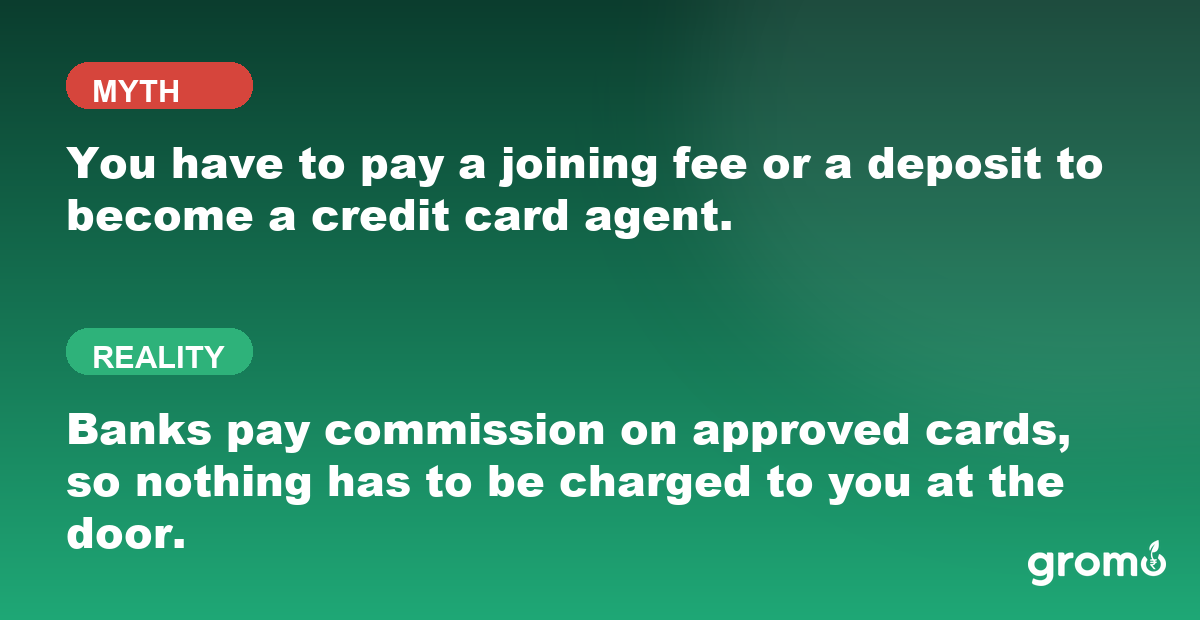
Nobody has to charge you at the door. The bank pays on the other end.
What Beginners Think It Costs
Almost everyone asks about the same five costs, and none of them apply.
- A joining or registration fee. There isn't one. If a person or a website asks you to pay to become a card agent, walk away.
- A security deposit. Not on a distribution platform. Deposits belong to some direct bank arrangements.
- Your own credit card. Not needed. You are recommending a product, not lending your own.
- An office or a shop. The whole job runs on the phone you already own.
- A degree, GST number or company registration. None of it is required to start.
What people rarely ask about is the real cost, which is time. Learning one card properly takes an evening. Sitting with a customer through an application takes twenty minutes. That is the investment, and it is the only one.
What You Actually Need to Start
The list is genuinely short.
- A smartphone with the app installed.
- A working mobile number.
- Your PAN card, needed when you withdraw your earnings after a sale is confirmed.
- A bank account for the money to land in.
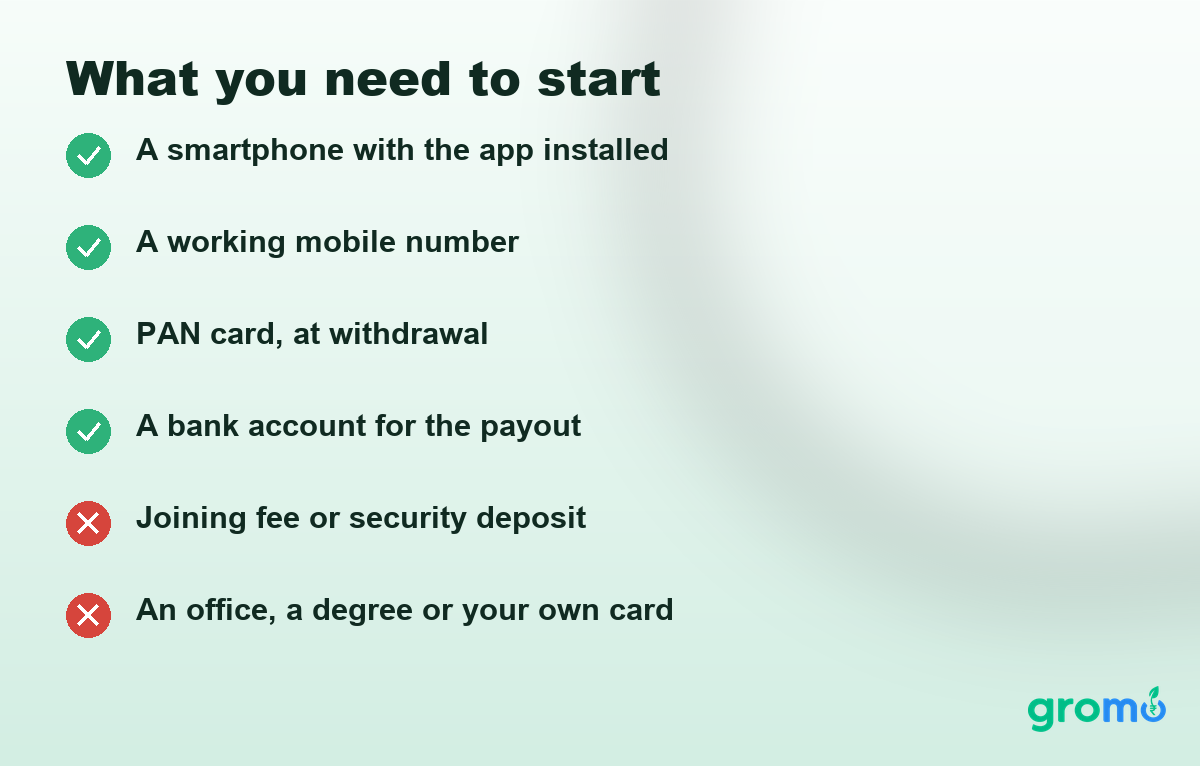
Everything on the left is a tick. There is nothing to buy.
Notice what is not on that list. No fee, no stock to hold, no target you are penalised for missing, and no minimum monthly commitment. If you place nothing this month, you have lost nothing except the time you chose to spend.
How to Start on GroMo in Four Steps
- Install the GroMo app. Free, on Android, and it runs on a modest phone.
- Sign up with your mobile number and verify the OTP.
- Register as a partner. Basic details, done inside the app in a few minutes.
- Start selling. Open the credit card section, pick one card, and share it with someone it genuinely suits.
Then, once a sale is confirmed and you want the money, add your PAN card at withdrawal. That is the point where documentation enters the process, and not before.
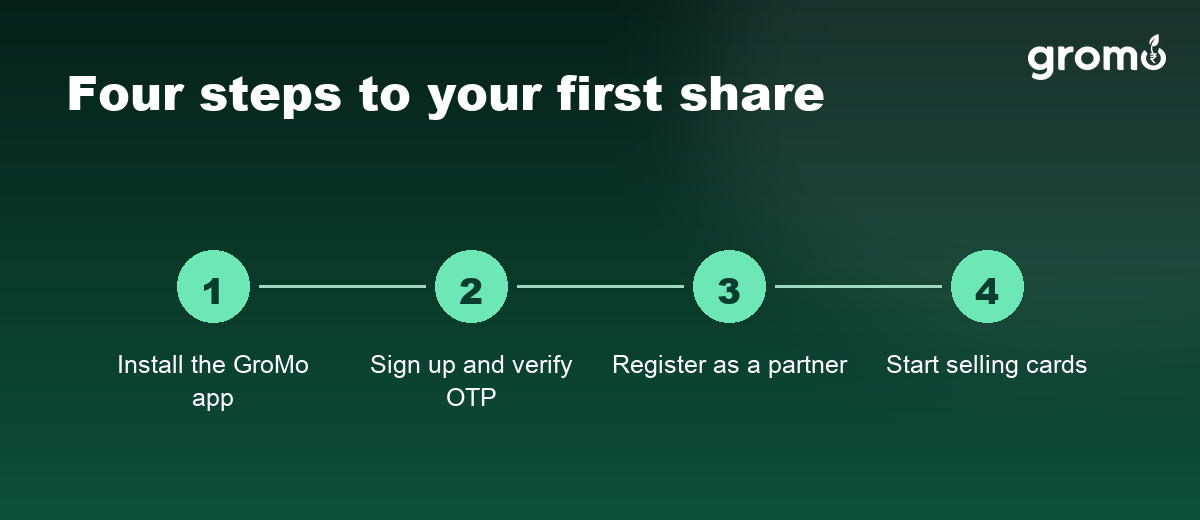
Four steps to your first share. The paperwork waits until you have earned something.
The order matters more than it looks. Most people who quit early do so because they tried to learn every card in the catalogue before sharing anything. Learn one, share one, watch what questions come back, and let the second card wait until the first application is decided.
Why the Bank Route Costs Money and This One Does Not
Both routes end at the same place, which is a commission for an approved card. They differ entirely in what they ask of you before that.
| Direct bank DSA | Platform distribution | |
|---|---|---|
| Cost to start | Agreement, sometimes a deposit | Nothing |
| Paperwork | DSA agreement, business proof, credit check | PAN at withdrawal |
| Time to first sale | Weeks | The same day |
| Cards you can offer | That bank's cards | Many banks, one app |
| If a customer is declined | No alternative to offer | Another card, or a secured card |
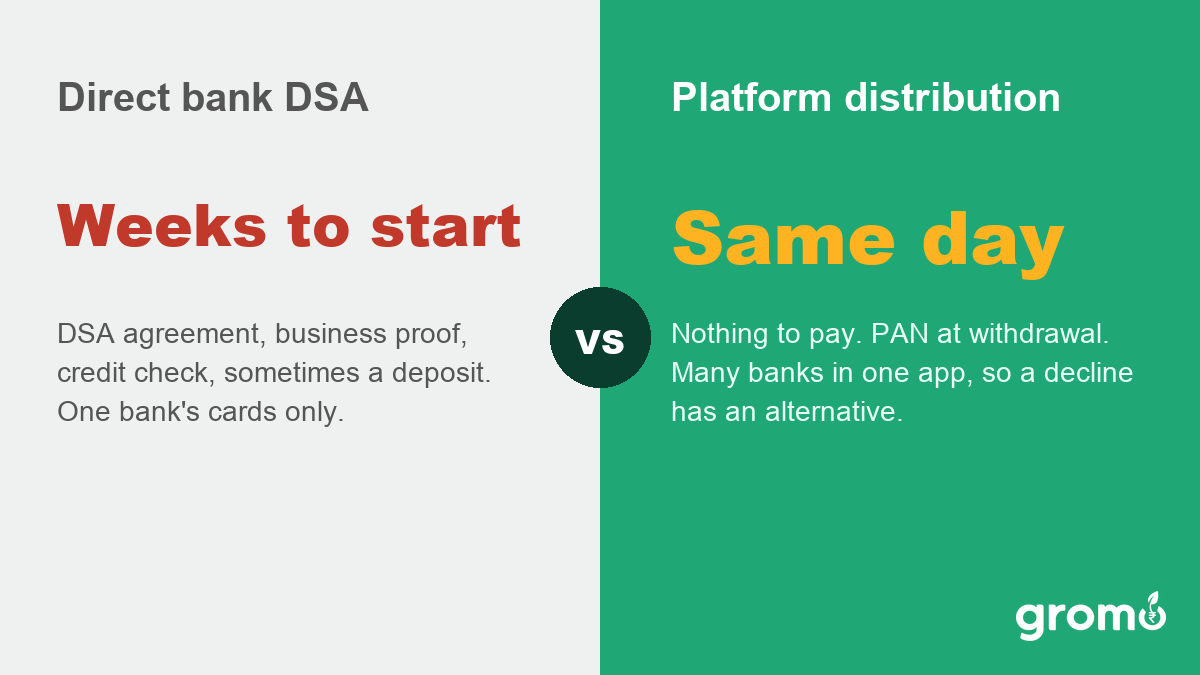
Same destination. One route asks you to pay and wait.
The last row is the one beginners underestimate. An agent tied to a single bank has nothing to say after a rejection. An agent with a full catalogue has a second card to suggest, or a secured card against a fixed deposit for someone with no credit history.
What One Approved Card Pays
Commission is per approved and issued card, and it varies by card.
| Card on GroMo | Commission per approved card |
|---|---|
| SBI Credit Card | Up to Rs 2,000 |
| AMEX Platinum Reserve Credit Card | Up to Rs 1,500 |
| Indian Oil Axis Bank Credit Card | Up to Rs 1,500 |
| Axis Flipkart Credit Card | Up to Rs 1,499 |
| IndianOil RBL Bank XTRA Credit Card | Up to Rs 1,399 |
Please note. Every figure above is a maximum rather than a flat fee, and comes from the app (GroMo product catalogue). Commissions are campaign-linked, so they move and can change without notice. The rate showing on the product card when you share it is the one you get paid.
Against a starting cost of zero, that arithmetic is unusual. There is no break-even point to reach, because nothing was spent. The full breakdown of the role, the card types and the eligibility rules sits in this guide to what a credit card agent does.
How to Find Customers Without Spending on Ads
Zero investment has to include marketing, or it isn't zero. Everything here costs nothing.
Start with people whose spending you already know. A cousin who fills fuel twice a week, a colleague who orders online constantly, a friend who has been asking about credit scores.
Answer questions in groups you are already in. Building societies, local trader groups, alumni networks. Answer the credit question honestly without pitching, and the pitch becomes unnecessary.
Use the fee waiver as the opening line. Most people assume every card costs money forever. Showing the annual spend that waives the fee changes the conversation immediately.
Be present at the moment of spending. Someone at a fuel pump every second day is a fuel card customer. Someone who just bought a phone on EMI is a rewards card customer.
Ask for one referral after the card arrives. A cardholder with the plastic in their hand is the warmest lead you will ever have, and it costs nothing to ask once. There is a fuller walkthrough of the day-to-day workflow in this guide to selling credit cards with GroMo.
How Long Until the First Payout?
Longer than the application, and that surprises people.
Sharing a card takes minutes. The customer applies the same day. Then the bank runs KYC and underwriting, which takes days rather than hours, and the commission is confirmed once the card is issued, with some issuers waiting for activation or a first spend. Payouts follow once the sale is confirmed.
So the honest sequence is: share today, application decided this week, commission confirmed after issue. Anyone promising money the same evening is describing something else.
Mistakes That Cost Beginners Money
- Paying anybody to become an agent. No legitimate platform charges you to join.
- Applying on the customer's behalf. They fill their own form and type their own OTP, always.
- Promising approval. You cannot approve anything. Say "you look eligible" instead.
- Hiding the annual fee. It shows up on the first statement, and the customer remembers who stayed quiet.
- Pitching everyone at once. A burst of applications from people who do not qualify teaches you nothing and costs you credibility.
- Quitting in week two. The first approval usually takes a few attempts, and the ones who stop just before it are the ones who conclude it does not work.
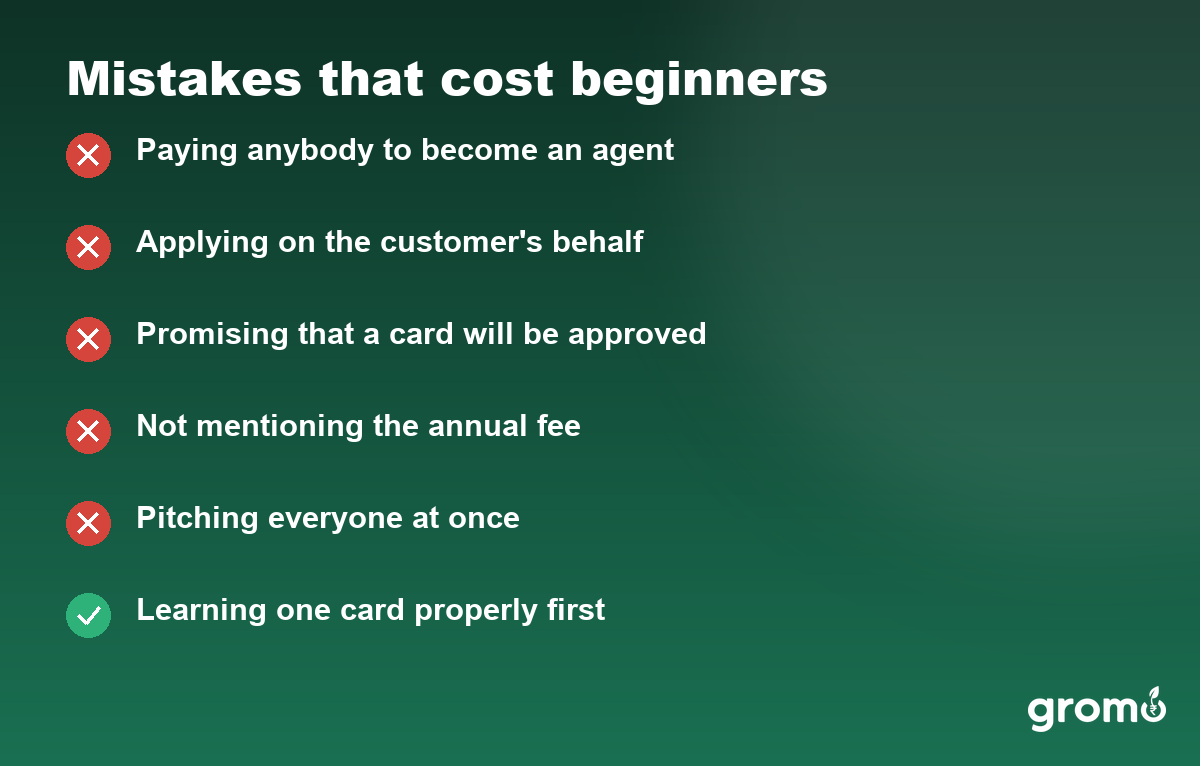
The first one is the only one that costs you money directly.
Frequently Asked Questions
How can I become a credit card agent without investment?
Join a distribution platform that already holds bank tie-ups rather than getting empanelled with a bank yourself. On GroMo the steps are install, sign up, register and start selling, with no joining fee and no deposit. Your PAN card is needed at withdrawal, once a sale is confirmed.
Do I need my own credit card to sell credit cards?
No. Holding a card is not a requirement for recommending one. What matters is understanding the card's fees, rewards and eligibility well enough to explain them honestly.
What documents do I need to start selling credit cards?
Nothing to start beyond the app and a verified mobile number. Your PAN card comes in at withdrawal, and you need a bank account for the payout to reach.
Is there any fee to become a credit card agent on GroMo?
No joining fee, no registration charge and no security deposit. If anyone asks you to pay to become a card agent, treat it as a warning sign.
How much can a credit card agent earn per card?
Up to Rs 2,000 per approved application depending on the card. Rates are campaign-linked and change, so check the live figure on the product card before quoting it to anyone.
Can a student or a housewife become a credit card agent?
Yes. There is no minimum education, income or employment requirement to start on a platform. Anyone above 18 with a phone and a network of people who trust their advice can do this work.
Conclusion
Becoming a credit card agent without investment is not a loophole or an offer that expires. It is simply how distribution works: the bank pays for an approved card, so nobody needs to charge you for the privilege of introducing one.
What that leaves is a job with no financial risk and a real learning curve. Install, sign up, register, start selling, and add your PAN when you withdraw. If you would rather see how the same model works across other products, this guide to earning from home as a GroMo Partner covers the rest of the catalogue. The people who do well are not the ones who memorised the catalogue. They are the ones who placed one card for one person, found out why it worked, and did it again next week.
Disclaimer
Nothing here is a guarantee of income. Credit card commissions are set by the issuing banks and revised as campaigns change, so a figure that is accurate today can be different next month. Every commission quoted in this article is a maximum rather than a flat fee, is indicative only, and was read from the app on 12 August 2026 (GroMo product catalogue, retrieved 2026-08-12).
What you actually earn depends on approvals. An application that fails KYC, or an applicant the bank declines, pays nothing however well you handled it. Approval, credit limit, fees and interest rates are decided entirely by the issuing bank.
Everything above is general information, not financial advice. Check the live commission in the GroMo app before quoting anything to a customer, and read your employment contract before taking up agency work alongside a job.


