
What Is Digital Gold? How to Buy It and Is It Safe?
What is digital gold? Buy gold online from one rupee, stored in an insured vault. How to buy digital gold, digital gold vs physical gold, charges and safety.

By Arvind Kumar · Published 9 October 2026 · Updated 9 October 2026
What is digital gold? It's physical gold you buy online in very small amounts, held for you in an insured vault by the seller rather than delivered to your home. Purchases can start from a rupee, so you buy by value rather than by weight. The gold is real and allocated to you, and most providers let you take delivery as coins or bars once your holding is large enough. Buying and selling prices differ, and GST applies on purchase, so it suits accumulation rather than quick trading.
Key takeaways- Digital gold is real, allocated gold stored in a vault, not a derivative or a paper claim. - You can start from very small amounts, buying by rupee value instead of grams. - GST applies on purchase at the prevailing bullion rate (GST Council, retrieved 2026-10-09), and buy and sell prices always differ. - Most providers cap how long they store it free, so it isn't a forever-free locker.
What is digital gold and how does it work?
Digital gold lets you buy a quantity of physical gold online, which the provider then stores on your behalf in a secure vault.
Definition — allocated gold. Gold held in your name against your specific holding, rather than a general pool the provider owes you from.
Definition — vault storage. Insured third-party storage, usually audited, where the metal backing your purchase physically sits.
Buying a hundred rupees of digital gold means the provider acquires the matching weight at that moment's rate and credits it to your account. The vocabulary around this is set out in investment product terms. Sell it and they buy it back at the prevailing sell price.
How to buy digital gold
- Pick a provider through an app or platform offering it.
- Complete KYC with PAN and Aadhaar, the same as for any financial product.
- Enter an amount in rupees, not grams. The app converts at the live rate.
- Check the price breakup before confirming, including GST and the spread.
- Pay by UPI, card or net banking.
- Hold, sell or take delivery once you reach the provider's minimum for physical delivery.
The whole process takes a few minutes once KYC is done. Selling is usually instant, with proceeds credited to your bank account.
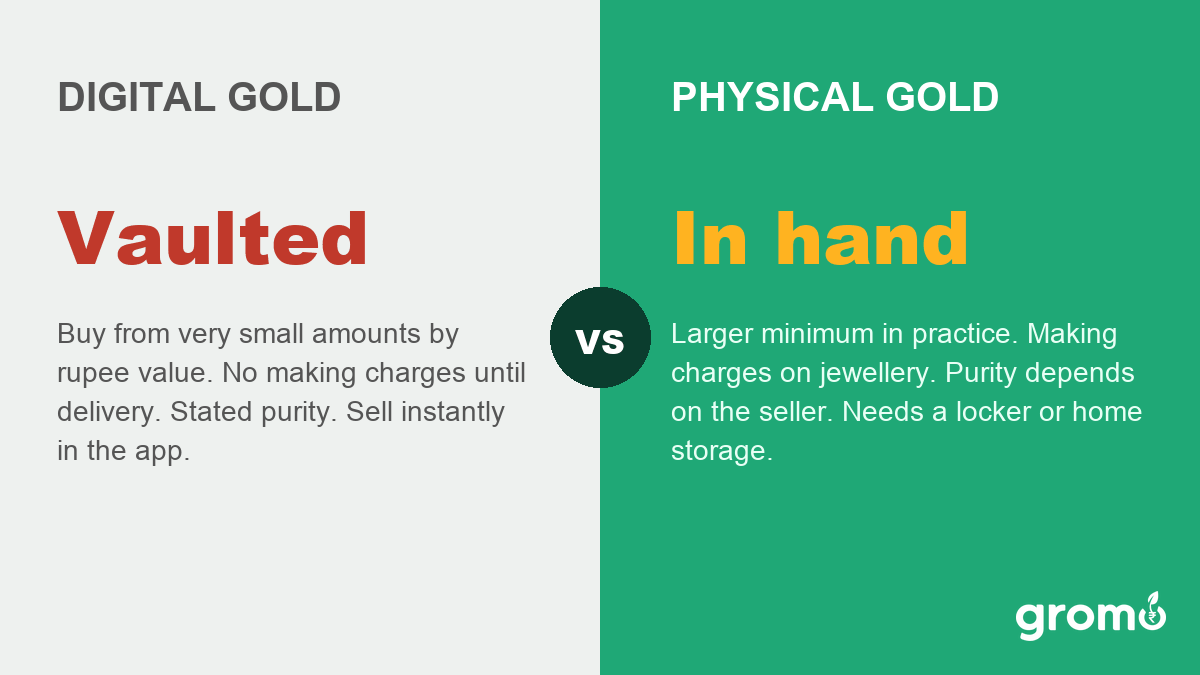
Storage, purity and liquidity differ sharply. Image: GroMo.
Digital gold vs physical gold
| Digital gold | Physical gold | |
|---|---|---|
| Minimum purchase | Very small, by rupee value | A gram upward, in practice more |
| Storage | Provider's insured vault | Your home or a bank locker |
| Making charges | None until you take delivery | Yes, on jewellery |
| Purity | Stated and certified by the provider | Depends on the seller |
| Selling | In the app, usually instant | Depends on finding a buyer |
| Ongoing cost | Free storage for a limited period | Locker rent, if used |
The honest comparison: digital gold wins on convenience, divisibility and purity certainty. Physical gold wins if you actually want the metal in your hand, or if you're buying jewellery to wear rather than to hold.
Is digital gold safe?
Real, vaulted metal answers the common worry, which answers the common worry. Three other things deserve attention though.
It is not a regulated investment product in the way mutual funds are. Digital gold sits outside the direct ambit of the main market regulators, so the protections differ from a SEBI-registered product.
Provider risk is real. You're relying on the provider's vaulting and audit arrangements, so who you buy from matters more than with an exchange-traded product.
Free storage is time-limited. Most providers store free for a fixed number of years, after which you take delivery, sell, or start paying.
None of this makes digital gold unsuitable. It does mean treating it as an accumulation product from a provider you've checked, rather than assuming investor protections that aren't there.
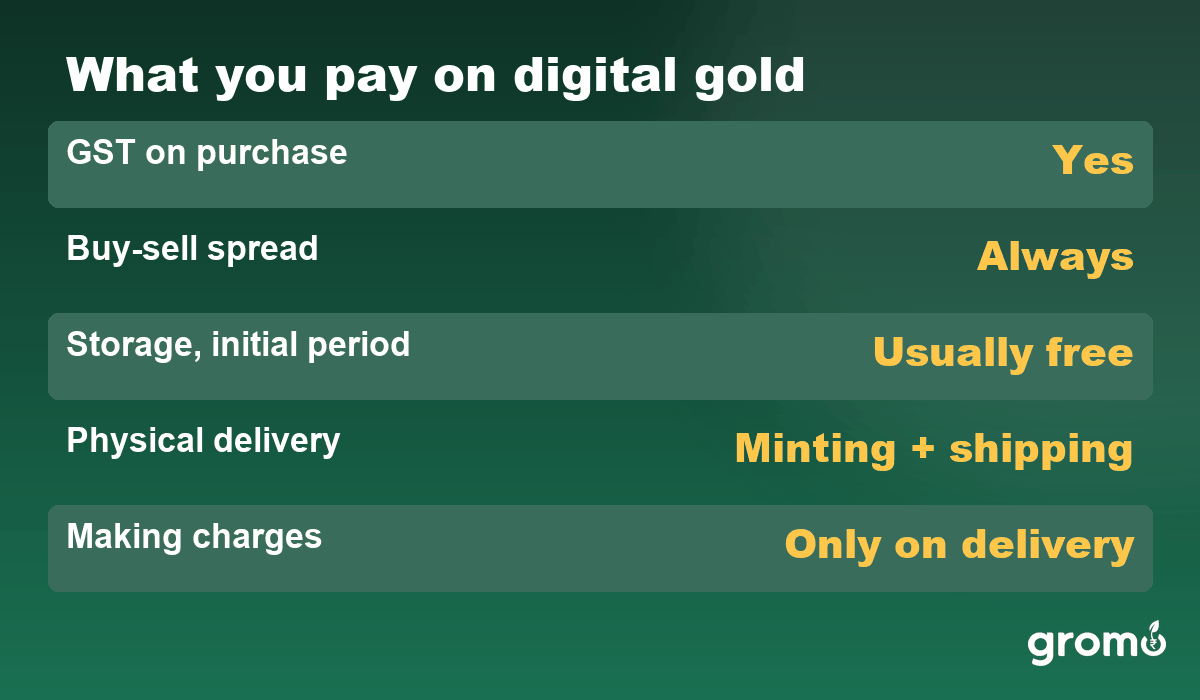
The spread is the cost most buyers miss. Image: GroMo.
What charges apply?
Three costs, and only one is obvious.
GST on purchase, charged at the prevailing rate on bullion set by the GST Council (retrieved 2026-10-09). The spread, meaning the gap between the buy price and the sell price at the same moment, which is how providers earn. Delivery charges, if you convert to coins or bars, covering minting and shipping.
Spread is the cost people miss. Because you buy at the higher price and sell at the lower one, a purchase is slightly underwater the instant it completes. Short holding periods rarely make sense for that reason.
Who does digital gold suit?
Digital gold suits someone accumulating steadily in small amounts, someone who wants gold exposure without a locker, and someone buying towards a future purchase such as a wedding.
Short-term traders are served poorly, because the spread and GST both work against quick round trips. For diversification across metals, digital silver follows similar mechanics with different price behaviour.
Anyone weighing it against market-linked options should remember that gold behaves differently from equity and serves a different purpose in a portfolio.
Referring gold and investment products with GroMo
GroMo is an Indian financial-products distribution platform where individuals refer products from partner banks, NBFCs and fund houses and earn a commission on approved referrals.
Digital gold sits in the catalogue alongside deposits and funds (GroMo product catalogue, retrieved 2026-10-09):
| Product | Commission per approved referral |
|---|---|
| Jiraaf Bond investment | ₹250 |
| BharatPe Digital Gold | ₹100 |
| BharatPe Fixed Deposit | ₹100 |
| Stable Money (FD) | ₹100 |
Rates are campaign-linked and change without notice. Gold converts easily in conversation because the product needs no explaining, only the mechanics of buying it online.
Frequently asked questions
Below are the questions people most often ask alongside this one.
What is digital gold in simple words?
Digital gold is real gold you buy online in small amounts, stored for you in an insured vault instead of being delivered. You own the metal; the provider holds it.
How to buy digital gold?
Complete KYC on a platform offering it, enter an amount in rupees rather than grams, check the price breakup including GST, and pay by UPI, card or net banking.
Is digital gold safe?
The gold is real and vaulted, but digital gold sits outside the direct ambit of the main market regulators, so protections differ from a SEBI-registered product. Provider choice matters.
Can I convert digital gold to physical gold?
Yes, once your holding reaches the provider's minimum for delivery. Minting and delivery charges apply when you do.
What is the minimum amount to buy digital gold?
Very small, and some providers start from a single rupee. You buy by value rather than by weight.
Is GST charged on digital gold?
Yes, at the prevailing rate on bullion, applied when you buy. It's part of why short holding periods rarely work out.
What is the difference between digital gold and a gold ETF?
A gold ETF trades on an exchange and is a SEBI-regulated market product needing a demat account. Digital gold is bought directly from a provider and needs no demat account.
Summary
Digital gold is real, allocated gold bought online in small amounts and stored in an insured vault by the provider. You buy by rupee value rather than weight, GST applies on purchase, and a spread between buy and sell prices means it suits accumulation rather than trading. The metal is real, but the regulatory protections differ from exchange-traded products, so the provider you choose matters. For the wider range of options, investment products sets them out.
Disclosures
GroMo (Vitrak Technologies Pvt Ltd) is a distribution platform. GroMo is not a bank, NBFC, insurer or investment adviser. All products are offered by their respective RBI, IRDAI or SEBI-regulated providers.
Partner earnings depend on effort, product mix and customer eligibility. Any figures shown are illustrative examples of individual results. They are not typical and are not guaranteed. GroMo does not guarantee any level of income.
Investments are subject to market risks. Gold prices fluctuate and past performance does not indicate future returns. Charges, storage terms and delivery minimums are set by each provider and change from time to time. This article is for information only and is not investment advice.
Written by Arvind Kumar. Published 9 October 2026. Last updated 9 October 2026.
Sources
- GroMo product catalogue, commission rates by product. Retrieved 9 October 2026.
- Charges, storage periods and delivery minimums vary by provider; check the provider's own terms before buying.


