
Loan Consultant in India: How to Become One, Fees and Income
Loan consultant in India: what a loan consultant or loan advisor does, how to become one, how they earn, consultant vs DSA vs loan agent, and red flags.

A loan consultant, also called a loan advisor, helps people choose the right loan, prepare documents and apply to a suitable bank or NBFC. In India, most loan consultants earn a commission from lenders by working as a DSA, a sub-DSA or a partner on a loan app, while some charge clients a service fee for paperwork and advice. You do not need an RBI licence to start, but you do need lender tie-ups and product knowledge.
If you want the basics first, read what a loan agent is.
Below are the 7 steps to become a loan consultant, how consultants earn, how they differ from DSAs and loan agents, and the red flags that separate a genuine consultant from a fake one. Where a route has trade-offs, we say so plainly.
| Question | Short answer |
|---|---|
| What does a loan consultant do? | Matches borrowers to the right loan and lender, and handles the application |
| Licence needed? | No RBI licence for DSAs; you need lender agreements |
| Qualification | No fixed degree; finance knowledge helps |
| How they earn | Lender commission, sometimes a client service fee |
| Investment | Low; a phone, laptop and a small office are enough to start |
| Types | Personal loan, business loan, home loan, MSME and Mudra loan consultants |
RBI does not license loan agents or DSAs; lenders appoint them and stay responsible for their conduct under RBI's outsourcing rules (RBI outsourcing guidance, retrieved 2026-10-28).
How this guide is ordered: the steps follow the real path, from learning the products to building a steady client base.
1. Learn the Loan Products
Know: personal, business, home, gold, loan against property | Understand: interest, processing fee, tenure, CIBIL | Time: 2 to 4 weeks
A consultant's value is knowing which loan fits which person. Learn how personal loans, business loans, home loans, gold loans and loans against property differ in rate, tenure and documents. Understand CIBIL scores, debt-to-income ratio and why lenders reject applications.
How to learn fast:
- Read lender product pages for 5 or 6 major banks and NBFCs.
- Compare eligibility, rates and fees in a simple sheet.
- Learn how a CIBIL report is read.
- Shadow an experienced DSA for a few weeks if you can.
2. Pick Your Niche
Personal loans: fast, high volume | Business and MSME loans: larger tickets, more paperwork | Home loans: biggest tickets, longest process
Most successful consultants specialise. A personal loan consultant handles many quick cases. A business loan or MSME consultant handles fewer, bigger cases and works closely with CAs. A home loan consultant works with builders and property dealers.
| Niche | Ticket size | Speed | Documents | Best for |
|---|---|---|---|---|
| Personal loan | Small to medium | Fast | Light | Beginners |
| Business / MSME loan | Medium to large | Medium | Heavy | People with CA or trader contacts |
| Home loan / LAP | Large | Slow | Heavy | People with property contacts |
| Gold loan | Small to medium | Very fast | Light | Rural and semi-urban areas |
3. Get Lender Tie-Ups
Direct DSA code: your own agreement with each lender | Sub-DSA: under a master DSA | Partner app: many lenders at once
You cannot help clients without lenders to send them to. Apply for a DSA code with a few banks and NBFCs, work under a master DSA, or join a partner app that already has many lender tie-ups. Our guide on the DSA code explains each route and the documents needed.
How to choose:
- Start with a partner app or sub-DSA code to begin quickly.
- Track which lenders approve your clients most often.
- Apply for direct codes with those lenders once you have volume.
4. Set Up Your Practice
Start with: phone, laptop, internet | Add later: small office, signboard | Register: GST once your income crosses the limit
You can begin from home. A small office helps with walk-in clients and trust, but it is not essential at the start. Keep a simple record of every client, document and application status.
How to set up:
- Get a separate phone number for work.
- Create a simple client tracker sheet.
- Set up a free Google Business Profile.
- Register for GST when your turnover requires it; talk to a CA.
5. Decide How You Will Earn
Lender commission: paid by the bank or NBFC on disbursal | Service fee: charged to the client, only for real services | Never: fees for "guaranteed approval"
Most loan consultants in India earn commission from lenders on every disbursed loan. Some also charge clients a service fee for real work like preparing financial statements or project reports for business loans. Be careful here: under the RBI (Digital Lending) Directions, 2025, any fee payable to a lending service provider must be paid by the lender, not the borrower (RBI Digital Lending Directions 2025, summarised by law firms, retrieved 2026-10-28). Never take money for "getting the loan approved".
| Income source | Who pays | When | Note |
|---|---|---|---|
| DSA or partner commission | Lender | After disbursal | Main income for most consultants |
| Service fee for paperwork | Client | Upfront or after | Only for real services, in writing |
| Approval or "file" fee | Client | Before loan | Red flag, avoid |
6. Find Clients
Best sources: referrals, local businesses, CAs, employers | Online: Google Business Profile, WhatsApp | Avoid: bought lead lists
Clients come from trust. Past clients, local traders, CAs, property dealers and HR contacts bring the best leads. Our guide on loan leads for DSA ranks 9 lead sources and explains how to qualify each lead.
7. Build a Reputation for Honest Advice
Do: explain the full cost, including fees and interest | Don't: push the loan that pays you most | Result: referrals for years
The consultants who last are the ones clients trust. Show the full cost of each option, tell clients when a loan is a bad idea, and never hide charges. Every honest case brings referrals.
What Is the Difference Between a Loan Consultant, DSA and Loan Agent?
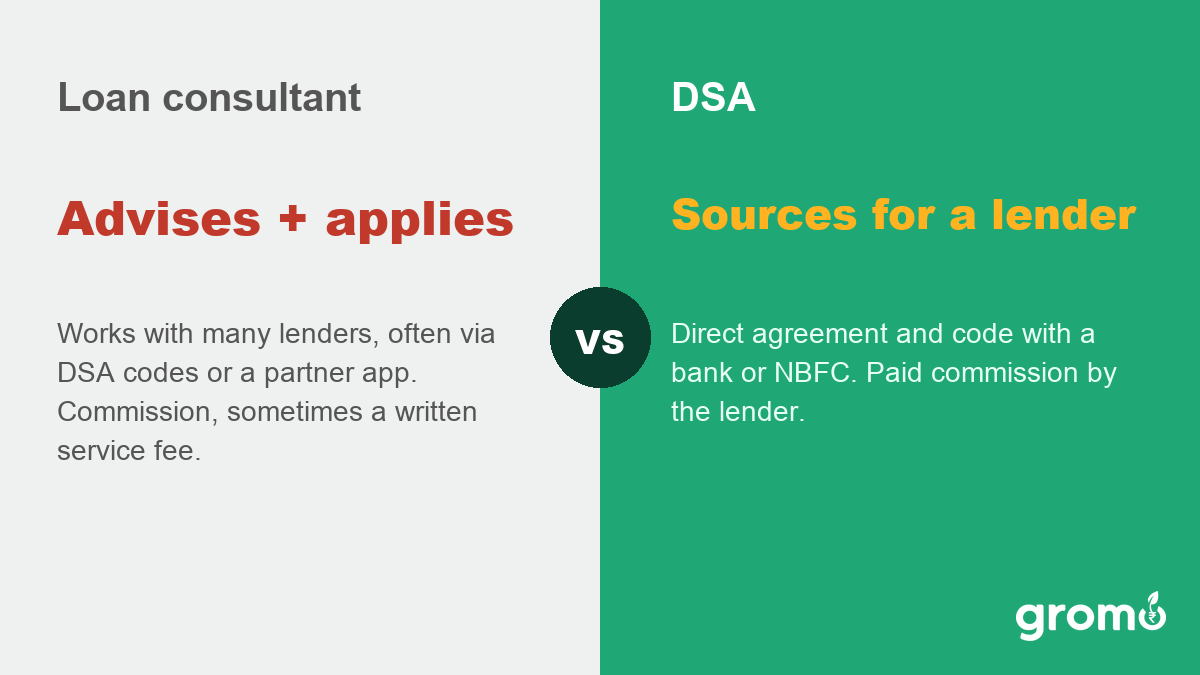
A loan consultant, a DSA and a loan agent overlap a lot in India. The difference is mostly in how they work and how they present themselves.
| Point | Loan consultant / advisor | DSA | Loan agent |
|---|---|---|---|
| Main role | Advises and applies | Sources applications for a lender | Refers customers |
| Tie-up | Many lenders, often via DSA codes | Direct agreement with lender | Usually via a DSA or app |
| Income | Commission, sometimes a service fee | Commission from lender | Commission or share |
| Office | Often has one | Varies | Not needed |
| Best for | Experienced people | Agents with volume | Beginners |
Types of loan consultants
- Personal loan consultant: quick salaried and self-employed personal loans.
- Business loan and MSME loan consultant: working capital, term loans, Mudra and CGTMSE-backed loans.
- Home loan consultant or advisor: home loans and loans against property, often with builder tie-ups.
- Loan settlement consultant: helps people negotiate settlements with lenders. Be careful, as settlement affects the credit score; this guide does not cover it.
How much does a loan consultant earn?
There is no fixed salary. A consultant's income depends on the number of disbursed loans and the commission per lender. On GroMo, for example, personal loans pay ₹100 to ₹500 per disbursed loan and credit cards pay up to ₹2,000 per approved card (GroMo catalogue, retrieved 2026-10-28). A consultant who closes 15 personal loans and 5 cards a month at those rates could earn several thousand to over ₹10,000, depending on the products.
Loan consultancy services: what a client should get
A genuine loan consultancy service should compare options from more than one lender, explain every charge, help with documents, and track the application. It should never ask for money to "guarantee" approval or ask for your OTP or net banking password.
How Do You Spot a Fake Loan Consultant?
- Asks for an "approval fee", "file charge" or "insurance fee" before the loan.
- Promises a loan "without CIBIL" or "100% approval".
- Shares a sanction letter before the lender has even checked your documents.
- Asks for your OTP, UPI PIN or net banking password.
- Has no office address, no lender name and no written terms.
If you meet a consultant like this, walk away and report it at cybercrime.gov.in or by calling 1930. Read more about fake loan apps and how they work.
Important Safety Tips
- Never charge for approval: your job is to help, the lender decides.
- Use official channels: submit documents only through lender apps or forms.
- Keep written terms: if you charge a service fee, put it in writing first.
- Protect client data: do not share documents with other agents.
- Stay updated: lender rules and RBI directions change; review them every few months.
Should You Become a Loan Consultant?
- Good with numbers and people? You will enjoy the work and earn referrals.
- Have CA, trader or property contacts? Business or home loan consulting fits you.
- Just starting with no tie-ups? Begin on a partner app, learn, then apply for DSA codes.
- Want quick money with no learning? This is not the right career.
A loan consultant earns by solving real problems: the right loan, the right lender and a smooth process. Start small, learn the products, stay honest, and your clients will keep coming back.
GroMo is a free app where partners help customers apply for personal loans, credit cards and bank accounts from many lenders, and earn a commission on approval, a simple way to start as a loan consultant without separate tie-ups.

FAQ: Loan Consultant
What does a loan consultant do?
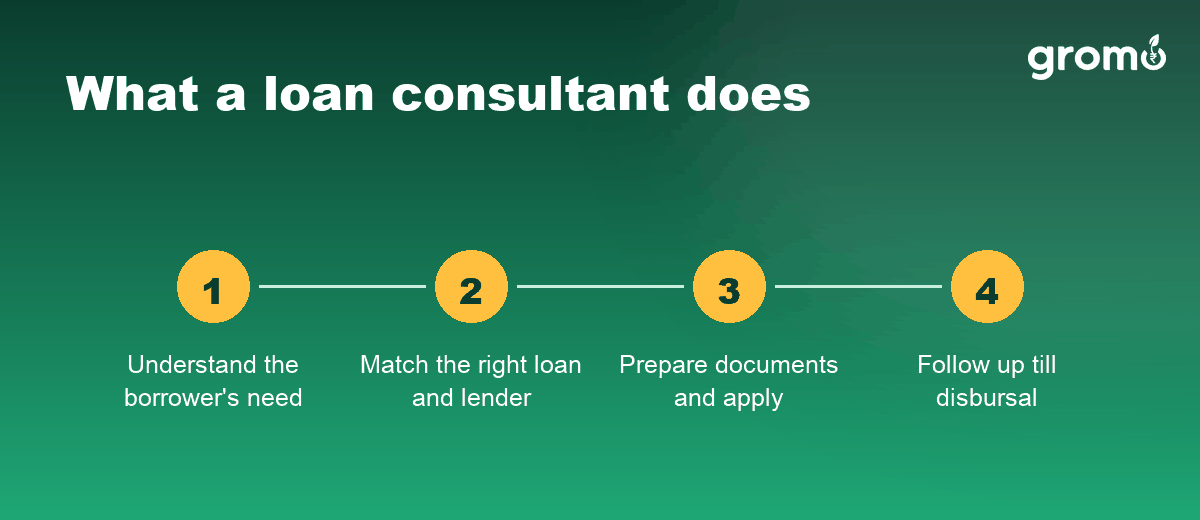
A loan consultant helps borrowers choose a suitable loan, prepares their documents, applies to a matching lender and follows up until the loan is disbursed.
How do I become a loan consultant in India?
Learn the loan products, pick a niche, get lender tie-ups through DSA codes, a master DSA or a partner app, set up a simple practice and build clients through referrals.
Do I need a licence to be a loan consultant?
RBI does not issue licences to loan agents or DSAs. You need agreements with lenders and must follow their code of conduct. Register for GST if your income requires it.
How do loan consultants get paid?
Mostly through commission from lenders on each disbursed loan. Some charge clients a written service fee for real paperwork, but never a fee for approval.
What is the difference between a loan consultant and a DSA?
A DSA has a direct agreement with a lender to source applications. A loan consultant usually advises clients and works with many lenders, often through DSA codes or a partner app.
Is it safe to pay a loan consultant?
Pay only for clearly written services, never for "guaranteed approval". Any request for an upfront approval fee, OTP or password is a red flag.
Can I become a loan consultant from home?
Yes. Many consultants start from home with a phone and a partner app. See how the GroMo app works.
GroMo (Vitrak Technologies Pvt Ltd) is a distribution platform. GroMo is not a bank, NBFC, insurer or investment adviser. All products are offered by their respective RBI, IRDAI or SEBI-regulated providers.
Partner earnings depend on effort, product mix and customer eligibility. Any figures shown are illustrative. They are not typical and are not promised.
Sources: RBI outsourcing guidance for regulated entities; RBI (Digital Lending) Directions, 2025, effective 8 May 2025; GroMo product catalogue, retrieved 2026-10-28.
Disclaimer
GroMo does not promise any level of income. Loan approval, interest rates and fees are decided by the lender. Rules on agents and fees can change; confirm the current terms with each lender and follow RBI directions. If you charge clients any service fee, take advice from a CA or lawyer on tax and legal compliance. GroMo commissions are set by partner lenders, vary by product and campaign, and are paid only on approved or disbursed cases. GroMo is available only to users aged 18 and above. Everything above is general information, not financial or legal advice.


