
Jan Seva Kendra Commission Chart: Full Retailer Commission List
AEPS, money transfer, recharge, bills, PAN, insurance, travel and tax filing commission for retailers, with examples.

A Jan Seva Kendra commission chart shows how much a retailer earns on each service: AEPS cash withdrawal, mini ATM, money transfer, mobile and DTH recharge, bill payments, PAN cards, insurance, travel bookings and tax filing. In the chart covered here, most cash services pay a small flat amount per transaction (₹0.25 to ₹10 on AEPS), recharges pay 1% to 3.5%, and paperwork services like ITR filing pay ₹100 to ₹1,000 per case. Running a counter? Our guide on CSC extra income shows how owners add more earning products.
Below is every number from the chart, service by service, in simple tables. The figures come from the commission chart published by the Jan Seva Kendra retailer portal (jansevakendra.org), dated September 2023. Rates may have changed since then, so confirm them before you sign up.
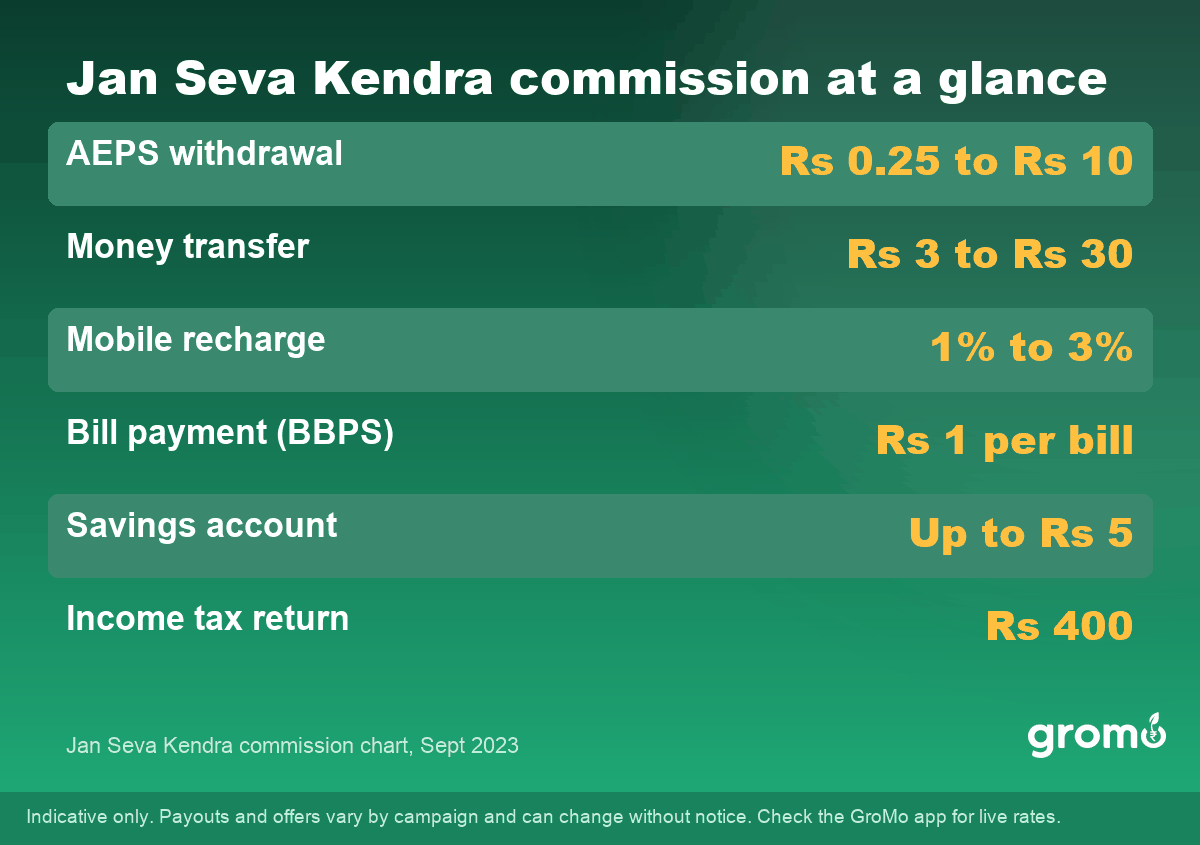
| Service | Retailer commission (as per chart) | How it is paid |
|---|---|---|
| AEPS cash withdrawal | ₹0.25 to ₹10 per transaction | Flat, by amount slab |
| Mini ATM (M-ATM) | ₹0.25 to ₹9 per transaction | Flat, by amount slab |
| Money transfer | ₹3 to ₹30 per transfer | Flat, by amount slab |
| Bank account opening | Up to ₹5 per account | Flat |
| Demat account | Up to ₹100 per account | Flat |
| Personal and business loan | Up to 1% | Of loan amount |
| Mobile recharge | 1% to 3% | Of recharge amount |
| DTH recharge | 2.5% to 3.5% | Of recharge amount |
| Bill payments (BBPS) | ₹1 per bill | Flat |
| Car, bike, health insurance | 5% | As per chart |
| Hotel, bus, flight | Up to 5% | As per chart |
| Registration services | ₹100 to ₹1,000 per case | Flat |
| Tax filing and correction | ₹100 to ₹1,000 per case | Flat |
| PAN card | ₹5 to ₹9 per PAN | Flat |
Commission figures above are the retailer column of the chart (Jan Seva Kendra commission chart, jansevakendra.org, September 2023). The chart also lists separate distributor and super distributor commissions, shown in each section below.
How this guide is ordered: services start with daily cash work (AEPS, mini ATM, money transfer), then accounts and loans, then recharges and bills, then insurance and travel, and end with paperwork services that pay the most per case.
1. AEPS Commission Chart: How Much per Withdrawal?
Pays: flat amount per withdrawal | Retailer charge: ₹0 | Best slab: ₹3,000 to ₹10,000 pays ₹10
AEPS (Aadhaar Enabled Payment System) lets a customer withdraw cash from their bank account using Aadhaar and a fingerprint. The retailer earns a flat amount that rises with the withdrawal size (Jan Seva Kendra commission chart, September 2023).
| Withdrawal slab (₹) | Retailer charge | Retailer commission | Distributor | Super distributor |
|---|---|---|---|---|
| 201 to 600 | 0 | ₹0.25 | ₹0.05 | ₹0.05 |
| 601 to 999 | 0 | ₹1.50 | ₹0.20 | ₹0.20 |
| 1,000 to 1,499 | 0 | ₹3.50 | ₹0.25 | ₹0.25 |
| 1,500 to 1,999 | 0 | ₹5.00 | ₹0.25 | ₹0.25 |
| 2,000 to 2,499 | 0 | ₹6.00 | ₹0.50 | ₹0.50 |
| 2,500 to 2,999 | 0 | ₹7.00 | ₹1.00 | ₹1.00 |
| 3,000 to 10,000 | 0 | ₹10.00 | ₹1.00 | ₹1.00 |
10 customers each withdrawing ₹2,000 in a day earns the retailer ₹60 (worked from the Jan Seva Kendra chart, September 2023). Small withdrawals are different. Those under ₹600 earn only 25 paise each, so AEPS pays well only when your area has many larger withdrawals.
2. Mini ATM (M-ATM) Commission Chart: Up to ₹9 per Withdrawal
Pays: flat amount per card withdrawal | Device: add-on purchase of ₹2,499 | Best slab: ₹3,000 to ₹10,000 pays ₹9
A mini ATM lets customers withdraw cash with their debit card at your counter. The chart lists the mini ATM device as an add-on purchase of ₹2,499 (Jan Seva Kendra commission chart, September 2023).
| Withdrawal slab (₹) | Retailer charge | Retailer commission | Distributor | Super distributor |
|---|---|---|---|---|
| 201 to 600 | 0 | ₹0.25 | ₹0.05 | ₹0.05 |
| 601 to 999 | 0 | ₹1.50 | ₹0.20 | ₹0.20 |
| 1,000 to 1,999 | 0 | ₹3.50 | ₹0.50 | ₹0.50 |
| 2,000 to 2,999 | 0 | ₹5.00 | ₹0.50 | ₹0.50 |
| 3,000 to 10,000 | 0 | ₹9.00 | ₹0.50 | ₹0.50 |
At ₹9 per large withdrawal, you need about 278 withdrawals of ₹3,000 or more just to earn back the ₹2,499 device cost (worked from the Jan Seva Kendra chart, September 2023).
3. Money Transfer Commission Chart: How Much per Transfer?
Pays: flat amount per transfer | Retailer charge: ₹10 to ₹50 by slab | Best slab: ₹4,001 to ₹5,000 pays ₹30
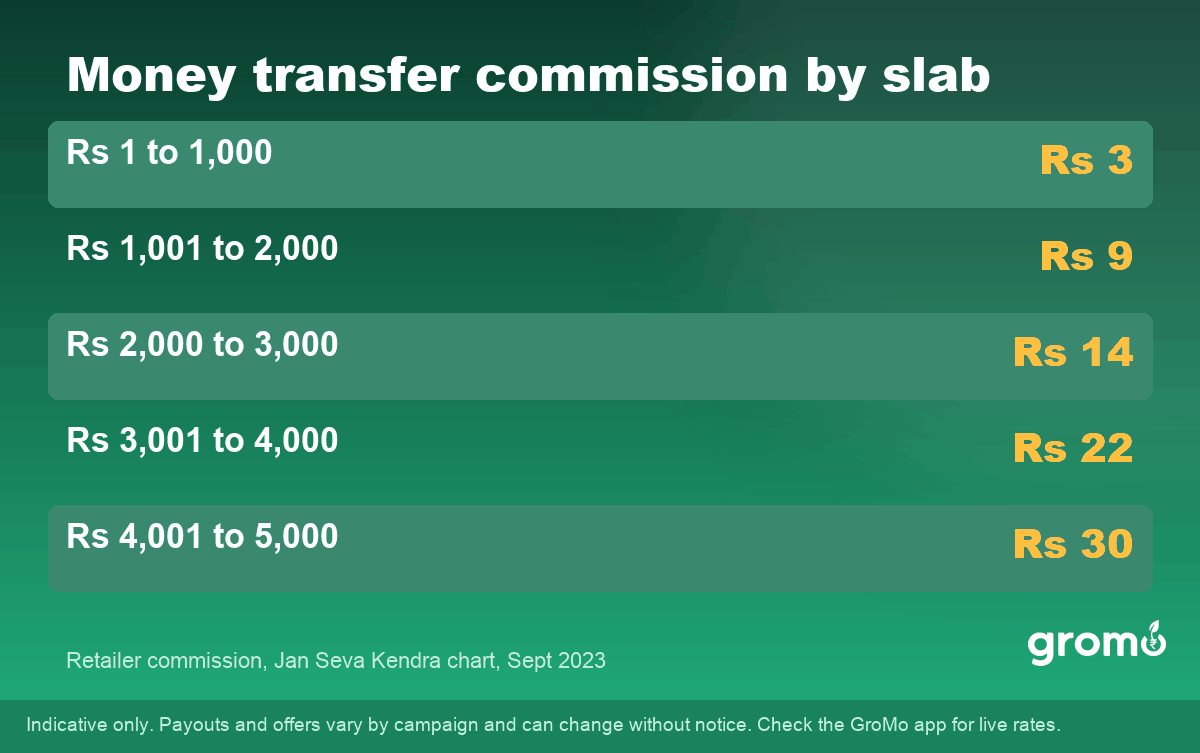
Domestic money transfer lets a customer send cash to any bank account from your counter. The chart lists a retailer charge for each slab and a retailer commission out of it (Jan Seva Kendra commission chart, September 2023).
| Transfer slab (₹) | Retailer charge | Retailer commission | Distributor | Super distributor |
|---|---|---|---|---|
| 1 to 1,000 | ₹10 | ₹3 | ₹1 | ₹1 |
| 1,001 to 2,000 | ₹20 | ₹9 | ₹1 | ₹1 |
| 2,000 to 3,000 | ₹30 | ₹14 | ₹1 | ₹1 |
| 3,001 to 4,000 | ₹40 | ₹22 | ₹1 | ₹1 |
| 4,001 to 5,000 | ₹50 | ₹30 | ₹1 | ₹1 |
5 transfers of ₹4,500 in a day earn ₹150 (worked from the Jan Seva Kendra chart, September 2023). That's good money. Money transfer is one of the better-paying cash services in the chart.
4. Bank and Demat Account Opening: Up to ₹5 and Up to ₹100
Account opening: up to ₹5 (10+ banks) | Demat: up to ₹100 | Retailer charge: self
The chart lists digital savings account opening with 10+ banks at up to ₹5 per account, and demat account opening at up to ₹100 per account (Jan Seva Kendra commission chart, September 2023).
| Service | Retailer charge | Retailer commission | Distributor | Super distributor |
|---|---|---|---|---|
| Digital account opening (10+ banks) | Self | Up to ₹5 | Up to ₹1 | Up to ₹1 |
| Demat account | Self | Up to ₹100 | ₹10 | ₹10 |
20 savings accounts in a month at ₹5 earn ₹100 (worked from the Jan Seva Kendra chart, September 2023). Account opening pays very little in this chart compared with the effort of KYC and follow-up.
5. Loan Commission Chart: Up to 1% of Loan Amount
Personal loan (salaried): up to 1% | Personal or business loan (self-employed): up to 1% | Credit cards: no rate listed
The chart section is titled "Credit Card and Loan Apply", but it lists rates only for loans: up to 1% for salaried personal loans and up to 1% for self-employed personal or business loans (Jan Seva Kendra commission chart, September 2023). No credit card commission appears in the chart.
| Service | Retailer charge | Retailer commission | Distributor | Super distributor |
|---|---|---|---|---|
| Personal loan (salaried) | Self | Up to 1% | Na | Na |
| Personal or business loan (self-employed) | Self | Up to 1% | Na | Na |
A ₹50,000 personal loan at up to 1% can earn up to ₹500 (worked from the Jan Seva Kendra chart, September 2023). "Up to" means the real rate can be lower, and it is paid only when the loan is disbursed.
6. Mobile Recharge Commission Chart: 1% to 3%
Highest: Vi at 3% | Lowest: Airtel at 1% | Retailer charge: ₹0
Mobile recharge pays a percentage of the recharge amount (Jan Seva Kendra commission chart, September 2023).
| Operator | Retailer charge | Retailer commission | Distributor | Super distributor |
|---|---|---|---|---|
| Airtel | 0 | 1.00% | 0.20% | 0.20% |
| Jio | 0 | 1.20% | 0.20% | 0.20% |
| Vi | 0 | 3.00% | 0.20% | 0.20% |
| BSNL | 0 | 2.50% | 0.20% | 0.20% |
| MTNL | 0 | 2.50% | 0.20% | 0.20% |
A ₹299 Jio recharge at 1.2% earns about ₹3.60 (worked from the Jan Seva Kendra chart, September 2023). Recharges bring footfall more than income.
7. DTH Recharge Commission Chart: 2.5% to 3.5%
Highest: Big TV at 3.5% | Others: 2.5% | Retailer charge: ₹0
DTH recharges pay a little more than mobile recharges (Jan Seva Kendra commission chart, September 2023).
| Operator | Retailer charge | Retailer commission | Distributor | Super distributor |
|---|---|---|---|---|
| Dish TV | 0 | 2.50% | 0.20% | 0.20% |
| Tata Sky | 0 | 2.50% | 0.20% | 0.20% |
| Big TV | 0 | 3.50% | 0.20% | 0.20% |
| Videocon D2h | 0 | 2.50% | 0.20% | 0.20% |
| Sun TV | 0 | 2.50% | 0.20% | 0.20% |
| Airtel TV | 0 | 2.50% | 0.20% | 0.20% |
A ₹400 DTH recharge at 2.5% earns ₹10 (worked from the Jan Seva Kendra chart, September 2023).
8. BBPS Bill Payment Commission Chart: ₹1 per Bill
Bills: electricity, water, gas, postpaid | Retailer commission: ₹1 each | Retailer charge: ₹0
Bill payments through Bharat BillPay (BBPS) pay a flat ₹1 per bill to the retailer (Jan Seva Kendra commission chart, September 2023).
| Bill type | Retailer charge | Retailer commission | Distributor | Super distributor |
|---|---|---|---|---|
| Electricity bill | 0 | ₹1 | ₹0.20 | ₹0.20 |
| Water bill | 0 | ₹1 | ₹0.20 | ₹0.20 |
| Gas bill | 0 | ₹1 | ₹0.20 | ₹0.20 |
| Postpaid bill | 0 | ₹1 | ₹0.20 | ₹0.20 |
300 bills a month earn ₹300 (worked from the Jan Seva Kendra chart, September 2023). Bill customers come back every month, which makes them good people to offer other services to.
9. Insurance Commission Chart: 5% on Motor and Health
Car, bike, health insurance: 5% | LIC bill payment: self | Retailer charge: ₹0
The chart lists 5% retailer commission on car, bike and health insurance (Jan Seva Kendra commission chart, September 2023).
| Service | Retailer charge | Retailer commission | Distributor | Super distributor |
|---|---|---|---|---|
| Car insurance | 0 | 5% | 1% | 1% |
| Bike insurance | 0 | 5% | 1% | 1% |
| Health insurance | 0 | 5% | 1% | 1% |
| LIC bill payment | 0 | Self | 1% | 1% |
A ₹2,000 bike insurance premium at 5% earns ₹100 (worked from the Jan Seva Kendra chart, September 2023). Selling insurance in India also needs the right IRDAI-approved setup, so ask the portal how policies are issued before you sell.
10. Travel Commission Chart: Up to 5% and IRCTC Agent ID
Hotel, bus, flight: up to 5% | IRCTC agent ID: SL ₹15, AC ₹30 per ticket (as listed) | Retailer charge: ₹0
Travel bookings pay up to 5%, and the chart lists IRCTC ticket earnings of ₹15 on sleeper and ₹30 on AC tickets (Jan Seva Kendra commission chart, September 2023).
| Service | Retailer charge | Retailer commission | Distributor | Super distributor |
|---|---|---|---|---|
| Hotel | 0 | Up to 5% | Up to 1% | Up to 1% |
| Bus | 0 | Up to 5% | Up to 1% | Up to 1% |
| Flight | 0 | Up to 5% | Up to 1% | Up to 1% |
| IRCTC agent ID | 0 | SL ₹15, AC ₹30 | Na | Na |
30 AC train tickets in a month earn ₹900 at ₹30 each (worked from the Jan Seva Kendra chart, September 2023).
11. Registration Services Commission Chart: ₹100 to ₹1,000 per Case
Highest: Pvt Ltd and One Person Company at ₹1,000 | Retailer charge: ₹500 to ₹10,000 | MSME: free, no commission
Business registrations pay the most per case in the chart, because the service fee is higher (Jan Seva Kendra commission chart, September 2023).
| Service | Retailer charge | Retailer commission | Distributor | Super distributor |
|---|---|---|---|---|
| GST registration | ₹500 | ₹100 | ₹50 | ₹50 |
| Pvt Ltd registration | ₹10,000 | ₹1,000 | ₹200 | ₹200 |
| Food registration (FSSAI) | ₹500 | ₹100 | ₹50 | ₹50 |
| MSME registration | Free | Na | Na | Na |
| TAN registration | ₹1,500 | ₹500 | ₹100 | ₹100 |
| One Person Company registration | ₹10,000 | ₹1,000 | ₹200 | ₹200 |
5 GST registrations and 2 TAN registrations in a month earn ₹1,500 (worked from the Jan Seva Kendra chart, September 2023).
12. Tax Filing and Correction Commission Chart: ₹100 to ₹1,000
ITR: ₹400 per return | TDS and GST return: up to ₹300 | Company changes: ₹1,000
Tax filing pays well per case, especially income tax returns during the filing season (Jan Seva Kendra commission chart, September 2023).
| Service | Retailer charge | Retailer commission | Distributor | Super distributor |
|---|---|---|---|---|
| Income tax return | ₹1,000 | ₹400 | ₹50 | ₹50 |
| TDS return | Up to ₹1,000 | Up to ₹300 | ₹50 | ₹50 |
| GST return | Up to ₹1,000 | Up to ₹300 | ₹50 | ₹50 |
| GST correction | ₹500 | ₹100 | ₹50 | ₹50 |
| Change business name, add or remove director or partner, change registered office | Up to ₹2,000 | ₹1,000 | ₹100 | ₹100 |
15 ITRs in July earn ₹6,000 (worked from the Jan Seva Kendra chart, September 2023). This income is seasonal. Don't count on it every month.
13. Government Services Commission Chart: PAN, Ration Card and More
PAN card: ₹5 to ₹9 | Ration card: ₹10 | Voter ID: free, no commission
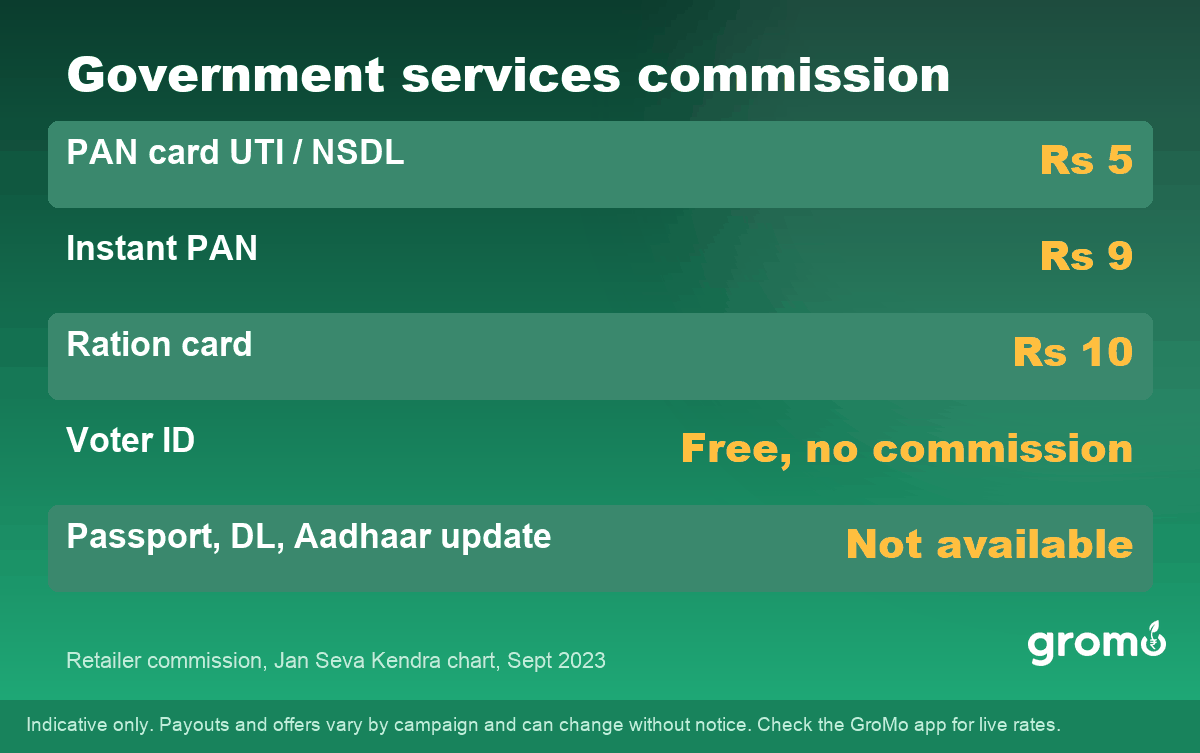
Government document services pay small amounts, and several are listed as Na (not available) in the chart (Jan Seva Kendra commission chart, September 2023).
| Service | Retailer charge | Retailer commission | Distributor | Super distributor |
|---|---|---|---|---|
| PAN card UTI | ₹110 | ₹5 | ₹1 | ₹1 |
| PAN card NSDL | ₹110 | ₹5 | ₹1 | ₹1 |
| Instant PAN (OTP or finger) | ₹120 | ₹9 | ₹1 | ₹1 |
| Voter ID | Free | Na | Na | Na |
| Passport | Na | Na | Na | Na |
| Driving licence | Na | Na | Na | Na |
| Aadhaar update | Na | Na | Na | Na |
| Ration card | ₹30 | ₹10 | ₹2 | ₹1 |
| State certificate | ₹20 | Na | Na | Na |
| Labour card | Na | Na | Na | Na |
40 PAN applications a month earn ₹200 (worked from the Jan Seva Kendra chart, September 2023).
How Much Does a Jan Seva Kendra Earn per Month?
A Jan Seva Kendra retailer usually earns most from money transfer, AEPS on larger withdrawals and paperwork services, and very little from bills and account opening. The chart's cover claims "earn up to ₹25,000 per month" (Jan Seva Kendra chart cover, September 2023), but real income depends on footfall.
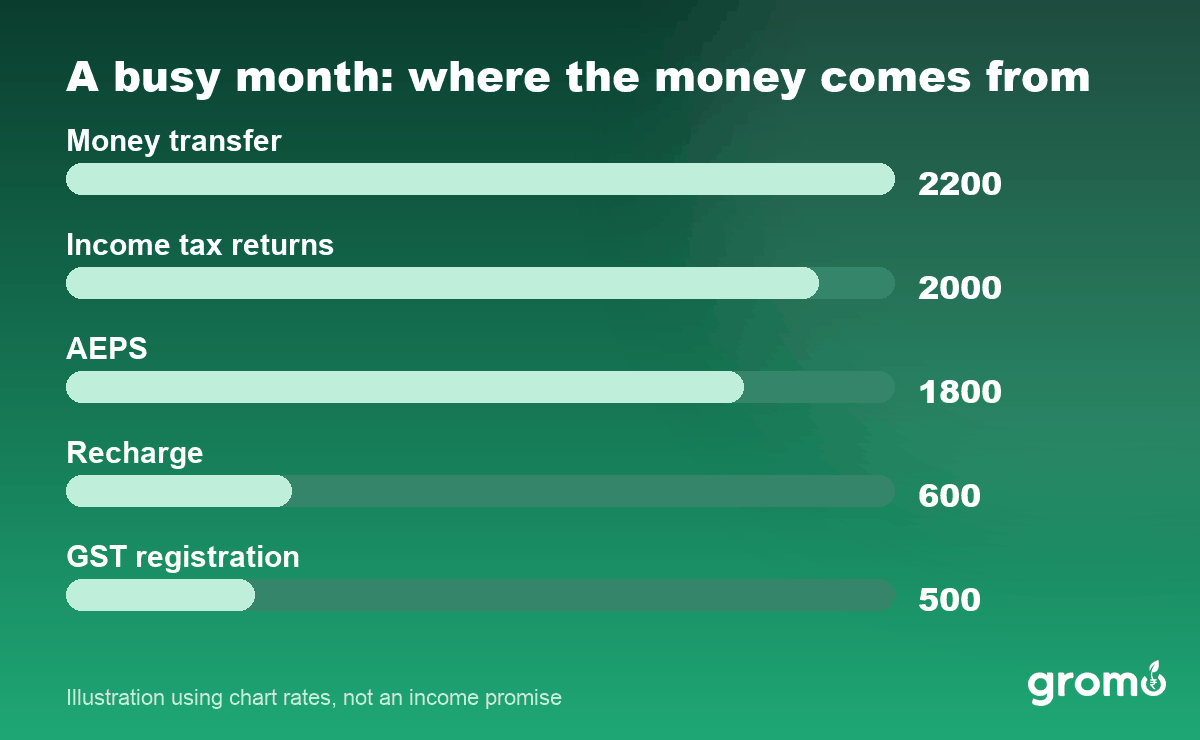
Here is an illustrative month for a busy counter using only the chart's rates:
| Service | Volume in a month | Rate (as per chart) | Earning |
|---|---|---|---|
| AEPS (₹2,000 to ₹2,499 slab) | 300 withdrawals | ₹6 | ₹1,800 |
| Money transfer (₹3,001 to ₹4,000 slab) | 100 transfers | ₹22 | ₹2,200 |
| Mobile recharge (Jio) | ₹50,000 recharged | 1.2% | ₹600 |
| Bill payments | 300 bills | ₹1 | ₹300 |
| PAN cards | 40 | ₹5 | ₹200 |
| GST registration | 5 | ₹100 | ₹500 |
| Income tax returns | 5 | ₹400 | ₹2,000 |
| Total | ₹7,600 |
The table is an illustration, not an income promise. A quiet counter may earn much less, and a busy market counter can earn more. You also need your own cash for AEPS and mini ATM payouts, plus a computer, printer, fingerprint device and internet.
Jan Seva Kendra vs the official CSC: know the difference
"Jan Seva Kendra" is the common name for a Common Service Centre (CSC), the government scheme run by CSC e-Governance Services India Ltd under the Ministry of Electronics and IT. Official CSC centres are registered through the CSC portals, and their commission rates are set by CSC and its service partners.
Many private retailer portals also use the name "Jan Seva Kendra". The chart in this guide comes from one such portal, jansevakendra.org, and is not an official CSC rate card. Before you pay any ID or registration fee, check who runs the portal, its company details and its refund terms.
How to open a Jan Seva Kendra (CSC) the official way
The official CSC route is free to register, but you must first pass the TEC (Telecentre Entrepreneur Course) exam. Most guides list the TEC exam fee at about ₹1,479 (public CSC registration guides, retrieved 2026-10-28).
- Take the TEC course and exam on the CSC Academy portal (cscentrepreneur.in).
- Keep your TEC certificate number ready.
- Register as a VLE on the official CSC registration portal.
- Upload Aadhaar, PAN, photo, bank details and qualification proof.
- Wait for verification, then log in to the Digital Seva portal and start services.
Avoid agents who charge ₹10,000 or more to "get your CSC ID". If you want to add banking services, read how a Bank Mitra and CSP works.
Jan seva kendra registration fees
Official CSC registration is free, apart from the TEC exam fee. Private portals set their own ID fees, and the chart in this guide does not state its joining fee. Always get the fee, the services included and the refund policy in writing before paying.
Important Safety Tips
- Verify the portal: private portals that use "Jan Seva Kendra" are not government offices. Check the company name, CIN and address before paying.
- Never pay for a "government ID" through WhatsApp or UPI to a person: official CSC registration does not work that way.
- Keep cash safe: AEPS and mini ATM pay out your own cash, so count twice and settle daily.
- Check rates every month: commission charts change, and a 2023 chart may not match today's rates.
- Protect customer data: never keep copies of a customer's Aadhaar, fingerprint or OTP.
Which Jan Seva Kendra Service Pays You the Most?
- Per case: company registrations and changes (₹1,000), ITR filing (₹400) and TAN registration (₹500).
- Per daily transaction: money transfer (up to ₹30) and large AEPS withdrawals (₹10).
- For footfall, not income: bill payments (₹1), recharges (1% to 3%) and PAN cards (₹5 to ₹9).
- Lowest: savings account opening (up to ₹5).
A Jan Seva Kendra earns steady small amounts on many daily services. Its biggest strength? Footfall. The same customers who come for bills and PAN cards often need a savings account, a credit card or a loan. Those products pay far more per customer on GroMo than the account and loan rates in this chart. See our Jan Seva Kendra vs GroMo commission comparison for the side-by-side numbers.
GroMo is a free app where partners help customers apply for savings accounts, credit cards, loans and demat accounts from partner banks, and earn a commission on approval.

FAQ: Jan Seva Kendra Commission Chart
How much commission does a Jan Seva Kendra get on AEPS?
AEPS pays ₹0.25 on ₹201 to ₹600 withdrawals, rising to ₹10 on withdrawals of ₹3,000 to ₹10,000 (Jan Seva Kendra chart, September 2023).
What is the money transfer commission in Jan Seva Kendra?
Money transfer pays ₹3 on transfers up to ₹1,000, rising to ₹30 on transfers of ₹4,001 to ₹5,000 (Jan Seva Kendra chart, September 2023).
How much does a Jan Seva Kendra earn on a PAN card?
PAN pays ₹5 on UTI and NSDL applications and ₹9 on instant PAN (Jan Seva Kendra chart, September 2023).
What is the mobile recharge commission at a Jan Seva Kendra?
Mobile recharge pays 1% on Airtel, 1.2% on Jio, 3% on Vi and 2.5% on BSNL and MTNL (Jan Seva Kendra chart, September 2023).
Is the Jan Seva Kendra commission chart official?
The chart in this guide is published by a private retailer portal, jansevakendra.org, not by the government CSC scheme. Official CSC rates are shared on the CSC Digital Seva portal.
Jan seva kendra kaise khole?
Official CSC (Jan Seva Kendra) kholne ke liye pehle CSC Academy par TEC exam pass karein, phir official CSC portal par VLE registration karein aur Aadhaar, PAN, photo aur bank details upload karein. Registration free hai, sirf TEC exam fee lagti hai.
How much does a Jan Seva Kendra earn per month?
Earnings depend on footfall. Using the chart's rates, a busy counter doing 300 AEPS withdrawals, 100 transfers, recharges, bills and a few tax filings can earn around ₹7,600 a month. A quiet counter earns less.
Can a Jan Seva Kendra also earn from GroMo?
Yes. GroMo is free to join, and a counter owner can offer savings accounts, credit cards and loans to the same customers. See how the GroMo app works for the steps.
GroMo (Vitrak Technologies Pvt Ltd) is a distribution platform. GroMo is not a bank, NBFC, insurer or investment adviser. All products are offered by their respective RBI, IRDAI or SEBI-regulated providers.
Sources: Jan Seva Kendra commission chart (PDF), jansevakendra.org, dated September 2023, retrieved 2026-10-28. CSC registration steps from public CSC registration guides, retrieved 2026-10-28. Rates are reproduced as published and may have changed.
Disclaimer
GroMo has no connection with jansevakendra.org or any portal named in this article, and does not endorse it. The commission figures are reproduced from that portal's chart dated September 2023 and may have changed; confirm current rates, fees and terms with the provider before joining or paying any fee. This chart is not an official Common Service Centre (CSC) rate card. Earning examples are illustrations, not income promises. GroMo does not promise any level of income. GroMo is available only to users aged 18 and above. Everything above is general information, not financial, legal or tax advice.


