
CSC Extra Income: How Jan Seva Kendra Owners Earn With GroMo
You already have the footfall and the trust. This is what to do with them.

CSC extra income means the money a Common Service Centre earns beyond its government service fees, and the fastest route to it is financial products. A Jan Seva Kendra already has what banks pay for: daily footfall, local trust, and an operator who handles PAN and Aadhaar every day. Adding credit cards, savings accounts, loans and demat accounts to the same counter costs nothing and pays up to Rs 2,000 on a single approved application.
Key Takeaways
- Government service fees are fixed and thin. One approved financial product can be worth more than a full day of certificate and bill payment work.
- GroMo needs no investment, no new licence and no extra shop. Onboarding is PAN and Aadhaar, and bank details are only needed at withdrawal.
- A CSC counter is already a KYC desk. The document skill you use for Aadhaar and PAN is the same skill a card or loan application needs.
- GroMo lists 83 products across 8 categories, so a customer who does not qualify for one can usually be placed on another.
- GroMo is a private distribution platform. It is not a CSC service, not a government scheme, and it does not replace anything on your CSC portal.
Table of contents
- Where Does CSC Extra Income Come From?
- Why Jan Seva Kendra Income Hits a Ceiling
- What You Already Have That Banks Pay For
- What Is GroMo and How Does It Fit a CSC Counter?
- Which Products Suit a Jan Seva Kendra?
- How Much Can a CSC Owner Earn?
- How to Start With GroMo Alongside Your CSC Work
- Which Customer to Offer What
- Rules Every CSC Owner Should Follow
- Mistakes CSC Owners Make With Financial Products
Where Does CSC Extra Income Come From?
Not from doing more of the same work. A CSC or Jan Seva Kendra earns a fixed fee per government transaction, so income rises only when footfall rises, and footfall is capped by the size of the town.
CSC extra income comes from raising what each visitor is worth. The same person standing at your counter for an Aadhaar update may also need a credit card, a savings account, a demat account or a small loan. Those pay a commission per approved application, and that commission does not depend on how many people walked in that day.
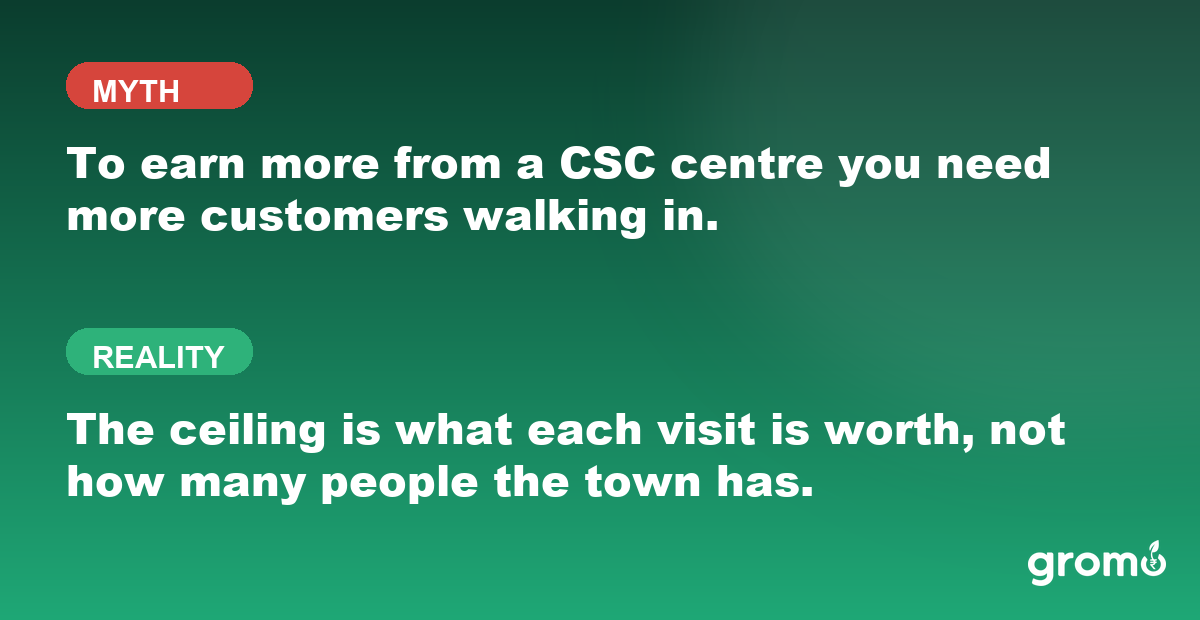
The ceiling is not footfall. It is what each visit is worth.
Why Jan Seva Kendra Income Hits a Ceiling
Every CSC owner runs into the same four walls.
- Fixed service fees. Rates for certificates, applications and bill payments are set for you. Working harder does not raise them.
- Footfall you cannot grow. A town has the number of people it has, and a second centre opening nearby splits them.
- Portal downtime. Hours where nothing can be processed are hours with no income at all.
- Seasonal swings. Scheme deadlines and exam forms create rushes, then months of quiet.
None of those are solved by longer hours. What solves them is having something else to offer the people already in front of you.
What You Already Have That Banks Pay For
A Jan Seva Kendra owner starts this work with advantages a city-based agent spends years building.
Daily footfall of the exact customers banks want. Salaried workers, shopkeepers, farmers, students, pensioners. Banks spend heavily to reach these people. You already see them.
Trust that was earned, not advertised. People hand you their Aadhaar and PAN without hesitating. That's the hardest part of financial selling, and you've already done it, which is why the route described in this guide to becoming a GroMo Partner is shorter for you than for most people.
Document skill. You know what a clean PAN photo looks like, what makes an address mismatch, and how a form gets rejected. Card and loan applications fail for exactly those reasons.
A reason for people to come back. A customer returns for a certificate, a bill payment or a printout. Every return visit is another chance to follow up on an application.
Local language and patience. You already explain government forms to people who find them intimidating. A credit card is easier than a pension form.
What Is GroMo and How Does It Fit a CSC Counter?
GroMo is an Indian financial products distribution app. Partners recommend credit cards, savings accounts, demat accounts, loans and credit lines from a single catalogue, and earn a commission when an application is approved.
GroMo fits a CSC counter because it asks for nothing you don't already have. No investment, no stock, no franchise fee, no second shop. Onboarding is PAN and Aadhaar KYC, and your bank details are needed only when you withdraw what you have earned. The app runs on the same phone you already carry.
Being clear about what it is not: GroMo is a private platform and has no connection to CSC e-Governance Services, to any Jan Seva Kendra scheme, or to any government department. You are not adding a CSC service. You are adding a separate line of business that happens to sit well beside one.

Which Products Suit a Jan Seva Kendra?
Some of the catalogue doesn't suit a small-town counter, and these are the categories that do, ranked by what one approved application pays.
| Product category | Best for the customer who | Pays up to |
|---|---|---|
| Credit Card | Has a salary or steady business income | Rs 2,000 |
| Investment | Wants to start small and regular | Rs 1,000 |
| Savings Account | Needs a zero balance or digital account | Rs 750 |
| Secured Credit Card | Has no credit history or a low score | Rs 500 |
| Personal Loan | Needs money for a short, specific reason | Rs 500 |
| Demat Account | Is asking about shares or mutual funds | Rs 400 |
| Credit Line | Wants a small buffer rather than a full loan | Rs 150 |
Please note. Every figure above is a maximum, not a flat fee, and comes from the app (GroMo product catalogue). Commissions are campaign-linked, so they move with campaigns and can change without notice. The rate showing on the product card when you share it is the one you get paid.
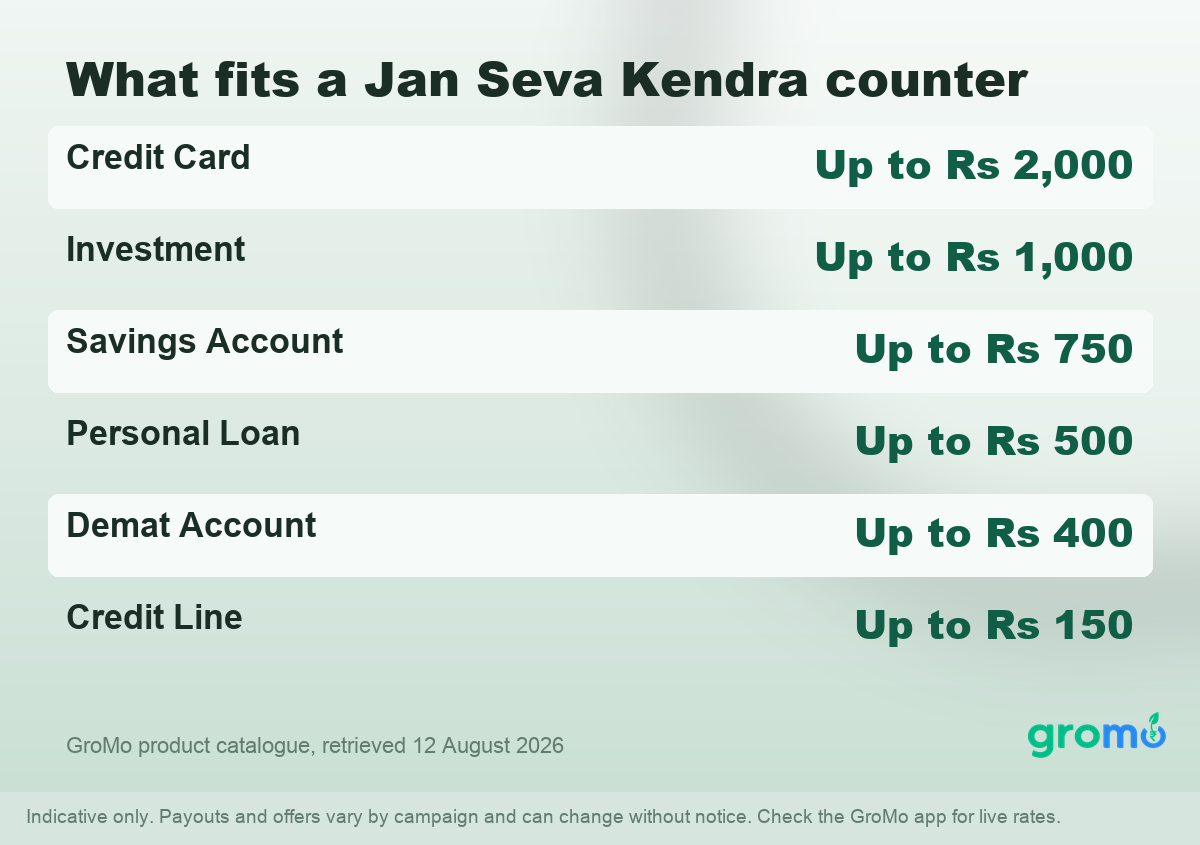
Seven categories that fit a small-town counter, ranked by payout.
Start with savings accounts and credit cards. Both are familiar to the customer, both need documents you are already holding, and neither requires you to explain a new concept. Demat accounts and loans come later, once you have placed a few. The product-by-product detail is covered in this guide to what a credit card agent does.
How Much Can a CSC Owner Earn?
Honestly, it depends on how many applications actually get approved, and nobody can promise you a number.
What can be shown is the arithmetic. A counter that places two savings accounts and one credit card in a month is doing modest, realistic work, and the commission on those three approvals is worth more than a week of small government transactions. A counter that places ten in a month has built a second business.
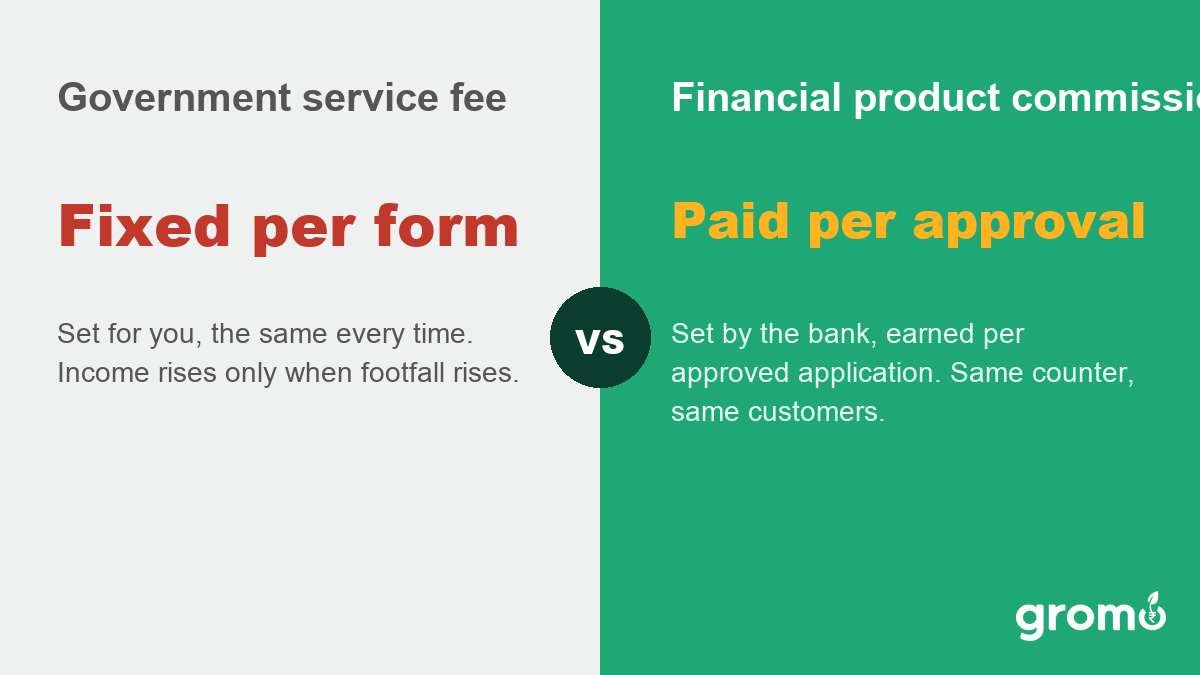
One is capped by footfall. The other is capped by approvals.
Three numbers decide your total: how many people you offer a product to, how many of those applications get approved, and what each approved product pays. The first is entirely in your control. The second improves fast once you stop pushing products at people who do not fit them. The third is set by the bank.
Where this genuinely beats city agents: your customers come to you. A GroMo partner in a metro spends the day chasing conversations. You have thirty a day walking through the door already, and you know their names.
How to Start With GroMo Alongside Your CSC Work
- Install the GroMo app and verify your mobile number.
- Finish KYC with PAN and Aadhaar, keeping the name spelling identical on both.
- Complete one GroMo Academy module, free, available in Hindi. Pick a savings account or a credit card.
- Read that product's page properly: eligibility, documents needed, and the live commission.
- Offer it to five customers this week while they are already at your counter for something else.
- Sit with them through the application, exactly as you do for a government form.
- Add your bank account when you are ready to withdraw. It is not needed to start.
- Track every application to approval or rejection, and learn from the rejections.
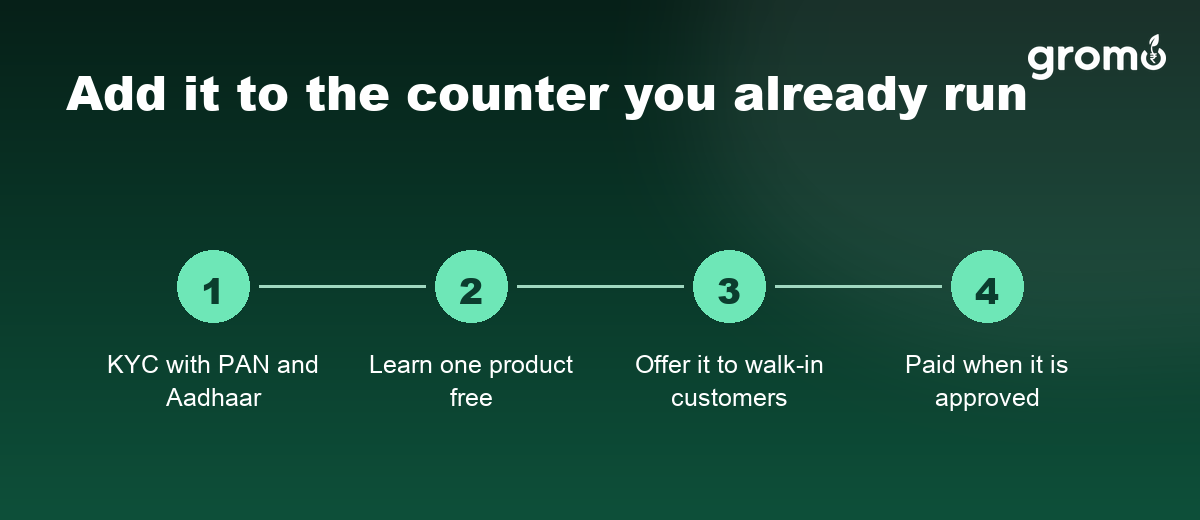
The same counter, one extra question at the end of each visit.
Do not learn ten products in week one. Place one product successfully, understand why it worked, then add the next.
Which Customer to Offer What
The offer works when it answers something the person actually said. Listen to why they came in.
| They came in for | Ask about | Product that fits |
|---|---|---|
| PAN card application | Whether they have a bank account they use | Savings account |
| Aadhaar or address update | Salary or shop income | Credit card |
| Bill payment, every month | Cash gaps before payday | Credit line |
| Pension or scheme paperwork | Where their savings sit | Investment, demat |
| Shop licence or GST work | Working capital and card spending | Business loan, credit card |
| A rejected loan somewhere else | Credit score and history | Secured credit card |
A rejection at one product is not the end of the conversation. Someone declined for a regular credit card is often a good fit for a secured card against a fixed deposit, and a year of clean repayment makes them eligible for the regular one. That's a customer you keep for years, and it's exactly the pattern described in this guide to what a loan agent does.
Rules Every CSC Owner Should Follow
Conduct matters more for you than for an ordinary agent, because your counter carries a public reputation.
Never charge the customer for the application. The bank pays you. Charging a fee on top is the fastest way to lose both the customer and your agent code.
Never handle OTPs, PINs or card details. The customer types their own OTP, always, even when it would be quicker to do it yourself.
Do not mix this with your government service pitch. Finish the CSC work first, then offer the product as a separate, optional thing. Never suggest a bank product is needed to complete a government service.
Check your own agreements. If you work as a banking correspondent or have exclusivity terms in a CSC or BC arrangement, read them before you start, and ask if you are unsure.
Say no when the product does not fit. A customer already struggling with two EMIs does not need a third. Turning that down protects the trust your whole counter runs on.
Keep documents inside the app flow. No customer paperwork on WhatsApp, no photos saved on your phone.
Mistakes CSC Owners Make With Financial Products
- Pitching to everyone who walks in. Rejections cost you nothing in commission and plenty in reputation.
- Promising approval. You cannot approve anything. Say "you look eligible" and never "it will be approved".
- Selling on payout instead of fit. The card with the highest commission is often the hardest to get approved.
- Rushing the customer through the form. A sloppy application is a rejection with extra steps.
- Going quiet after submission. The customer will ask you, not the bank. Be the person who followed up.
- Treating it as a side hobby. Five offers a day is a business. Two a week isn't, and the difference shows up within a month.
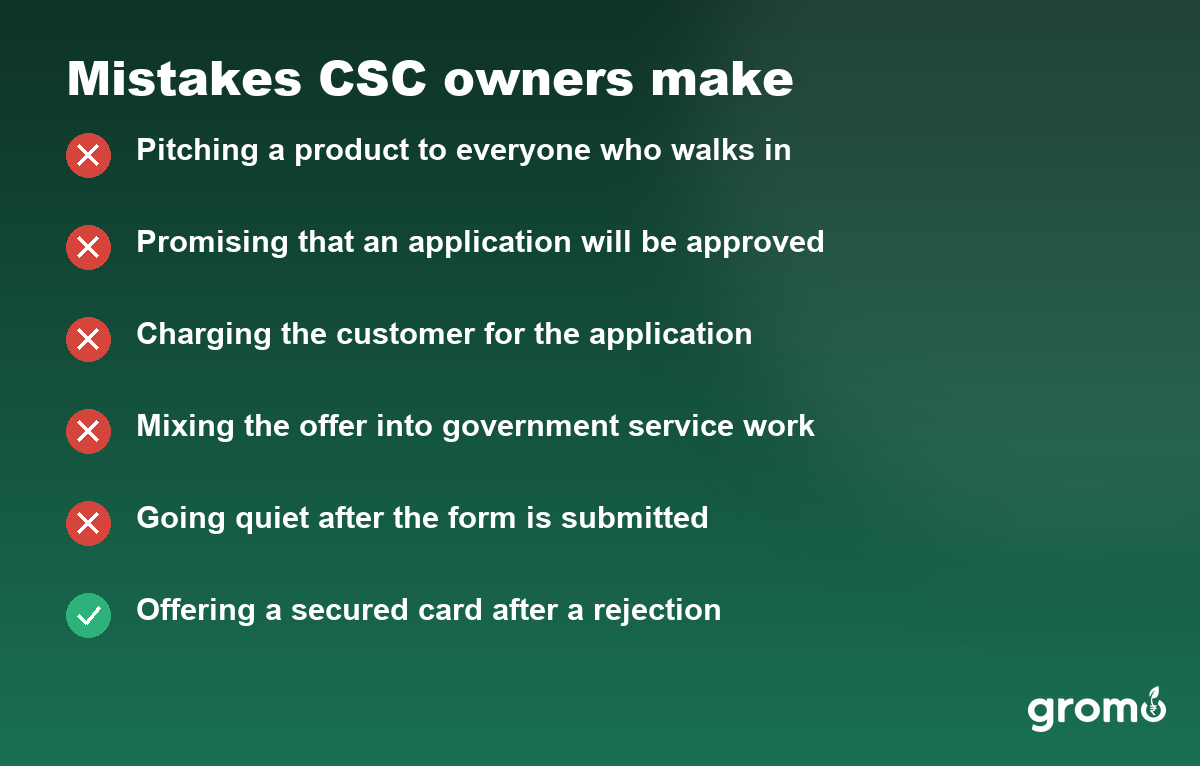
Every one of these is fixable in a week.
Frequently Asked Questions
Can a CSC or Jan Seva Kendra owner join GroMo?
Yes. Anyone above 18 with PAN, Aadhaar and an Indian bank account can join. Running a CSC is not required and not a barrier, and there is no separate approval needed from CSC to use a private app in your own time.
Is GroMo part of CSC or a government scheme?
No. GroMo is a private financial products distribution platform with no connection to CSC e-Governance Services or any government department. It is a separate business you run alongside your centre.
Do I need investment or a licence to start?
No investment and no licence. Onboarding is PAN and Aadhaar KYC. Bank details are needed only when you withdraw your earnings.
How much extra income can a CSC owner make?
Earnings depend entirely on approvals, so nobody can promise a figure. What is fixed is the payout side: one approved application pays up to Rs 2,000 depending on the product, which is why a handful of approvals a month is meaningful money next to per-transaction service fees.
Will this take time away from my government service work?
Not if you keep it to the end of a visit that's already finishing, and the application itself is completed on the customer's own phone.
What if my customer's application gets rejected?
Nothing is deducted and nothing is owed. Look at why it was declined, then offer a product that fits better, such as a secured credit card for someone who doesn't have a credit history yet.
Conclusion
A CSC or Jan Seva Kendra is already a financial services counter. The centre handles identity, documents and money movement for the whole neighbourhood, and it has the one thing every bank struggles to buy, which is trust in a small town.
Adding financial products doesn't change what your centre is. It changes what a visit is worth. The work is the same work you already do well, the setup costs nothing, and the difference shows up on the approvals, not on the footfall. Start with one product, place it for one customer, and let that decide whether the second one is worth learning. The broader partner journey is laid out in this guide to earning from home as a GroMo Partner.

Disclaimer
Nothing here is a guarantee of income. Commissions are set by banks, NBFCs and product partners and revised as campaigns change, so a figure that is accurate today can be different next month. Every commission quoted in this article is a maximum rather than a flat fee, is indicative only, and was read from the app on 12 August 2026 (GroMo product catalogue, retrieved 2026-08-12).
What you actually earn depends on approvals. An application that fails KYC, or a customer a bank declines, pays nothing however well you handled it. Approval, credit limits, interest rates and final terms rest entirely with the bank or NBFC.
GroMo is a private platform and is not affiliated with CSC e-Governance Services India Limited, with any Jan Seva Kendra scheme, or with any government department. Nothing here is financial or legal advice. Read your own CSC, banking correspondent or partner agreements before taking up additional distribution work, and check the live commission in the GroMo app before quoting anything to a customer.


