
15 Finance Business Ideas in India 2026 (Low Investment)
Loan DSA, mutual fund distribution, tax services and more, with the licence each one needs and how to start.

The best finance business ideas in India don't need you to lend your own money: selling financial products with GroMo, working as a loan DSA, mutual fund distribution, insurance agency and tax services. You earn fees or commissions for connecting people to regulated products. Each idea has its own licence rules, so check them first. Learn how selling works in our guide to selling financial products.
Below are 15 finance business ideas with the cost, skills and registration each needs. Commissions are set by banks and regulators and they change, so we quote only figures we can source. Nothing here is a promise of income.
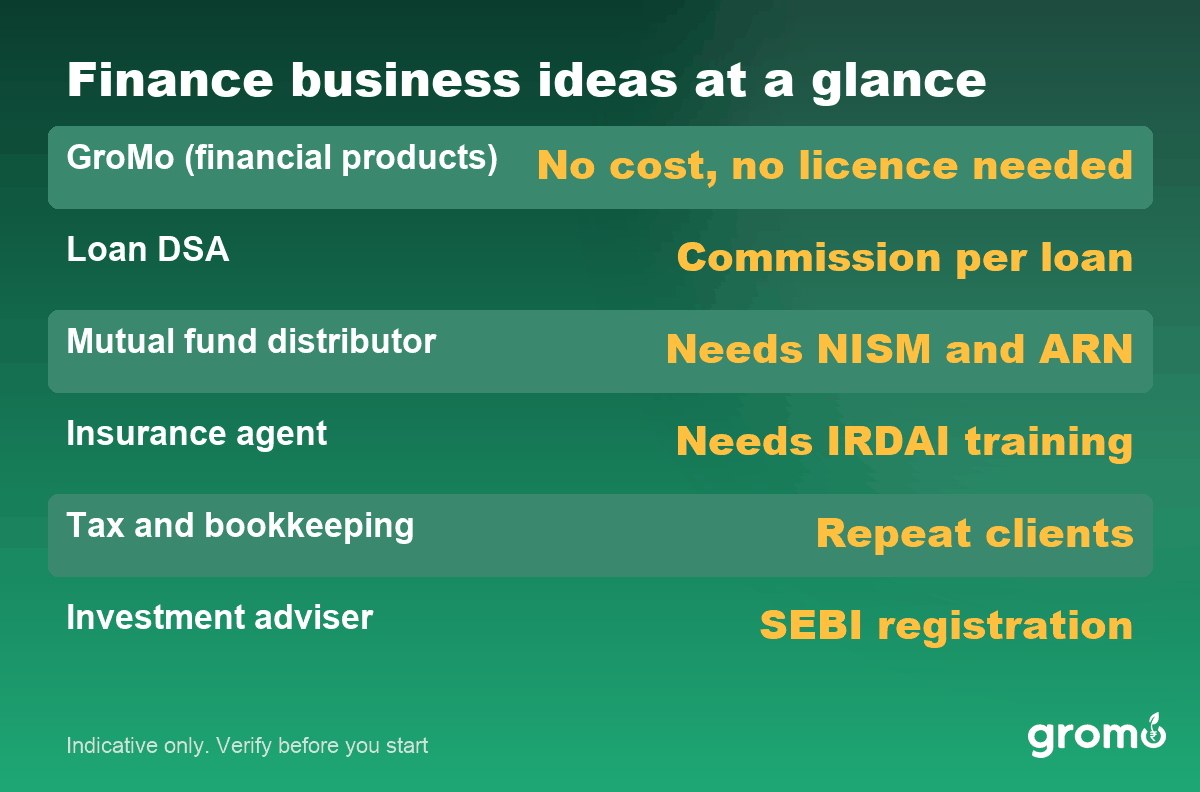
| # | Idea | Starting cost | Skills needed | Best for |
|---|---|---|---|---|
| 1 | Selling Financial Products With GroMo | None | Basic phone use; free training in the app | Anyone 18 or older |
| 2 | Loan DSA (Direct Selling Agent) | Very low | Local network, loan basics | People with many business contacts |
| 3 | Credit Card Agent | None | Basic eligibility knowledge | People with salaried contacts |
| 4 | Mutual Fund Distributor | Low | NISM V-A certificate, AMFI ARN | People good at explaining money |
| 5 | Insurance Agent or POSP | Low | IRDAI-required training | People with a family and business network |
| 6 | Bank Mitra or Business Correspondent | Medium | Trust, basic computer skills | Areas with few bank branches |
| 7 | Income Tax Filing Service | Very low | Tax knowledge | Accountants and commerce graduates |
| 8 | Bookkeeping Service | Very low | Tally, Excel, accounting basics | Commerce graduates |
| 9 | GST Registration and Filing Help | Very low | GST knowledge | Accountants and tax practitioners |
| 10 | Merchant Payments Agent | None | Field sales, local contacts | People who know local markets |
| 11 | Financial Literacy Trainer | Very low | Clear teaching, finance basics | Teachers and finance professionals |
| 12 | Loan Agency From Home | Low | Sales management, loan knowledge | Experienced DSAs |
| 13 | DSA Franchise | Medium | Business management | People with a budget and local reach |
| 14 | Finance Content Creator | Low | Clear explaining, consistency | People who can simplify finance |
| 15 | SEBI Registered Investment Adviser | High | SEBI registration, qualifications | Experienced finance professionals |
Starting-cost labels are our own rough estimates: None, Very low, Low, Medium and High. Actual costs depend on your city and setup.
How this list is ranked: GroMo comes first because it needs no money or separate bank tie-ups. The rest follow the ideas that appear most often in top-ranking Indian guides for this search, from the simplest to those that need certification, qualifications or more capital.
1. Selling Financial Products With GroMo: Bank-paid commissions, no stock
Starting cost: None | Skills: Basic phone use; free training in the app | Best for: Anyone 18 or older
Selling financial products with GroMo tops this list because it costs nothing to start and needs only a smartphone. GroMo is a free app where you help people apply for credit cards, savings accounts, loans and demat accounts from partner banks, and you earn a commission when the application is approved. On GroMo, credit cards pay up to ₹2,000, savings accounts up to ₹1,000, demat accounts up to ₹450, and personal loans up to 4.5% of the loan amount (GroMo catalogue, retrieved 2026-11-06). It's the simplest way into a finance business, because the app holds the bank tie-ups and teaches each product. The pay is commission only, with no fixed salary, and only approved applications earn; you must be 18 or older.
How to start:
- Download the GroMo app and register free with your phone number.
- Finish the one-time verification and the free in-app training.
- Share a product link with someone who genuinely needs it, then track the application in the app.
2. Loan DSA (Direct Selling Agent): Connect borrowers with lenders
Starting cost: Very low | Skills: Local network, loan basics | Best for: People with many business contacts
A loan DSA connects borrowers with banks and NBFCs for a commission, without lending money. Rates are negotiated by product and volume, and one 2026 guide reports 1% to 2.5% on personal loans (MyMudra, retrieved 2026-11-06). See our guide to DSA loan agent registration.
How to start:
- Learn how loan eligibility works.
- Apply to a lender or a DSA platform.
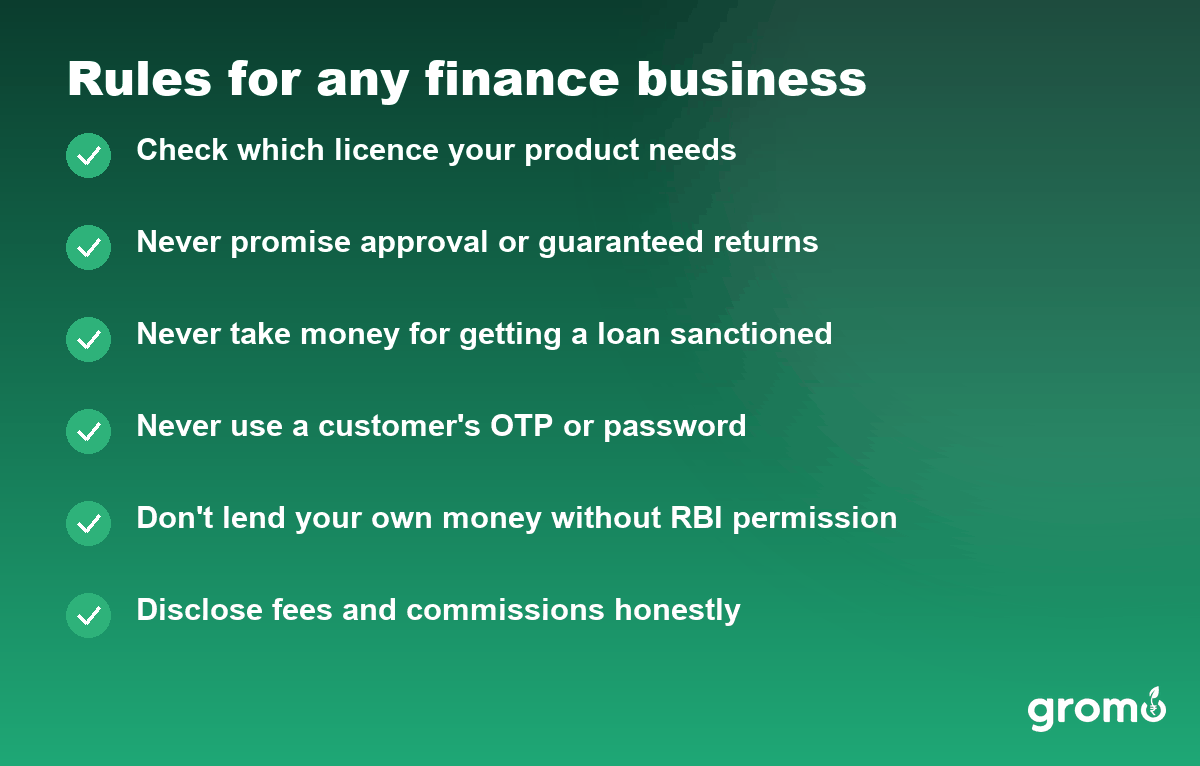
- Never take money from a borrower for approval.
3. Credit Card Agent: Earn per approved card
Starting cost: None | Skills: Basic eligibility knowledge | Best for: People with salaried contacts
Credit card agents help people apply for cards and earn when the bank approves them. Good advice matters here: match the card to the person's income and credit score, and explain the fees honestly.
How to start:
- Learn the main card types.
- Register through a bank partner or app.
- Check eligibility before you share a link.
4. Mutual Fund Distributor: Earn trail commission on investments
Starting cost: Low | Skills: NISM V-A certificate, AMFI ARN | Best for: People good at explaining money
Mutual fund distribution needs the NISM Series V-A exam and an AMFI ARN before you can sell. Income comes as trail commission, which grows only if clients stay invested. Read how to become a mutual fund distributor.
How to start:
- Pass NISM Series V-A.
- Apply for your ARN with AMFI.
- Empanel with fund houses or a platform.
5. Insurance Agent or POSP: Earn on premiums
Starting cost: Low | Skills: IRDAI-required training | Best for: People with a family and business network
Insurance agents and POSPs earn commission on premiums, and one guide reports 10% to 25% on new policies with lower renewal rates (Niva Bupa, retrieved 2026-11-06). Insurance isn't on GroMo's current catalogue, so you would join a licensed insurer or broker.
How to start:
- Choose a licensed insurer or broker.
- Complete the required training and exam.
- Explain exclusions honestly.
6. Bank Mitra or Business Correspondent: Banking in your area
Starting cost: Medium | Skills: Trust, basic computer skills | Best for: Areas with few bank branches
A Bank Mitra runs a small banking point on behalf of a bank. It needs money for equipment and cash handling, and income depends on footfall. Our guide to Bank Mitra and CSP explains the costs and risks.
How to start:
- Check which banks need agents nearby.
- Apply through the bank or its corporate BC.
- Pay only through official channels.
7. Income Tax Filing Service: Busy every filing season
Starting cost: Very low | Skills: Tax knowledge | Best for: Accountants and commerce graduates
Tax filing services help salaried people and small shops file returns. Demand peaks each year near the filing deadline, and you can grow by adding bookkeeping. Only give advice you're qualified to give, and sign only what the law permits.
How to start:
- Learn ITR forms and filing rules well.
- Start with people you know.
- Charge a clear fee per return.
8. Bookkeeping Service: Monthly repeat clients
Starting cost: Very low | Skills: Tally, Excel, accounting basics | Best for: Commerce graduates
Bookkeeping keeps accounts for small businesses that don't need a full-time accountant. Monthly clients make income steadier than most ideas here, and you can run it from home with a laptop.
How to start:
- Refresh your Tally or Excel skills.
- Start with two local shops.
- Agree a fixed monthly fee.
9. GST Registration and Filing Help: Recurring small business need
Starting cost: Very low | Skills: GST knowledge | Best for: Accountants and tax practitioners
GST filing help serves small businesses that must file returns regularly. Recurring filing brings repeat work, but mistakes can cost clients money, so learn the rules well or work with a qualified professional.
How to start:
- Learn the GST filing process.
- Start with small local traders.
- Offer a monthly filing package.
10. Merchant Payments Agent: Onboard shops onto payment apps
Starting cost: None | Skills: Field sales, local contacts | Best for: People who know local markets
Merchant agents sign up shops for QR codes, card machines and business accounts for fintech companies. Pay is often per onboarding, so check how you'd get paid if a shop signs up but doesn't use the service.
How to start:
- Find a known payments company's partner role.
- Learn the product and charges.
- Explain charges clearly to shopkeepers.
11. Financial Literacy Trainer: Teach money basics
Starting cost: Very low | Skills: Clear teaching, finance basics | Best for: Teachers and finance professionals
Financial literacy trainers teach budgeting and safe banking to schools, self-help groups and companies. Teaching general basics is one thing, but personalised investment advice needs SEBI registration, so stay clearly on the education side.
How to start:
- Prepare a simple session on budgeting.
- Offer it to a local school or group.
- Avoid recommending specific investments.
12. Loan Agency From Home: Build a small team of agents
Starting cost: Low | Skills: Sales management, loan knowledge | Best for: Experienced DSAs
A loan agency grows from solo DSA work into a small team that sources loans across products. Compliance gets more important as you grow, so read how to start a loan agency business from home first.
How to start:
- Start as a solo DSA.
- Add one or two trained agents.
- Keep clear records for every case.
13. DSA Franchise: Work under an established brand
Starting cost: Medium | Skills: Business management | Best for: People with a budget and local reach
A DSA franchise gives you a brand and tie-ups for a fee, but some franchise offers are expensive for what you get. Compare the fee with free options first, and ask existing franchisees what they really earn.
How to start:
- Compare fees with free partner apps.
- Ask for lender tie-ups in writing.
- Speak to existing franchisees.
14. Finance Content Creator: Teach money online
Starting cost: Low | Skills: Clear explaining, consistency | Best for: People who can simplify finance
Finance creators earn from ads and sponsors by explaining money topics. SEBI rules restrict unregistered people from giving investment advice or tying up with regulated entities in certain ways, so stick to education and disclose all sponsors.
How to start:
- Pick one money topic you know well.
- Post simple explainers weekly.
- Avoid specific buy or sell calls.
15. SEBI Registered Investment Adviser: Fee-based advice
Starting cost: High | Skills: SEBI registration, qualifications | Best for: Experienced finance professionals
A SEBI registered investment adviser charges clients a fee for personal investment advice. It has qualification, certification and compliance requirements, so it suits experienced professionals rather than beginners. Check current rules on SEBI's website.
How to start:
- Read SEBI's current adviser rules.
- Complete the required qualifications.
- Apply for registration.
How Much Does GroMo Pay for Each Product?
| Product on GroMo | Pays partners up to |
|---|---|
| SBI Credit Card | ₹2,000 per approved card |
| HDFC Secured Credit Card | ₹1,750 per approved card |
| Axis Saving Account | ₹1,000 per account |
| Digi Credit Personal Loan | 4.5% of the loan amount |
| Kotak 811 Super Account | ₹600 per account |
| Kotak Securities Demat Account | ₹450 per account |
The SBI Credit Card pays partners up to ₹2,000 per approved card (GroMo catalogue, retrieved 2026-11-06). Commission is paid only on approval.
The Axis Saving Account pays up to ₹1,000 per successful account (GroMo catalogue, retrieved 2026-11-06). Many other products pay less.
The Digi Credit Personal Loan pays up to 4.5% of the loan amount, and most other lenders pay less (GroMo catalogue, retrieved 2026-11-06). Check the live payout in the app.
Which finance business is best for beginners?
Selling financial products on commission is the best finance business for beginners because it needs no money, certificate or separate bank tie-up. Credit card and loan referrals teach you how lending works. Once you have experience, you can add mutual fund distribution or build a small loan agency. Rural readers can compare this with our village business ideas.
Can you start a finance company with no money?
You can't start a lending company with no money, but you can start a finance business with almost none. Lending in your own name needs RBI registration as an NBFC and substantial capital. Distribution businesses, where you connect people to regulated lenders, don't need this. Lending without RBI permission is illegal, so don't do it, even informally for profit.
What licences does a finance business need?
A finance business needs a licence that depends on what you sell. Mutual funds need NISM Series V-A and an AMFI ARN. Insurance needs IRDAI-required training through a licensed company. Personal investment advice needs SEBI registration. Lending needs RBI registration, and tax work has its own rules. Always check the regulator's website, because requirements change.
What should a finance business never do?
A finance business must never promise loan approval, guaranteed returns, or take money from customers to get a loan sanctioned. Never fill a form using someone's OTP. Those shortcuts are how customers get hurt, and they can end your business. Explain the costs honestly and let the customer decide. If you're weighing a paid setup, read our guide to the loan DSA franchise first.

GroMo is a free app where partners help customers apply for credit cards, loans, savings accounts and demat accounts from partner banks, and earn a commission on approval.
FAQ: Finance Business Ideas
What is the best finance business to start?
For beginners, selling financial products with GroMo or working as a loan DSA is simplest. With certification, mutual fund distribution can build longer-term trail income.
Which finance business has the lowest investment?
Selling financial products on commission, credit card referrals and tax filing help need very little money. Your main cost is your time.
Do I need a licence to sell financial products on GroMo?
You don't need a separate licence to start referring products in the GroMo app. Mutual funds and insurance sold independently have their own rules.
Can I lend money as a business in India?
Lending as a business needs proper registration, such as an NBFC licence from RBI or state money-lending rules. Don't lend for profit without checking the law.
Is mutual fund distribution a good business?
Yes, it can be a good long-term business because trail commission continues while clients stay invested, but income builds slowly. You need NISM Series V-A and an AMFI ARN.
How much can I earn from a finance business?
That depends on your product, network and effort. Commissions vary by lender and product, so treat any fixed income claim with caution.
GroMo (Vitrak Technologies Pvt Ltd) is a distribution platform. GroMo isn't a bank, NBFC, insurer or investment adviser. All products are offered by their respective RBI, IRDAI or SEBI-regulated providers.
Partner earnings depend on effort, product mix and customer eligibility. Any figures shown are illustrative. They aren't typical and aren't promised.
Sources: Top-ranking guides checked: Kanakkupillai, Business Outreach, Aditya Birla Udyog Plus, MyMudra and Niva Bupa, retrieved 2026-11-06. Regulator rules: RBI, SEBI, IRDAI and AMFI. GroMo product catalogue, commission rates by product, retrieved 2026-11-06.
Disclaimer
GroMo doesn't promise any level of income. Commissions are set by partner banks, vary by product and campaign, and are paid only on approved applications; check the live commission in the GroMo app. Starting-cost labels are our own rough estimates, and any pay figures from other sites or job listings are what those sources state, not a guarantee. GroMo is available only to users aged 18 and above. Everything above is general information, not financial, legal or career advice.


