
15 Village Business Ideas in India 2026 (Low Investment)
Low investment rural businesses, what each needs, how to start, and the schemes and licences to check first.

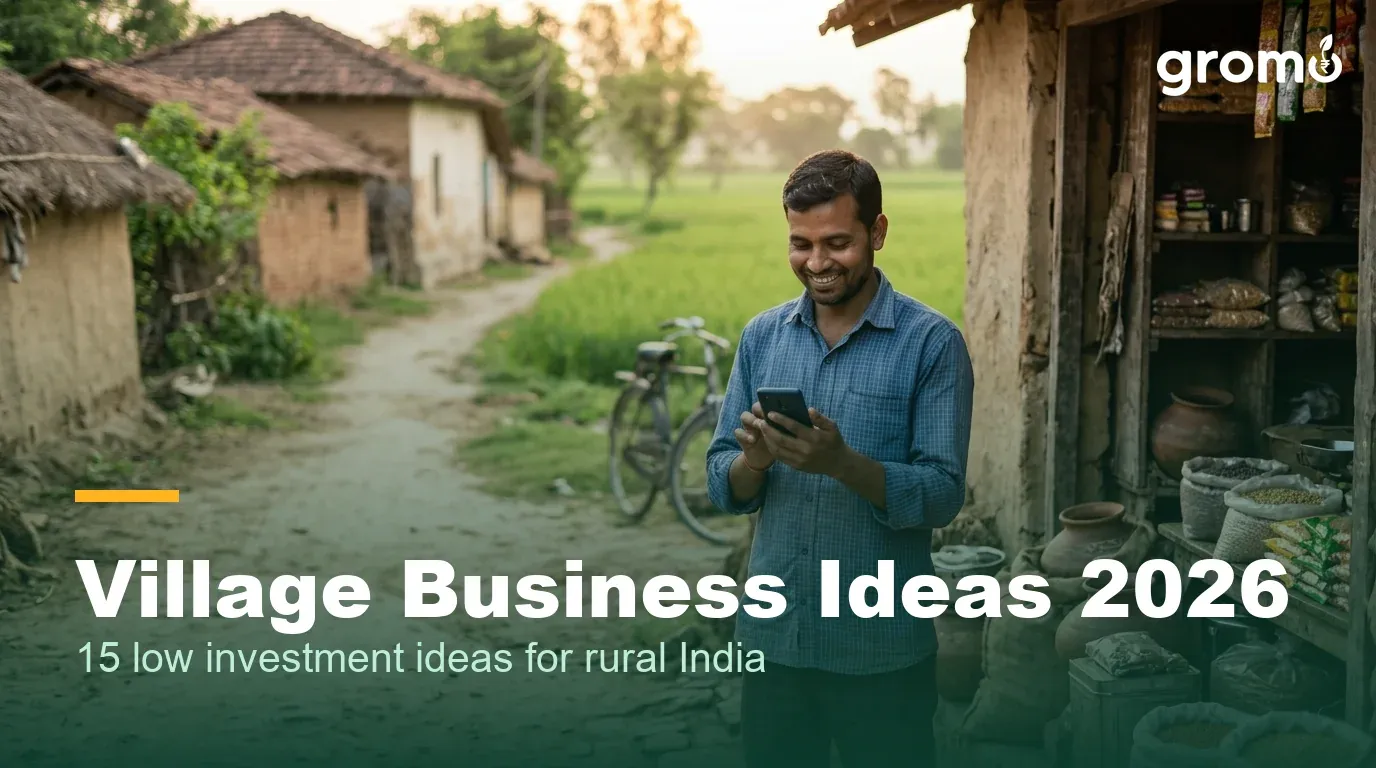
The best village business ideas in India meet everyday local needs at low cost: selling financial products with GroMo, a kirana store, mobile repair, a small dairy, tailoring and digital services. Villages have steady demand and little competition for many of these. Choose one that fits your land, skills and budget, and talk to local buyers first. City-focused options are in our list of small business ideas.
Below are 15 rural business ideas with what each costs, the skills it needs and the steps to start. Earnings depend on your village, effort and customers, so we make no income promises. Where an idea needs a licence, or carries a real risk, we say so.
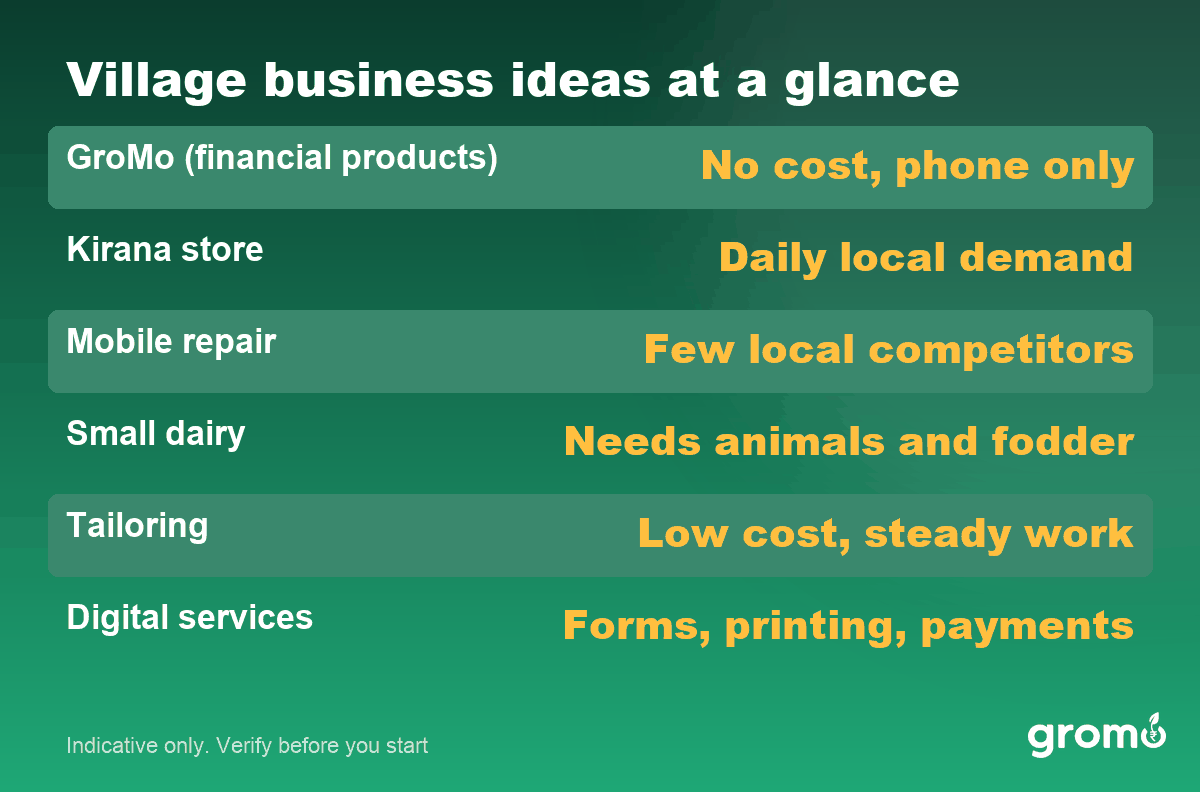
| # | Idea | Starting cost | Skills needed | Best for |
|---|---|---|---|---|
| 1 | Selling Financial Products With GroMo | None | Basic phone use; free training in the app | Anyone 18 or older |
| 2 | Kirana and General Store | Medium | Basic accounts, supplier contacts | Busy village roads and junctions |
| 3 | Mobile Repair and Accessories | Low | Repair training | Young people with technical interest |
| 4 | Small Dairy Unit | High | Animal care | Families with space and fodder |
| 5 | Goat Farming | Medium | Animal care | Families with open land |
| 6 | Poultry Farming | Medium | Bird care, hygiene | People near local markets |
| 7 | Organic Vegetable Farming | Medium | Farming knowledge, land | Families with some land |
| 8 | Tailoring and Stitching | Low | Stitching | Women and men with sewing skills |
| 9 | Digital Services Centre | Medium | Computer basics | Young people with computer skills |
| 10 | Tea and Snack Shop | Low | Cooking, cleanliness | Bus stops, markets and schools |
| 11 | Bank Mitra or CSP Outlet | Medium | Trust, basic computer skills | Trusted local people |
| 12 | Agarbatti and Candle Making | Low | Simple training | Families and self-help groups |
| 13 | Flour Mill | Medium | Machine operation, maintenance | Villages without a nearby mill |
| 14 | Seed and Fertiliser Shop | Medium | Crop knowledge, licence | People with farming contacts |
| 15 | Solar Sales and Installation | Medium | Technical training or an installer partner | People with electrical knowledge |
Starting-cost labels are our own rough estimates: None, Very low, Low, Medium and High. Actual costs depend on your city and setup.
How this list is ranked: GroMo comes first because it needs no money, shop or stock, only a phone. The rest follow the ideas that appear most often in the top-ranking Indian guides for this search, from the lowest cost to those that need land or animals.
1. Selling Financial Products With GroMo: Bank-paid commissions, no stock
Starting cost: None | Skills: Basic phone use; free training in the app | Best for: Anyone 18 or older
Selling financial products with GroMo tops this list because it costs nothing to start and needs only a smartphone. GroMo is a free app where you help people apply for credit cards, savings accounts, loans and demat accounts from partner banks, and you earn a commission when the application is approved. On GroMo, credit cards pay up to ₹2,000, savings accounts up to ₹1,000, demat accounts up to ₹450, and personal loans up to 4.5% of the loan amount (GroMo catalogue, retrieved 2026-11-06). Many village families still need a first savings account, a credit card or help with a loan, and people often prefer to ask someone they already know. The pay is commission only, with no fixed salary, and only approved applications earn; you must be 18 or older.
How to start:
- Download the GroMo app and register free with your phone number.
- Finish the one-time verification and the free in-app training.
- Share a product link with someone who genuinely needs it, then track the application in the app.
2. Kirana and General Store: Every village needs one
Starting cost: Medium | Skills: Basic accounts, supplier contacts | Best for: Busy village roads and junctions
A kirana store is listed as one of the most practical rural businesses because every village needs groceries, snacks and household items. Selling mobile accessories and recharge from the same counter can bring more customers through the door.
How to start:
- Check what nearby shops don't stock.
- Start with fast-moving items only.
- Limit credit to people you know well.
3. Mobile Repair and Accessories: Demand outpaces supply
Starting cost: Low | Skills: Repair training | Best for: Young people with technical interest
Mobile repair is popular in village guides because smartphone use keeps rising while repair shops stay few. A short training course and a basic tool kit are usually enough, and covers, chargers and earphones add steady side sales.
How to start:
- Complete a short repair course.
- Buy a basic tool kit.
- Start from home or a small shared counter.
4. Small Dairy Unit: Daily income from milk
Starting cost: High | Skills: Animal care | Best for: Families with space and fodder
A small dairy of 3 to 5 cows or buffaloes can bring daily income by supplying milk to a cooperative or private dairy (Shriram Finance guide, retrieved 2026-11-06). Animals cost a lot and can fall sick, so start small and speak to a vet and your local cooperative first.
How to start:
- Check buying rates at your nearest cooperative.
- Start with one or two animals.
- Budget for fodder, vet care and insurance.
5. Goat Farming: Lower upkeep than cattle
Starting cost: Medium | Skills: Animal care | Best for: Families with open land
Goat farming suits villages because goats need less upkeep than cattle and can feed on local vegetation. Prices rise around festivals, but disease can hurt a small herd quickly, so learn the basics from your local veterinary office.
How to start:
- Visit a working goat farm first.
- Start with a small herd.
- Arrange vaccination through a local vet.
6. Poultry Farming: Eggs and chicken for local demand
Starting cost: Medium | Skills: Bird care, hygiene | Best for: People near local markets
Poultry farming meets growing demand for chicken and eggs. A small backyard unit is the safest way to learn, because bird disease and feed prices are the main risks, and you should check any local rules before you expand.
How to start:
- Start with a small backyard flock.
- Find buyers in the local market first.
- Keep the shed clean and arrange vaccination.
7. Organic Vegetable Farming: Sell to nearby towns
Starting cost: Medium | Skills: Farming knowledge, land | Best for: Families with some land
Organic vegetable farming ranks high in several rural guides, but it depends on land, water and access to buyers. Selling directly to nearby towns or housing societies usually earns more than selling through a middleman.
How to start:
- Test a small plot first.
- Line up buyers in a nearby town.
- Learn about organic certification if you plan to use the label.
8. Tailoring and Stitching: Steady wedding and festival demand
Starting cost: Low | Skills: Stitching | Best for: Women and men with sewing skills
Tailoring is rated as a low-investment village business with steady, seasonal demand. School uniforms, blouses and alterations bring regular work, and a single sewing machine is enough to begin.
How to start:
- Start with alterations and blouses.
- Offer uniform stitching to local schools.
- Add a second machine when orders grow.
9. Digital Services Centre: Forms, printing and online work
Starting cost: Medium | Skills: Computer basics | Best for: Young people with computer skills
A digital services centre helps villagers with online forms, printing, photocopies and payments. An official CSC ID can add government services, and our guide to CSC extra income shows how counter owners add more income.
How to start:
- Check the demand and nearby centres.
- Set up a computer, printer and internet.
- Apply for a CSC ID through the official portal.
10. Tea and Snack Shop: Low cost, daily customers
Starting cost: Low | Skills: Cooking, cleanliness | Best for: Bus stops, markets and schools
A tea and snack shop needs little money and sells every day if the location is right. Food businesses need FSSAI registration, which starts at about ₹100 a year (IncorpX, retrieved 2026-11-06), and clean service brings customers back.
How to start:
- Choose a busy spot.
- Get FSSAI registration.
- Start with tea and two or three snacks.
11. Bank Mitra or CSP Outlet: Banking in your village
Starting cost: Medium | Skills: Trust, basic computer skills | Best for: Trusted local people
A Bank Mitra runs a small banking point where people can deposit and withdraw cash. It needs some money upfront and cash handling, so read our guide to Bank Mitra and CSP and apply only through a bank or an authorised partner.
How to start:
- Check whether your area has a banking point.
- Apply through a bank or its authorised partner.
- Never pay anyone outside official channels.
12. Agarbatti and Candle Making: Small home production
Starting cost: Low | Skills: Simple training | Best for: Families and self-help groups
Agarbatti and candle making can run from home with simple equipment, and it suits self-help groups. Making them is easy; selling is harder, so tie up with local shops and temples before producing in large numbers.
How to start:
- Learn the process from a local trainer.
- Make one small batch.
- Sell to nearby shops and temples first.
13. Flour Mill: Local daily need
Starting cost: Medium | Skills: Machine operation, maintenance | Best for: Villages without a nearby mill
A small flour mill serves families who prefer freshly ground atta and spices. Check the power supply and how far people now travel to get flour ground, since these two things decide whether it will work.
How to start:
- Count how far people travel for grinding now.
- Check the electricity supply and machine cost.
- Start with grinding, then sell packed atta.
14. Seed and Fertiliser Shop: Serve local farmers
Starting cost: Medium | Skills: Crop knowledge, licence | Best for: People with farming contacts
A seed and fertiliser shop serves steady farming demand, but it needs a licence from your state's agriculture department and carries seasonal stock risk. Advice that genuinely helps farmers is what makes them return.
How to start:
- Ask the agriculture office which licence you need.
- Start with products for local crops.
- Avoid selling large amounts on credit.
15. Solar Sales and Installation: Growing rural demand
Starting cost: Medium | Skills: Technical training or an installer partner | Best for: People with electrical knowledge
Solar services are appearing in more village business guides as interest in solar pumps and rooftop panels grows. Technical training matters here, and you can begin as a sales partner to an established installer before you do the work yourself.
How to start:
- Learn about local solar demand and subsidies.
- Partner with an established installer.
- Check scheme details on official sites only.
How Much Does GroMo Pay for Each Product?
| Product on GroMo | Pays partners up to |
|---|---|
| SBI Credit Card | ₹2,000 per approved card |
| HDFC Secured Credit Card | ₹1,750 per approved card |
| Axis Saving Account | ₹1,000 per account |
| Digi Credit Personal Loan | 4.5% of the loan amount |
| Kotak 811 Super Account | ₹600 per account |
| Kotak Securities Demat Account | ₹450 per account |
The SBI Credit Card pays partners up to ₹2,000 per approved card (GroMo catalogue, retrieved 2026-11-06). Commission is paid only on approval.
The Axis Saving Account pays up to ₹1,000 per successful account (GroMo catalogue, retrieved 2026-11-06). Many other products pay less.
The Digi Credit Personal Loan pays up to 4.5% of the loan amount, and most other lenders pay less (GroMo catalogue, retrieved 2026-11-06). Check the live payout in the app.
Which business is most profitable in a village?
No single village business is most profitable everywhere, because it depends on local demand, land and competition. Service businesses such as selling financial products or mobile repair keep costs low, while dairy and poultry can earn more but carry bigger risks. Compare your options with our low investment high profit business ideas.
Which business can you start in a village with no money?
Selling financial products on commission is one of the few village businesses you can start with almost no money, because a phone is all you need. Other low-cost options are tailoring alterations and home tuition.
Which government schemes can help a village business?
Village business guides commonly mention PMEGP, PM Vishwakarma and MUDRA loans for financing (Poonawalla Fincorp and Shriram Finance guides, retrieved 2026-11-06). Rules, limits and eligibility change, so check the official website or your bank before you apply. Never pay an agent a fee to get a government loan.
How do you test a village business idea?
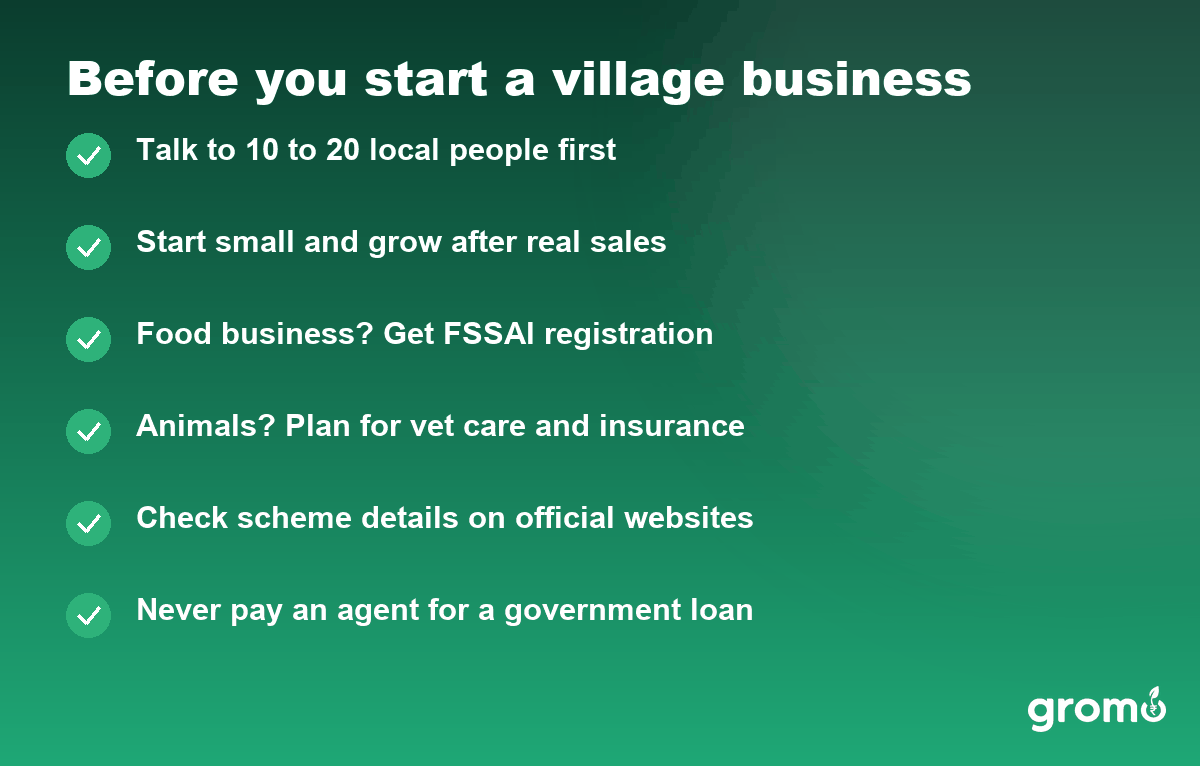
Test a village business by talking to 10 to 20 local people before you spend money. Ask what they buy, where they buy it and what they wish was closer. Start with the smallest version you can, and spend more only once people are paying. Thinking about loans later? Read how to start a loan agency business from home.

GroMo is a free app where partners help customers apply for credit cards, loans, savings accounts and demat accounts from partner banks, and earn a commission on approval.
FAQ: Village Business Ideas
What is the best village business idea?
There is no single best idea. Selling financial products with GroMo needs no money, while kirana stores, mobile repair and tailoring suit most villages and bring steady local demand.
Which small business is good for a village with low investment?
Mobile repair, tailoring, a tea shop and agarbatti making need relatively little money. Test local demand first, even for low-cost ideas.
Can I use GroMo in a village?
Yes, if you're 18 or older and have a smartphone with internet. Customers apply on their own phones, and you earn when an application is approved.
Is dairy farming profitable in a village?
That can happen, but animal costs, fodder, disease and milk prices all affect profit. Start with one or two animals and check rates with your local cooperative.
Do I need a licence for a village business?
That depends on the business. Food businesses need FSSAI registration, seed and fertiliser shops need a state licence, and some trades need local permissions.
Can I get a government loan for a village business?
Schemes such as PMEGP and MUDRA exist, but eligibility varies. Apply through your bank or the official website, not through an agent who charges a fee.
GroMo (Vitrak Technologies Pvt Ltd) is a distribution platform. GroMo isn't a bank, NBFC, insurer or investment adviser. All products are offered by their respective RBI, IRDAI or SEBI-regulated providers.
Partner earnings depend on effort, product mix and customer eligibility. Any figures shown are illustrative. They aren't typical and aren't promised.
Sources: Top-ranking guides checked: Shriram Finance, Poonawalla Fincorp, L&T Finance, Flexiloans, Kanakkupillai, Godrej Capital and Tata Capital, retrieved 2026-11-06. GroMo product catalogue, commission rates by product, retrieved 2026-11-06.
Disclaimer
GroMo doesn't promise any level of income. Commissions are set by partner banks, vary by product and campaign, and are paid only on approved applications; check the live commission in the GroMo app. Starting-cost labels are our own rough estimates, and any pay figures from other sites or job listings are what those sources state, not a guarantee. GroMo is available only to users aged 18 and above. Everything above is general information, not financial, legal or career advice.


