
Top Zero Investment Side Income Ideas 2026 Earn Online

The best side income ideas in 2026 share three traits: zero upfront investment, flexible hours, and actual earning potential. Financial product distribution via GroMo sits at the top of this list partners earn anywhere from ₹300 to ₹5,000 daily by sharing links for credit cards, loans, demat accounts, and savings accounts within their networks. No inventory. No office. No boss.
Traditional side hustles like freelancing or food delivery require specialized skills or a vehicle. Modern commission-based distribution bypasses these hurdles while paying more per transaction than most gig economy apps.
Financial Product Distribution: The Zero-Capital Side Hustle
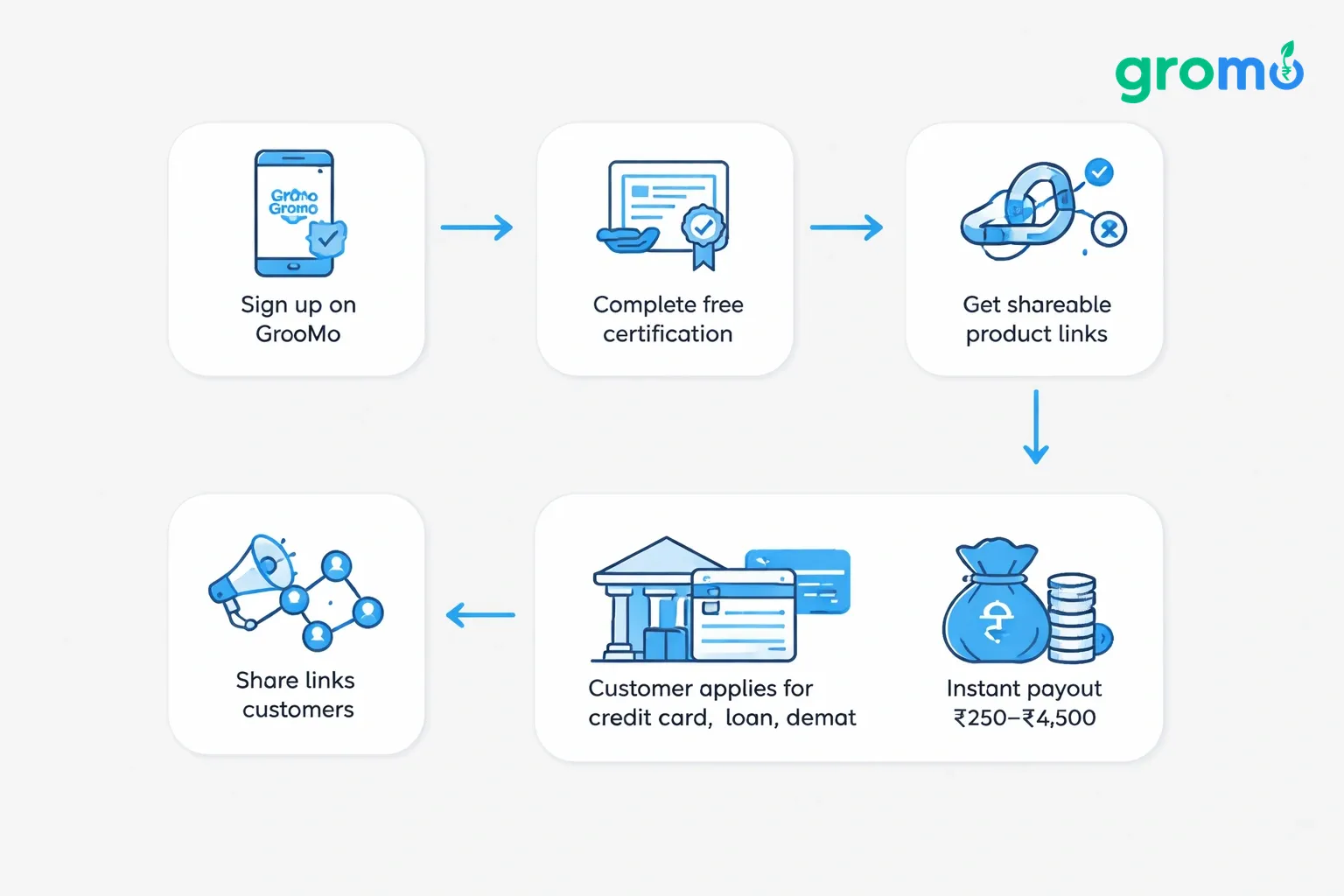
Financial product distribution turns your smartphone into a commission engine. You sign up on platforms like GroMo, complete a free certification, and get shareable links for over 50 financial products from banks like HDFC, Axis, IDFC FIRST, and Kotak. When an application is approved whether for a credit card, personal loan, or demat account you get an instant payout ranging from ₹250 for basic products to ₹4,500 for premium ones.
The business model requires zero capital because you are connecting customers to banks, not lending money yourself. Partner platforms handle the KYC verification, customer service, compliance, and payment processing. Your job is purely customer acquisition through your social network, community groups, or digital marketing channels.
Over 60 lakh Indians currently earn through GroMo's financial distribution platform, collectively generating ₹100 crore in payouts. An active partner averages ₹15,000 to ₹50,000 monthly by dedicating 2-3 hours a day to sharing product links and following up with leads.
Product categories include credit cards (₹600-₹2,400 per approval), personal loans (0.5%-2.5% of the disbursed amount), savings accounts (₹150-₹500), demat accounts (₹250-₹2,250), business loans (1.5%-2.5%), and credit lines (₹200-₹800). Premium products like SBI Credit Cards pay a flat ₹2,000 per approval. Secured cards like SBM Novio offer ₹1,500 with near-guaranteed approval for customers with thin credit files.
Income grows in two ways: increasing your personal deal flow by expanding your network, and building a referral team where you earn override commissions on recruits' sales. Top performers who use both strategies cross ₹1 lakh monthly within 6-12 months.
Content Creation & Digital Marketing Services
Content creation covers writing, video production, graphic design, and social media management for businesses that don't have in-house teams. Freelance content writers charge ₹500 to ₹5,000 per article depending on length, research, and technical complexity. Video editors make ₹1,000 to ₹10,000 per project for YouTube content, reels, or corporate videos.
Social media managers usually charge ₹8,000 to ₹30,000 monthly retainers to handle content calendars, engagement, and analytics for 1-3 platforms. Graphic designers price logo work at ₹2,000 to ₹20,000, while social media graphics run ₹200 to ₹1,000 per design. The pricing spread reflects experience, turnaround time, and how many revisions the client wants.
To start, you need a portfolio. New creators build these through discounted work for local businesses, pro-bono projects for nonprofits, or spec work that shows their approach. Platforms like Upwork, Fiverr, Contra, and LinkedIn connect freelancers with clients, but they take a 10%-20% cut.
The main challenge is the irregular income during the first 6-12 months while you build relationships. Successful freelancers handle this by keeping 3-5 concurrent clients, setting clear scope boundaries to avoid unpaid revision loops, and requesting 50% payment upfront.
Scaling happens by raising rates as your portfolio gets stronger, specializing in high-value niches (SaaS marketing, fintech content, B2B design), or moving top clients to retainer agreements. Freelancers earning ₹50,000+ monthly typically have 2-3 retainer clients plus 3-5 project-based gigs.
Online Tutoring & Skill Training
Online tutoring connects subject matter experts with students via video platforms. Academic tutors teaching CBSE, ICSE, or competitive exam subjects (JEE, NEET, UPSC) charge ₹300 to ₹1,500 per hour based on credentials and track record. Language instructors for English, Spanish, or Mandarin earn ₹500 to ₹2,000 hourly, especially with certifications (TEFL, CELTA, HSK).
Professional skill training covers software tools (Excel, Tally, AutoCAD), programming languages (Python, JavaScript), or business skills (digital marketing, data analytics). Corporate trainers get ₹2,000 to ₹10,000 per session for company workshops. Individual coaching for professional certifications averages ₹800 to ₹3,000 per hour.
To start, define your expertise, create a curriculum, and choose your distribution. Direct channels mean running your own course website or live classes via Zoom/Google Meet, keeping 100% of revenue. Marketplace platforms like Unacademy, Vedantu, Udemy, or Coursera provide student traffic but take a 30%-50% revenue share.
Building a student base requires consistent marketing through free content YouTube tutorials, blog posts, or webinars that show your teaching quality. Successful tutors convert 2%-5% of free viewers into paying students. Retention comes down to results; tutors who show measurable score improvements keep 60%-80% of students.
Income scales by increasing hourly rates as testimonials build up, creating recorded courses that sell while you sleep, or hiring junior tutors to handle overflow. Established tutors with 50+ active students earn ₹60,000 to ₹2,00,000 monthly.
E-commerce & Dropshipping Operations
E-commerce is selling physical products through your own store or marketplaces like Amazon, Flipkart, or Meesho. Traditional inventory models need ₹50,000 to ₹5,00,000 upfront for stock, storage, and logistics. Dropshipping kills the inventory cost you list supplier products, forward orders to them, and they ship directly. Your margin is the difference between your price and the supplier cost.
Product selection makes or breaks the store. High-performing categories include phone accessories (cases, chargers, cables), home organization tools, fitness equipment, beauty products, and pet supplies. Good products solve specific problems, carry 40%-60% profit margins, weigh under 500 grams (cheaper shipping), and aren't in every local retail store.
Store setup costs ₹5,000 to ₹30,000 for domain registration (₹500-₹1,500/year), Shopify/WooCommerce subscription (₹1,500-₹3,000/month), product photography, and logo design. Marketing costs extra ₹10,000 to ₹50,000 monthly for Facebook/Instagram ads testing different product-audience combinations. Successful stores hit 2-3x return on ad spend after 2-3 months of tweaking.
The biggest challenge is thin margins after advertising, payment gateway fees (2%-3%), return rates (5%-15%), and customer acquisition. Most dropshipping stores fail within 6 months because they run out of testing budget or pick oversaturated categories.
Sustainable e-commerce businesses eventually move from dropshipping to branded inventory, improving margins and customer experience. Stores doing ₹5,00,000+ monthly revenue usually carry 200-500 SKUs, spend ₹1,00,000-₹3,00,000 on ads, and net ₹50,000-₹1,50,000 monthly profit. It demands 4-6 hours daily for orders, customer questions, supplier coordination, and campaigns.
App-Based Delivery & Transportation Services
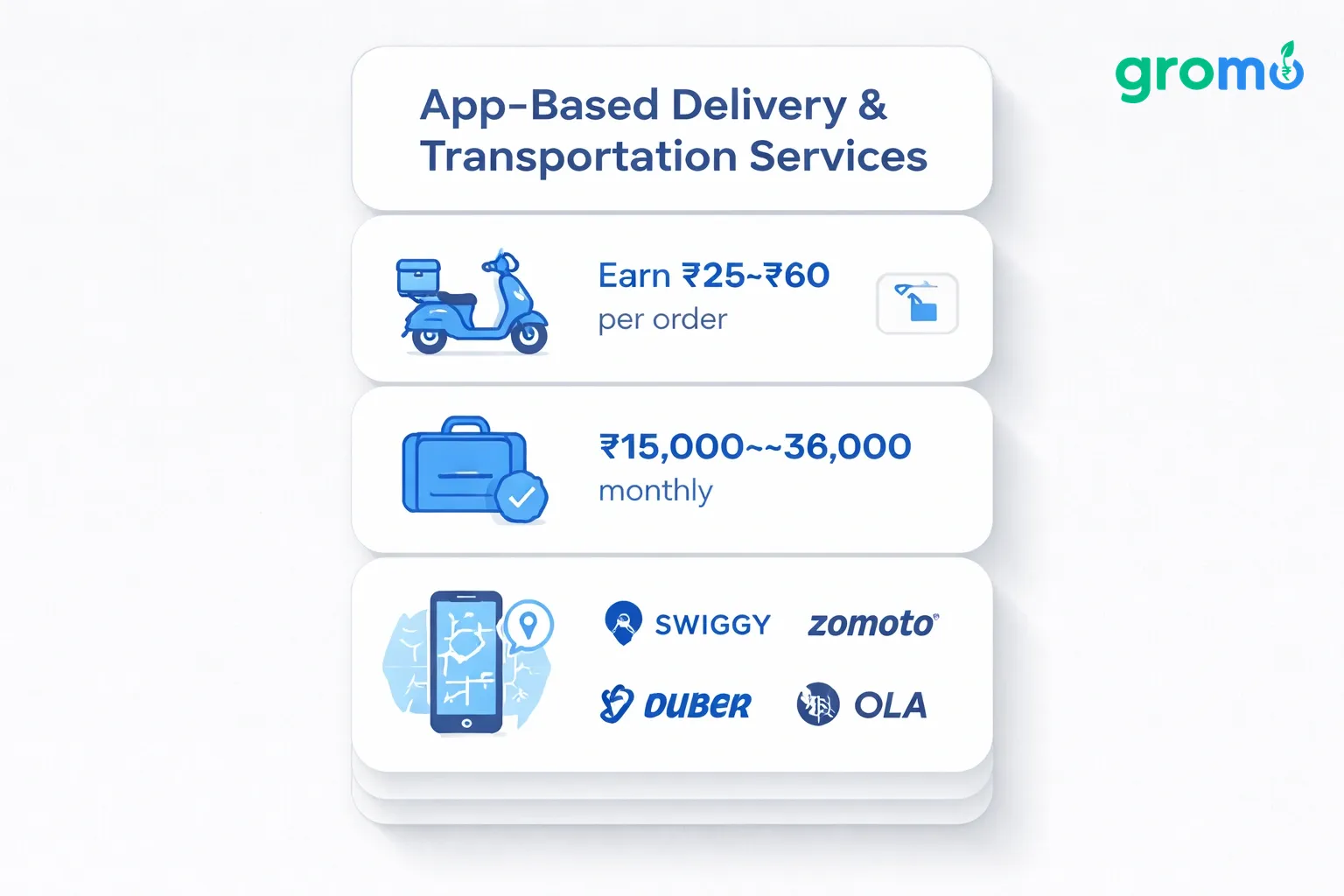
Delivery and transportation platforms like Swiggy, Zomato, Dunzo, Uber, and Ola connect service providers with customers who need food delivery, package courier, or rides. Delivery partners earn ₹25 to ₹60 per order depending on distance, weather, and surge pricing. Full-time partners completing 8-10 orders daily make ₹15,000 to ₹30,000 monthly.
Requirements are a smartphone, a two-wheeler with valid registration, a driver's license, and navigation skills. Most platforms give insulated delivery bags and branded t-shirts. Partners pay for their own fuel (₹3,000-₹6,000 monthly), vehicle maintenance (₹1,000-₹3,000 monthly), and data (₹300-₹500 monthly). Net earnings after expenses usually run ₹12,000 to ₹25,000 for full-time work.
Ride-sharing needs a four-wheeler, commercial insurance, and platform verification. Uber and Ola drivers earn ₹400 to ₹1,200 daily based on hours and city. Platform commissions take 20%-30% of the fare. After fuel (₹4,000-₹8,000 monthly) and maintenance (₹2,000-₹5,000 monthly), full-time drivers net ₹20,000 to ₹45,000 monthly.
The model offers schedule flexibility work when you want which is ideal for students or those supplementing a primary job. However, earnings are directly tied to hours worked. Unlike commission-based financial product distribution, you cannot earn while sleeping.
The physical toll is real: 6-8 hours daily riding in traffic and weather, accident risks, and difficult customers. Gig platforms provide almost no worker protections no health insurance, paid leave, or job security. Successful partners treat this as temporary income while building long-term skills.
Freelance Consulting Services
Freelance consulting means advising businesses in domains where you have deep expertise. Common niches include digital marketing strategy, HR recruitment and training, financial planning and taxation, legal compliance, supply chain optimization, and technology implementation. Consultants bill ₹1,500 to ₹10,000 per hour based on expertise and client size.
You generally need 5+ years of domain experience from corporate or agency roles to start. Initial clients usually come from your professional network former colleagues, industry contacts, LinkedIn connections. Landing the first projects often means offering diagnostic audits (1-2 hour assessments) at discounted rates to prove value.
Service delivery varies: hourly billing for ad-hoc advice, monthly retainers (₹25,000-₹2,00,000) for ongoing advisory, or project-based pricing for defined outcomes like implementing a CRM or running recruitment drives. Retainers provide stability; project work offers higher per-engagement revenue.
Building a sustainable practice means keeping your knowledge updated, developing proprietary frameworks that differentiate you, and creating case studies with quantified results. Consultants who say "I helped X company reduce acquisition costs by 35%" charge 2-3x higher rates than generalists claiming broad expertise.
Income scales by specializing in high-value problems (regulatory compliance, enterprise sales), raising rates as case studies accumulate, creating digital products (courses, templates) for passive income, or building a boutique firm with 2-5 partners. Established consultants earn ₹1,00,000 to ₹5,00,000 monthly.
Affiliate Marketing & Performance Partnerships
Affiliate marketing promotes third-party products through unique tracking links. When someone buys via your link, you earn commission typically 5%-30% for physical goods, 20%-50% for digital products, or flat fees for leads. Amazon Associates pays 1%-10% depending on category; software affiliates like hosting providers or SaaS tools pay ₹1,000-₹20,000 per conversion.
Success requires audience trust built through content that actually helps them. Top affiliate marketers run YouTube channels, blogs, Instagram accounts, or email newsletters in specific niches personal finance, tech gadgets, fitness, travel, home improvement. They create comparison reviews, tutorials, or curated recommendations where affiliate products fit naturally.
Building an audience takes 6-18 months of consistent content before monetization kicks in. YouTube channels need 1,000 subscribers and 4,000 watch hours; blogs need 10,000+ monthly visitors; Instagram accounts need 5,000-10,000 engaged followers. Early months generate minimal income while the content library grows.
The model favors digital products and recurring subscriptions. Promoting a ₹500 physical product at 5% commission requires 400 sales monthly for ₹10,000. Promoting a ₹5,000 annual software subscription with 30% commission needs just 7 sales for the same result. SaaS affiliates also often earn recurring commissions as long as customers stay subscribed.
Financial product affiliate programs work differently. Instead of percentage commissions, they pay flat fees per approved application ₹600-₹4,500 for credit cards, ₹150-₹500 for savings accounts, or a percentage of loan amounts (0.5%-2.5%). This generates higher per-conversion earnings than traditional e-commerce affiliate programs.
Scaling happens by expanding content production (hiring writers or editors), diversifying across traffic channels (YouTube + blog + email), or building comparison websites that rank for "best [product category]" keywords. Successful affiliate marketers earning ₹1,00,000+ monthly usually have 50-200 pieces of evergreen content driving consistent traffic.
Digital Product Creation & Sales
Digital products e-books, templates, presets, stock photos, printables, software tools require creation effort once but sell infinitely with no inventory cost. A Canva template pack priced at ₹300 generates ₹30,000 from 100 sales with zero marginal cost. This model offers the highest profit margins of any side income idea.
Product categories depend on your skills. Designers create Canva templates, Lightroom presets, or Figma UI kits. Writers produce how-to guides, workbook planners, or resume templates. Developers build WordPress plugins, Notion templates, or Excel calculators. Photographers sell stock images or Lightroom editing presets. Each product solves a specific problem faster or cheaper than the customer could do themselves.
Creation time ranges from 10 hours for simple template packs to 200+ hours for comprehensive courses or software. Validation before building prevents wasted effort successful creators sell via pre-orders or beta launches, using initial revenue to fund completion. Minimal viable products with 70% of planned features often convert just as well as "perfect" products delayed for months.
Distribution channels include your own website (keeping 100% revenue minus payment fees), Gumroad (8.5% + fees), Teachable for courses (5%-10% + transaction fees), or marketplaces like Creative Market for design assets (30%-50% commission). Owned channels give higher per-sale profit but require your own traffic; marketplaces provide built-in buyers.
Marketing focuses on free content demonstrating expertise, email list building, strategic collaboration with complementary creators, and search optimization. Launch periods (first 7-14 days) typically generate 40%-60% of first 90-day revenue through concentrated promotion.
Income scales by expanding the product catalog (creating 5-10 related products), raising prices as testimonials accumulate, or creating tiered offerings free lead magnet, ₹500 starter product, ₹3,000 comprehensive version, ₹25,000 done-with-you implementation. Creators with established brands earn ₹50,000 to ₹5,00,000 monthly from digital product portfolios.
Comparison: Side Income Models by Key Factors
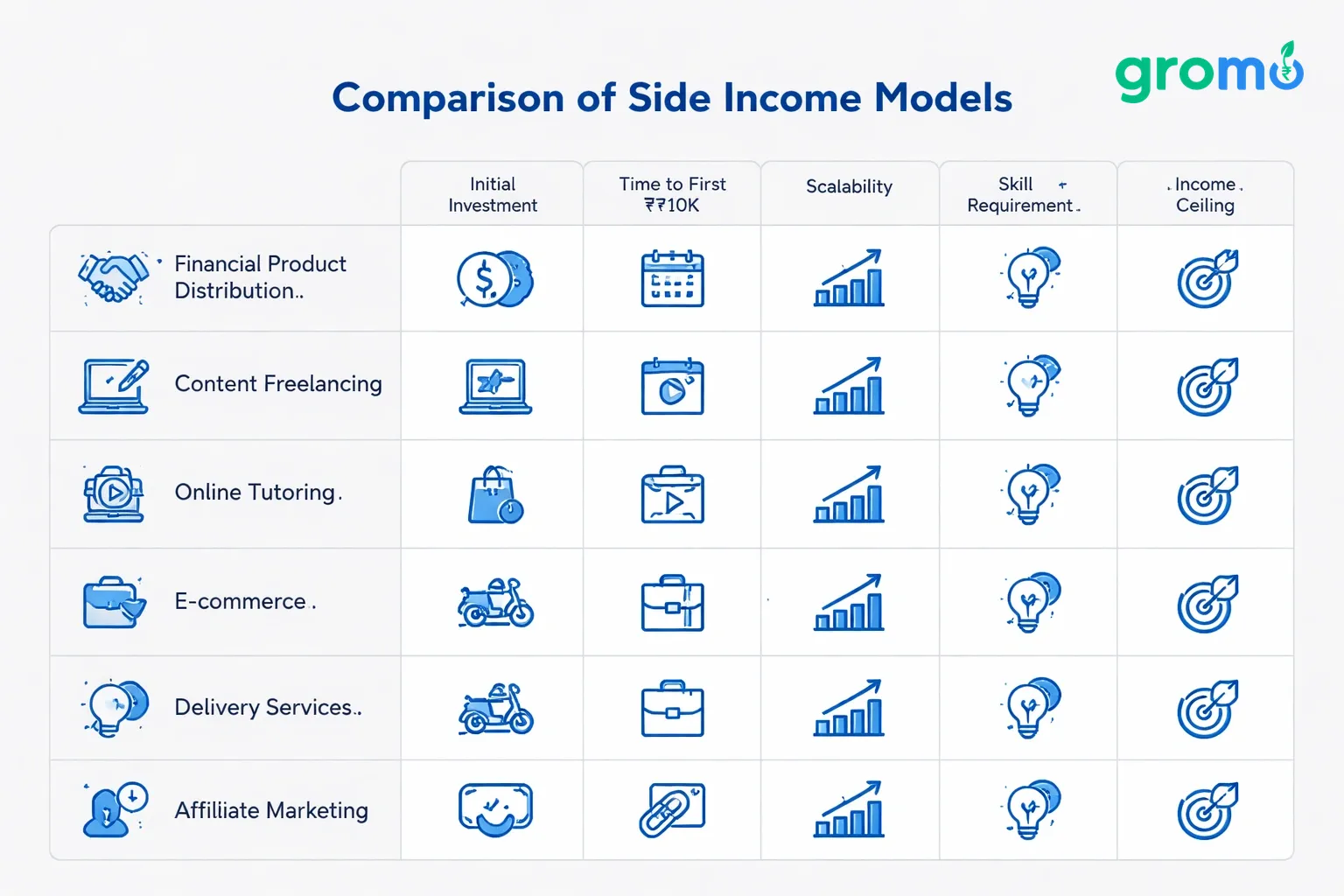
| Model | Initial Investment | Time to First ₹10K | Scalability | Skill Requirement | Income Ceiling |
|---|---|---|---|---|---|
| Financial Product Distribution | ₹0 | 15-30 days | High | Low | ₹3L+/month |
| Content Freelancing | ₹5K-15K (laptop) | 30-60 days | Medium | Medium-High | ₹2L/month |
| Online Tutoring | ₹3K-10K (setup) | 30-45 days | Medium | High | ₹2.5L/month |
| E-commerce | ₹50K-2L | 60-120 days | High | Medium | ₹5L+/month |
| Delivery Services | ₹20K-40K (vehicle) | 7-14 days | Low | Low | ₹30K/month |
| Consulting | ₹5K-10K | 45-90 days | Medium | Very High | ₹5L+/month |
| Affiliate Marketing | ₹10K-30K | 120-180 days | High | Medium | ₹3L+/month |
| Digital Products | ₹5K-20K | 60-120 days | Very High | Medium-High | ₹10L+/month |
Financial product distribution stands out for immediate accessibility zero investment requirement, minimal technical skills, and the fastest path to first earnings. Unlike freelancing or consulting that require demonstrable expertise, or e-commerce demanding capital and marketing budgets, commission-based distribution lets anyone with a smartphone start immediately.
The income ceiling beats most gig alternatives. Delivery partners hit earning limits based on daily order capacity; financial product partners scale through team building and passive income from recruits. A GroMo partner building a 20-person team where each member closes 5 deals monthly generates ₹30,000-₹80,000 override commission beyond personal sales.
Strategic Selection Framework
Choose a side income model that fits your constraints. Zero-capital situations favor financial product distribution, content writing, or affiliate marketing through organic social media. Limited time (2-3 hours daily) suits consulting, digital product creation, or commission-based distribution rather than time-heavy e-commerce or delivery services.
Skill-based selection: existing professional expertise supports consulting or specialized freelancing; creative abilities align with content services or digital product design; teaching skills match tutoring; relationship networks benefit referral-based income models. Working professionals earning ₹40,000-₹80,000 monthly usually seek ₹15,000-₹40,000 supplemental income, making 2-3 hour daily commitments optimal.
Risk tolerance matters. Conservative people prefer immediate, guaranteed per-hour income from freelancing, tutoring, or delivery. Risk-tolerant people accept 3-6 month build periods for affiliate marketing or digital products offering passive income upside. Commission models like financial distribution balance both immediate per-deal payouts plus long-term team override income.
Market conditions in June 2026 favor digital-native models. Remote work normalization expanded freelance client pools. UPI payment infrastructure maturation enabled instant commission payouts for digital distribution. Creator economy growth provided distribution channels for digital products and affiliate content. Financial product digital adoption created a massive market for online credit cards, loans, and demat accounts.
Test multiple models simultaneously in month one, measuring which gains traction fastest. Dedicate 70% effort to your leading model by month two while keeping secondary options active. Double down exclusively on your winner by month three once you've validated product-market fit for your situation.
Tax & Compliance Considerations
Side income exceeding ₹2,50,000 annually (₹3,00,000 for senior citizens) requires filing income tax returns even if you have a salaried job. Freelance, consulting, affiliate, and commission income falls under "Profits and Gains from Business or Profession" or "Income from Other Sources" depending on regularity. Keep invoices, payment confirmations, and expense receipts for deductions.
Business expense deductions reduce taxable income. Eligible deductions include internet and phone bills (proportionate business usage), laptop and equipment depreciation, coworking space rent, software subscriptions, advertising costs, and professional training. Claiming these requires a separate business bank account and systematic documentation.
GST registration becomes mandatory when annual turnover crosses ₹20 lakhs for services (₹40 lakhs for goods in most states). Registered businesses must file monthly/quarterly GST returns and charge GST on invoices. Many freelancers and consultants structure operations to stay below the threshold, though voluntary registration allows claiming input tax credits.
Financial product distribution partners receive commission income reported through Form 26AS. Platform providers like GroMo typically deduct TDS on payments, which you claim against final tax liability. Maintain month-wise commission statements for reconciliation during return filing.
Professional tax consultation costs ₹3,000-₹10,000 annually but prevents costly mistakes. Tax professionals advise on optimal business structure (proprietorship vs LLP vs private limited), legitimate deduction claims, advance tax payment schedules, and GST compliance if applicable. Setting this up early prevents scrambling during tax season.
Risk Management & Sustainability
Income diversification protects against single-channel volatility. Instead of depending on one freelance client, platform algorithm, or product line, maintain 3-5 parallel income streams. If one gets disrupted client budget cuts, platform policy changes, market saturation others sustain overall income while you rebuild.
Client concentration risk applies to freelancing and consulting. If 60%-70% of income comes from one client, you have job-like dependency without employment protections. Actively maintain 4-6 clients contributing relatively equal portions. Accept slightly lower rates from diversified clients rather than premium rates from a single concentrated relationship.
Platform dependency risks affect delivery services, affiliate marketing, and marketplace-based selling. Algorithm changes, commission structure adjustments, or policy updates can reduce earnings overnight. Platform-dependent businesses should simultaneously build owned assets email lists, branded websites, direct customer relationships that survive platform changes.
Emergency fund recommendations suggest 6-12 months expenses saved before treating side income as primary income. Irregular cashflow particularly for project-based work or seasonal business requires buffer capital to smooth consumption during low-income months. Conservative financial planning prevents desperate pricing decisions that commoditize your services.
Legal earning methods beat sketchy alternatives promising unrealistic returns. Avoid pyramid schemes disguised as network marketing, gambling apps masked as skill games, cryptocurrency Ponzi schemes, or data entry scams requiring advance payments. Legitimate side income means providing real value products, services, or customer connections not perpetual recruitment loops.
Frequently Asked Questions
Q: How much time daily does financial product distribution require compared to other side income options?
A: Active financial product distribution takes 2-3 hours daily for customer outreach, application follow-ups, and product education. That compares favorably to freelancing (4-6 hours for client projects), e-commerce (4-5 hours for order management), or delivery services (6-8 hours on the road). Distribution work happens in flexible time blocks morning commute, lunch breaks, evenings rather than continuous chunks. Partners building referral teams reduce active hours further by earning override commissions on recruits' sales.
Q: Can I combine multiple side income models simultaneously or should I focus on one?
A: Start with 2-3 models during your first month to test which matches your skills and gains traction fastest. By month two, allocate 70% effort to your leading performer while maintaining others at baseline. Successful multi-income individuals typically maintain one primary model generating 60%-70% of side earnings plus 1-2 passive or low-maintenance streams. For example, combine active financial product distribution (primary) with affiliate content creation (building) and digital product sales (passive). Avoid spreading equally across 5+ models diluted effort prevents achieving critical mass in any single channel.
Q: What income level from side work justifies leaving my full-time job?
A: Conservative guidance suggests achieving 2x your current monthly salary from side income sustained for 6+ months before transitioning. If you earn ₹50,000 monthly employed, target ₹1,00,000+ monthly side income with minimal volatility. This buffer accounts for losing employer benefits (PF, health insurance, paid leave) and covers initial business expenses when independent. Additionally, maintain a 12-month emergency fund covering all expenses before making the jump. Many financial product distribution partners successfully earn ₹40,000-₹80,000 monthly while retaining job security until side income stabilizes.
Q: How do I handle irregular income from side work when planning monthly expenses?
A: Create a separate bank account for side income. Transfer a fixed "salary" amount to your personal account monthly (start conservatively 60%-70% of average monthly side earnings). Leave the remainder in the business account as an operating buffer for volatile months. This psychological separation treats side income professionally rather than windfall spending. Track 3-month rolling average earnings to set realistic monthly transfer amounts, adjusting quarterly as income grows. Build an emergency fund covering 6 months of essential expenses before increasing lifestyle based on side income.
Q: Do financial product distribution partners need financial certification like NISM or IRDAI licenses?
A: No. Financial product distribution partners work as referral partners, not financial advisors or insurance agents. Banks and lending institutions handle product recommendations, suitability assessment, and compliance. Partners simply connect potential customers with financial institutions through tracked referral links. GroMo provides free certification training covering product features, customer profiling, and ethical sales practices, but these are platform-specific rather than regulatory requirements. If you expand into active financial advisory or insurance selling, regulatory licenses become mandatory.
Q: What are realistic first-month earnings for someone starting financial product distribution part-time?
A: Part-time beginners (2-3 hours daily) typically close 3-8 applications in month one, earning ₹3,000-₹15,000 depending on product mix. Secured credit cards and savings accounts convert fastest for new partners lacking extensive networks. Month two earnings average ₹8,000-₹25,000 as you refine targeting and leverage initial customer testimonials. By month three, established partners closing 10-15 applications monthly earn ₹15,000-₹40,000. Top performers reaching ₹1,00,000+ monthly typically require 6-12 months building referral teams and mastering high-value product categories like personal loans and premium credit cards.


