
15 Low Investment High Profit Business Ideas in India 2026
What each costs to start, what really drives profit, the risks, and how to test an idea cheaply.


The most profitable low investment high profit business in India is usually one with little stock and repeat customers: selling financial products on commission, digital marketing, online tutoring, home food, and local services. Profit comes from low running costs and repeat demand, not from a trendy idea. No business is guaranteed to make money, so test yours cheaply first. Our list of low cost business ideas with high profit has more options.
Below are 15 profitable business ideas in India with what each costs to start, why it can earn well, and the main risk. Rankings on other sites often quote big profit numbers with no proof, so we leave those out and explain what drives profit instead.
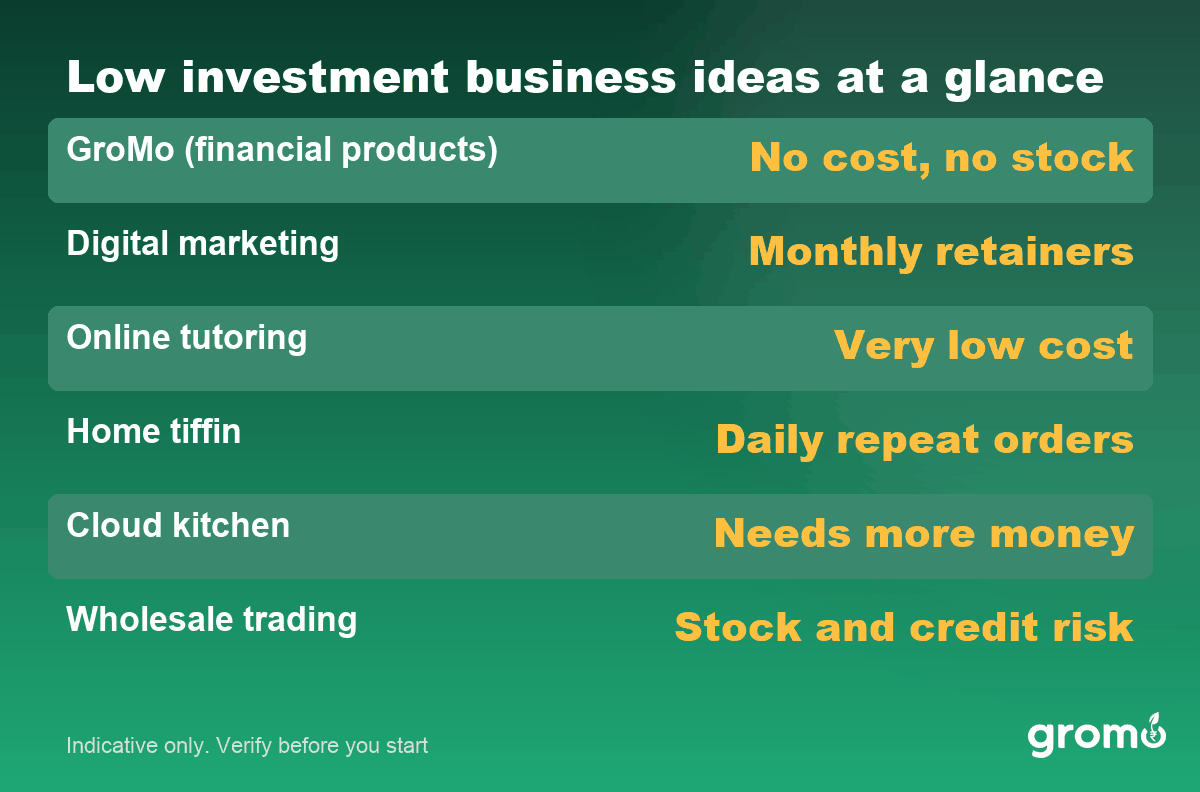
| # | Idea | Starting cost | Skills needed | Best for |
|---|---|---|---|---|
| 1 | Selling Financial Products With GroMo | None | Basic phone use; free training in the app | Anyone 18 or older |
| 2 | Digital Marketing Agency | Low | Ads, social media, reporting | People with marketing skills |
| 3 | Online Tutoring | Very low | Subject expertise | Teachers and strong students |
| 4 | Freelance Services | Very low | A marketable skill | Skilled individuals |
| 5 | Cloud Kitchen | Medium | Cooking, food delivery apps | Good cooks |
| 6 | Home Tiffin Service | Low | Cooking, reliability | Home cooks near offices or hostels |
| 7 | Tailoring and Boutique | Medium | Stitching, design sense | Skilled tailors |
| 8 | Accounting and Tax Services | Low | Accounting qualification | Accountants |
| 9 | Beauty and Salon Services at Home | Medium | Beauty training | Trained beauticians |
| 10 | Reselling and Online Store | Low | Selling, sourcing | People with a network |
| 11 | Hyperlocal Quick Commerce | Medium | Local supplier contacts | Tier-2 and tier-3 city owners |
| 12 | Fitness or Yoga Classes | Low | Certification, teaching | Trainers and instructors |
| 13 | Candle, Pickle or Handmade Products | Low | Craft or recipe skill | Home makers and hobbyists |
| 14 | Print on Demand | Very low | Basic design | Designers |
| 15 | Small Wholesale Trading | Medium | Sourcing, credit control | People with market contacts |
Starting-cost labels are our own rough estimates: None, Very low, Low and Medium. Actual costs depend on your city and setup.
How this list is ranked: GroMo comes first because it needs no money or stock, so there is little to lose. The rest follow the ideas that keep appearing in the top-ranking Indian guides for this search, ordered from the lowest-cost service ideas to those that need more money.
1. Selling Financial Products With GroMo: Bank-paid commissions, no stock
Starting cost: None | Skills: Basic phone use; free training in the app | Best for: Anyone 18 or older
Selling financial products with GroMo tops this list because it costs nothing to start and needs only a smartphone. GroMo is a free app where you help people apply for credit cards, savings accounts, loans and demat accounts from partner banks, and you earn a commission when the application is approved. On GroMo, credit cards pay up to ₹2,000, savings accounts up to ₹1,000, demat accounts up to ₹450, and personal loans up to 4.5% of the loan amount (GroMo catalogue, retrieved 2026-11-06). Your cost is only your time, so almost all you earn is profit, but income depends on how many applications get approved. The pay is commission only, with no fixed salary, and only approved applications earn; you must be 18 or older.
How to start:
- Download the GroMo app and register free with your phone number.
- Finish the one-time verification and the free in-app training.
- Share a product link with someone who genuinely needs it, then track the application in the app.
2. Digital Marketing Agency: Run ads and pages for shops
Starting cost: Low | Skills: Ads, social media, reporting | Best for: People with marketing skills
A digital marketing agency is named among the most profitable small businesses in several top guides because you sell skill rather than stock. Monthly retainers bring repeat income, though clients leave quickly if they don't see results.
How to start:
- Learn one service well, such as Google or Meta ads.
- Run a small project for one local business.
- Turn results into a case study and pitch more clients.
3. Online Tutoring: Low cost, steady demand
Starting cost: Very low | Skills: Subject expertise | Best for: Teachers and strong students
Online tutoring has high margins because your main cost is your own time. Demand is steady around exams, and small group batches let you earn more per hour than one-to-one classes.
How to start:
- Pick a subject and exam.
- Offer a demo class.
- Move to small group batches.
4. Freelance Services: Writing, design, development
Starting cost: Very low | Skills: A marketable skill | Best for: Skilled individuals
Freelance services are among the most consistently recommended low investment ideas because nearly all fees are profit. The main risk is uneven income, so aim for two or three regular clients.
How to start:
- Choose one service.
- Create three samples.
- Pitch for small jobs, then build regular clients.
5. Cloud Kitchen: Food delivery, no dining space
Starting cost: Medium | Skills: Cooking, food delivery apps | Best for: Good cooks
A cloud kitchen sells only through delivery, so you avoid the cost of a restaurant space. Lendingkart ranks it among the most profitable small businesses, but delivery app commissions eat into margins, and FSSAI registration is required.
How to start:
- Start from your home kitchen with one cuisine.
- Get FSSAI registration.
- List on delivery apps after testing with local orders.
6. Home Tiffin Service: Daily repeat customers
Starting cost: Low | Skills: Cooking, reliability | Best for: Home cooks near offices or hostels
A home tiffin service earns from daily repeat orders, which makes income more predictable than most food businesses. FSSAI registration starts at about ₹100 a year (IncorpX, retrieved 2026-11-06), and reliable timing matters most.
How to start:
- Test one menu with five customers.
- Get FSSAI registration.
- Take monthly subscriptions.
7. Tailoring and Boutique: Skill-based, repeat customers
Starting cost: Medium | Skills: Stitching, design sense | Best for: Skilled tailors
Tailoring and boutique work has steady local demand, especially before weddings and festivals. A sewing machine is the main cost, and repeat customers make word of mouth your cheapest marketing.
How to start:
- Start with alterations and blouses.
- Show finished work on WhatsApp and Instagram.
- Add festive collections later.
8. Accounting and Tax Services: Recurring yearly work
Starting cost: Low | Skills: Accounting qualification | Best for: Accountants
Accounting and tax services bring recurring income because small businesses need them every year. Shriram Finance names accounting among the steadier low-investment models, but stay within what your qualification allows.
How to start:
- List services you're qualified to offer.
- Start with a few local shops.
- Offer yearly packages.
9. Beauty and Salon Services at Home: Low setup, high repeat
Starting cost: Medium | Skills: Beauty training | Best for: Trained beauticians
Salon services at home keep rent low and bring regular customers, especially for bridal and festive work. Hygiene and good reviews matter more than expensive equipment when you're starting.
How to start:
- Get basic training if you need it.
- Start with neighbours.
- Collect reviews and add bridal packages.
10. Reselling and Online Store: Margin on every sale
Starting cost: Low | Skills: Selling, sourcing | Best for: People with a network
Reselling earns a margin on each product without any manufacturing. The risk is unsold stock, so begin by taking orders first and buying only what has already sold.
How to start:
- Pick a narrow product category.
- Sell through WhatsApp and Instagram.
- Add a marketplace listing once you have repeat buyers.
11. Hyperlocal Quick Commerce: Delivery in small towns
Starting cost: Medium | Skills: Local supplier contacts | Best for: Tier-2 and tier-3 city owners
Hyperlocal delivery takes groceries or medicines from nearby shops to homes in small cities, where big apps are often less active. Delivery costs can eat profit, so start with a small area and one category.
How to start:
- Pick one neighbourhood and one category.
- Partner with two or three local shops.
- Take orders on WhatsApp and deliver yourself first.
12. Fitness or Yoga Classes: Low setup, monthly fees
Starting cost: Low | Skills: Certification, teaching | Best for: Trainers and instructors
Fitness and yoga classes earn monthly fees with little equipment, and wellness is among the steadier categories named in top guides. Online batches can widen your reach beyond your own area.
How to start:
- Get certified if needed.
- Start a small batch in a park or online.
- Offer monthly plans.
13. Candle, Pickle or Handmade Products: Small-batch home production
Starting cost: Low | Skills: Craft or recipe skill | Best for: Home makers and hobbyists
Handmade products sell best with festive demand and good packaging. Margins can be healthy, but selling is the hard part, and food products such as pickle need FSSAI registration.
How to start:
- Make one small batch.
- Sell to your local circle and at fairs.
- Improve packaging and list online.
14. Print on Demand: No stock, custom products
Starting cost: Very low | Skills: Basic design | Best for: Designers
Print on demand prints each item only after it sells, so no money gets stuck in stock. Margins per item are small, so profit depends on finding a clear audience.
How to start:
- Pick a niche with a clear audience.
- Upload a few designs.
- Promote them on Instagram.
15. Small Wholesale Trading: Supply local shops
Starting cost: Medium | Skills: Sourcing, credit control | Best for: People with market contacts
Wholesale trading of daily-use items has consistent demand across cities and villages. It needs more money than the ideas above, and unpaid shop credit is the main risk, so sell small and collect quickly.
How to start:
- Find one fast-moving item.
- Buy a small trial lot.
- Limit credit to shops you know.
How Much Does GroMo Pay for Each Product?
| Product on GroMo | Pays partners up to |
|---|---|
| SBI Credit Card | ₹2,000 per approved card |
| HDFC Secured Credit Card | ₹1,750 per approved card |
| Axis Saving Account | ₹1,000 per account |
| Digi Credit Personal Loan | 4.5% of the loan amount |
| Kotak 811 Super Account | ₹600 per account |
| Kotak Securities Demat Account | ₹450 per account |
The SBI Credit Card pays partners up to ₹2,000 per approved card (GroMo catalogue, retrieved 2026-11-06). Commission is paid only on approval.
The Axis Saving Account pays up to ₹1,000 per successful account (GroMo catalogue, retrieved 2026-11-06). Many other products pay less.
The Digi Credit Personal Loan pays up to 4.5% of the loan amount, and most other lenders pay less (GroMo catalogue, retrieved 2026-11-06). Check the live payout in the app.
How much money do you need to start?
Many profitable businesses in India can start under ₹50,000, and service ideas can start with almost nothing, though guides disagree widely on exact costs (Shiprocket, retrieved 2026-11-06). Budget for the setup, three months of running costs and a small safety buffer. Don't put your full savings or a high-interest personal loan into an untested idea. Our guide to small business ideas lists more options by type.
What makes a low investment business profitable?
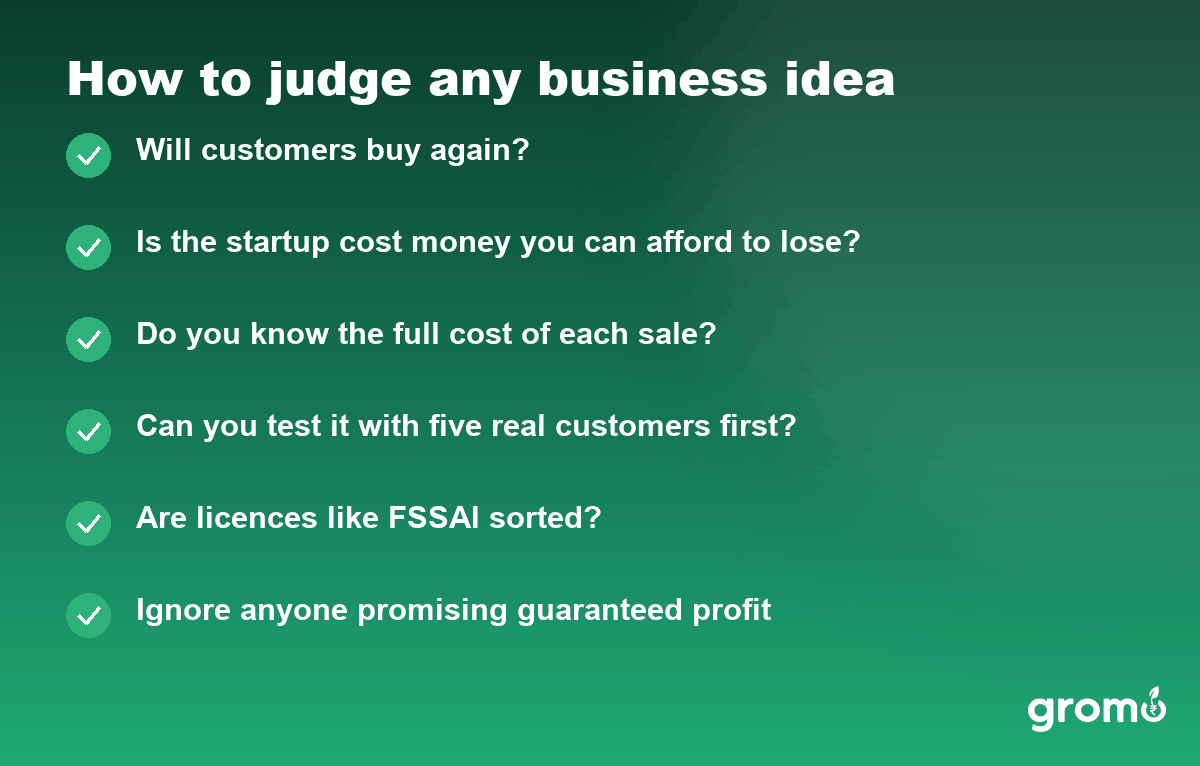
A low investment business is profitable when customers come back and running costs stay low. Service businesses keep most of what they charge, while stock businesses lose money to unsold goods and returns. Three questions help: will customers buy again, what does each sale really cost, and how long until you earn back your money?
How do you test a business idea before investing?
Test an idea by selling to real customers before spending on setup. Take five or ten orders using what you already have, count every cost, and check whether people buy again. If they don't, change the idea cheaply. Selling on commission is one of the cheapest tests of your sales skill; here is how to sell financial products and earn money.

GroMo is a free app where partners help customers apply for credit cards, loans, savings accounts and demat accounts from partner banks, and earn a commission on approval.
FAQ: Low Investment High Profit Business
Which business is most profitable in India with low investment?
No single business wins for everyone. Service businesses such as digital marketing, tutoring and selling financial products on commission tend to keep the most profit because they have little stock and few running costs.
Which business can I start with 50,000 rupees?
Home tiffin, tailoring, reselling, beauty services and small online stores can often start within that budget. Keep part of the money aside for running costs.
Which business has zero investment?
Selling financial products with GroMo, freelancing, tutoring and affiliate marketing can start with almost no money, only your time and a phone.
Is a small business profitable from the first month?
Rarely. Most businesses take months to cover their costs. Treat early months as testing, and don't count on business income to pay bills straight away.
Do I need a licence to start a small business?
That depends on the business. Food businesses need FSSAI registration, and other trades may need local licences or GST registration. Check the rules for your type and turnover.
Are big profit figures on business websites true?
Treat them as rough claims. Most sites give no proof, and real profit depends on your location, costs and customers.
GroMo (Vitrak Technologies Pvt Ltd) is a distribution platform. GroMo isn't a bank, NBFC, insurer or investment adviser. All products are offered by their respective RBI, IRDAI or SEBI-regulated providers.
Partner earnings depend on effort, product mix and customer eligibility. Any figures shown are illustrative. They aren't typical and aren't promised.
Sources: Top-ranking guides checked: Lendingkart, Shiprocket, Flexiloans, Bajaj Finserv, Shriram Finance, OfficeChai and IncorpX, retrieved 2026-11-06. GroMo product catalogue, commission rates by product, retrieved 2026-11-06.
Disclaimer
GroMo doesn't promise any level of income. Commissions are set by partner banks, vary by product and campaign, and are paid only on approved applications; check the live commission in the GroMo app. Starting-cost labels are our own rough estimates, and any pay figures from other sites or job listings are what those sources state, not a guarantee. GroMo is available only to users aged 18 and above. Everything above is general information, not financial, legal or career advice.


