
All Types of Credit Card Hidden Charges in India 2026
Every credit card hidden charge in India 2026: interest, GST, forex markup, no cost EMI hidden charges and small fees, with simple ways to avoid each.

Credit card hidden charges are the fees nobody explains at signup: interest that starts the day you pay only the minimum due, an 18 percent GST quietly added to every fee, forex markup on international spends, and the processing fee inside "no cost" EMI. None of them are secret, they all sit in the card's schedule of charges, but they are built to be missed.
This guide lists every hidden charge on credit cards in India in 2026, with typical amounts, and exactly how to avoid each one.
All Credit Card Hidden Charges at a Glance
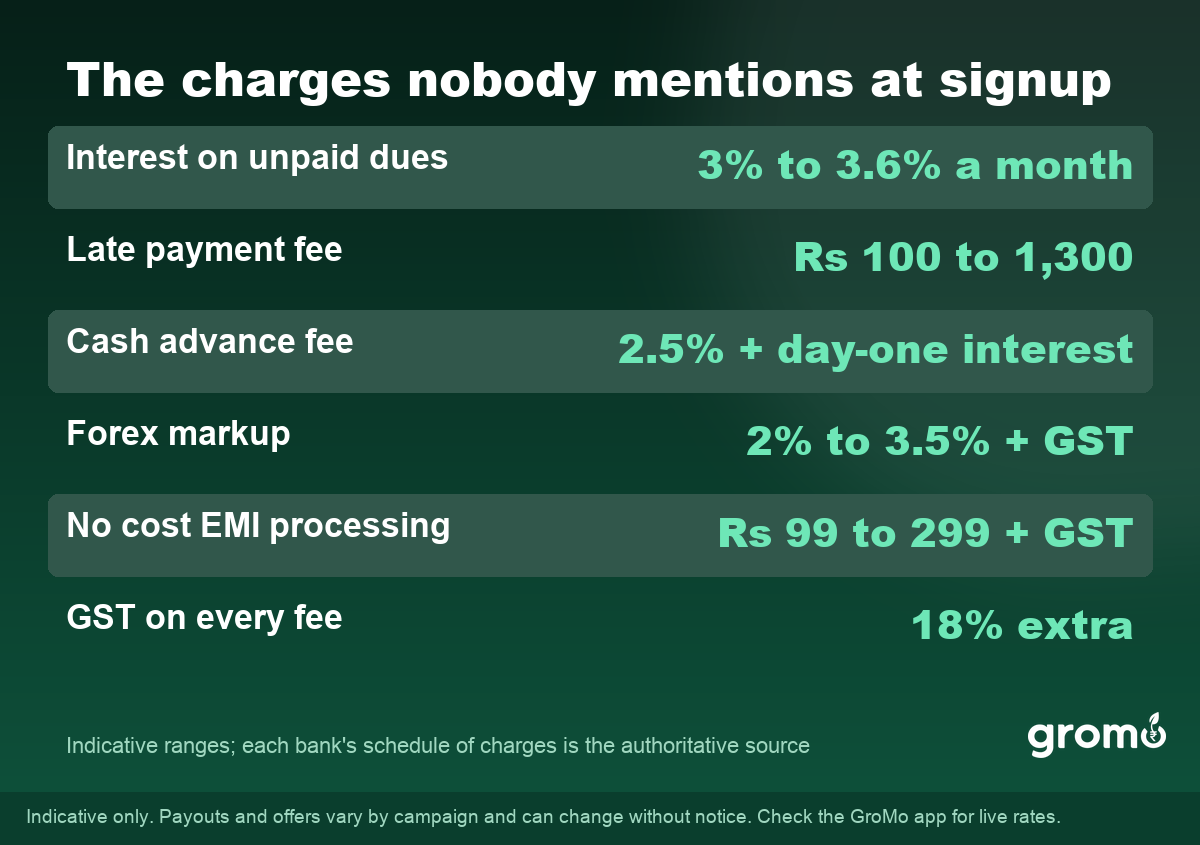
| Hidden charge | Typical amount | When it hits |
|---|---|---|
| Interest (finance charges) | 3% to 3.6% per month (36% to 43% a year) | Unpaid dues after the due date |
| Late payment fee | Rs 100 to Rs 1,300 by outstanding slab | Missing even the minimum due |
| GST on everything | 18% extra | On every fee and interest charge |
| Cash advance fee | 2.5% (min Rs 250 to Rs 500) plus day-one interest | ATM withdrawal on the card |
| Forex markup | 2% to 3.5% plus GST | International or foreign-currency spends |
| Annual fee | Rs 500 to Rs 12,000 plus GST | Yearly, unless spend target waives it |
| EMI processing fee | 1% to 3% or Rs 99 to Rs 299 plus GST | Converting purchases to EMI, including no cost EMI |
| EMI foreclosure charge | Around 3% of outstanding | Closing an EMI early |
| Overlimit fee | 2.5% (min Rs 500) | Spending past your credit limit |
| Fuel surcharge | 1% (often waived in slabs) | Fuel station swipes outside the waiver slab |
| Reward redemption fee | Rs 99 to Rs 199 | Redeeming points on many cards |
| Cash/cheque payment fee | Rs 100 to Rs 250 | Paying the bill in cash at a branch |
| Card replacement / duplicate statement | Rs 100 to Rs 500 | Reissue requests |
| Rent payment surcharge | Around 1% | Rent paid via card through apps |
1. Interest: The Biggest Hidden Charge of All
Credit card interest is not hidden in amount, it is hidden in behaviour. Pay your bill in full and it never exists; pay only the minimum due and it switches on at 3 to 3.6 percent per month on the entire outstanding.
Worse, once you carry a balance, most cards suspend the interest-free period on new purchases too, so even fresh spending starts collecting interest from day one. The minimum due is designed to feel safe; it is the single most expensive habit in Indian personal finance.
2. Late Payment Fees
Miss the due date and a slab-based fee applies, typically Rs 100 for small dues up to Rs 1,100 to Rs 1,300 for large ones, plus GST, plus interest. Repeated late payments can also cancel promotional offers and undo years of work to improve your credit score, a triple cost from one missed reminder.
3. GST: The 18 Percent Multiplier
Every fee on this page, and the interest itself, attracts 18 percent GST on top. A Rs 500 annual fee is really Rs 590; Rs 1,000 of interest is really Rs 1,180. Banks quote fees before tax, so read every number with 18 percent added mentally.
4. No Cost EMI Hidden Charges
"No cost EMI" is the most searched hidden-charge topic in India, and for good reason: the EMI is rarely zero-cost. Here is what actually happens behind the label:
- Interest is charged, then offset. The bank charges its usual EMI interest, and the merchant gives you an equivalent discount upfront. You pay interest on paper; the discount cancels it.
- GST on that interest is NOT offset. You pay 18 percent GST on the interest portion of every EMI, and no discount covers it. On a Rs 30,000 phone over 9 months, this quietly adds a few hundred rupees.
- Processing fee applies. Most no cost EMI conversions charge Rs 99 to Rs 299 or 1 to 2 percent, plus GST.
- You may lose the instant discount. The "no cost" price is often the price without the cash discount another buyer gets, so the interest is effectively hidden inside the sticker price.
- Reward points are usually not earned on EMI transactions, a small invisible loss.
No cost EMI is still often worth it for big purchases, but compare the total EMI outflow including GST and processing fee against the full-payment price with discount before choosing.
5. Regular Credit Card EMI Hidden Charges
Converting any purchase or your outstanding balance to EMI carries its own charge set: interest of typically 12 to 18 percent a year, a processing fee of 1 to 3 percent plus GST, GST on each EMI's interest portion, and a foreclosure charge of around 3 percent if you close the EMI early.
The EMI amount blocks your credit limit until repaid, and a missed EMI is treated like any missed card payment, with late fees and score damage.
6. Cash Advance Charges
Withdrawing cash on a credit card triggers two charges at once: a cash advance fee of about 2.5 percent (minimum Rs 250 to Rs 500), and interest from the day of withdrawal with no interest-free period at all.
A Rs 10,000 withdrawal repaid after one month can cost Rs 600 or more. Treat credit card cash as a genuine emergency tool only.
7. Foreign Currency (Forex) Markup
Every international transaction, including foreign websites billed in dollars, carries a forex markup of typically 2 to 3.5 percent plus GST. On a Rs 1,00,000 international trip, that is Rs 2,400 to Rs 4,100 gone silently.
Some travel-focused cards cut this to zero or near-zero, which is exactly why frequent travellers should choose cards by forex markup, not lounge visits.
8. Annual and Renewal Fees
Cards advertise "free for the first year" and start charging from the second, anywhere from Rs 500 to Rs 12,000 plus GST by card tier. Most cards waive the fee if you cross an annual spend target, and banks often reverse it for good customers who ask.
If the fee outweighs what you use the card for, ask for a waiver, downgrade the card, or learn how to close the credit card properly rather than letting renewal fees bill silently.
9. The Small, Sneaky Fees
- Overlimit fee: about 2.5 percent (minimum Rs 500) for crossing your limit, chargeable only if you opted in to overlimit usage.
- Fuel surcharge: 1 percent at fuel stations, waived on most cards only within a monthly slab, for example Rs 400 to Rs 5,000 per transaction.
- Reward redemption fee: Rs 99 to Rs 199 charged when you redeem the points you earned.
- Cash or cheque bill payment fee: Rs 100 to Rs 250 for paying your bill at a branch instead of online.
- Card replacement and duplicate statement fees: Rs 100 to Rs 500 per request.
- Rent payment surcharge: around 1 percent when paying rent through card-enabled apps, often with capped or zero reward points.
How to Avoid Credit Card Hidden Charges
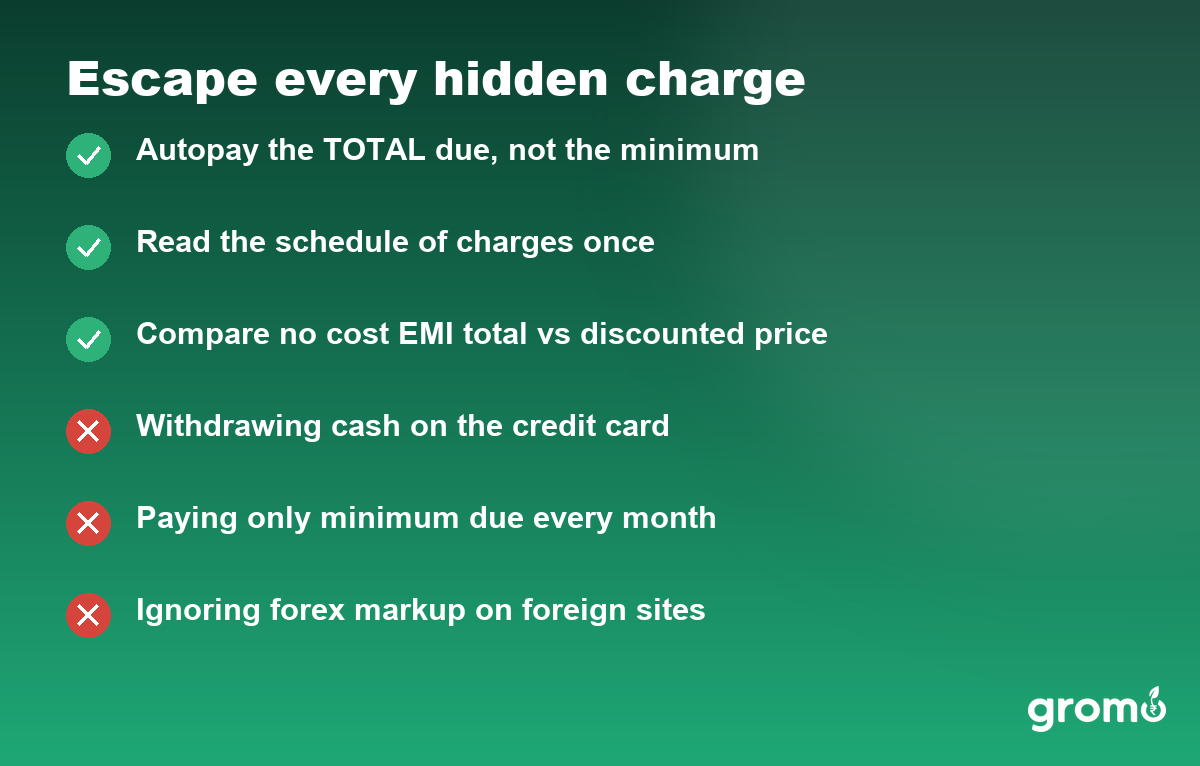
- Pay the total due, always. Full on-time payment kills interest, late fees, and score damage in one stroke; autopay the total amount, not the minimum.
- Read the schedule of charges once. Every bank publishes it; fifteen minutes with it beats years of surprises.
- Do the no cost EMI math. Compare total EMI outflow (with GST and processing fee) against the full-payment discounted price.
- Never withdraw cash on the card outside a real emergency.
- Match the right one of the many types of credit cards to your life: a zero-forex card for travel, high fuel-waiver card for commutes, and a genuinely fee-free card for basic use.
- Check statements monthly and dispute unknown charges immediately; billing errors and sneaky subscriptions hide best in unread statements.
Choosing a Card With Fewer Hidden Charges
The cheapest card is the one whose charges you will never trigger. Compare cards on the four numbers that actually bite: annual fee and its waiver target, interest rate, forex markup, and EMI charges.
On the GroMo app you can compare 30+ credit cards from different banks on exactly these terms and apply digitally. GroMo is a distribution platform, not a bank; fees and approval are always set by the issuing bank.
FAQ: Credit Card Hidden Charges
What are the hidden charges on credit cards in India?
The main ones are interest of 3 to 3.6 percent per month on unpaid dues, slab-based late payment fees up to about Rs 1,300, 18 percent GST added to every fee and interest charge, cash advance fees with day-one interest, forex markup of 2 to 3.5 percent on international spends, annual renewal fees, EMI processing and foreclosure charges, overlimit fees, fuel surcharge, and small fees for reward redemption, card replacement, and cash bill payment.
What are the hidden charges in no cost EMI?
Three costs hide inside no cost EMI: 18 percent GST on the interest portion of every EMI, which no discount offsets; a processing fee of Rs 99 to Rs 299 or 1 to 2 percent plus GST; and often the loss of the instant cash discount another buyer would get. The interest itself is charged and offset by a merchant discount, so the real extra cost is the GST plus the fee.
Does no cost EMI affect my credit card limit or score?
The full purchase amount blocks your credit limit until the EMIs finish, which raises your utilisation and can nudge your score down temporarily. Paying every EMI on time builds your record; missing one triggers late fees and score damage exactly like a missed card bill.
How can I avoid credit card interest completely?
Pay the total amount due, not the minimum, by the due date every month, and the interest-free period of 20 to 50 days makes all your purchases genuinely free credit. Set autopay for the full statement amount, and never withdraw cash on the card, because cash advances accrue interest from day one with no free period.
Why was I charged GST on my credit card?
GST at 18 percent applies to every fee and charge on a credit card: annual fees, late fees, processing fees, and the interest itself. Banks quote charges before tax, so a Rs 500 fee appears as Rs 590 on the statement. GST on charges is normal; GST on a charge you do not recognise is worth a dispute call.
Are credit card hidden charges avoidable?
Almost all of them. Full on-time payment removes interest and late fees, spending within limit avoids overlimit fees, paying bills online avoids cash payment fees, the right card kills forex and fuel costs, and reading the schedule of charges once tells you exactly what your card charges for what.
The only near-unavoidable cost is GST on fees you do choose to pay.
Disclaimer
This article is general information, not financial advice. All fee amounts, rates, slabs, and waiver conditions are indicative industry ranges at the time of writing; each bank sets its own schedule of charges, which changes over time, and that schedule plus the card's terms are the only authoritative source. Card approval and fee decisions rest with the issuing bank.
GroMo is a financial product distribution platform, not a bank or lender, and is available only to users aged 18 and above. Bank and card names are trademarks of their respective owners.


