
Difference between Credit Card and Debit Card
The difference between credit card and debit card explained simply: money source, interest, rewards, CIBIL impact, safety, and which is better when.

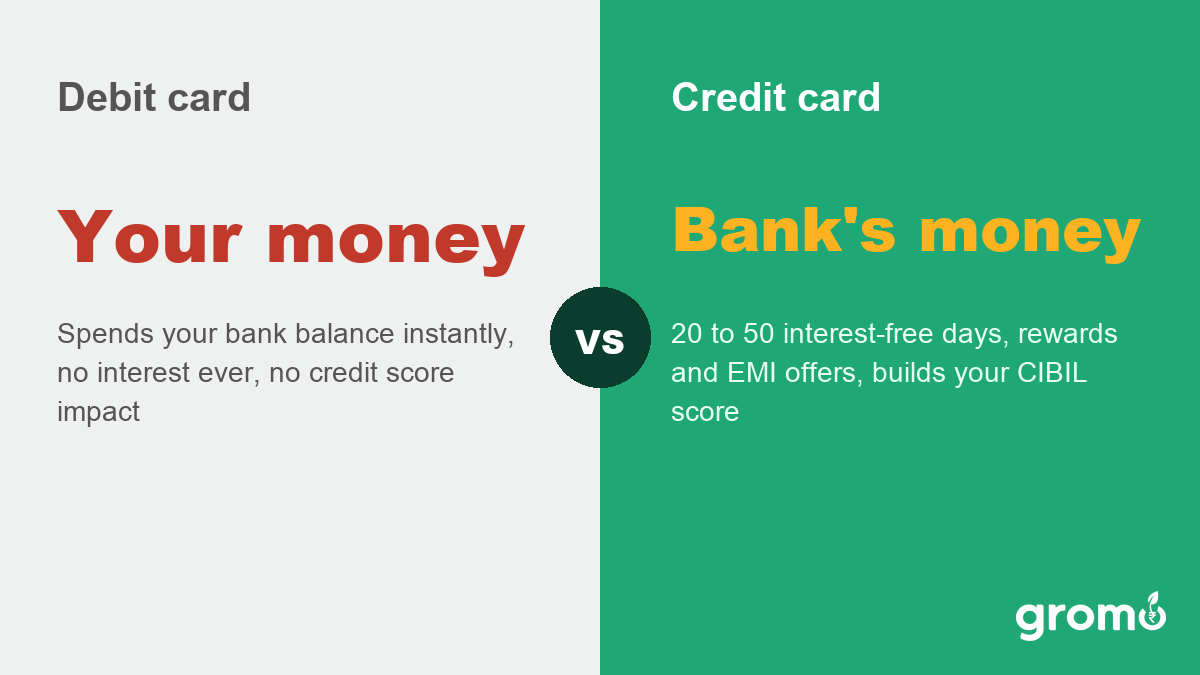
The difference between a credit card and a debit card comes down to whose money you spend: a debit card spends your own money straight from your bank account, while a credit card spends the bank's money, which you repay later. That one difference changes everything else: interest, rewards, credit score impact, fraud protection, and what each card is best used for.
This guide explains every difference in simple terms and answers the real question: debit card or credit card, which is better for you?
Credit Card vs Debit Card: Key Differences at a Glance
| Point | Debit card | Credit card |
|---|---|---|
| Whose money | Yours, from your savings or current account | The bank's, up to a credit limit you repay |
| Spending limit | Your account balance | Credit limit set by the bank |
| Interest | None; it is your money | None if you pay in full on time; roughly 3 to 3.6% per month on unpaid dues |
| Bill | No bill; money leaves instantly | Monthly bill with 20 to 50 interest-free days |
| Credit score | No impact | Builds or damages your CIBIL score |
| Rewards | Minimal or none | Cashback, points, lounge access, EMI offers |
| Fees | Small annual fee, often Rs 100 to Rs 500 | Zero to a few thousand rupees, by card type |
| Eligibility | Comes free with a bank account | Needs income proof or a fixed deposit, and bank approval |
| Overspending risk | Low; you cannot spend what you do not have | Real; the limit tempts spending beyond income |
What Is a Debit Card?
A debit card is directly linked to your bank account. When you swipe, tap, or pay online, the amount is deducted from your balance immediately.
Every savings account comes with one, there is no approval process, and there is no debt possible: if your balance is zero, the card simply stops working. That makes it the simplest and most disciplined way to pay.
What Is a Credit Card?
A credit card lets you spend the bank's money up to a sanctioned credit limit. Your purchases collect into a monthly bill, and you get an interest-free period, typically 20 to 50 days depending on the billing cycle, to repay in full.
Pay the full bill on time and the borrowing costs nothing. Pay only the minimum due and the remaining amount attracts interest at roughly 3 to 3.6 percent per month, which is 36 to 43 percent a year, among the costliest debt in India. The card's power and its danger are the same feature: money you do not yet have.
Difference 1: Where the Money Comes From
This is the root difference between a credit card and a debit card. Debit spends your past income, sitting in your account. Credit spends your future income, which you commit to repaying.
Practically, this means a debit card can never charge you interest or late fees, while a credit card can. It also means a credit card keeps working in an emergency when your balance cannot.
Difference 2: Credit Score Impact
A debit card does nothing for your credit history, no matter how much you spend through it. It is not credit, so CIBIL never sees it.
A credit card is often the first and easiest credit-history builder: every on-time bill payment helps improve your credit score, and low utilisation of your limit helps it further. Miss payments, and the same card damages your score just as efficiently.
If a loan or home purchase is in your future plans, a responsibly used credit card is the cheapest way to build the score those approvals will depend on.
Difference 3: Rewards and Benefits
Debit card rewards in India are close to nonexistent: occasional cashback offers and little else, because banks earn very little on debit transactions.
Credit cards fund real benefits from the fees merchants pay: cashback of 1 to 5 percent on categories, reward points, airport lounge access, fuel surcharge waivers, and no-cost EMI on big purchases. For the same Rs 20,000 of monthly spending, a well-chosen credit card can quietly return several thousand rupees a year that a debit card never would.
Difference 4: Safety and Fraud Protection
This difference surprises most people: a credit card is safer for online and card payments. If a fraudster hits your credit card, the bank's money is at risk while you dispute it; your salary stays untouched in your account.
If your debit card is compromised, your own money leaves your account first and comes back only after the dispute resolves. RBI rules give strong protection on unauthorised transactions for both cards if you report quickly, ideally within 3 days, but the waiting period hurts far more when it is your rent money that is frozen.
Difference 5: Fees and Costs
Debit cards cost little: most banks charge Rs 100 to Rs 500 a year, and many accounts waive it.
Credit cards range from genuinely lifetime-free cards to premium cards charging a few thousand rupees a year for bigger benefits. The real cost of a credit card is never the fee; it is the interest on unpaid bills and the late fees, both of which are fully avoidable by paying the total due on time.
Debit Card or Credit Card: Which Is Better?
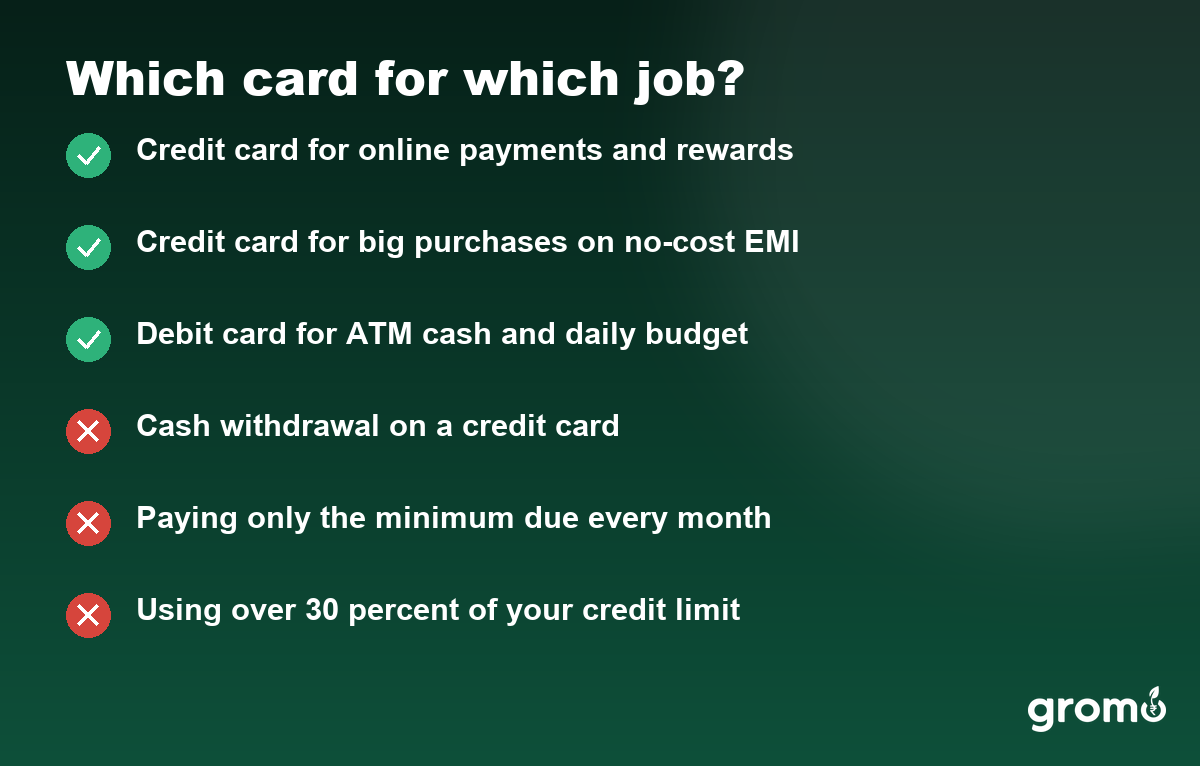
Neither is better for everyone; each is better at a different job. The honest answer for most working adults is both: a debit card for cash withdrawal and budget-controlled daily spending, and a credit card for online payments, big purchases, and building a credit score.
| Situation | Better choice | Why |
|---|---|---|
| ATM cash withdrawal | Debit card | Free at your bank's ATMs; credit card cash advances charge heavy fees and instant interest |
| Online shopping and subscriptions | Credit card | Better fraud protection and rewards; your account balance stays untouched |
| Big purchases (phone, appliances) | Credit card | No-cost EMI offers and instant discounts, plus 20 to 50 days to pay |
| Strict monthly budgeting | Debit card | You physically cannot overspend your balance |
| Building credit history for future loans | Credit card | The only one of the two that CIBIL sees |
| First card for a student or new earner | Debit first, then a secured or low-limit credit card | Learn discipline first, then build score safely |
| Emergencies away from home | Credit card | Works even when your balance is low |
Can a Debit Card Do a Credit Card's Job?
Only partly. Some banks now offer EMI on debit cards for select purchases, and UPI has made debit-account spending effortless. But a debit card cannot build your CIBIL score, cannot give you an interest-free borrowing window, and cannot match credit card rewards or purchase protections.
The reverse is also true: a credit card is a poor ATM card, because cash withdrawals on credit attract fees and immediate interest with no free period.
Rules to Use Both Cards Smartly
- Pay the credit card bill in full every month; treat the minimum due as an emergency-only option, never a habit.
- Keep credit utilisation under about 30 percent of your limit to protect your score.
- Use the credit card for planned spending and online payments; use the debit card for cash and daily budget control.
- Never withdraw cash on a credit card except in a genuine emergency.
- Set transaction alerts and app locks on both cards, and report any fraud to the bank immediately, within 3 days at most.
Choosing Your First Credit Card
If this comparison has convinced you to add a credit card alongside your debit card, match the right one of the many types of credit cards to your spending pattern, not to whichever bank calls first. On the GroMo app you can compare 30+ credit cards from different banks in one place, check eligibility by your profile and pincode, and apply digitally in minutes.
GroMo is a distribution platform, not a bank; card approval always rests with the issuing bank.
FAQ: Difference Between Credit Card and Debit Card
What is the main difference between a credit card and a debit card?
A debit card spends your own money, deducted instantly from your bank account, while a credit card spends the bank's money up to a limit, which you repay through a monthly bill. Because of that, only credit cards charge interest on unpaid dues, offer interest-free periods and rewards, and affect your CIBIL score.
Debit card or credit card, which is better?
Each is better at a different job, and most working adults should use both. A debit card is better for ATM cash and strict budgeting because you cannot overspend your balance.
A credit card is better for online payments, big purchases on EMI, rewards, and building the credit score that future loan approvals depend on, provided you pay the full bill on time.
Is a credit card safer than a debit card for online payments?
Yes. If a credit card is compromised, the bank's money is at risk while you dispute the transaction, and your salary stays untouched in your account.
With a debit card, your own money leaves first and returns only after the dispute resolves. RBI rules protect both if you report unauthorised transactions quickly, ideally within 3 days.
Does using a debit card improve my CIBIL score?
No. A debit card is not credit, so no amount of debit spending appears in your credit history. A credit card is usually the easiest first credit-builder: on-time full payments and utilisation kept under about 30 percent of the limit steadily strengthen your score.
Do credit cards charge interest on every purchase?
No. If you pay the total bill by the due date, purchases enjoy an interest-free period of roughly 20 to 50 days and cost you nothing extra. Interest, at about 3 to 3.6 percent per month, applies only when you carry unpaid dues past the due date, and cash withdrawals, which attract interest from day one.
Should a student or first-time earner take a credit card?
Start with the debit card that comes with your bank account, learn budget discipline, and then add a low-limit or secured credit card, one issued against a fixed deposit, to start building a credit score safely. Keep spending small and always pay in full; the score you build now makes future loans cheaper.
Disclaimer
This article is general information, not financial advice. Interest rates, fees, interest-free periods, reward structures, and liability rules vary by bank and card and change over time; figures here are indicative industry ranges at the time of writing, and the issuing bank's official terms are the only authoritative source. Card approval is always the bank's decision.
GroMo is a financial product distribution platform, not a bank or lender, and is available only to users aged 18 and above. Bank and card names are trademarks of their respective owners.


