
Top 15 Low Cost Business Ideas with High Profit in 2026
15 low cost business ideas with high profit for India 2026 — investment needed, profit margins, expected monthly income, and why each model earns so well.

Every profitable small business answers one equation: keep costs near zero, sell something people already want, and let margin do the work. High profit rarely comes from charging more — it comes from not paying rent, not holding inventory, and building on a skill, space, or network you already own. That is why the ideas below can start under ₹50,000 (most under ₹10,000, several at ₹0) yet run at 40–90% profit margins that many funded startups would envy.
This guide covers 15 low cost business ideas with high profit for India in 2026. For each one you get the investment needed, expected monthly income, the profit margin, and — most importantly — why it is high profit, so you can judge the model instead of trusting a list. Read to the end and you will not need another blog: there is a decision guide, the traps that quietly destroy margins, and answers to the questions people actually search.
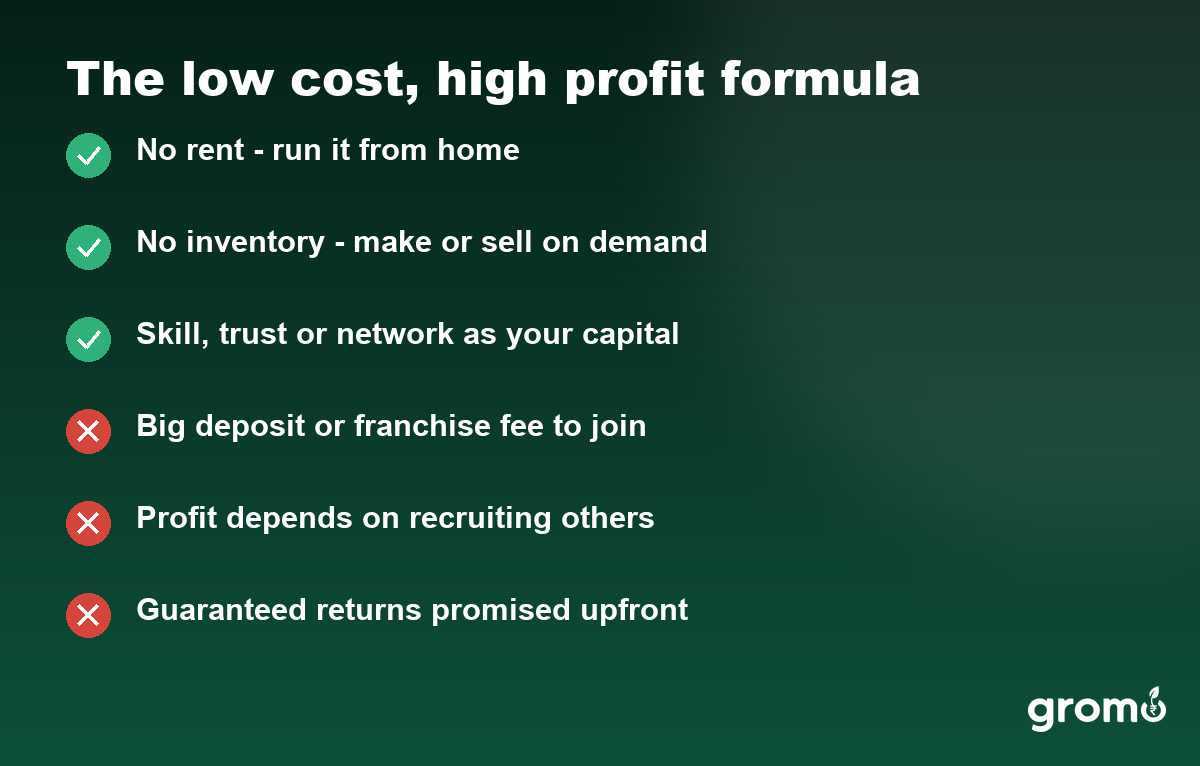
What Makes a Business Low Cost but High Profit?
- No rent: operating from home removes the single biggest fixed cost that eats small business profits.
- No inventory risk: models where you make-to-order, resell on demand, or sell services can never leave you with dead stock.
- Skill and trust as capital: when the "raw material" is your knowledge or your network, cost of goods is nearly zero — which is why tuition, services, and commission businesses hit 70–90% margins.
- Digital distribution: WhatsApp, Instagram, and UPI replace the marketing and billing infrastructure that used to cost lakhs.
Keep those four levers in mind — every idea below scores high on at least three.
1. Tiffin Service and Cloud Kitchen
Home-cooked meals for office workers, students, and PG residents — sold on weekly or monthly subscriptions, which means predictable revenue and zero waste when you cook against confirmed orders. Why high profit: your kitchen already exists, ingredients are bought at retail-but-bulk prices, and subscriptions remove marketing costs after the first customers. Margins run 30–40%, and a cloud kitchen listing on delivery apps scales the same kitchen further.
Investment: ₹3,000–₹15,000 | Monthly income: ₹15,000–₹60,000 | Margin: 30–40%
2. Selling Financial Products with GroMo
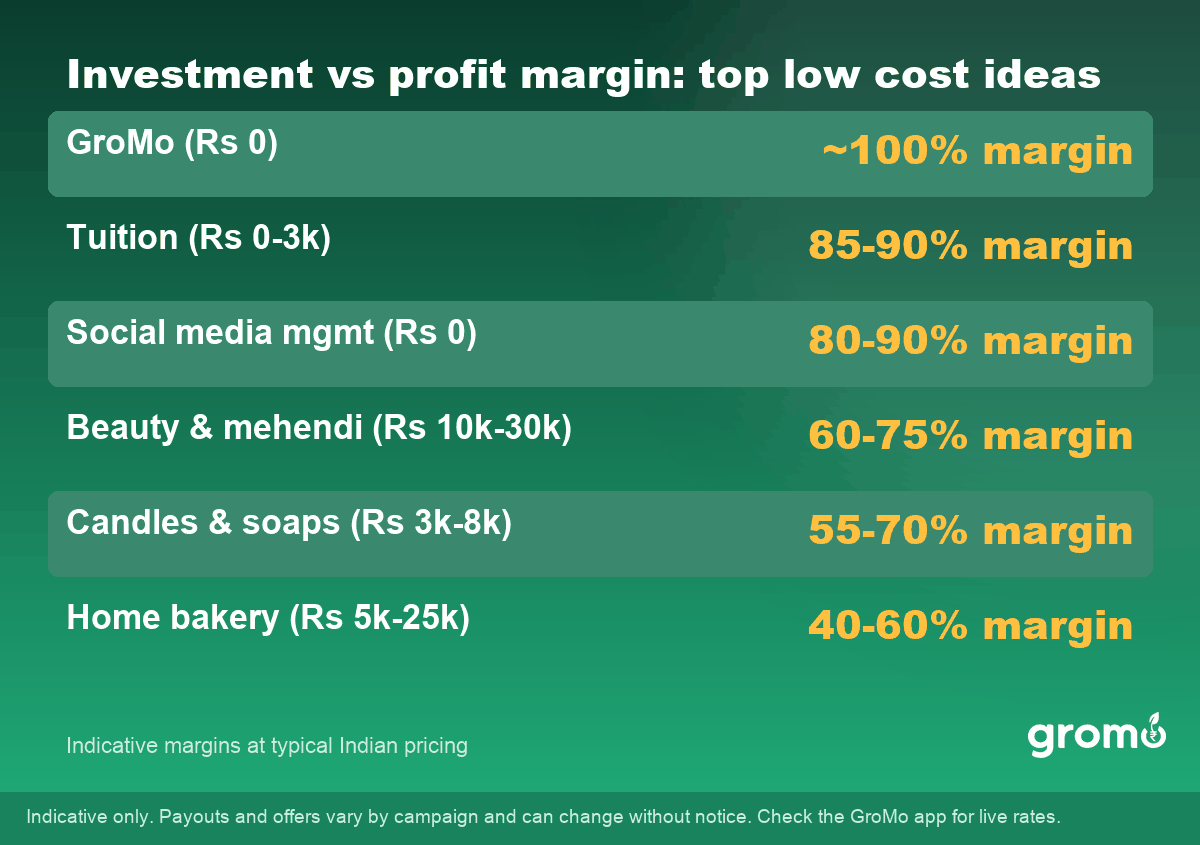
This is the lowest-budget entry on the list — almost zero budget, because no investment is required at all. As a GroMo Partner you help people in your circle get savings accounts, credit cards, loans, demat accounts, and more from India's leading banks and regulated financial companies, and the institutions pay you a commission on every approved application — a single credit card approval can pay ₹1,000–₹2,000+.
Why high profit: there is nothing to buy, stock, ship, or rent — so practically everything you earn is profit. The business runs on an asset you already own: your audience. Your family, friends, colleagues, society groups, and social media followers all need financial products at some point; your earning scales directly with how much trust and reach you have, and grows as customers return for their next product. GroMo adds free training and a tracking dashboard, so the only real investment is a few focused hours a week.
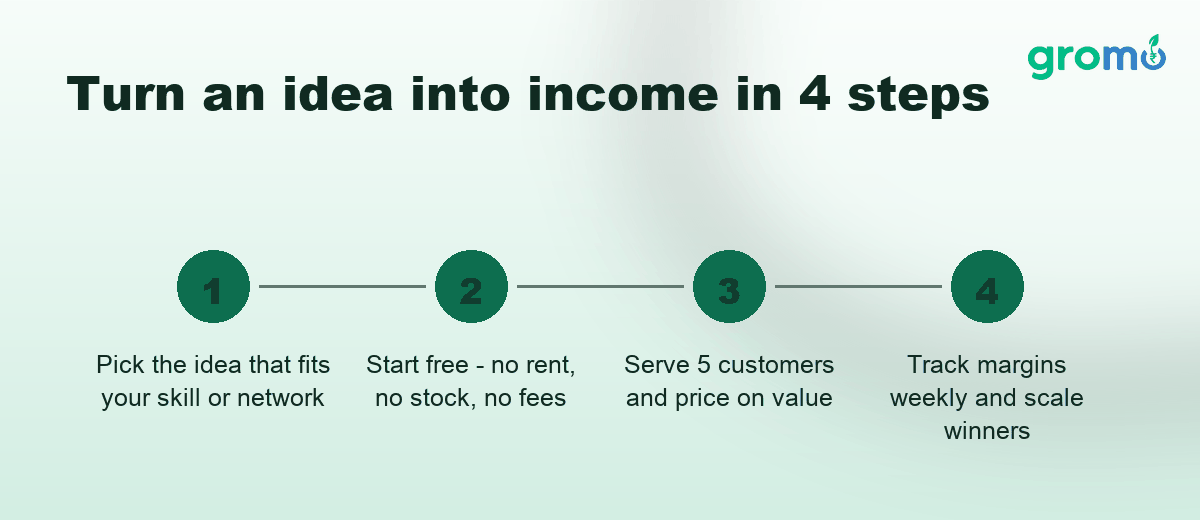
How to start: download the GroMo app, finish the free training, list 20 people who need a financial product, and help five of them this week.
Investment: ₹0 | Monthly income: ₹5,000–₹50,000+ | Margin: effectively 100%
3. Online Reselling with Meesho and WhatsApp
Share catalogue products with your margin added; the platform handles delivery, payments, and returns. Why high profit: zero inventory means zero risk — you never own stock, so every sale is pure margin on top of the platform price. The winners curate for a specific audience instead of forwarding everything.
Investment: ₹0 | Monthly income: ₹3,000–₹20,000 | Margin: your markup, typically 15–30%, on zero capital
4. Home Bakery and Custom Chocolates
Cakes, brownies, and gift boxes ordered on Instagram and WhatsApp. Why high profit: baked goods carry 40–60% margins because customers pay for occasion and customisation, not ingredients — a ₹300-cost cake sells at ₹800–₹1,200. Festival and wedding seasons multiply order volume.
Investment: ₹5,000–₹25,000 | Monthly income: ₹10,000–₹60,000 | Margin: 40–60%
5. Tuition and Coaching Classes
Batches of 5–10 students in the evening, at home or online. Why high profit: the product is knowledge you already have — margins touch 90% because there is nothing to manufacture. Two evening batches out-earn many office salaries, and results compound into referrals.
Investment: ₹0–₹3,000 | Monthly income: ₹10,000–₹50,000 | Margin: 85–90%
6. Mobile and Gadget Repair
A 2–3 month repair course (₹5,000–₹15,000) plus a basic toolkit starts a service every neighbourhood needs weekly. Why high profit: customers pay for skill and urgency — parts cost a fraction of the repair bill, and word of mouth replaces marketing entirely.
Investment: ₹10,000–₹30,000 (incl. course) | Monthly income: ₹15,000–₹50,000 | Margin: 50–70%
7. Beauty Parlour and Mehendi at Home
A spare room and certified skills run a parlour without a salon's rent and staff. Why high profit: services are labour, not goods — product cost per facial or mehendi booking is tiny against what clients pay, and bridal season bookings command premium rates.
Investment: ₹10,000–₹30,000 | Monthly income: ₹10,000–₹50,000 | Margin: 60–75%
8. Candle, Soap and Gifting Products
Scented candles and artisanal soaps made in your kitchen, sold via Instagram, exhibitions, and corporate gifting. Why high profit: raw materials are cheap and buyers pay for fragrance, packaging, and story — a ₹60-cost candle retails at ₹250–₹400. Bulk festival orders change the math further.
Investment: ₹3,000–₹8,000 | Monthly income: ₹5,000–₹25,000 | Margin: 55–70%
9. Digital Products and Online Courses
E-books, exam notes, templates, recipe collections, and mini courses — made once, sold forever. Why high profit: after creation, each sale costs nothing to deliver, so margin approaches 100%. The honest catch: you need an audience or marketplace before sales flow, so pair it with content or an existing network.
Investment: ₹0 | Monthly income: ₹2,000–₹30,000+ | Margin: ~100% after creation
10. Social Media Management for Local Businesses
Salons, cafes, clinics, and coaching centres need Instagram handled; you sell a monthly package of posts, replies, and a report. Why high profit: your costs are time and a phone — a ₹5,000–₹15,000 monthly retainer is nearly all margin, and three clients make a serious home income.
Investment: ₹0 | Monthly income: ₹9,000–₹45,000 | Margin: 80–90%
11. Print-on-Demand Merchandise
Design t-shirts, mugs, and posters; a print partner produces and ships each order. Why high profit in practice: the per-unit margin is a modest 20–40%, but you invest nothing in stock, so return on capital is effectively infinite — the only real spend is your design time. Niche designs (one college, one profession, one fandom) beat generic ones.
Investment: ₹0–₹2,000 | Monthly income: ₹2,000–₹25,000 | Margin: 20–40% with zero stock risk
12. Fitness and Yoga Coaching
Morning and evening batches at a park, terrace, or on video calls — certification courses cost ₹10,000–₹25,000 and pay back in weeks. Why high profit: one hour serves 10–20 paying clients simultaneously, and recurring monthly fees make income predictable. Health spending in India keeps climbing.
Investment: ₹5,000–₹25,000 | Monthly income: ₹10,000–₹40,000 | Margin: 80–90%
13. Event and Balloon Decoration
Birthdays, baby showers, and society functions every single weekend. Why high profit: materials for a typical decoration cost ₹800–₹2,500 while clients pay ₹3,000–₹10,000 — you are charging for design sense and execution, not balloons. Cake shop and photographer tie-ups keep the pipeline full.
Investment: ₹5,000–₹15,000 | Monthly income: ₹8,000–₹35,000 | Margin: 55–70%
14. Pickle, Papad and Masala Brand
The classic household business, modernised by courier services and Instagram. Why high profit: family recipes command premium prices against grocery-store products — homemade achar sells at 2–3× ingredient cost, and shelf-stable products let you produce in efficient batches on your own schedule.
Investment: ₹2,000–₹8,000 | Monthly income: ₹8,000–₹30,000 | Margin: 45–60%
15. YouTube Channel and Blogging
Content in a niche you genuinely know — cooking, local finance, repair, farming — monetised through ads, sponsorships, and affiliate income. Why high profit: production costs are near zero and income streams stack on the same content. The trade-off is time: expect 8–18 months of consistent publishing before meaningful money, then compounding after.
Investment: ₹0–₹3,000 | Monthly income: ₹0 early, later ₹5,000–₹1,00,000+ | Margin: 90%+ once monetised
How to Keep a Low Cost Business High Profit
- Price on value, not cost. Underpricing is the most common margin killer — charge for the occasion, skill, or urgency you serve.
- Say no to inventory as long as possible. Make-to-order and resell-on-demand until demand is proven.
- Let customers market for you. Every idea above grows fastest on referrals; ask for one after every happy order.
- Track weekly. Money in, money out, repeat customers. A business you do not measure quietly becomes a hobby.
- Avoid fake "businesses." Anything demanding a big deposit, franchise fee, or recruiting others is designed to profit from you, not with you.
Which Low Cost Business Should You Pick?
- Have an audience or strong network? GroMo (#2) — zero budget, effectively 100% margin, and it monetises trust you already own.
- Love cooking? Tiffin (#1), bakery (#4), or a pickle brand (#14).
- Have a skill or can learn one fast? Tuition (#5), repair (#6), parlour (#7), fitness coaching (#12).
- Want zero-risk product businesses? Reselling (#3) and print-on-demand (#11).
- Playing the long game? Digital products (#9) and YouTube (#15) — slowest start, best economics at scale.
Start with one idea, five customers, and ninety days of consistency — that sequence turns any of these fifteen from an idea into an income. And if you want the single cheapest start on this list, become a GroMo Partner today: zero investment, free training, and a business built entirely on the audience you already have.
FAQ: Low Cost Business Ideas with High Profit
Which business has the lowest investment and highest profit?
Businesses where your skill, trust, or network is the capital: selling financial products with GroMo (Rs 0 investment, effectively 100% margin since there is nothing to buy or stock), tuition (85-90% margin), and social media management for local businesses (80-90% margin). All three can start today and reach Rs 10,000-50,000 monthly with consistency.
What is the cheapest business to start from home?
GroMo, online reselling, tuition, social media management, and digital products all start at Rs 0 — your phone and time are the entire setup. Production businesses like candles, pickles, or a tiffin service start under Rs 10,000. Nothing on this list needs a loan to begin.
How much profit can a low investment business make monthly?
Realistic ranges for consistent part-time effort: Rs 3,000-20,000 from reselling, Rs 8,000-35,000 from craft and service businesses, Rs 10,000-50,000 from tuition, repair, parlour work, and tiffin services, and Rs 5,000-50,000+ from GroMo depending on your network. Most ideas take 2-6 months to stabilise; content businesses take longer but scale furthest.
Why are these businesses high profit despite low investment?
Because the four big costs of traditional business — rent, inventory, staff, and marketing — are removed. You operate from home, make or sell on demand, work solo at the start, and grow through WhatsApp and referrals. When the input is your skill or network rather than purchased stock, most of the revenue stays with you as profit.
Can I run these businesses alongside a job?
Yes — most were designed for exactly that. GroMo, reselling, digital products, social media management, and evening tuition batches all fit around working hours. Food and decoration businesses are weekend-heavy. Start part-time, prove the income for 90 days, and scale hours only when the earnings justify it.
Disclaimer
Nothing here is a guarantee of income or profit. All investment figures, income ranges, and margin estimates are indicative for typical consistent effort; actual results vary with location, pricing, demand, and execution. GroMo commissions are set by partner banks and financial institutions, vary by product and campaign, and are paid only on approved applications — check the live commission in the GroMo app before relying on any figure. GroMo is available only to users aged 18 and above.
Everything above is general information, not financial, legal, or tax advice. Verify current licensing requirements for food, beauty, and fitness services in your state, and never pay a deposit or joining fee to any platform that promises earnings.


