
Earn ₹1,000 Daily Online with GroMo: 2026 Commission Guide


Earning ₹1,000 a day online through GroMo comes down to one simple loop: refer 3–5 people a day to a financial product they actually need — a credit card, a personal loan, a zero-balance savings account — and let the bank's commission do the rest. You're not clicking ads for pennies or gambling on crypto. You're connecting people to products they were going to need anyway, and the payout lands in your account within hours of approval.
Over 60 lakh partners already use GroMo's zero-investment platform this way, and a meaningful share of them are consistently pulling in ₹30,000–₹50,000 a month by helping 3–5 people a day. This guide walks through the math, the products, the daily routine, and the mistakes that quietly cap most people's earnings.
What's changed in this guide (last updated August 2026)
This is a refreshed version of an earlier post. The core method hasn't changed — commission-based referrals still work the same way — but a few things have been updated: outdated year-over-year commission comparisons have been removed since they can't be verified going forward, the daily-routine section has been expanded with a clearer time-block breakdown, and a new section now directly covers whether this model works for people in tier 2 and tier 3 cities, since that's one of the most common searches that lands on this page. If you're weighing this against other side incomes, it's also worth reading this roundup of legitimate ways to make money online in India before you commit your time.
Why hitting ₹1,000 a day is realistic

The math is blunt. One approved credit card typically pays ₹300–₹800. A personal loan pays a percentage of the loan value — get a ₹50,000 loan approved and you're looking at roughly ₹1,000–₹2,000, credited soon after approval.
It gets predictable once you know your own numbers. Send links to 10 people who genuinely need the product, and typically 2–3 will apply. If your average payout per approval sits around ₹300–₹400, hitting ₹1,000 a day just means staying consistent, not lucky. That reliability is what separates financial product distribution from anything that depends on ad views or referral games.
GroMo works with established names — Axis Bank, Kotak 811, Upstox, Paytm Money, and Bajaj Finserv among them. Payout timing and rates differ by product, but you're never carrying inventory or running an office. You're a connector, and every adult eventually needs a bank account, a credit card, or a loan.
Start Earning ₹1,000 Daily — Download GroMo Now
Which financial products pay the most commission?
Not every product pays the same, and matching effort to payout matters more than chasing volume. Here's how the main categories generally compare:
| Product | Typical payout | Best for |
|---|---|---|
| Credit cards | ₹1,750–₹3,750 per approval | Salaried people with a payslip — fastest, easiest approvals |
| Personal loans | 2–4% of loan value | People needing quick cash for emergencies, weddings, or debt consolidation |
| Zero-balance savings accounts | Lower per-activation payout, high volume | Anyone with PAN and Aadhaar — easy referrals, no income proof needed |
| Demat accounts | Higher fixed payout per funded account | Millennials and Gen Z starting out in investing |
| SIPs / mutual fund starts | Payout after a minimum holding period | People already comfortable with monthly savings discipline |
Credit cards are usually the easiest first sell because approval is fast and the customer sees the benefit immediately. Personal loans pay the most per successful referral, which is why partners who get comfortable with loan conversations tend to earn more overall — see RBI-approved loan apps and how their payouts work for specifics. Zero-balance savings accounts pay less per sign-up but almost anyone qualifies, so they're a good way to keep daily numbers steady between bigger-ticket sales.
How should you structure your day to hit ₹1,000?
The partners who hit their number consistently treat this like a schedule, not a random hustle. A simple time-block approach works well:
| Time block | What to do |
|---|---|
| Morning (7–10 AM) | Post one credit card or savings offer on your WhatsApp status with a short, specific line — people check phones first thing. |
| Midday (12–2 PM) | Catch working professionals on lunch break. This is a good window for salary account upgrades or demat account conversations. |
| Evening (6–9 PM) | Family and friend conversations happen now. Share loan options in local groups, or follow up with anyone who clicked a link earlier. |
| Weekends | People have time to actually fill out forms. Use this window for detailed comparisons and offer to walk someone through an application. |
Throughout the day, find 3–5 people who have an actual need — someone complaining about medical bills gets a loan link, a friend annoyed about bank charges gets a zero-balance account link. GroMo's customer management tools show you who's clicked, so following up isn't guesswork.
Which product fits which type of customer?
Salaried employees (₹20,000–₹50,000/month): Best for entry-level credit cards and small loans. A salary slip speeds up approval significantly.
Self-employed and business owners: They usually care more about getting approved than getting the lowest rate. Suggest premium cards or business-friendly loan products with flexible documentation.
Students and first-time earners: Need to build credit from scratch. Zero-balance accounts and secured cards against a fixed deposit are a natural fit — this is also where building a credit history early pays off for the customer long-term.
Investors: Already know what they want. Talk brokerage costs and platform tools rather than basics.
People with a weak or thin credit file: Some lenders look at income and banking history rather than just a CIBIL score. Being the person who can still get them approved when a big bank says no builds long-term trust — and referrals. For a deeper look at what's available to this group, see loan options for people with low or bad credit scores.
Is GroMo a good option for tier 2 and tier 3 city residents without investment?
Yes — GroMo's model was built specifically to remove the two biggest barriers tier 2 and tier 3 city residents face: capital and access to a formal sales network. There's no fee to join, no stock to buy, and no office to rent. All you need is a smartphone and people in your network who need a bank account, card, or loan — which, in smaller cities, is often a bigger untapped need than in metros where banks already compete hard for customers.
The app's academy and webinars support this directly with regional language content in Hindi, Tamil, Telugu, Marathi, and Bengali, so the training barrier isn't English fluency. Many partners outside metro cities lean on trust-based selling — they're already the person their neighbourhood asks about money — rather than cold outreach, which tends to convert better anyway. If you're comparing this against other zero-investment options before deciding where to put your time, this breakdown of earning ₹10K–₹1L monthly with zero investment is a useful next read.
Real partner examples

Rajesh, in Pune, has a corporate job and spends about 90 minutes a day on GroMo — 30 minutes on his commute, an hour after dinner. He sticks to credit cards for coworkers and loans for extended family, and stays close to ₹1,000–₹1,400 in average daily earnings when he keeps up that routine.
Priya, in Jaipur, is a homemaker who runs a WhatsApp group of 250+ women focused on household finance. She doesn't pitch products — she answers questions, and referrals follow naturally through savings accounts, demat accounts, and SIP starts.
Amit, in Bangalore, is a student who built his network around university staff and students, mixing education loan referrals with smaller personal loan and card sign-ups to keep his income steady across the month.
What they have in common: they show up daily, solve an actual problem for the person in front of them, and don't treat a single good day as a reason to stop.
What mistakes quietly kill your GroMo earnings?
Spamming. Sending "apply for loan" to your entire contact list gets you ignored or blocked. Talk to people first, find out what they actually need, then send the link.
No follow-up. If someone clicks a link but doesn't finish the application, most partners just move on. Use the in-app tracking tool instead and send a short nudge — "saw you started the application, need help?" A follow-up like this recovers a meaningful share of otherwise-lost sales.
Only chasing big-ticket loans. If you only push large loans, you skip the majority of people who need something smaller — a card or a savings account. Mix ticket sizes.
Ignoring the rules. Don't promise approvals, don't collect KYC documents yourself, and don't offer cashback out of your own commission. These get accounts flagged. Stick to RBI-registered lending practices and let the platform handle documentation.
Stopping after a good day. Earning ₹5,000 in one day and then taking a week off resets your momentum with contacts who were mid-conversation. This works best as a daily habit, not a streak you chase occasionally.
How do you scale from ₹1,000 to ₹3,000–₹5,000 a day?
Build a small team. GroMo pays you a share when people you bring onto the platform earn money themselves. Teaching 10 people your process can turn into meaningful passive income on top of your own referrals.
Specialise. Become known as the "loan person" or "credit card person" in your circle. Once people associate you with a specific product, they come to you instead of the other way around.
Use short-form content. A short video explaining a card's perks or a loan's eligibility, with your GroMo link in the bio, can bring in leads well after you've stopped actively pitching.
Tap local groups. Housing societies and professional clubs are full of people who need financial products but rarely get a straightforward explanation. Offering a free 20–30 minute chat about finances turns attendees into warm leads.
Track your funnel. Know your ratio — clicks to applications, applications to approvals. If it takes 10 conversations to get 1 approval, schedule 30 conversations to get 3. For more structured ways to build this into a real monthly income, see these passive income ideas that pair well with referral work, or if you're doing this alongside a full-time job, this guide to earning ₹50K+ monthly with zero investment.
What free training does GroMo offer?
GroMo's in-app academy covers what you actually need on the ground — card features, loan eligibility, and how to answer "I'm not sure" without losing the lead. Certified partners generally sound more credible on a call, which shows up in approval rates.
Weekly webinars feature experienced partners covering practical tactics — turning a cold lead into a loan customer, or selling a credit card well through a WhatsApp status update. Product-specific explainer videos are short and focused, so you're not sitting through generic training before pushing a specific card or loan.
Compliance checklists appear before you share a link. Reading them takes a minute and prevents statements that could get a commission reversed later.
What tools inside the app actually help you earn more?
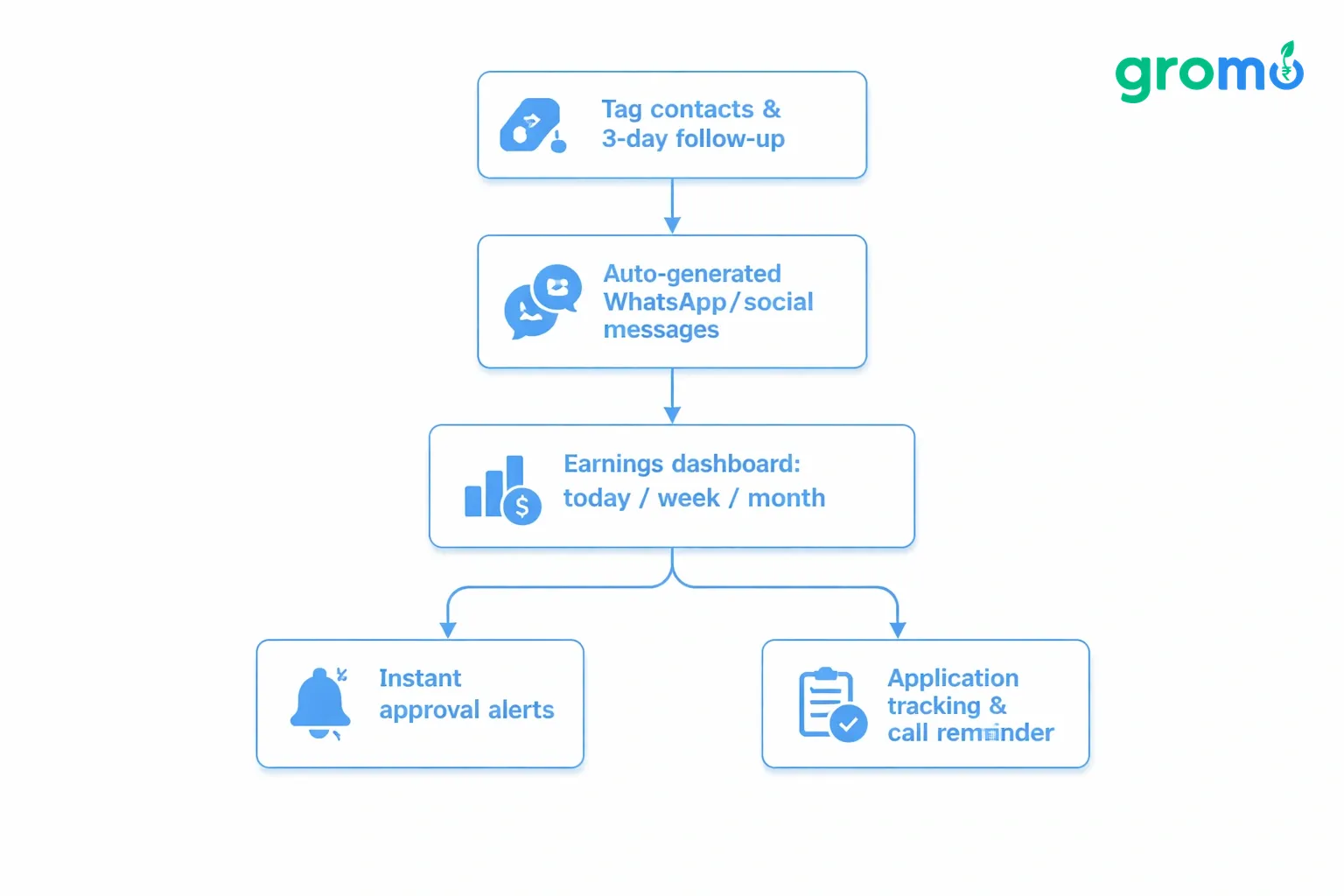
CRM features: Tag contacts by interest and get reminded to follow up after a few days.
Auto-generated content: Pick a product and an audience, and the app drafts the WhatsApp message or social post for you.
Dashboard: Shows earnings for today, this week, and this month — useful for spotting which days or products are underperforming.
Instant alerts: A notification the moment an approval happens, so you know immediately whether a pitch worked.
Application tracking: Shows exactly where a customer's application is stuck, so a quick call at the right moment can push it through.
Why is now a good time to start?
Digital payments are now the default way most people manage money, and that comfort has carried over to trust in digital credit cards and online loans — a shift covered in more detail in this look at India's fintech shift. Regulatory scrutiny on lending apps has also increased, which means sharing products through an RBI-approved lending platform carries more weight with customers than it used to — they've heard the horror stories about unregulated loan apps and actively look for the opposite.
Side income through a phone is no longer unusual — it's become one of the more normal ways people supplement a salary, which makes the conversation with a friend or family member easier to start than it was a few years ago.
Do you need to pay tax on GroMo income?
If your GroMo earnings push you over the basic exemption limit, you're required to file an ITR, and this income is generally treated as "income from business or profession" rather than salary. Here's a simple checklist to stay on top of it:
- Download your transaction history from the app regularly and save monthly statements — don't rely on the app being your only record.
- If your monthly income is consistently high enough to matter, consult a CA about advance tax and legitimate deductions like phone and internet bills used for the work.
- You don't need GST registration unless you're operating as a formal business entity crossing the relevant turnover threshold — most individual partners referring under their personal PAN don't need one.
- You don't need any special license to distribute financial products through GroMo — the platform holds the relevant registrations on its side.
If you eventually want to diversify beyond credit cards and loans, distributing mutual funds is one adjacent option worth understanding — see how mutual fund distribution commissions work in India before deciding if it fits your customer base.
FAQs
Q: What are the best commission-based earning platforms for tier 2 city residents without investment?
A: Platforms like GroMo work well because they need no capital, no office, and no formal sales experience — just a phone and a network. Partners in tier 2 and tier 3 cities often do well because trust-based referrals convert better in smaller communities than cold outreach does in metros.
Q: How can I make ₹1,000 a day with GroMo?
A: Refer 3–5 financial products daily. Credit cards typically pay ₹300–₹800, loans pay 2–4% of the loan value, and savings accounts pay a smaller flat amount per activation. Focus on people who genuinely need the product, show up daily, and use the app's tracking to follow up on stalled applications.
Q: Can I use AI tools to help with this?
A: Not to make money directly, but tools like ChatGPT can help you draft WhatsApp pitch messages or explainer posts about a card's benefits faster. Pair that drafted content with your GroMo referral link rather than relying on it to generate leads on its own.
Q: How do I earn around ₹500 in an hour?
A: Focus on higher-commission products during a focused window. Spend an hour calling 5–7 loan prospects during lunch hours (12–2 PM) — if two apply and one ₹50,000 loan gets approved, that single hour can clear ₹1,000–₹1,500 depending on the payout rate.
Q: What other income sources pair well with GroMo commissions?
A: Salary, rental income, fixed deposit interest, freelancing, and referral team income (when people you bring onto GroMo start earning) are common combinations. GroMo itself can cover both a direct commission stream and a smaller passive one through team referrals.


