
How to Sell a Credit Card in India: Steps, Script & Earnings
Learn how to sell a credit card in India — get cards to sell, find customers online and offline, match cards right, plus a ready Hindi call script.

Selling credit cards is one of the highest-paying skills an ordinary person can learn in India — banks pay ₹1,000–₹2,000+ for every approved card, and they never stop needing new customers. Yet most people who try it fail, because they pitch cards like salespeople instead of matching cards like advisors. This guide teaches the real method end to end: where to get cards to sell, how to find customers online and offline, how to match the right card to the right person, and exactly what to say — including a ready-to-speak pitch and a full Hindi call script you can use today.
Step 1: How to Get Credit Cards to Sell
Before you can sell, you need authorised access to cards. (New to the role? Start with what a credit card agent is — types, eligibility, and documents.) There are three routes in India:
- Become a bank DSA (Direct Selling Agent): you sign up with one bank, often through an agency. Works, but you are limited to that single bank's cards, onboarding takes time, and some agencies charge fees.
- Join a bank's tele-sales or branch team: a job, not a business — fixed hours, fixed salary, one bank's products.
- Use a distribution platform like GroMo: one free registration gives you credit cards from India's leading banks in a single app — along with savings accounts, loans, and demat accounts to cross-sell later. There is no joining fee, no exam, and no target pressure — you can become a credit card agent without investment: you complete sign up, finish the free training, and can share your first card link the same day. When a customer's application is approved, the bank pays the commission into your account through the platform.
For beginners, the platform route wins on every axis that matters: multiple banks (so you can genuinely match cards to customers instead of pushing one bank's product), zero investment, and tracking — the app shows every application's status, so you know what you will be paid and when. That multi-bank access is not a convenience; it is the foundation of the honest selling method in this guide.
Step 2: Know Your Cards Before You Sell One
Customers do not buy "a credit card" — they buy fuel savings, airport lounges, cashback on groceries, or their first step into the credit system. Learn the five card families and you can serve almost anyone:
- Cashback cards — flat or category cashback on everyday spending. Best for online shoppers and household spenders.
- Travel and rewards cards — points, air miles, lounge access. Best for frequent travellers and professionals.
- Fuel cards — surcharge waivers and fuel points. Best for daily commuters, cab and delivery drivers.
- Lifetime-free cards — no annual fee, simpler benefits. Best for first-time users and fee-averse customers.
- Secured cards — issued against a fixed deposit. Best for people with no credit history or a low CIBIL score who want to build credit.
Spend one evening in your platform's training on the specific cards you can distribute — their joining fees, welcome bonuses, and eligibility — and read our guide on how to sell credit cards effectively with GroMo for deeper product tactics. Ten cards known deeply beat a hundred known vaguely.
Step 3: How to Find Customers — Offline and Online
Your offline network (start here)
Your first 20 customers already know you. Make an actual list — this is the step most beginners skip:
- Family and relatives paying annual fees on cards that don't match their spending.
- Friends and colleagues — every salaried person is eligible for something; many still don't have a card.
- Local shopkeepers and business owners — they run high monthly expenses and love fuel/cashback savings; visit during quiet hours.
- Society and community groups — festivals, RWA meetings, and kitty groups are natural moments to mention what you do.
- Referrals — after every approved card, ask one question: "Aapke jaan-pehchaan mein kisi ko card chahiye?" One happy customer typically knows two more — the same engine behind every credit card refer and earn program.
Digital channels (scale here)
- WhatsApp — your most powerful tool. Post one useful card tip or offer on your Status weekly (not daily spam). Share application links in one-to-one chats, never blast groups.
- Instagram and Facebook — short reels comparing two cards, "5 things before your first credit card", festival offer alerts. Local Facebook groups ("Jobs in Indore", "Delhi startups") are full of first-card seekers.
- LinkedIn — for premium travel and rewards cards; salaried professionals are the ideal audience.
- Content compounding — a simple YouTube or regional-language channel answering card questions turns strangers into inbound leads while you sleep.
The rule across both: be the person who explains, not the person who pushes. Educational posts get shared; sales blasts get muted.
Step 4: Match the Right Card to the Right Customer
This table is the heart of honest credit card selling — and of high approval rates, because a matched customer completes the application and passes the bank's checks:
| Customer profile | What they need | Recommend |
|---|---|---|
| Salaried, shops online often | Everyday savings | Cashback card |
| Travels for work or holidays | Lounge access, miles | Travel/rewards card |
| Daily commuter, cab/delivery driver | Fuel savings | Fuel card |
| First job, no credit history | Easy approval, no fee | Lifetime-free entry card |
| Low CIBIL score or no income proof | Credit building | Secured card against FD |
| Business owner, high monthly spends | Higher limits, business perks | Premium cashback/business card |
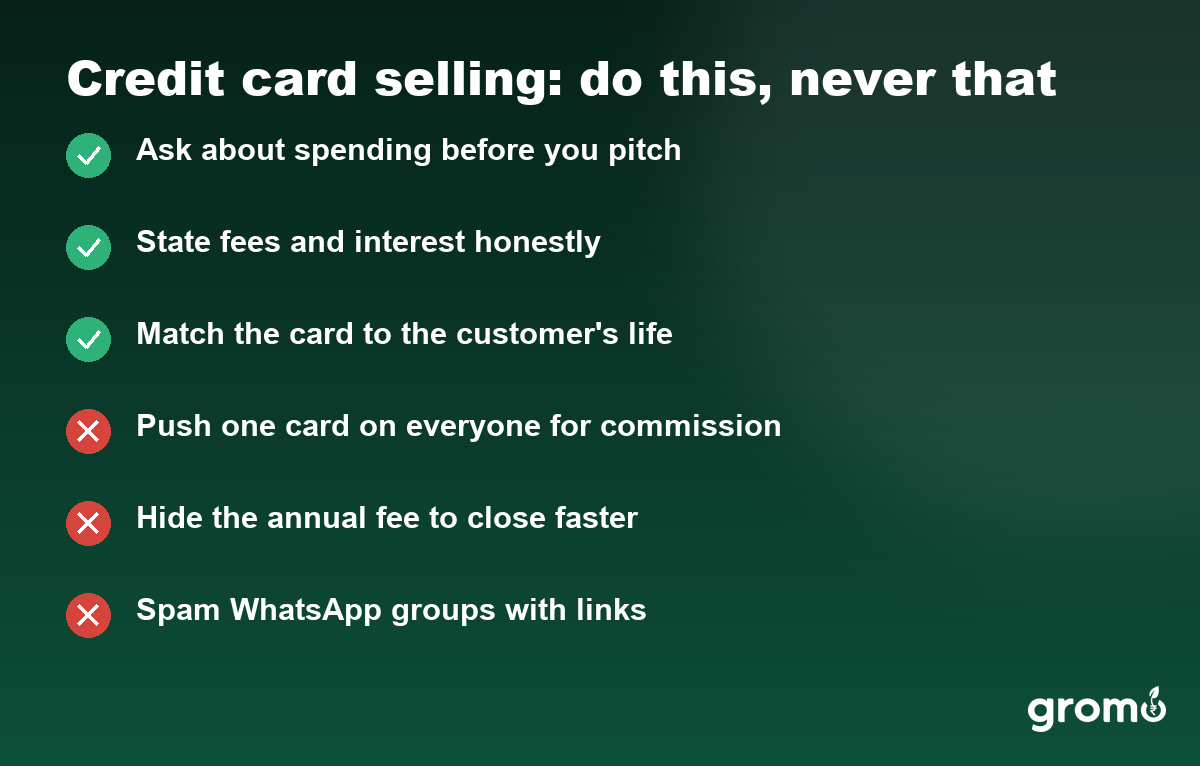
Two honest rules that protect your reputation: never push a card on someone who struggles to repay, and always mention the annual fee and interest reality — "card ka fayda tabhi hai jab aap time par bill bharein." Customers remember the agent who told them the truth, and they return for their next product.
Step 5: Your Ready-to-Speak Pitch
Memorise this 30-second structure — it works face to face, on WhatsApp voice notes, and as your call opening:
"Hi [Name], I help people find credit cards that actually match how they spend — from India's top banks, and my help costs you nothing. Quick question: what do you spend most on every month — online shopping, fuel, or travel? … Based on that, there's a card that gives you [specific benefit] and the application takes 10 minutes from your phone. I'll guide you through it, and you'll know the status at every step. Shall I send you the link?"
Notice what it does: states your role, asks one discovery question, matches a specific benefit, makes the next step tiny. That is the entire art.
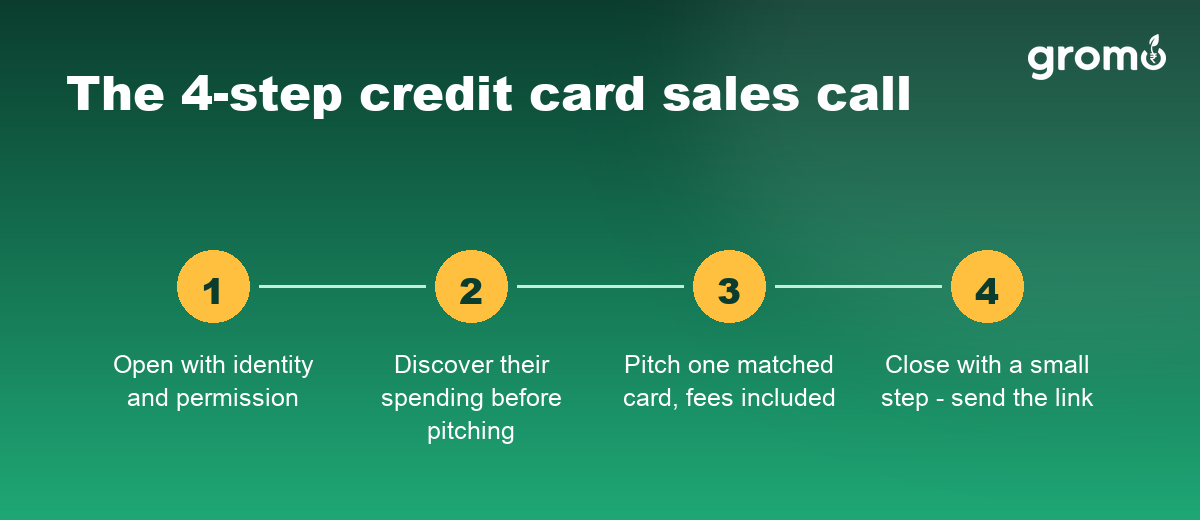
How to Sell a Credit Card on Call: The 4-Step Method
- Open with identity and permission (15 sec): who you are, why you're calling, "is this a good time?" Respect earns attention.
- Discover before you pitch (60 sec): two or three questions about their spending — never present a card before you know what they need.
- Pitch one matched card (60 sec): one card, two or three benefits tied to what they just told you, fee stated honestly.
- Close with a micro-step (30 sec): not "buy this" but "main aapko WhatsApp par link bhej deta hoon" — small yeses lead to applications.
Speak 40%, listen 60%, and keep the call under five minutes. If they are busy, book a time — a scheduled call converts far better than a rushed one.
Credit Card Sales Pitch in Hindi: Full Call Script
Opening —
"नमस्ते [नाम] जी, मैं [आपका नाम] बोल रहा हूँ। मैं लोगों को उनके खर्च के हिसाब से सही क्रेडिट कार्ड चुनने में मदद करता हूँ — देश के टॉप बैंकों के कार्ड्स, और मेरी मदद बिल्कुल फ्री है। क्या दो मिनट बात कर सकते हैं?"
Discovery —
"आपका सबसे ज़्यादा खर्च किस चीज़ पर होता है — ऑनलाइन शॉपिंग, पेट्रोल, या ट्रैवल?" … "अभी कोई क्रेडिट कार्ड इस्तेमाल करते हैं? उसमें क्या अच्छा नहीं लगता?"
Matched pitch (example: cashback card) —
"जैसा आपने बताया, आपकी ज़्यादातर शॉपिंग ऑनलाइन होती है। उसके लिए [बैंक] का कार्ड सबसे सही रहेगा — हर ऑनलाइन खर्च पर कैशबैक, और पहले साल की फीस भी माफ़ है। मतलब जो खर्च आप वैसे भी करते हैं, उसी पर पैसे वापस मिलेंगे।"
Objection: "ज़रूरत नहीं है" —
इससे आपका CIBIL स्कोर बनता है
Objection: "फीस कितनी है?" —
"अच्छा सवाल है। इस कार्ड की जोइनिंग फीस [X] है, लेकिन वेलकम बेनिफिट उससे ज़्यादा का मिलता है। और अगर आप बिल टाइम पर भरते हैं तो कोई ब्याज नहीं लगता — मैं आपको पूरा हिसाब भेज देता हूँ।"
Close —
"ठीक है, मैं अभी आपको WhatsApp पर लिंक भेजता हूँ — सिर्फ 10 मिनट लगते हैं, PAN और Aadhaar से हो जाता है। कोई दिक्कत आए तो मैं साथ में हूँ। और हाँ — approval के बाद भी कुछ पूछना हो तो मुझे ही कॉल कीजिएगा।"
Referral ask (after approval) —
"[नाम] जी, कार्ड approve हो गया, बधाई हो! आपके जान-पहचान में कोई हो जिसे सही कार्ड चाहिए, तो मेरा नंबर दे दीजिएगा — उनकी भी फ्री में मदद कर दूँगा।"
Practise the script aloud five times, then stop reading it — the structure should stay, your own words should flow.
After the Yes: Application, Approval, and Your Commission
- Send the link and stay on WhatsApp while they apply — most drop-offs happen at document upload, and your presence fixes that.
- Set expectations: approval is the bank's decision, based on income, CIBIL score, and documents. Tell the customer honestly — it builds trust even when a bank declines.
- If declined: suggest the fallback (a secured card or an entry-level card), which often converts the same customer anyway.
- Track and follow up: your platform dashboard shows each application's stage; follow up within 24 hours of any stall. Commissions are credited after approval — on GroMo you can see the exact payout per card before you ever pitch it.
Mistakes That Kill Credit Card Sales
- Pitching before asking a single question — the number one beginner error.
- Hiding fees — one surprised customer costs you ten referrals.
- Pushing one card on everyone because its commission is higher.
- Spamming groups instead of building one-to-one trust.
- Stopping after the sale — the follow-up and referral ask is where the business compounds.
Selling credit cards well is really advising well: know your cards, find people through the trust you already have, match honestly, and speak simply. Do that consistently and the numbers take care of themselves — active agents earn ₹10,000–₹50,000+ a month, and every satisfied customer becomes next month's pipeline. If you want to start today with cards from India's leading banks, zero investment, and payouts you can track, become a GroMo Partner, finish the free training, and make your first call from the script above.
FAQ: How to Sell a Credit Card
How can I sell a credit card online?
Register free on a distribution platform like GroMo, complete KYC and training, then share card application links through WhatsApp, Instagram, Facebook groups, and LinkedIn. The customer applies digitally with PAN and Aadhaar in about 10 minutes, you track the application in the app, and the bank's commission is paid to you after approval. Educational content — card comparisons, tips, offer alerts — brings inbound customers over time.
How much can I earn by selling credit cards?
Banks pay roughly Rs 1,000-2,000+ per approved credit card depending on the card and campaign. Part-time agents helping a few customers a month earn Rs 5,000-15,000, while consistent agents working their network and digital channels earn Rs 10,000-50,000+ monthly. Commissions vary by product and are paid only on approved applications — always check live rates in your platform app.
Do I need any qualification or licence to sell credit cards?
No degree or licence is required. Banks authorise distribution through DSAs and platforms — on GroMo you simply complete KYC with PAN and bank details, and finish the free in-app training. What actually determines success is product knowledge and trust, not certificates.
How do I convince a customer to take a credit card?
Don't convince — match. Ask two or three questions about their spending (online shopping, fuel, travel), then recommend one card whose benefits fit that answer, stating the fee honestly. Follow the 4-step call method: open with permission, discover needs, pitch one matched card, close with a small step like sending the link on WhatsApp. Matched customers apply willingly and pass approval more often.
What if my customer's credit card application gets rejected?
Rejections are normal — banks decide on income, CIBIL score, and documents. Tell customers upfront that approval is the bank's call, and keep a fallback ready: a secured card against a fixed deposit or an entry-level lifetime-free card usually works for thin credit files. Handled honestly, a rejection still earns you the customer's trust and future business.
Disclaimer
Nothing here is a guarantee of income. All earning figures are indicative estimates; actual earnings depend on your network, effort, approval rates, and campaigns. Credit card commissions are set by the issuing banks, vary by product and campaign, and are paid only on approved applications — check the live commission in the GroMo app before quoting or relying on any figure. Card approval, limits, fees, and interest rates are decided entirely by the issuing bank. GroMo is available only to users aged 18 and above.
Everything above is general information, not financial advice. Always describe card fees and terms accurately to customers — mis-selling harms them and your own business.


