
BFSI Meaning: What Is BFSI? Full Form, Types, and Importance
BFSI meaning explained simply: the full form, what the sector includes, how it works, top companies, regulators, careers and its future in India.


BFSI meaning, in one line: BFSI stands for Banking, Financial Services, and Insurance, the umbrella term for the entire industry that manages money in an economy, from your savings account and UPI payment to your loan, mutual fund, and insurance policy. This guide explains the BFSI full form, what the sector includes, how the industry actually works, the companies and regulators inside it, and the careers it offers, in simple words with everyday examples.
BFSI: Quick Facts
| Question | Answer |
|---|---|
| BFSI full form | Banking, Financial Services, and Insurance |
| What it covers | Banks, NBFCs, loans, investments, mutual funds, payments, fintech, and all insurance |
| Main regulators in India | RBI (banking and NBFCs), SEBI (markets and mutual funds), IRDAI (insurance), PFRDA (pensions) |
| Why it matters | It moves credit, protects risk, and powers every payment in the economy |
| Career entry | From bank jobs needing degrees to agent and distribution roles needing none |
1. What Is BFSI? BFSI Meaning
BFSI is the collective name for every business that handles money professionally: accepting it, lending it, growing it, moving it, and protecting it. If a company touches your money as its core business, it is part of the BFSI sector.
An everyday example makes the meaning concrete. Your salary lands in a bank account (Banking), part of it goes into a mutual fund SIP and a personal loan EMI (Financial Services), and a health policy protects your family from hospital bills (Insurance). One salary, and all three arms of BFSI touched it within a day.
The sector is important because nothing else in the economy runs without it: businesses need credit to grow, families need safe savings and protection, and every digital payment travels on BFSI rails.
2. What Is the Full Form of BFSI?
The BFSI full form is Banking, Financial Services, and Insurance:
- B for Banking: institutions that accept deposits and lend money, your savings account, fixed deposits, and bank loans.
- F for Financial Services: everything money-related beyond plain banking, loans from NBFCs, investments, mutual funds, wealth management, payments, and fintech.
- I for Insurance: companies that protect people and businesses against risk, life, health, motor, and general insurance.
The three are deeply connected: banks distribute insurance and mutual funds, insurers invest premiums in financial markets, and fintechs stitch all of it into apps. That interdependence is why the industry is treated as one sector rather than three.
3. What Does the BFSI Sector Include?
Banking
Commercial banks form the base: public sector banks like SBI, private banks like HDFC Bank and ICICI Bank, small finance banks, payments banks, and cooperative banks. Digital banking has moved most of their services, accounts, deposits, transfers, and loans, onto phones.
Financial Services
This is the widest arm: loans and credit from banks and NBFCs, credit cards, investments in stocks and bonds, mutual funds, wealth management, and the payments and fintech layer of UPI, wallets, and digital lending platforms. NBFCs matter especially in India, lending where banks reach thinly; the NBFC loan app list shows how big that layer has become.
Insurance
Life insurance protects a family's income, health insurance covers medical costs, and general insurance covers everything else: motor, home, travel, and business risk. Insurers collect premiums, pool the risk, and pay claims when covered events happen.
4. How Does the BFSI Industry Work?
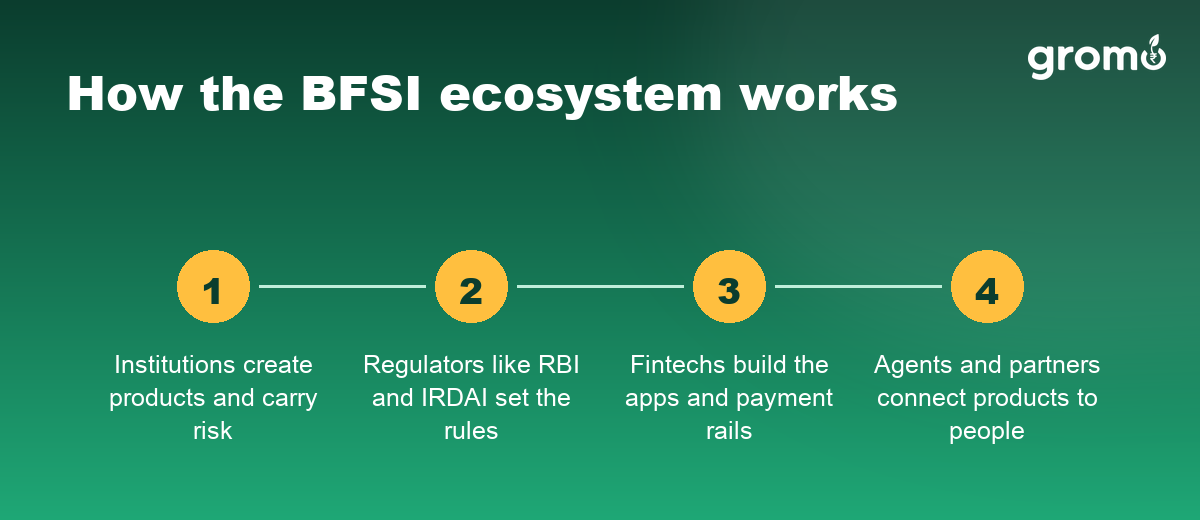
The industry is an ecosystem of five players working together:
- Institutions (banks, NBFCs, insurers, fund houses) create the products and carry the risk.
- Regulators (RBI, SEBI, IRDAI, PFRDA) set the rules that keep customer money safe.
- Fintechs build the technology rails: payment apps, lending platforms, and comparison tools.
- Agents, advisors, and channel partners connect products to customers, the human layer that explains, matches, and guides, from a DSA in banking to insurance advisors and platforms like GroMo.
- Customers complete the loop: their deposits become someone's loan, their premiums pool into claims, their investments fund businesses.
A simple ecosystem example: a shop owner applies for a business loan through an agent's app link; an NBFC approves and disburses it under RBI rules; the owner insures the shop; and repayments flow back as depositor interest and fresh lending capacity. Every player above appears in that one transaction.
5. Why Is the BFSI Sector Important?
- It funds growth: businesses and homes are built on credit the sector provides.
- It rewards saving: deposits, funds, and bonds turn idle money into growing money.
- It absorbs shocks: insurance converts catastrophic personal losses into manageable premiums.
- It moves money instantly: UPI and digital payments run on BFSI infrastructure.
- It includes the excluded: Jan Dhan accounts, microloans, and small-ticket insurance have pulled millions into the formal economy.
- It employs millions: from bank staff and actuaries to the growing army of agents and distribution partners.
6. Examples of BFSI Products and Services
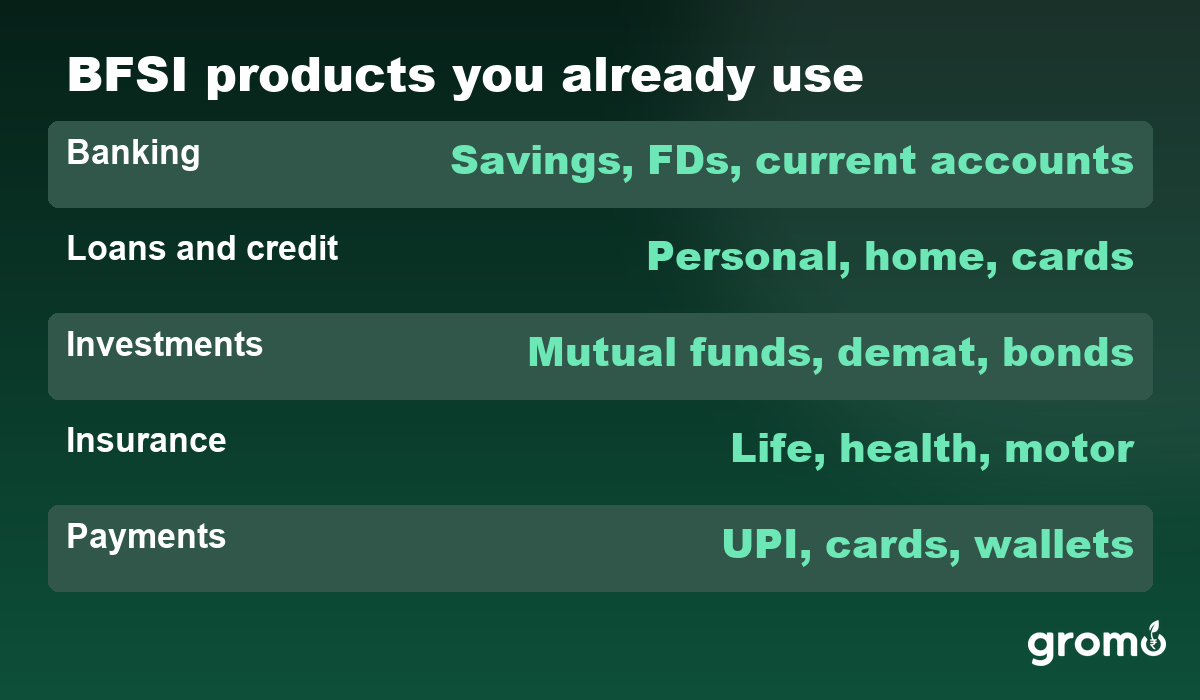
| Category | Examples |
|---|---|
| Banking | Savings accounts, current accounts, fixed deposits |
| Loans | Personal loans, home loans, business loans, credit cards |
| Investments | Mutual funds, bonds, demat accounts, wealth management |
| Insurance | Life, health, motor, and general insurance |
| Payments | UPI, debit and credit cards, digital wallets |
Most households use products from at least three rows of this table, usually without ever thinking of them as one industry, which is exactly what BFSI is.
7. BFSI vs Banking: What's the Difference?
Banking is one part of BFSI, not a synonym for it. A bank account and a bank loan are banking; a mutual fund, an NBFC loan, a UPI wallet, and a health policy are BFSI but not banking.
The practical test: HDFC Bank is banking and therefore BFSI; Bajaj Finance (an NBFC), Zerodha (a broker), and LIC (an insurer) are BFSI but not banks. When job listings or news say "BFSI sector", they mean this full spread, not just banks.
8. What Are BFSI Companies?
- Banks: SBI, HDFC Bank, ICICI Bank, Axis Bank, and public sector peers.
- NBFCs: Bajaj Finance, Tata Capital, Muthoot Finance, and hundreds of RBI-registered lenders.
- Insurance companies: LIC, HDFC Life, ICICI Lombard, Star Health, and other IRDAI-licensed insurers.
- Investment and asset firms: mutual fund houses, brokers like Zerodha and Upstox, wealth managers.
- Fintech and distribution companies: payment apps, digital lenders, and platforms like GroMo that distribute products from across the ecosystem.
Many companies now span categories: banks sell insurance, NBFCs run apps, and fintechs distribute everything, which is why "BFSI companies" increasingly means the whole connected ecosystem rather than neat boxes.
9. Role of Technology in the BFSI Industry
- Digital and mobile banking moved the branch into the phone; most transactions never touch paper.
- UPI made India the world's live experiment in instant, free payments at national scale.
- Digital lending approves and disburses loans in minutes through app-based KYC and credit models.
- AI and automation now run credit scoring, fraud detection, chat support, and claim processing.
- Insurtech sells bite-sized policies digitally and settles simple claims in hours.
- Data security and cybersecurity became core banking work, because the money is now digital.
Technology also rewrote distribution: an agent with a smartphone can now offer products from dozens of institutions, work that once required a branch and a franchise.
10. Career Opportunities in BFSI
BFSI is among India's largest employers, and its careers split into two tracks:
The job track: bank officers and relationship managers, loan and credit analysts, risk and compliance roles, insurance underwriters and actuaries, fintech product and engineering roles. These typically need degrees and exams, and reward specialisation.
The distribution track: agents, advisors, and channel partners who sell and service BFSI products, insurance advisors, mutual fund distributors, credit card and credit card agents, and loan partners. This track needs no degree, starts at zero investment, and pays on performance.
The distribution track is also the easiest entry into BFSI today: on the GroMo app you can distribute 100+ financial products, credit cards, savings accounts, loans, and demat accounts, from 30+ banks and NBFC partners, with free GroMo Academy training covering the product knowledge and selling skills. It is a working BFSI career you can start this week, the model behind every serious commission earning app.
11. Future of the BFSI Industry in India
- Deeper digital adoption: account opening, lending, and claims moving fully paperless, in regional languages.
- Fintech growth: more credit and investment products built app-first, distributed through networks rather than branches.
- Financial inclusion: the next hundred million customers coming from towns and villages, served by local agents with smartphones.
- AI-driven services: personalised credit, robo-advice, and instant underwriting becoming standard.
- Rising customer expectations: minutes not days, transparency by default, and comparison before purchase.
Every one of these trends increases the value of trusted human guidance, which is why the sector's distribution layer is growing fastest of all.
12. Frequently Asked Questions About BFSI
What is the meaning of BFSI?
BFSI means Banking, Financial Services, and Insurance, the collective term for the industry that manages money: accepting deposits, lending, investing, moving payments, and protecting against risk. If a company's core business touches your money, from your bank and loan app to your insurer and UPI wallet, it belongs to the BFSI sector.
What is the full form of BFSI and what does it stand for?
BFSI stands for Banking, Financial Services, and Insurance. B covers banks and their deposit and lending services, F covers everything else money-related, loans, investments, mutual funds, payments, and fintech, and I covers life, health, motor, and general insurance.
What are examples of BFSI products and services?
Savings accounts, fixed deposits, personal and home loans, credit cards, mutual funds, demat accounts, wealth management, UPI and wallet payments, and life, health, and motor insurance. Most households use products from at least three of these categories without thinking of them as one industry.
What are BFSI companies?
Banks like SBI and HDFC Bank, NBFCs like Bajaj Finance and Tata Capital, insurers like LIC and HDFC Life, brokers and fund houses like Zerodha and the mutual fund companies, and fintech and distribution platforms like payment apps and GroMo. Increasingly, one company spans several of these categories.
What is the difference between BFSI and banking?
Banking is one part of BFSI. A savings account and a bank loan are banking; an NBFC loan, a mutual fund, a UPI wallet, and a health policy are BFSI but not banking. When job listings or news mention the BFSI sector, they mean the full spread of banking plus financial services plus insurance.
What are the career opportunities in BFSI?
Two tracks: jobs, bank officers, credit analysts, underwriters, actuaries, risk and fintech roles, which need degrees and exams; and distribution, agents, advisors, and channel partners selling loans, cards, insurance, and investments, which needs no degree and pays on performance. Platforms like GroMo let anyone 18 or above start the distribution track free, with GroMo Academy training included.
Which regulators control the BFSI sector in India?
Four main ones: the RBI regulates banks, NBFCs, and digital lending; SEBI regulates stock markets, brokers, and mutual funds; the IRDAI regulates insurance companies and agents; and the PFRDA regulates pension funds. Each publishes registers you can use to verify any company claiming to operate in its space.
Disclaimer
This article is general educational information, not financial, legal, or career advice. Company names are used as illustrative examples only, and sector details change over time; regulators' official websites are the authoritative source for registrations and rules.
GroMo is a financial product distribution platform, not a bank, lender, or insurer; payouts are set by partner brands and paid on approved transactions, and the app is available only to users aged 18 and above. All company and brand names are trademarks of their respective owners.


