
FD Full Form: What Is Fixed Deposit and How Does It Work?
FD full form is Fixed Deposit. What is fixed deposit, how FD interest works, tenure and premature withdrawal rules, and how an FD compares with a savings account.


By Arvind Kumar · Published 9 October 2026 · Updated 9 October 2026
FD full form is Fixed Deposit. A fixed deposit is money you place with a bank or NBFC for a fixed period at a rate agreed on day one, so you know the maturity amount before you start. Tenures run from seven days to ten years at most banks. The rate doesn't move once booked, even if market rates fall. You can usually withdraw early, but a penalty applies and the rate is recalculated for the shorter period actually served.
Key takeaways- FD full form: Fixed Deposit. The rate is locked when you book it. - Tenure runs from about seven days to ten years, under RBI deposit rules (retrieved 2026-10-09). - Premature withdrawal is allowed on most FDs, with a penalty and a reworked rate. - Interest is taxable, and the bank deducts TDS once it crosses the annual threshold.
FD full form and what is fixed deposit
FD stands for Fixed Deposit, sometimes called a term deposit. You hand over a lump sum, the bank holds it for an agreed period, and it pays a fixed rate of interest for that period.
Definition — tenure. The agreed holding period, from about seven days to ten years under RBI deposit rules (retrieved 2026-10-09).
Definition — maturity amount. Principal plus interest, payable at the end of the tenure.
What makes an FD different from almost everything else is certainty. A savings account pays a variable rate on a balance you can move any day. An FD trades that flexibility for a known return.
How does a fixed deposit work?
- Choose the amount and tenure. Longer usually pays more, though not always.
- Lock the rate. Whatever rate applies on booking day stays for the full term.
- Pick how interest is paid. Either paid out periodically, or compounded and paid at maturity.
- Leave it alone until maturity. The money is available early, with a penalty.
- Collect principal plus interest, or let it renew automatically if you chose that.
Automatic renewal is worth a second look. Many banks renew at whatever rate applies on the renewal date, which may be well below what you had, so it pays to compare against your savings account rate before letting it roll.
Cumulative or non-cumulative: which should you pick?
| Cumulative FD | Non-cumulative FD | |
|---|---|---|
| Interest paid | At maturity, compounded | Monthly, quarterly or annually |
| Best for | Growing a lump sum | Someone needing regular income |
| Final payout | Higher, because interest earns interest | Lower, because interest leaves the deposit |
| Typical user | Salaried saver building a corpus | Retiree supplementing income |
Compounding is the whole difference. In a cumulative FD the interest stays in and earns further interest; in a non-cumulative one it's paid out and stops working for you.
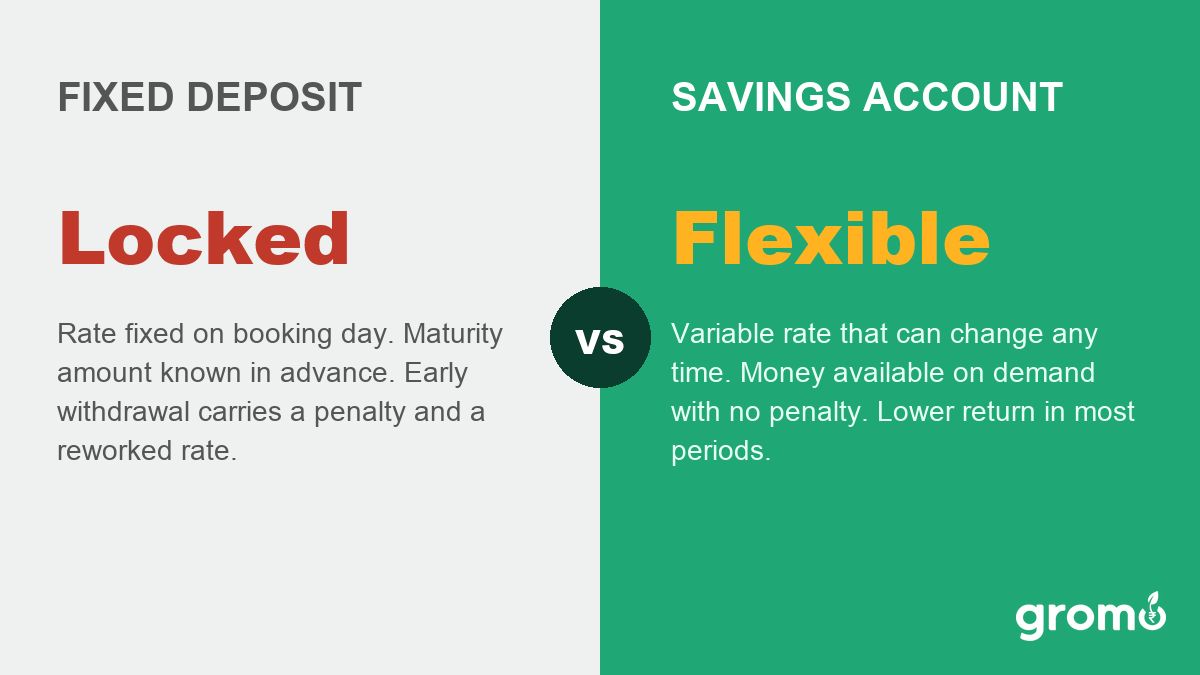
Certainty against flexibility. Image: GroMo.
What happens if I break an FD early?
Most fixed deposits allow premature withdrawal, and two things happen when you do.
A penalty applies, commonly a small reduction in the rate. The rate is reworked to the one that applied for the period you actually held it, not the one you booked.
So a five-year FD broken after one year typically earns the one-year rate, minus the penalty. That can be noticeably less than you expected.
Two ways round it. Laddering means splitting one large deposit into several smaller ones with staggered maturities, so you can break only what you need. And a loan against FD lets you borrow against the deposit instead of breaking it, which often costs less than the penalty.
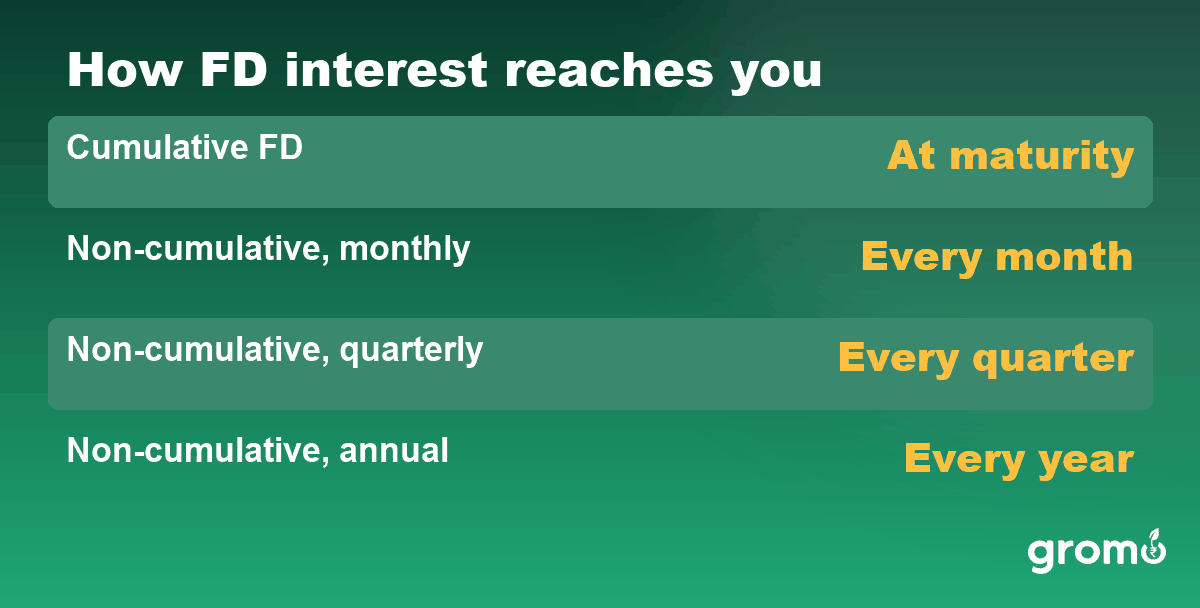
Compounding is the whole difference between the two. Image: GroMo.
Is FD interest taxable?
Yes. Interest from a fixed deposit is added to your income and taxed at your slab rate, and the bank deducts TDS once your interest from that bank crosses the annual threshold for the year.
Two points people miss. TDS is not the final tax: if your slab rate is higher you owe the difference, and if your total income is below the taxable limit you can reclaim it. And the threshold applies per bank, so deposits spread across banks are each counted separately.
Form 15G, or 15H for senior citizens, tells the bank not to deduct TDS when your income is below the taxable limit. Submit it at the start of the financial year rather than after the deduction.
Who should consider a fixed deposit?
An FD suits money you'll need on a known date and cannot afford to see fall: a fee due next year, an emergency buffer, a deposit for something planned.
An FD suits long-horizon money less well, because the certainty costs you return. For money you won't touch for several years, investment products with market exposure have historically done better, with real falls along the way.
Neither choice is wrong. The question is simply when you need the money and whether you can tolerate it moving.
Referring deposit products with GroMo
GroMo is an Indian financial-products distribution platform where individuals refer products from partner banks, NBFCs and fund houses and earn a commission on approved referrals.
Deposit and investment products sit in the catalogue alongside cards and loans. Four deposit-side products pay between ₹100 and ₹250 per approved referral (GroMo product catalogue, retrieved 2026-10-09):
| Product | Commission per approved referral |
|---|---|
| Jiraaf Bond investment | ₹250 |
| BharatPe Fixed Deposit | ₹100 |
| Stable Money (FD) | ₹100 |
| BharatPe Digital Gold | ₹100 |
Rates are campaign-linked and change without notice. Deposits convert differently from cards: the customer isn't borrowing, so the conversation is about where idle money sits rather than about eligibility.
Frequently asked questions
Below are the questions people most often ask alongside this one.
What is the FD full form?
Fixed Deposit. It's also called a term deposit, and both describe money placed with a bank for a fixed period at a fixed rate.
What is fixed deposit in simple words?
You give a bank a lump sum for an agreed period. The bank pays a fixed rate of interest for that period and returns the principal plus interest at the end.
What is the meaning of FD in bank?
In a bank, FD means a deposit held for a set tenure at a rate locked on the day you book it, separate from your savings account balance.
Can I withdraw my FD before maturity?
Usually yes. A penalty applies and the interest is recalculated at the rate for the period you actually held the deposit, which is normally lower than the booked rate.
Is FD interest taxable in India?
Yes. It's added to your income and taxed at your slab rate. The bank deducts TDS once interest from that bank crosses the annual threshold.
What is the minimum amount for an FD?
The minimum varies by bank, and many accept small amounts well under ten thousand rupees. Check the specific bank, since the minimum differs widely.
Is an FD safer than a savings account?
Both sit with the same bank and carry the same deposit insurance cover provided through DICGC, an RBI subsidiary (retrieved 2026-10-09). An FD simply locks the rate; it doesn't change who holds your money.
Summary
FD full form is Fixed Deposit: a lump sum held by a bank for an agreed tenure at a rate locked on booking day, with the maturity amount known from the start. Tenures run from about a week to ten years, early withdrawal costs a penalty and a reworked rate, and the interest is taxable with TDS deducted past an annual threshold. It suits money you need on a known date and can't afford to see fall. To park that money first, how to open a savings account covers the steps.
Disclosures
GroMo (Vitrak Technologies Pvt Ltd) is a distribution platform. GroMo is not a bank, NBFC, insurer or investment adviser. All products are offered by their respective RBI, IRDAI or SEBI-regulated providers.
Partner earnings depend on effort, product mix and customer eligibility. Any figures shown are illustrative examples of individual results. They are not typical and are not guaranteed. GroMo does not guarantee any level of income.
Interest rates, tenures, penalties and tax thresholds are set by each bank and by prevailing tax law, and change from time to time. This article is general information, not investment or tax advice. Check current rates with the bank and your own tax position before deciding.
Written by Arvind Kumar. Published 9 October 2026. Last updated 9 October 2026.
Sources
- GroMo product catalogue, commission rates by product. Retrieved 9 October 2026.
- Reserve Bank of India, deposit regulation and deposit insurance. https://www.rbi.org.in/


