
RBI Loan Recovery Guidelines: Recovery Agent Rules, Your Rights
Recovery agent calling hours, what counts as harassment, home visit rules, new rules from January 2027, and how to complain.

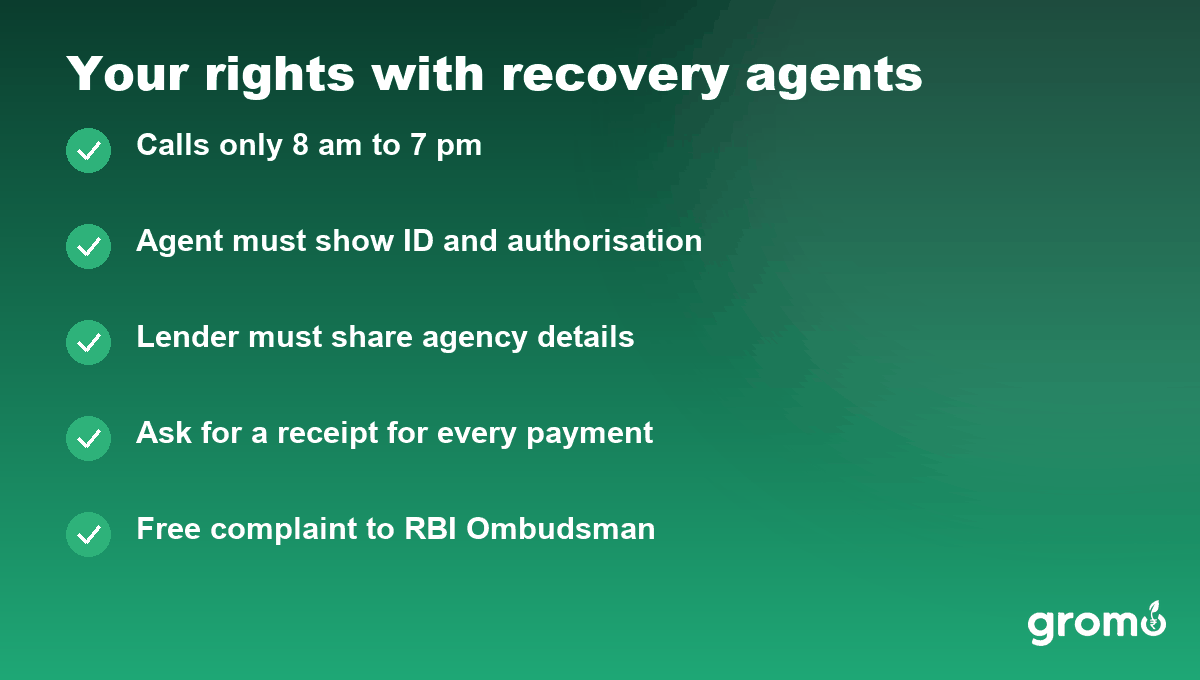
Under the RBI loan recovery guidelines, a bank or NBFC and its recovery agents can contact you only between 8 am and 7 pm, must not threaten, abuse or harass you, and must not shame you in front of your family, friends or on social media. Agents must carry an authorisation letter and ID. If they break these rules, complain to the lender first, then to the RBI Ombudsman.
You can reach the Ombudsman through cms.rbi.org.in or the 14448 helpline if the lender does not resolve your complaint within 30 days. RBI has also issued stricter recovery rules that take effect on 1 January 2027 (RBI press release 2026-2027/827, 6 August 2026). Being contacted by a stranger claiming to be from a lender? Read how to check a private loan agent.
Below are the 9 recovery rules every borrower should know, what changes from January 2027, and a step-by-step guide to complaining to RBI. These rules protect you from harassment; they do not cancel what you owe, so we also cover how to talk to your lender.
| Question | Short answer |
|---|---|
| Calling hours | Only 8 am to 7 pm |
| Threats or abuse | Not allowed, verbal or physical |
| Calling family and friends to shame you | Not allowed |
| Social media posts about your debt | Not allowed |
| Home or office visit | Allowed by an authorised agent with ID, without harassment |
| Agent must carry | Authorisation letter, notice and ID card |
| Where to complain first | Your lender's grievance officer |
| Then | RBI Ombudsman: cms.rbi.org.in or 14448, free |
| New rules | From 1 January 2027 |
The core conduct rules come from RBI's circular on recovery agents (RBI/2022-23/108, 12 August 2022) and its earlier guidelines on engaging recovery agents (RBI/2007-2008/296, 24 April 2008).
How this guide is ordered: rules start with calls and messages, then visits and agent identity, then money and records, followed by the 2027 changes and the complaint process.
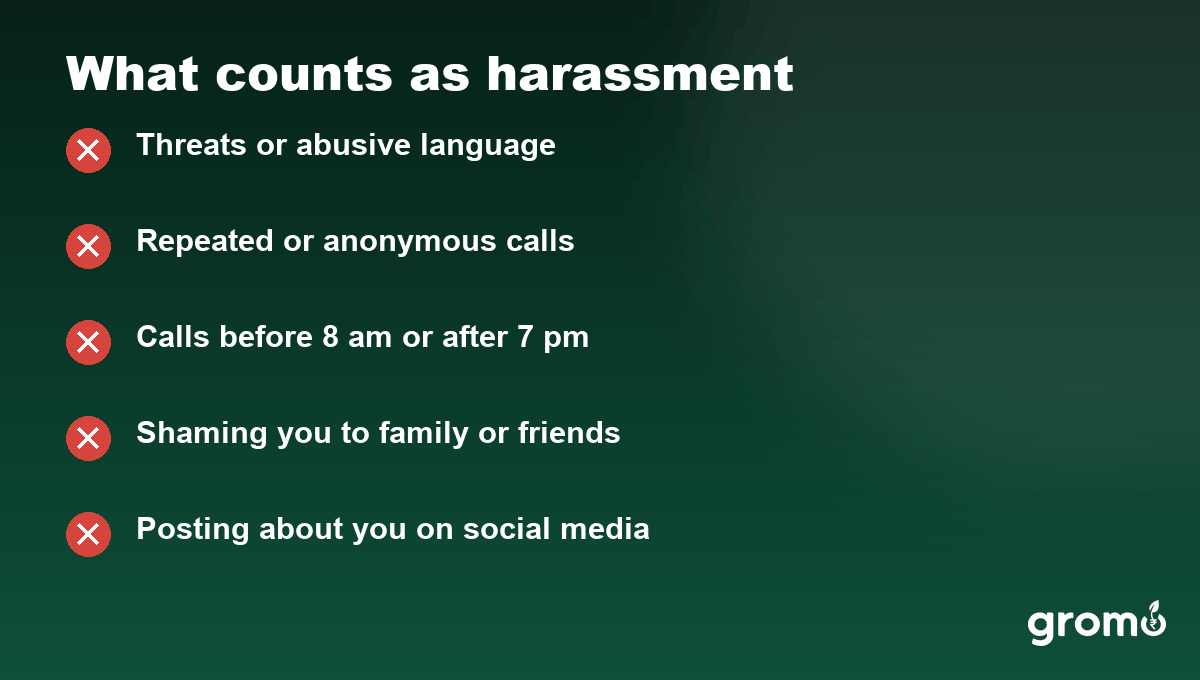
1. Calls Only Between 8 am and 7 pm
Rule: no calls before 8:00 am or after 7:00 pm | Applies to: the lender and its agents | Source: RBI circular, 12 August 2022
RBI's August 2022 circular says lenders and their agents must not call borrowers before 8:00 am or after 7:00 pm (RBI/2022-23/108, 12 August 2022). It covers banks, NBFCs including housing finance companies, co-operative banks and asset reconstruction companies.
What to do if it happens:
- Note the date, time and number of each call.
- Take screenshots of your call log.
- Include this record in your written complaint to the lender.
2. No Threats, Abuse or Repeated Harassing Calls
Banned: intimidation or harassment of any kind, verbal or physical | Also banned: threatening or anonymous calls, repeated calling | Source: RBI circular, 12 August 2022
The same circular bars lenders and agents from using intimidation or harassment of any kind, threatening or anonymous calls, and making false and misleading representations (RBI/2022-23/108, 12 August 2022). Calling you again and again to pressure you is specifically named as harassment.
3. No Shaming Through Family, Friends or Social Media
Banned: acts to humiliate you publicly or intrude on the privacy of your family, referees and friends | Banned: inappropriate messages on mobile or social media | Source: RBI circular, 12 August 2022
Agents cannot call your relatives, friends or the people you gave as references to shame you, and cannot send inappropriate messages through mobile or social media (RBI/2022-23/108, 12 August 2022). Loan app agents who message your contacts are breaking these rules.
4. Agents Must Be Authorised and Carry ID
Must carry: a copy of the lender's notice, an authorisation letter and an ID card | Must include: the recovery agency's phone number | Source: RBI guidelines, 24 April 2008
RBI's 2008 guidelines require recovery agents to carry a copy of the notice, the authorisation letter from the lender and their identity card, and the notice and letter must carry the agency's phone number (RBI/2007-2008/296, 24 April 2008). You have the right to ask an agent for these before talking.
How to check an agent:
- Ask for the authorisation letter and ID.
- Note the agency name and phone number.
- Call your lender's official customer care to confirm the agency.
5. You Must Be Told Who the Recovery Agency Is
Rule: the lender must share the agency's details when it hands over your case | Digital loans: agent details sent by email or SMS before contact | Source: RBI 2008 guidelines; Digital Lending Directions 2025
Under the 2008 guidelines, the lender must inform you of the recovery agency's details when it assigns your case, and tell you if the agency changes (RBI/2007-2008/296, 24 April 2008). For digital loans, the lender must send you the recovery agent's details by email or SMS before the agent contacts you (RBI Digital Lending Directions, 8 May 2025, para 8(v)).
6. Home and Workplace Visits: What Is Allowed
Allowed: a visit by an authorised agent with ID, with no harassment | Not allowed: intimidation, humiliating you in front of others, intruding on family privacy | From 2027: stricter visit rules
Today, an authorised agent can visit your home or workplace, but must follow the conduct rules above. Your dignity and your family's privacy are protected. From 1 January 2027, the new rules add limits on where and when visits can happen (see the 2027 section below).
7. Cash Recovery Must Be Credited and Receipted
Digital loans: cash recovered must be credited to your loan account the same day | Always: ask for a receipt for every payment | Source: Digital Lending Directions 2025, para 9(v)
For digital loans, any cash recovery must be credited to your account the same day (RBI Digital Lending Directions, 8 May 2025, para 9(v)). For any loan, pay only through the lender's official channels where possible, and always ask for a receipt.
8. Agents Must Be Trained and Calls Recorded
Training: a certificate course linked to IIBF | Calls: lenders must record recovery calls | Checks: background verification of agents
RBI's 2008 guidelines require lenders to verify agents' backgrounds, make them complete an IIBF-linked certificate course, and record recovery calls (RBI/2007-2008/296, 24 April 2008). These records can support your complaint.
9. No Recovery Action While Your Complaint Is Pending
Rule: a bank should not send your case to a recovery agency while your grievance about it is pending | Source: RBI guidelines, 24 April 2008
If you have raised a complaint about your loan with the bank, the 2008 guidelines say the bank should not hand the case to a recovery agency until the complaint is resolved (RBI/2007-2008/296, 24 April 2008). Mention your pending complaint if an agent contacts you.
What Changes From 1 January 2027?
RBI issued new directions on loan recovery and recovery agents for banks, NBFCs and other lenders on 6 August 2026, which take effect on 1 January 2027 (RBI press release 2026-2027/827, 6 August 2026). Until then, the rules above apply. Based on summaries of the new directions, the main changes are:
| Area | From 1 January 2027 |
|---|---|
| Contact hours | 8 am to 7 pm, unless you ask otherwise |
| Harassment | Contacting relatives, friends, referees or co-workers to pressure you is banned |
| Social media | Posting your details or call recordings online is banned |
| Agent training | Agents need the IIBF Debt Recovery Agent certificate; existing agents get one year |
| Advance notice | Agency details must reach you at least one day before the first visit |
| Visits | First meeting at a place you choose; no visits at times like a death, calamity or wedding in the family |
| Agency list | Each lender must publish its recovery agencies on its website |
| Records | Calls must be recorded and kept for 6 months |
The details above are from published summaries of the directions; check the final text on RBI's website before relying on any single point.
How to Complain About a Recovery Agent
If a recovery agent harasses you, follow these steps in order. The RBI complaint route is free.
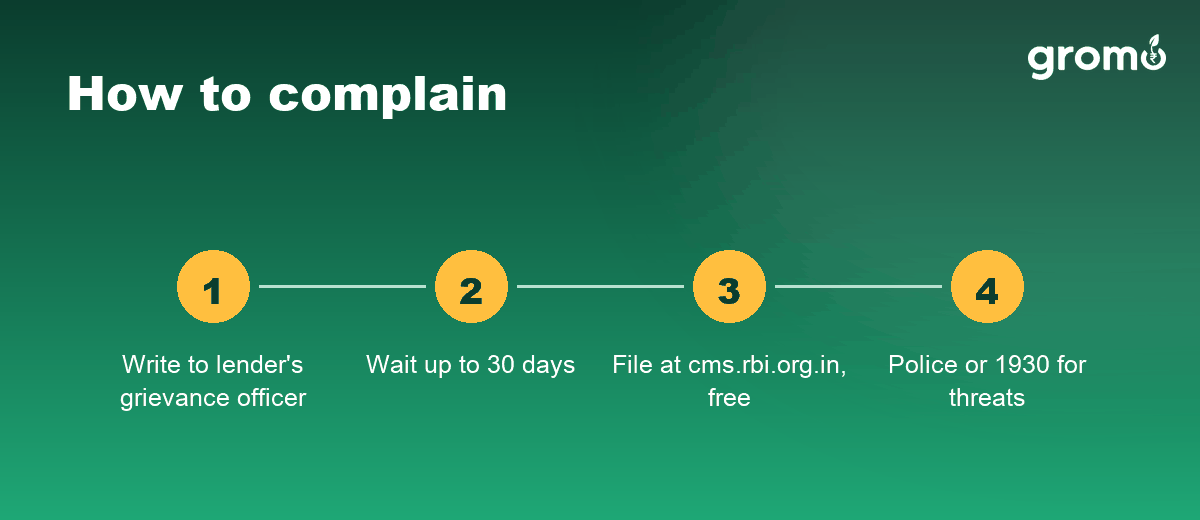
Step 1: Complain to the lender in writing
- Email or write to the lender's grievance redressal officer, whose details are on the lender's website.
- Describe what happened: dates, times, numbers and messages.
- Attach screenshots and call logs.
- Keep the complaint number or acknowledgement.
Step 2: Escalate to the RBI Ombudsman
If the lender rejects your complaint, gives an unsatisfactory reply or does not reply within 30 days, you can complain to the RBI Ombudsman under the Reserve Bank Integrated Ombudsman Scheme, 2026, in force from 1 July 2026. Filing is free.
You can file:
- Online on RBI's complaint management system at cms.rbi.org.in.
- By email to crpc@rbi.org.in.
- By post to the Centralised Receipt and Processing Centre (CRPC), Reserve Bank of India, 4th Floor, Sector 17, Chandigarh 160017.
The scheme's salient features, as published by banks, list compensation of up to ₹30 lakh for loss and up to ₹3 lakh for mental agony and harassment (RB-IOS 2026 salient features, retrieved 2026-10-28).
Step 3: Call the RBI helpline 14448 for help
RBI's contact centre number 14448 helps you file or track a complaint. It runs an automated service round the clock and human agents from 8 am to 10 pm, Monday to Saturday, in English, Hindi and 10 regional languages (RBI CMS, retrieved 2026-10-28).
Step 4: Go to the police for threats and online harassment
If an agent threatens violence, uses abusive language, or a loan app harasses your contacts, file a police complaint. For online loan app harassment, report at the national cybercrime portal or call 1930. Our fake loan apps list explains how app-based harassment works.
Complaint in RBI against a bank or NBFC: what to include
- Your name, contact details and loan account number.
- The lender's name and branch.
- A short, dated timeline of what happened.
- Copies of your complaint to the lender and its reply, if any.
- Screenshots, call logs and messages.
Do the Rules Cancel Your Loan? Why You Still Need a Plan
RBI's recovery rules stop harassment, but they do not cancel what you owe. Missed EMIs also hurt your CIBIL score. If you are struggling to pay, contact your lender early and ask about restructuring, a revised EMI or a payment plan. Get any settlement offer in writing, because a "settled" loan can stay on your credit report for years.
Once you are back on track, rebuilding your score takes steady, on-time payments. A secured option like a credit card against FD can help rebuild credit history.
Important Safety Tips
- Never pay a recovery agent in cash without a receipt: pay through the lender's official channels.
- Ask for ID and authorisation: before discussing your loan with any agent.
- Record everything: dates, times, numbers, messages and screenshots.
- Do not trust "settlement" offers from unknown numbers: confirm with the lender directly.
- Beware fake agents: fraudsters pose as recovery agents to collect money; verify with the lender first.
What Should You Do First?
- Getting calls at night or abusive messages? Collect evidence and complain to the lender in writing today.
- No reply from the lender in 30 days? File with the RBI Ombudsman at cms.rbi.org.in.
- Threats of violence or contacts being messaged? Go to the police and report at cybercrime.gov.in or 1930.
- Can't pay your EMIs? Talk to your lender about restructuring before the case goes to recovery.
You have the right to be treated with dignity even when you owe money. GroMo is a financial products distribution app, not a lender, and does not collect loans; this guide is here to help borrowers know their rights. Know the rules, keep records, use the free complaint routes, and work with your lender on a repayment plan.
FAQ: RBI Loan Recovery Guidelines
What are the RBI guidelines for recovery agents?
Recovery agents can contact you only between 8 am and 7 pm, must not threaten, abuse or harass you, must not shame you through family, friends or social media, and must carry an authorisation letter and ID.
What time can recovery agents call?
Only between 8:00 am and 7:00 pm, as per RBI's circular of 12 August 2022.
Can recovery agents come to my home?
An authorised agent can visit, but must carry ID and an authorisation letter and must not harass or humiliate you or your family. Stricter visit rules start on 1 January 2027.
Can recovery agents call my family or friends?
Recovery agents must not contact your family, friends or references to humiliate you or intrude on their privacy.
How do I complain to RBI about a recovery agent?
Complain to the lender first. If it does not resolve the complaint within 30 days or the reply is unsatisfactory, file free with the RBI Ombudsman at cms.rbi.org.in, by email to crpc@rbi.org.in, or call 14448 for help.
What is the RBI complaint number?
RBI's contact centre number is 14448. Human agents are available from 8 am to 10 pm, Monday to Saturday.
Do the RBI rules mean I don't have to repay the loan?
No. The rules stop harassment, but the loan must still be repaid. Talk to your lender about restructuring if you cannot pay.
What changes in loan recovery rules from January 2027?
New RBI directions from 1 January 2027 add advance notice before visits, IIBF certification for agents, published agency lists, call recording rules and stronger bans on harassment.
GroMo (Vitrak Technologies Pvt Ltd) is a distribution platform. GroMo is not a bank, NBFC, insurer or investment adviser. All products are offered by their respective RBI, IRDAI or SEBI-regulated providers.
Sources: RBI circular RBI/2022-23/108 on recovery agents (12 August 2022); RBI guidelines RBI/2007-2008/296 on engaging recovery agents (24 April 2008); RBI (Digital Lending) Directions, 2025 (8 May 2025); RBI press release 2026-2027/827 on loan recovery directions (6 August 2026), with law-firm summaries of the new directions; Reserve Bank Integrated Ombudsman Scheme, 2026 salient features; RBI CMS contact centre information; all retrieved 2026-10-28.
Disclaimer
The information here is general and meant to help borrowers understand their rights, not legal advice. RBI rules and the Ombudsman scheme can change; check the latest text on RBI's website and consult a lawyer for your specific case. The rules described protect borrowers from harassment but do not reduce or cancel any amount owed. If you face threats or violence, contact the police immediately.


