
List of All Banks in India 2026: Complete RBI Official List
Complete list of all banks in India from the official RBI list: public sector, private, small finance, payments, foreign, RRBs and co-operative banks.

India's banking system is organised by the Reserve Bank of India into clear categories, each with its own licence type and role: public sector banks owned by the government, private sector banks, small finance banks for underserved customers, payments banks for deposits and payments, foreign banks, regional rural banks, and co-operative banks. This article presents the complete list of all banks in India, category by category, compiled from the RBI's official published list.
Banks in India at a Glance
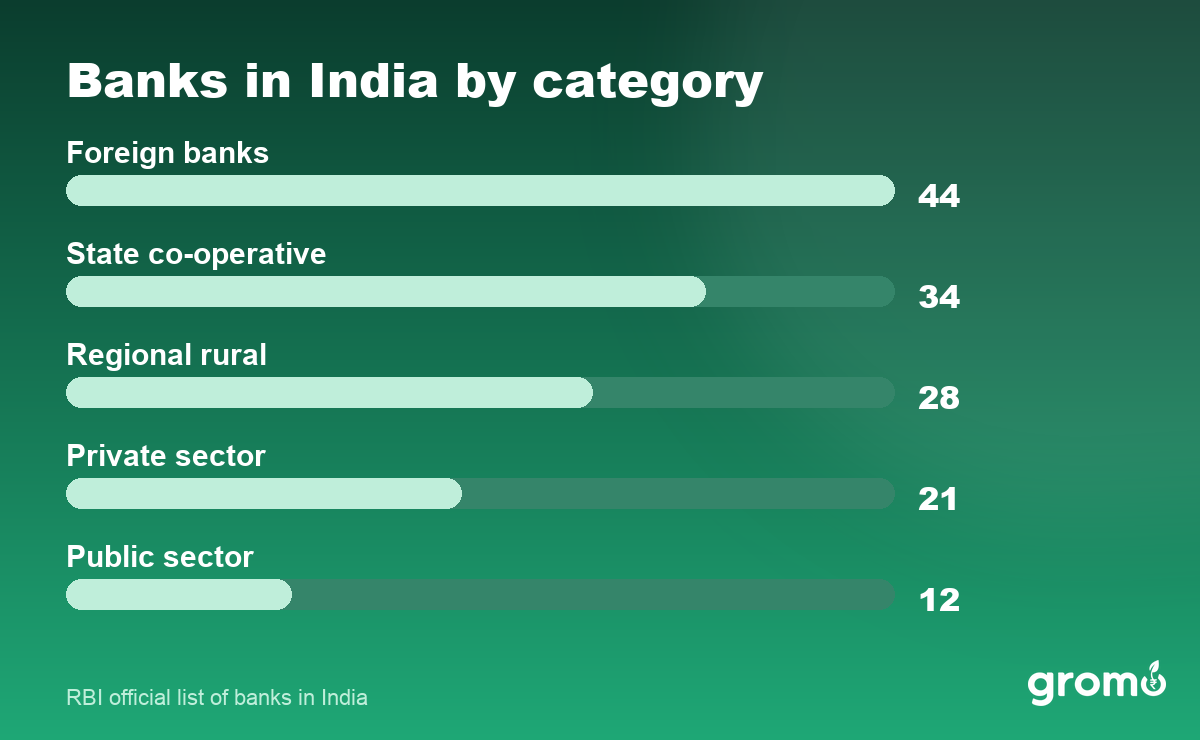
| Category | Count | What they are |
|---|---|---|
| Public Sector Banks | 12 | Government-majority banks including SBI |
| Private Sector Banks | 21 | Indian privately owned commercial banks |
| Small Finance Banks | 11 | Full banks focused on small customers and MSMEs |
| Payments Banks | 5 | Deposits and payments, no lending |
| Foreign Banks | 44 | Overseas banks operating in India |
| Regional Rural Banks | 28 | State-level rural banks sponsored by PSBs |
| State Co-operative Banks | 34 | Apex co-operative banks of states and UTs |
Public Sector Banks in India (12)
Government-majority-owned banks form the backbone of Indian banking. State Bank of India is the largest bank in the country, followed by 11 nationalised banks (head office city in brackets):
- State Bank of India (Mumbai)
- Bank of Baroda (Vadodara)
- Bank of India (Mumbai)
- Bank of Maharashtra (Pune)
- Canara Bank (Bengaluru)
- Central Bank of India (Mumbai)
- Indian Bank (Chennai)
- Indian Overseas Bank (Chennai)
- Punjab & Sind Bank (New Delhi)
- Punjab National Bank (New Delhi)
- UCO Bank (Kolkata)
- Union Bank of India (Mumbai)
Private Sector Banks in India (21)
Privately owned Indian commercial banks, from giants like HDFC Bank and ICICI Bank to focused regional players:
- Axis Bank (Ahmedabad)
- Bandhan Bank (Kolkata)
- CSB Bank (Thrissur)
- City Union Bank (Kumbakonam)
- DCB Bank (Mumbai)
- Dhanlaxmi Bank (Thrissur)
- Federal Bank (Ernakulam)
- HDFC Bank (Mumbai)
- ICICI Bank (Vadodara)
- IndusInd Bank (Pune)
- IDFC FIRST Bank (Chennai)
- Jammu & Kashmir Bank (Srinagar)
- Karnataka Bank (Mangaluru)
- Karur Vysya Bank (Karur)
- Kotak Mahindra Bank (Mumbai)
- Nainital Bank (Nainital)
- RBL Bank (Kolhapur)
- South Indian Bank (Thrissur)
- Tamilnad Mercantile Bank (Thoothukudi)
- YES Bank (Mumbai)
- IDBI Bank (Mumbai)
Local Area Banks (2)
A small category of banks licensed to operate in limited districts:
- Coastal Local Area Bank (Vijayawada)
- Krishna Bhima Samruddhi Local Area Bank (Madhapur)
Small Finance Banks in India (11)
Full-service banks with a mandate to serve small businesses, micro industries, and unserved customers. They accept deposits like any bank and typically offer higher savings and FD rates (several appear in our zero balance savings accounts list):
- AU Small Finance Bank (Jaipur)
- Capital Small Finance Bank (Jalandhar)
- Equitas Small Finance Bank (Chennai)
- ESAF Small Finance Bank (Thrissur)
- Suryoday Small Finance Bank (Navi Mumbai)
- Ujjivan Small Finance Bank (Bengaluru)
- Utkarsh Small Finance Bank (Varanasi)
- slice Small Finance Bank (Guwahati)
- Jana Small Finance Bank (Bengaluru)
- Shivalik Small Finance Bank (New Delhi)
- Unity Small Finance Bank (New Delhi)
Payments Banks in India (5)
Payments banks can accept deposits (currently up to Rs 2 lakh per customer) and provide savings account, payments and remittance services, but cannot lend:
- Airtel Payments Bank (New Delhi)
- India Post Payments Bank (New Delhi)
- Fino Payments Bank (Navi Mumbai)
- Jio Payments Bank (Mumbai)
- NSDL Payments Bank (Mumbai)
Note: Paytm Payments Bank appears in older lists but its banking licence has been cancelled, so it is excluded above.
Foreign Banks in India (44)
Overseas banks operating through branches in India, plus two operating as wholly owned subsidiaries:
- AB Bank PLC
- American Express Banking Corporation
- Australia and New Zealand Banking Group Ltd
- Bank of America N.A.
- Bank of Bahrain and Kuwait B.S.C.
- Bank of Ceylon
- Bank of China Limited
- Bank of Nova Scotia
- Barclays Bank Plc
- BNP Paribas
- Citibank N.A.
- Cooperatieve Rabobank U.A.
- Credit Agricole Corporate and Investment Bank
- CTBC Bank Co. Limited
- Deutsche Bank A.G.
- Doha Bank Q.P.S.C.
- Emirates NBD Bank P.J.S.C
- First Abu Dhabi Bank PJSC
- FirstRand Bank Limited
- Hongkong and Shanghai Banking Corporation (HSBC)
- Industrial and Commercial Bank of China
- Industrial Bank of Korea
- J.P. Morgan Chase Bank N.A.
- JSC VTB Bank
- KEB Hana Bank
- Kookmin Bank
- Mashreqbank P.S.C
- Mizuho Bank Ltd
- MUFG Bank Ltd
- NatWest Markets plc
- NongHyup Bank
- PT Bank Maybank Indonesia TBK
- Qatar National Bank (Q.P.S.C)
- Sberbank
- Shinhan Bank
- Societe Generale
- Sonali Bank PLC
- Standard Chartered Bank
- Sumitomo Mitsui Banking Corporation
- United Overseas Bank Limited
- UBS AG
- Woori Bank
- DBS Bank India Limited (wholly owned subsidiary)
- SBM Bank India Limited (wholly owned subsidiary)
Regional Rural Banks in India (28)
After the amalgamation into one RRB per state, India has 28 regional rural banks, each sponsored by a public sector bank and focused on agricultural and rural credit:
- Andhra Pradesh Grameena Bank
- Assam Gramin Bank
- Arunachal Pradesh Rural Bank
- Bihar Gramin Bank
- Chhattisgarh Gramin Bank
- Gujarat Gramin Bank
- Haryana Gramin Bank
- Himachal Pradesh Gramin Bank
- Jharkhand Gramin Bank
- Jammu and Kashmir Grameen Bank
- Karnataka Grameena Bank
- Kerala Grameena Bank
- Maharashtra Gramin Bank
- Madhya Pradesh Gramin Bank
- Manipur Rural Bank
- Meghalaya Rural Bank
- Mizoram Rural Bank
- Nagaland Rural Bank
- Odisha Grameen Bank
- Punjab Gramin Bank
- Puducherry Grama Bank
- Rajasthan Gramin Bank
- Tamil Nadu Grama Bank
- Telangana Grameena Bank
- Tripura Gramin Bank
- Uttar Pradesh Gramin Bank
- Uttarakhand Gramin Bank
- West Bengal Gramin Bank
State Co-operative Banks in India (34)
The apex co-operative banks of states and union territories, sitting above district central co-operative banks in the co-operative credit structure:
- Andaman and Nicobar State Co-operative Bank
- Andhra Pradesh State Co-operative Bank
- Arunachal Pradesh State Co-operative Apex Bank
- Assam Co-operative Apex Bank
- Bihar State Co-operative Bank
- Chandigarh State Co-operative Bank
- Chhattisgarh Rajya Sahakari Bank
- Delhi State Co-operative Bank
- Goa State Co-operative Bank
- Gujarat State Co-operative Bank
- Haryana State Co-operative Apex Bank
- Himachal Pradesh State Co-operative Bank
- Jammu and Kashmir State Co-operative Bank
- Jharkhand State Co-operative Bank
- Karnataka State Co-operative Apex Bank
- Kerala State Co-operative Bank
- Madhya Pradesh Rajya Sahakari Bank
- Maharashtra State Co-operative Bank
- Manipur State Co-operative Bank
- Meghalaya Co-operative Apex Bank
- Mizoram Co-operative Apex Bank
- Nagaland State Co-operative Bank
- Odisha State Co-operative Bank
- Puducherry State Co-operative Bank
- Punjab State Co-operative Bank
- Rajasthan State Co-operative Bank
- Sikkim State Co-operative Bank
- Tamil Nadu State Apex Co-operative Bank
- Telangana State Cooperative Apex Bank
- Tripura State Co-operative Bank
- Uttar Pradesh State Co-operative Bank
- Uttarakhand State Co-operative Bank
- West Bengal State Co-operative Bank
- Daman and Diu State Co-operative Bank
Other Co-operative Banks
Beyond the state apex banks, the RBI also regulates scheduled and non-scheduled urban co-operative banks and district central co-operative banks. These number in the hundreds and change more frequently; the complete current lists are maintained on the RBI website.
How to Verify Any Bank
- Visit the RBI website's list of banks in India section.
- Match the exact legal name of the bank, not just a similar-sounding brand.
- For deposits (see how to open a savings account), remember DICGC insurance covers up to Rs 5 lakh per depositor per bank, and it applies to commercial banks, small finance banks, payments banks, and eligible co-operative banks.
- Be cautious with entities using bank-like names without an RBI licence (the same verification habit behind our RBI approved loan apps list); only institutions on these lists may accept public deposits as banks.
FAQ: List of Banks in India
How many banks are there in India?
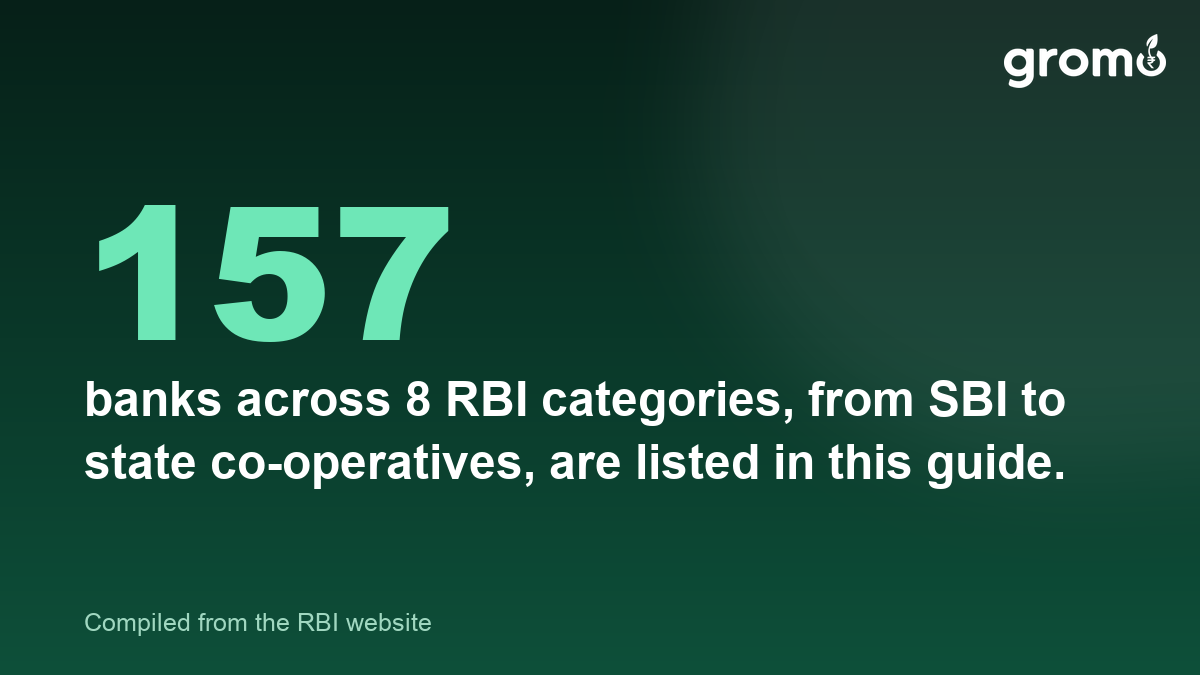
Per the RBI's official list, India has 12 public sector banks, 21 private sector banks, 2 local area banks, 11 small finance banks, 5 payments banks, 44 foreign banks, 28 regional rural banks, and 34 state co-operative banks: 157 institutions across these categories, plus hundreds of urban and district co-operative banks that the RBI lists separately.
Which is the largest bank in India?
State Bank of India is the largest bank in India by assets, branches, and customers, headquartered in Mumbai. Among private sector banks, HDFC Bank is the largest, followed by ICICI Bank and Axis Bank.
What is the difference between public and private sector banks?
Ownership. In public sector banks the government holds the majority stake (SBI and 11 nationalised banks). Private sector banks are majority-owned by private shareholders. Both are regulated identically by the RBI, and deposits in both carry the same DICGC insurance of up to Rs 5 lakh per depositor per bank.
Are small finance banks and payments banks safe?
Yes, within their design. Small finance banks are full RBI-licensed banks whose deposits carry DICGC insurance up to Rs 5 lakh, the same as any commercial bank. Payments banks are also RBI-licensed and insured, but can hold deposits only up to Rs 2 lakh per customer and cannot lend. Safety comes from the licence, not the size.
How many regional rural banks are there in India now?
28, following the amalgamation that consolidated RRBs into broadly one per state. Each RRB is sponsored by a public sector bank and focuses on rural and agricultural banking, such as Bihar Gramin Bank, Karnataka Grameena Bank, and Uttar Pradesh Gramin Bank.
Disclaimer
This list is compiled from the Reserve Bank of India's official published list of banks and reflects it at the time of writing. Bank mergers, new licences, licence cancellations, and name changes occur periodically, so always verify the current status of any bank on the RBI website before making decisions. This article is general information, not financial advice; bank names are trademarks of their respective owners.


