
How to Transfer Money from Credit Card to Bank Account
Yes, you can transfer money from credit card to bank account in India — but it costs 2.5%–3.5% in fees plus interest from day one. Know the methods, charges, and safer options.

Yes, you can transfer money from a credit card to a bank account in India — but it comes at a cost. Most methods involve a cash advance or balance transfer, both of which attract fees (2.5%–3.5%), interest from day one (up to 3.5% per month), and GST. This guide covers every legit method, the exact charges you should expect, the risks involved, and safer alternatives you should consider first.
Can You Transfer Money from Credit Card to Bank Account?
Short answer: Yes, but it is treated as a cash advance or balance transfer — not a regular purchase. Banks allow you to move money from your credit card to a bank account through net banking, mobile apps, ATM cash withdrawal, or by requesting a balance transfer. However, this is not free money. You will pay a cash advance fee (usually 2.5%–3.5% of the amount), interest from the day of the transaction (typically 2.5%–3.5% per month), and GST on those charges. There is no interest-free period for cash advances. Use this option only when you have no other choice — and always plan to repay fast.
Key Takeaways
- Transferring money from credit card to bank account is possible in India, but it counts as a cash advance — not a normal purchase.
- Cash advance fees range from 2.5% to 3.5% of the amount, with no interest-free grace period.
- Interest is charged from the day of withdrawal, usually at 2.5%–3.5% per month (about 30%–42% per year).
- Your credit utilisation ratio goes up, which can hurt your CIBIL score.
- Methods include: bank net banking/app transfer, ATM cash advance, balance transfer to bank, and loan on credit card.
- Avoid grey-area tricks like loading wallets or using third-party apps to "cash out" — these can violate card terms and lead to card blocking.
- Safer alternatives: personal loan, salary advance, overdraft facility, or emergency fund.
- Always check your bank's specific charges before proceeding — fees vary by card issuer and transaction type.
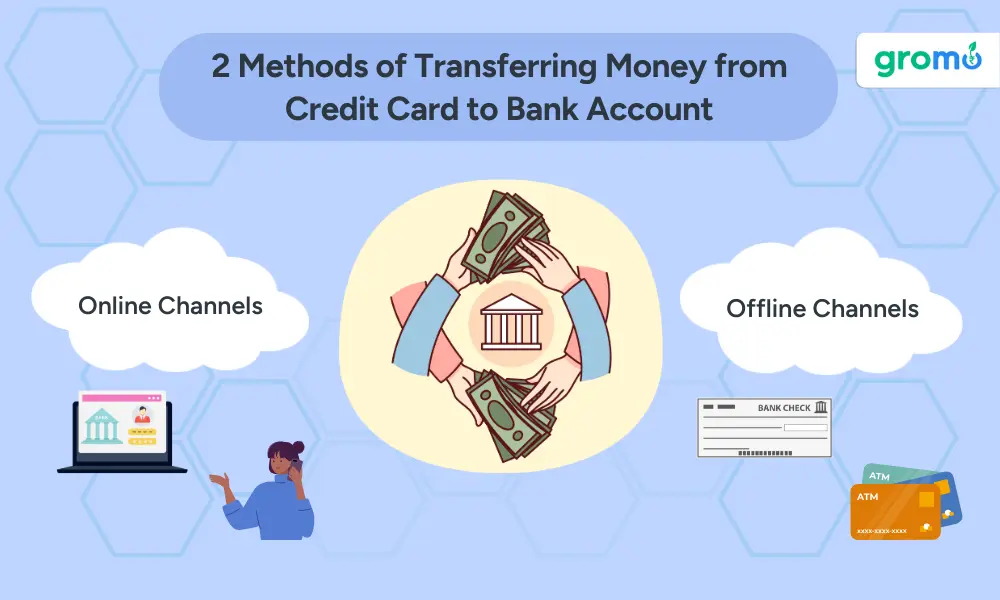
Methods at a Glance: Credit Card to Bank Account Transfer
| Method | Typical Time | Typical Cost | Risk Level | Best For |
|---|---|---|---|---|
| Bank net banking / app transfer | Instant to 1 day | 2.5%–3.5% fee + interest from day 1 + GST | Medium | When your bank supports direct transfer |
| ATM cash advance | Instant (cash in hand) | 2.5%–3.5% fee + interest from day 1 + GST + ATM charges | High | Emergency need for physical cash |
| Balance transfer to bank account | 1–3 days | Processing fee (varies) + interest (may be lower) | Medium | When bank offers promotional BT rate |
| Loan on credit card (EMI) | 1–3 days | Processing fee + fixed interest rate on EMI | Low–Medium | Planned expense, want EMI option |
| Wallet / third-party app route | Varies | Transaction fee + risk of card block | High (grey area) | Not recommended — can violate card terms |
How to Transfer Money from Credit Card to Bank Account (Step by Step)
Here are the main methods available in India, with honest details about what each one costs.
Method 1: Through Your Bank's Net Banking or Mobile App
Some banks let you transfer money from your credit card directly to a savings account through net banking or the bank's mobile app. This is the most straightforward method.
Steps:
- Log in to your credit card issuer's net banking portal or mobile app.
- Go to the "Fund Transfer" or "Credit Card" section.
- Look for an option like "Transfer to Bank Account" or "Cash Advance to Account."
- Enter your bank account number and IFSC code (for a different bank) or select your linked savings account.
- Enter the amount you want to transfer.
- Review the charges displayed and confirm the transaction.
- You should receive the money in your bank account within a few minutes to 24 hours.
Charges to expect:
- Cash advance fee: 2.5%–3.5% of the transfer amount (varies by bank)
- Interest: Charged from day one at 2.5%–3.5% per month — no grace period
- GST: 18% on the fee and interest
- Minimum charge: Some banks have a minimum fee of ₹250–₹500
Important: Not all banks offer this feature. Check your bank's app or call customer care to confirm availability.
Method 2: ATM Cash Advance (Withdraw and Deposit)
You can use your credit card at any ATM to withdraw cash, and then deposit that cash into your bank account.
Steps:
- Visit any ATM that accepts your card network (Visa, Mastercard, RuPay).
- Insert your credit card and enter your ATM PIN (you may need to set this up first through your bank's app or customer care).
- Select "Cash Withdrawal" and enter the amount.
- Collect the cash.
- Deposit the cash into your bank account — either at your bank's branch, deposit machine, or another ATM with deposit facility.
Charges to expect:
- Cash advance fee: 2.5%–3.5% of the withdrawn amount
- Interest: Starts from the day of withdrawal, typically 2.5%–3.5% per month
- ATM transaction fee: ₹100–₹300 per transaction (if using a different bank's ATM)
- GST: 18% on all fees and interest
- Daily withdrawal limit: Usually ₹10,000–₹25,000 per transaction (varies by bank)
⚠️ Warning: ATM cash advances are one of the most expensive ways to get money. There is no interest-free period — interest starts from the moment you withdraw. If you withdraw ₹10,000 and repay after 30 days, you could end up paying ₹350–₹500 in fees and interest alone. Avoid this unless it is a genuine emergency.
Method 3: Balance Transfer to Bank Account
Some banks offer a "balance transfer" facility where they transfer a lump sum from your credit card to your bank account. This is different from a regular cash advance — the interest rate may be lower, and you may get an EMI repayment option.
Steps:
- Call your credit card issuer's customer care or check the mobile app.
- Ask about "Balance Transfer to Bank Account" or "Credit Card to Savings Account Transfer."
- The bank will check your eligibility based on your credit limit and repayment history.
- If approved, provide your bank account details (account number, IFSC code).
- The amount will be credited to your bank account in 1–3 working days.
Charges to expect:
- Processing fee: 1%–2.5% of the transfer amount (varies by bank and offer)
- Interest rate: Can be lower than regular cash advance — some banks offer 1%–1.5% per month for promotional periods
- GST: 18% applicable on fees and interest
- Repayment: Usually as EMI over 3–24 months
Note: This option is not available on all cards. Banks typically offer it to customers with a good repayment track record and sufficient available credit limit.
Method 4: Loan on Credit Card (EMI Conversion)
Many banks now offer a "Loan on Credit Card" feature — a pre-approved loan amount based on your credit limit that gets deposited directly into your bank account.
Steps:
- Check your bank's app or net banking under "Offers" or "Pre-approved Loans."
- If eligible, you will see the loan amount, tenure, and interest rate.
- Select the amount and repayment tenure.
- Enter or confirm your bank account details.
- The loan amount is credited to your bank account, and EMIs are charged to your credit card.
Charges to expect:
- Processing fee: 0.5%–2% of the loan amount
- Interest rate: Usually lower than cash advance — 12%–24% per year depending on the bank and your profile
- GST: 18% applicable
- Foreclosure charges: Some banks charge 2%–3% if you repay early
This is often the cheapest way to get money from your credit card to your bank account, if you are eligible. The interest rate is significantly lower than a regular cash advance.
Method 5: Wallet Loading / Third-Party App Route (Not Recommended)
Some people try to transfer money from credit card to bank by loading mobile wallets (like Paytm, PhonePe) using a credit card and then transferring the wallet balance to a bank account.
⚠️ Strong Caution:
- Most wallets and UPI apps have stopped allowing credit card loading or charge a fee for it.
- This method can violate your credit card's terms and conditions.
- Your card issuer may flag this as misuse and block your card.
- RBI guidelines have tightened rules around credit card usage for wallet loading.
- Even if it works today, the rules can change anytime — and you could be left with a blocked card and pending charges.
We do not recommend this method. If you need money urgently, use the official channels listed above or consider the safer alternatives mentioned later in this article.
Fees and Charges: What You Will Actually Pay
Before you transfer money from credit card to bank account, understand the full cost. Here is a checklist:
- Cash advance fee: 2.5%–3.5% of the amount (charged upfront, minimum ₹250–₹500 at most banks)
- Interest rate: 2.5%–3.5% per month (about 30%–42% per year) — charged from the day of transaction
- No interest-free period: Unlike regular credit card purchases, cash advances do NOT get a grace period
- GST: 18% on all fees and interest charges
- ATM fee: ₹100–₹300 per withdrawal (if using another bank's ATM)
- Late payment fee: ₹500–₹1,300 if you miss the repayment due date
- Overlimit fee: If the transfer pushes you over your credit limit, you may be charged an overlimit fee
- Total effective cost: On a ₹10,000 cash advance repaid after 30 days, you could pay ₹600–₹900 in total charges
Example: If you transfer ₹20,000 from your credit card to your bank account:
- Cash advance fee (3%): ₹600
- Interest for 30 days (3% per month): ₹600
- GST on charges (18%): ₹216
- Total cost for just one month: ₹1,416
This is why you should treat this as a last resort.
How Credit Card to Bank Transfer Affects Your Credit Score
Transferring money from your credit card to your bank account can impact your credit score in several ways:
1. Higher Credit Utilisation Ratio
When you use your credit card for a cash advance, it increases your credit utilisation ratio — the percentage of your total credit limit that you are using. Anything above 30% utilisation is considered risky by credit bureaus like CIBIL, Experian, and Equifax. A high utilisation ratio can pull your score down by 20–50 points.
2. Payment History Risk
Cash advances are expensive. If you struggle to repay on time because of the high interest, any missed or late payment will show up on your credit report and damage your score for months.
3. New Debt Signal
Frequent cash advances signal to lenders that you may be financially stretched. This can make it harder to get approved for future loans or credit cards.
Best practice: If you do take a cash advance, repay it as quickly as possible — ideally before your next billing cycle. Keep your total credit card usage (including the cash advance) below 30% of your limit.
Safer Alternatives to Credit Card Cash Advance
Before you transfer money from your credit card to your bank account, consider these options — they are almost always cheaper:
1. Personal Loan
Banks and NBFCs offer personal loans at interest rates of 10%–24% per year. This is much cheaper than a credit card cash advance at 30%–42% per year. You get a fixed EMI and a clear repayment plan.
2. Salary Advance
Many employers offer salary advances or early salary disbursement. Some fintech apps also offer earned wage access. Check with your HR team.
3. Overdraft Facility
If you have a savings account with an overdraft facility, you can withdraw more than your balance at a much lower interest rate than a credit card cash advance.
4. Loan Against Fixed Deposit
If you have a fixed deposit, you can take a loan against it at 1%–2% above the FD interest rate. This is one of the cheapest borrowing options available.
5. Borrow from Family or Friends
This comes with no interest charges. Just be transparent about the repayment timeline.
6. Emergency Fund
If you have been building an emergency fund, this is exactly when you should use it. That is what it is there for.
Bottom line: A credit card cash advance should be your last resort, not your first choice. The total cost can be 3–4 times more expensive than a personal loan for the same amount and duration.
Common Mistakes to Avoid
-
Not checking the total cost before transferring — Most people only look at the cash advance fee and forget about the daily interest, GST, and other charges that add up fast.
-
Assuming you get an interest-free period — Unlike regular credit card purchases, cash advances have NO grace period. Interest starts from day one.
-
Transferring more than you can repay quickly — The longer you take to repay, the more interest you pay. Always have a repayment plan before you transfer.
-
Using wallet or third-party app routes — These grey-area methods can get your card blocked, and you may still be charged fees with no recourse.
-
Not making at least the minimum payment — Missing even the minimum due on your credit card bill results in late fees, penalty interest, and a hit to your CIBIL score.
-
Ignoring the impact on credit utilisation — A ₹50,000 cash advance on a ₹1,00,000 limit means 50% utilisation. This will hurt your credit score.
-
Not comparing with personal loan rates — In most cases, a quick personal loan is significantly cheaper. Always compare before deciding.
-
Sharing OTP or card details with unknown apps — Never share your OTP, CVV, or UPI PIN with any third-party app or person. Only use your bank's official app or website.
-
Repeating cash advances regularly — If you find yourself doing this often, it is a sign of deeper financial stress. Consider speaking to a financial advisor or looking into a personal loan for consolidation.
Safety Tips for Credit Card to Bank Transfers
- Use only your bank's official app or website — Do not use unknown third-party apps or websites.
- Never share your OTP, CVV, or UPI PIN with anyone — bank employees will never ask for these.
- Check if the platform is RBI-regulated — Before using any fintech service, verify they are authorised by the Reserve Bank of India.
- Keep transaction alerts ON — Enable SMS and email alerts for every credit card transaction.
- Download apps only from Google Play Store or Apple App Store — Avoid APK downloads from unknown sources.
- Report fraud immediately — If you notice any unauthorised transaction, call your bank's helpline within 24 hours. Under RBI guidelines, your liability is limited if you report promptly.
Frequently Asked Questions (FAQs)
1. Can I transfer money from credit card to bank account for free?
No. Every method of transferring money from a credit card to a bank account involves charges. You will pay a cash advance fee (2.5%–3.5%), interest from day one, and GST. There is no free way to do this.
2. Is it legal to transfer money from credit card to bank account in India?
Yes, it is legal. Banks themselves offer this facility as a cash advance or balance transfer. However, using grey-area methods like loading wallets and transferring out may violate your card's terms and conditions.
3. How much does it cost to transfer ₹10,000 from credit card to bank?
Roughly ₹600–₹900 if you repay within 30 days. This includes a cash advance fee of ₹250–₹350, interest of about ₹250–₹350, and GST. The exact amount depends on your bank's charges.
4. Does credit card to bank transfer affect CIBIL score?
Yes, it can. It increases your credit utilisation ratio and adds a new debt entry. If you miss repayments, the damage is worse. Keep utilisation below 30% and repay on time to limit the impact.
5. Which banks allow credit card to bank account transfer?
Most major banks in India — SBI, HDFC, ICICI, Axis, Kotak, IndusInd — offer cash advance or balance transfer facilities. The exact features and charges vary. Check your bank's app or call customer care.
6. How long does the transfer take?
Through net banking or mobile app: instant to 24 hours. Through balance transfer or loan on card: 1–3 working days. ATM cash advance is instant (you get physical cash).
7. Is there an interest-free period for cash advances?
No. Unlike regular purchases, cash advances do not get any interest-free grace period. Interest is charged from the day of the transaction until you repay in full.
8. Can I use UPI to transfer money from credit card to bank?
RBI has allowed credit cards to be linked with UPI (starting with RuPay cards on some platforms). However, UPI credit card transactions are treated differently from regular cash advances. Check your bank's latest policy on this.
9. What happens if I don't repay the cash advance on time?
You will be charged late payment fees (₹500–₹1,300), penalty interest (which can be even higher than regular cash advance interest), and your CIBIL score will take a hit. Continued non-payment can lead to the bank sending your account to collections.
10. Can I transfer money from someone else's credit card to my bank account?
Technically, some banks may allow it if the credit card holder authorises the transaction. However, this is generally not recommended and may raise compliance flags. Each cardholder should use their own card.
11. Is Loan on Credit Card better than cash advance?
Yes, in most cases. Loan on credit card typically has a lower interest rate (12%–24% per year vs. 30%–42% for cash advance), a fixed EMI plan, and clearer terms. If your bank offers this, it is usually the better option.
12. What is the maximum amount I can transfer from credit card to bank?
This depends on your available cash advance limit, which is usually 20%–40% of your total credit card limit. For example, if your credit limit is ₹2,00,000, your cash advance limit may be ₹40,000–₹80,000. Check your card statement or app for the exact limit.
13. Can I do credit card to bank transfer through Google Pay or PhonePe?
As of 2025, some apps allow credit card-linked UPI payments, but direct transfer from credit card to bank account through these apps is generally not available as a standard feature. Rules around this are evolving — always check the latest terms.
14. Should I transfer money from credit card to bank account?
Only if you have no other option. The cost is high — you pay fees, interest from day one, and it affects your credit score. Consider alternatives like personal loans, salary advance, or overdraft facilities first. If you must do it, have a clear repayment plan and pay back as fast as possible.
Also Read:


